
HSE-360 · Lesson 12 of 12 · 21 min
Joint health and safety committees, return to work and the year ahead
The earlier lessons dealt with particular hazards. This final lesson looks at the systems that hold a school's safety work together over time: the committee that brings workers and management together, the written program that sets out who does what, the process for helping injured staff return to work, and the yearly cycle of planning and review. It ends with a capstone case in which Willow Park builds its safety plan for the coming year using everything in the course.
The committee
Under the OHSA, a workplace that regularly has 20 or more workers must have a joint health and safety committee (JHSC), and a workplace with 6 to 19 workers must have a health and safety representative. In a school board, this generally means each school with 20 or more staff has its own JHSC, unless the Minister has approved a different arrangement, such as a committee covering several sites. The committee must have at least two members in workplaces with fewer than 50 workers and at least four in larger ones, and at least half the members must be workers who do not exercise managerial functions, selected by the workers or their unions. There are two co-chairs, one from each side. At least one worker member and one management member must be certified, which involves completing approved training. The committee must meet at least once every three months.
Whatever the details, a good school committee does the same core work:
- Inspects the workplace regularly, as described in Lesson 3.
- Hears concerns from staff and brings them to management.
- Reviews injury, near-miss and violence reports, looking for patterns.
- Takes part in investigations of serious incidents.
- Makes recommendations to the employer for improvements.
- Follows up to check that recommendations and repairs have been carried out.
- Keeps staff informed through minutes posted on the health and safety board and short updates at staff meetings.
The committee's power is mainly the power to recommend, but the law backs it up. Under the OHSA, the employer must respond in writing to the committee's written recommendations within 21 days, either with a timetable for carrying them out or with reasons for disagreeing. Certified members also have specific powers, including, in certain dangerous circumstances, the power to direct the employer to stop work.
At Pinecrest Secondary School, Hannah and Marion co-chair the committee. In her first year, Hannah noticed that the committee spent most of each meeting going through the same open items. She introduced a simple tracker: every finding or recommendation has an owner, a target date and a status, and the meeting starts with overdue items only. Meetings became shorter and more focused, and the number of overdue items fell from 31 to 6 over the year.
The written program
The OHSA requires every employer with more than five regularly employed workers to prepare and review at least once a year a written occupational health and safety policy, and to develop and maintain a program to implement it. For a school board, the program usually includes the workplace violence and harassment programs, WHMIS, first aid, inspections, incident reporting and investigation, return to work, training, and procedures for specific hazards such as working alone, heat, asbestos and student transfers. The policy is signed by the director of education and posted in every school.
A written program is only useful if people know it and use it. The test Daniel applies when he visits a school is simple: can a staff member, asked at random, say how to report a hazard, how to summon help in an emergency, where the SDSs are, and who is on the committee? If not, the program exists on paper only.
Return to work
When a staff member is injured, getting them back to work safely and as soon as their recovery allows is good for them and for the school. People who stay connected to work tend to recover better, keep their income and avoid the long-term harm that comes with extended absence. A good return-to-work process is cooperative: the worker, the principal, the board's disability management staff, the worker's health care providers, the union and the WSIB all have parts.
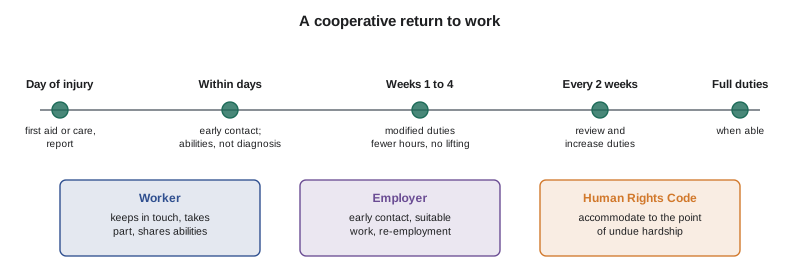
Under Ontario's workplace insurance law, the employer and the worker must cooperate in the worker's early and safe return to work. The employer must contact the worker as soon as possible after the injury, try to provide suitable work that is available and consistent with the worker's functional abilities, and give the WSIB information it asks for. The worker must also contact the employer, take part, and share information about their functional abilities, though not their diagnosis. Employers with 20 or more workers have a duty to re-employ workers who had at least one year of continuous employment before the injury, in many cases. Separately, the Ontario Human Rights Code requires employers to accommodate workers with disabilities, including work-related ones, to the point of undue hardship.
In a school, suitable modified work is often easier to find than people think. A custodian with a shoulder injury might do light cleaning, inventory and supervision of summer students. A teacher recovering from a concussion might start with half days, no yard duty and a quieter classroom. An educational assistant with a back injury might work with students who do not need transfers, or support reading groups. The key is to focus on what the worker can do, review regularly, and increase duties step by step.
The yearly cycle
Safety in a school follows the school year. Daniel encourages every principal to think of it as a cycle:
- August: review last year's incidents and inspection findings, update safety plans for students, check that training is current, and plan orientation for new staff.
- September: orientation for new and returning staff, emergency drills, and a walk-through of the building after summer work.
- October to December: regular inspections, flu season, darker mornings and the start of winter maintenance.
- January to March: winter slips, indoor air in closed-up buildings, and the yearly review of the policy and programs.
- April to June: heat, outdoor activities, field trips, end-of-year moves and chemical clear-outs.
- Throughout: incident reporting, investigation, committee meetings and follow-up.
Capstone: Willow Park's plan for the year
In August, Willow Park's principal sits down with Jenna, Priya, the school's committee members and Daniel to build the safety plan for the coming year. They start from the data. The program below summarizes last year's incidents at Willow Park by cause and ranks the causes by a simple priority score that combines how often they happen with how much time off they cause.
# Rank Willow Park's incident causes by frequency and lost days.
causes = {
    # cause: (number of reports, lost work days)
    "student incidents (resource room)": (19, 41),
    "slips at the front entrance (winter)": (6, 12),
    "lifting and student transfers": (4, 9),
    "student incidents (other classes)": (5, 3),
    "bodily fluid exposures": (3, 0),
    "standing on chairs or desks": (2, 6),
    "office aggression from adults": (2, 0),
}
total_reports = sum(n for n, _ in causes.values())
total_days = sum(d for _, d in causes.values())

def score(n, d):
    # equal weight to share of reports and share of lost days
    return 50 * n / total_reports + 50 * d / total_days

ranked = sorted(causes.items(), key=lambda kv: score(*kv[1]), reverse=True)
for cause, (n, d) in ranked:
print(f"{score(n, d):5.1f} {cause:38} {n:2} reports, {d:2} lost days")52.0 student incidents (resource room) 19 reports, 41 lost days 15.8 slips at the front entrance (winter) 6 reports, 12 lost days 11.2 lifting and student transfers 4 reports, 9 lost days 8.2 student incidents (other classes) 5 reports, 3 lost days 6.7 standing on chairs or desks 2 reports, 6 lost days 3.7 bodily fluid exposures 3 reports, 0 lost days 2.4 office aggression from adults 2 reports, 0 lost days
The ranking confirms what everyone at the table already suspected: behaviour incidents in the resource room are the largest problem by far, followed by entrance slips and student transfers. The team agrees on a plan with a small number of actions, each with an owner, a date and a way to check whether it worked.
| Priority | Action | Owner | Check |
|---|---|---|---|
| Behaviour incidents | Review and update every resource room safety plan before school starts; refresher de-escalation training for all resource room staff; test the radio response time monthly | Principal and special education lead | Incidents and lost days per month; response time under two minutes |
| Entrance slips | Extend matting to about 4.5 m (15 ft) and add an outside scraper mat; wet-weather mopping routine at bell times | Head custodian | Slip reports December to March compared with last year |
| Student transfers | Check that every student who needs help moving has a current transfer plan; service the ceiling and floor lifts; train new staff on each plan | Principal and educational assistants | Plans current; lift service records; no manual lifts of students who cannot bear weight |
| Falls from chairs | Step stool in every classroom; clear rule in staff orientation | Office administrator | Stools in place by September; no reports of standing on furniture |
| Office aggression | Code word and a clear exit behind the counter; visitor communication guideline sent to families | Principal and office administrator | Incidents reported and followed up |
| Reporting culture | "You reported, we fixed" item at every staff meeting; reply to every hazard report within two school days | Principal | Number of hazard and near-miss reports, which should rise |
Two things about the plan are worth noting. First, it is short: six priorities rather than forty, because a plan that tries to do everything does nothing well. Second, the checks include leading indicators, such as plans updated, training completed and reports made, as well as injury numbers, so the team can tell whether the work is being done before the injury numbers change. The committee reviews progress at each meeting and the whole plan at the end of the year, and the cycle begins again.
Worked problem
Returning after a concussion
In October, a teacher at Willow Park was knocked over during a behaviour incident and suffered a concussion. Her doctor says she can return to work in mid-November with reduced hours, no yard duty, limited screen time and no work with students whose behaviour can be unsafe, for four weeks. What should the school do?
Show solution
- The principal contacted the teacher within a few days of the injury, kept in touch during her absence and made sure the claim was filed.
- When the restrictions arrive, the principal meets the teacher, a union representative and the board's disability management staff to plan the return, focusing on what she can do.
- She starts with mornings only, teaching a class whose students do not have safety plans, with a colleague covering her yard duty and an educational assistant supporting the class. Screen-based tasks are cut back and she is given a quieter room for preparation.
- The plan is reviewed every two weeks and her hours and duties increase as her symptoms allow. Before she returns to her original class, the student's safety plan is reviewed with her.
- The incident itself was investigated, as described in Lesson 11, and the changes to the student's plan are part of making her return safe.
Answer: Keep in touch early, plan the return around her abilities with modified hours and duties, review every two weeks, and fix the cause before she returns to the original class.
Common mistakes
MistakeTreating the committee as a meeting to get through.
InsteadUse it to inspect, review reports, recommend and follow up, with a tracker of owners and dates.
MistakeKeeping the safety program in a binder no one reads.
InsteadMake sure staff can say how to report, summon help and find SDSs.
MistakeWaiting until an injured worker is fully recovered before contacting them.
InsteadMake early contact and plan a gradual return around their abilities.
MistakeAsking an injured worker for their diagnosis.
InsteadAsk about functional abilities and restrictions, not the diagnosis.
MistakeA safety plan with dozens of actions.
InsteadA short list of priorities from the data, each with an owner, a date and a check.
Summary and key terms
- Workplaces with 20 or more workers need a JHSC with certified members, meeting at least every three months.
- The committee inspects, reviews reports, recommends and follows up; a tracker keeps it focused.
- The employer must answer written committee recommendations in writing within 21 days.
- A written policy reviewed yearly and a program to implement it hold the safety work together.
- Return to work is cooperative and focuses on what the worker can do, with regular reviews.
- Safety follows the school year, with predictable hazards in each season.
- A good yearly plan is short, based on data, and checked with leading indicators as well as injuries.
- Joint health and safety committee (JHSC)
- A committee of worker and management members that inspects, reviews and recommends on health and safety.
- Certified member
- A committee member who has completed approved training and has additional powers.
- Health and safety representative
- A worker representative required in workplaces with 6 to 19 workers.
- Suitable work
- Work that is available and matches an injured worker's functional abilities.
- Undue hardship
- The point at which accommodating a worker would impose excessive cost or health and safety risks.
Practice problems
Work each problem on paper first, then reveal the answer to check.
How many workers trigger the need for a JHSC in Ontario?
Show answer
20 or more regularly employed workers.
Name four things a school safety committee does.
Show answer
Any four of: inspects, hears concerns, reviews reports, takes part in investigations, recommends, follows up, keeps staff informed.
What test does Daniel use to see whether a safety program is real?
Show answer
Whether a staff member asked at random can say how to report a hazard, summon help, find the SDSs and who is on the committee.
What should an employer ask an injured worker about when planning a return?
Show answer
Their functional abilities and restrictions, not their diagnosis.
Give an example of modified work for an injured custodian.
Show answer
Light cleaning, inventory or supervising summer students, depending on restrictions.
Why does Willow Park's plan include leading indicators?
Show answer
To show whether the safety work is being done before injury numbers change.
Lesson quiz · 5 questions
Score 60% or more to complete this lesson.
Create a free account to save your progress, take quizzes and earn a certificate.