
HSE-360 · Lesson 8 of 12 · 21 min
Custodial work, ladders and bodily fluids
Custodians and maintenance staff keep schools clean, warm, lit and working. Their jobs involve more hazards than almost anyone else's in the building: chemicals, floor machines, ladders, electricity, boilers, heavy lifting, bodily fluids, sharps, and long evening shifts, often alone. Other staff share some of these hazards too: educational assistants who help students with personal care, teachers who clean up after a sick student, and anyone who gives first aid. This lesson covers the hazards of custodial and maintenance work, safe use of ladders, and how to deal with blood, vomit, needles and other bodily fluids safely.
The custodian's day
At Pinecrest Secondary School, Victor's crew of six works two shifts. The day shift opens the building at 6:30 a.m., checks the boilers and walkways, deals with spills, washroom problems and set-ups during the day, and supports events. The evening shift, from 3:00 to 11:30 p.m., does most of the cleaning: classrooms, washrooms, hallways, gyms and the cafeteria. In summer, the whole crew does deep cleaning and floor refinishing.
The main hazards across that work are:
- Chemicals, covered in Lesson 6, especially concentrated cleaners and floor strippers.
- Floor machines: burnishers and scrubbers can kick or pull, and their cords are trip hazards.
- Lifting and pushing, covered in Lesson 5: garbage, furniture, supplies and carts.
- Ladders and work at height: changing lights, cleaning high windows, reaching ceiling vents.
- Electrical equipment and boilers, which need trained, authorized people.
- Bodily fluids and sharps in washrooms, classrooms and on the grounds.
- Working alone on evening and weekend shifts, sometimes with people in the building who should not be there.
Floor machines and equipment
Floor machines are some of the most powerful tools in a school. Before using one, a custodian should check the cord and plug for damage, check the pad or brush is fitted correctly, make sure the area is clear and signed, and keep the cord behind the machine and away from the pad. Machines should be used only by people trained on them, and guards and switches must never be removed or taped down. Battery-powered ride-on scrubbers remove the cord hazard but need training on charging batteries safely, because charging can release hydrogen gas in poorly ventilated rooms.
Electrical and boiler work
Custodians often deal with small electrical problems, such as a tripped breaker, a dead outlet or a broken light fixture, and maintenance staff handle bigger ones. The basic rules are that only qualified people work on electrical systems, that equipment is locked out before anyone works on it so it cannot be switched on by someone else, and that damaged cords and equipment are taken out of service. Lockout means turning off the energy source, locking it with a personal lock and tag, and testing that the equipment is actually dead before starting work. It applies to electrical panels, boilers, pumps, kitchen equipment and shop machines.
In Ontario, electrical work in buildings must be done by licensed electricians, and boilers and pressure vessels are regulated by the Technical Standards and Safety Authority (TSSA), which sets requirements for who may operate and maintain them. Custodians may have duties such as checking boiler readings, but they must not adjust controls or carry out repairs beyond their training and certification.
Ladders
Ladders cause many falls in schools, mostly because they are the wrong ladder for the job, set up badly or used carelessly. The rules are simple and worth knowing by heart.
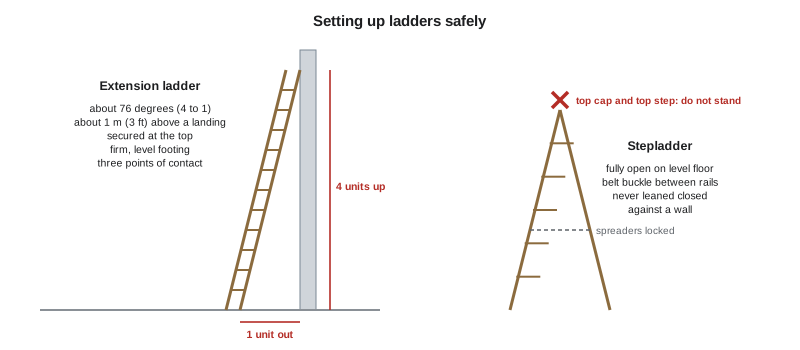
- Choose the right ladder: a stepladder for work at a fixed point, an extension ladder for reaching a roof or upper level. Check that its rating covers the weight of the person plus tools and materials.
- Inspect it before use: no cracked or bent rails, missing or loose rungs, damaged feet or broken spreaders. Take damaged ladders out of service.
- Set it up on firm, level, dry ground, away from doors that could open into it, or with the door locked and signed.
- For an extension ladder, place the base about one unit out for every four units of height to the top support point, extend it about 1 m (3 ft) above the landing if it is used to get onto a roof, and secure it so it cannot slip.
- For a stepladder, open it fully and lock the spreaders. Do not stand on the top cap or the top step, and do not use a closed stepladder leaned against a wall.
- Keep three points of contact while climbing: two hands and a foot, or two feet and a hand. Carry tools in a belt or raise them with a line.
- Keep your belt buckle between the side rails. If you have to lean out, get down and move the ladder.
- Do not use ladders near overhead power lines, and use non-conductive ladders for electrical work.
The 4 to 1 rule is easy to check. The program below works out how far from the wall the base of an extension ladder should be for a few common heights.
# 4-to-1 rule: base distance = working height / 4, where working height is
# the height from the ground to the point where the ladder rests at the top.
import math

for height_m in (2.4, 3.0, 3.6, 4.8, 6.0):
    base = height_m / 4
    ladder_len = math.hypot(height_m, base)       # length of ladder from base to support point
    angle = math.degrees(math.atan2(height_m, base))
    print(f"support at {height_m:3.1f} m: base {base:4.2f} m out, "
f"ladder length to support {ladder_len:4.2f} m, angle about {angle:4.1f} degrees")support at 2.4 m: base 0.60 m out, ladder length to support 2.47 m, angle about 76.0 degrees support at 3.0 m: base 0.75 m out, ladder length to support 3.09 m, angle about 76.0 degrees support at 3.6 m: base 0.90 m out, ladder length to support 3.71 m, angle about 76.0 degrees support at 4.8 m: base 1.20 m out, ladder length to support 4.95 m, angle about 76.0 degrees support at 6.0 m: base 1.50 m out, ladder length to support 6.18 m, angle about 76.0 degrees
The angle works out to about 76 degrees every time, which is the angle most ladder manufacturers specify. A quick field check is to stand with your toes at the base of the ladder and stretch your arms straight out: your palms should just reach the rung at shoulder height.
Teachers and other staff should not use ladders above step-stool height without training. Jobs such as changing high lights, reaching ceiling-mounted projectors or hanging banners in the gym go to custodians, who are trained and have the right ladders or a lift.
Bodily fluids and bloodborne pathogens
Blood and other body fluids can carry bloodborne pathogens: viruses such as hepatitis B, hepatitis C and HIV that can be passed on when infected blood enters another person's body through a cut, a needle-stick, or splashes to the eyes, nose or mouth. Vomit and diarrhea can spread norovirus and other infections that move quickly through schools. In schools, contact with body fluids happens when custodians clean washrooms and spills, when educational assistants help students with toileting, feeding or personal care, when anyone gives first aid for a cut or nosebleed, and occasionally from bites.
The core idea is to treat all blood and body fluids as potentially infectious, without trying to judge who might be carrying an infection. This approach, often called routine practices or standard precautions, means:
- Wear disposable gloves for any contact with blood or body fluids, and add eye protection and an apron or gown if splashing is likely.
- Cover your own cuts and scrapes with waterproof bandages.
- Use a spill kit with absorbent powder, a scoop, disinfectant and a bag for cleaning up blood, vomit and other fluids.
- Clean the area, then disinfect it with a product that is approved for the purpose, left on for the contact time on the label.
- Remove gloves without touching the outside with bare skin and wash hands thoroughly with soap and water.
- Dispose of contaminated materials as the board's procedure requires, usually double-bagged in the regular waste unless they are soaked with blood, which may need special handling.
- Report any exposure, such as a needle-stick or a splash to the eyes or mouth, right away.
Ontario does not have a specific regulation on bloodborne pathogens for schools, but the OHSA's general duty applies and school boards are expected to have procedures based on routine practices, with training and supplies for staff who may be exposed. Many boards offer the hepatitis B vaccine to staff whose work puts them at risk, such as custodians and educational assistants who provide personal care.
Needles and sharps
Custodians and staff on yard duty sometimes find used needles on school grounds, in parks next to schools, in washrooms or in lost-and-found items. Students may bring sharps for medical reasons, such as insulin needles, which should be disposed of in a sharps container provided for that purpose. A needle found on the grounds should never be picked up with bare hands, recapped or put in a regular garbage bag.
The safe way to deal with a found needle is: keep students away, put on puncture-resistant gloves, use tongs or a similar tool to pick it up by the barrel with the point away from you, place it point-first in a rigid sharps container, close the container and wash your hands. Report the find so the board can track where needles are being found and, if necessary, ask the municipality to check the area. Anyone who is stuck by a needle should wash the area with soap and water right away, report it immediately and go for medical assessment the same day, because some preventive treatments work best when started within hours.
Working alone
Evening custodians often work alone in large buildings, sometimes with outside groups using the gym or doors propped open by others. The risks include being injured with no one around to help, and meeting someone in the building who should not be there. Controls include a check-in system, such as a call to a supervisor or a central office at set times, a phone or radio, a rule that custodians do not confront intruders but leave and call for help, good lighting in parking lots and entrances, and locking doors that should be locked. Higher-risk tasks, such as ladder work or boiler room work, can be scheduled when someone else is in the building.
Worked problem
A needle by the playground fence
During morning recess at Willow Park, a Grade 3 student tells the teacher on yard duty that there is a needle near the playground fence. What should happen?
Show solution
- The teacher keeps students away from the area, asks another staff member to watch the area, and calls the office to send the custodian with the sharps kit. She does not pick it up herself with bare hands.
- The custodian puts on puncture-resistant gloves, picks up the needle by the barrel with tongs, point away from his body, and drops it point-first into the sharps container.
- He checks the surrounding area for other needles, removes his gloves safely and washes his hands.
- The office records the find and reports it to Daniel, who asks the city to check the park beside the school. The principal reminds staff and students to report needles and never touch them.
- If anyone had been stuck, they would have washed the area, reported it immediately and gone for medical assessment the same day.
Answer: Keep students away, have a trained person pick it up with tongs into a sharps container, check the area, report the find and follow up.
Common mistakes
MistakeStanding on the top step of a stepladder.
InsteadUse a taller ladder; never stand on the top step or top cap.
MistakeWorking on equipment with only the switch turned off.
InsteadLock out the energy source with a personal lock and test before starting.
MistakeCleaning up blood without gloves because it was only a little.
InsteadTreat all blood and body fluids as potentially infectious and always use gloves.
MistakePicking up a found needle by hand or recapping it.
InsteadUse puncture-resistant gloves and tongs and put it point-first in a sharps container.
MistakeConfronting an intruder on an evening shift.
InsteadLeave the area and call for help.
Summary and key terms
- Custodial and maintenance staff face chemicals, machines, ladders, electricity, lifting, bodily fluids and working alone.
- Floor machines are used only by trained staff, with guards in place and cords kept clear.
- Only qualified people work on electrical systems and boilers, and equipment is locked out first.
- Ladders need the right type, inspection, firm footing, the 4 to 1 angle and three points of contact.
- Treat all blood and body fluids as potentially infectious: gloves, spill kits, disinfection and hand washing.
- Ontario boards use routine practices and many offer hepatitis B vaccine to staff at risk.
- Found needles are picked up with tongs into a sharps container; needle-sticks need same-day medical assessment.
- Lockout
- Isolating an energy source with a personal lock and tag so equipment cannot be started during work.
- 4 to 1 rule
- Set an extension ladder's base one unit out for every four units of height.
- Bloodborne pathogens
- Viruses carried in blood, such as hepatitis B, hepatitis C and HIV.
- Routine practices
- Treating all blood and body fluids as potentially infectious and using precautions every time.
- Sharps container
- A rigid, puncture-resistant container for used needles and other sharps.
Practice problems
Work each problem on paper first, then reveal the answer to check.
What are three steps of lockout?
Show answer
Turn off the energy source, lock and tag it with a personal lock, test that the equipment is dead.
How far from the wall should an extension ladder be for a 4 m support height?
Show answer
About 1 m (one quarter of the height).
What does three points of contact mean?
Show answer
Two hands and a foot, or two feet and a hand, on the ladder at all times while climbing.
What is the core idea of routine practices?
Show answer
Treat all blood and body fluids as potentially infectious.
What should someone do right after a needle-stick?
Show answer
Wash with soap and water, report it immediately and get medical assessment the same day.
Name two controls for custodians working alone.
Show answer
Any two of: check-in system, phone or radio, do not confront intruders, good lighting, locked doors, scheduling risky tasks when others are present.
Lesson quiz · 5 questions
Score 60% or more to complete this lesson.
Create a free account to save your progress, take quizzes and earn a certificate.