
HSE-360 · Lesson 7 of 12 · 22 min
Indoor air, mould and older buildings
Staff spend most of their working day inside the school building, and the condition of that building affects their health. Stuffy classrooms leave people tired and headachy. Leaks lead to mould. Many schools built before the 1980s contain asbestos, and older plumbing and paint can contain lead. Boiler rooms, portables and top-floor classrooms can be very hot, and some rooms are cold in winter. This lesson covers indoor air quality, mould, asbestos, lead and temperature: hazards that are mostly invisible, mostly long-term, and mostly the responsibility of the board's facilities department, but where staff play an important part by noticing and reporting problems.
Indoor air quality
Indoor air quality, or IAQ, describes how clean and comfortable the air in a building is. Poor IAQ in schools usually comes from a few sources: not enough fresh outdoor air for the number of people in the room, moisture and mould, dust, odours from cleaning products, renovations or new furniture, vehicle exhaust drawn in near bus loops, and occasionally specific pollutants such as radon or carbon monoxide.
The symptoms staff report are often vague: headaches, tiredness, stuffiness, itchy eyes, sore throats and difficulty concentrating, which get better at home or on weekends. These are real effects, and the pattern of symptoms that improve away from the building is a strong clue that the building is part of the problem.
Ventilation and carbon dioxide
People breathe out carbon dioxide (CO2). In a classroom with 28 students and a teacher, CO2 builds up unless enough fresh outdoor air comes in to dilute it. CO2 at the levels found in classrooms is not itself a serious hazard, but it is a good, cheap indicator of whether the room is getting enough fresh air. Outdoor air has roughly 420 parts per million (ppm) of CO2. Many ventilation guidelines treat indoor levels that stay well above about 1,000 ppm as a sign that ventilation should be checked, and readings of 2,000 ppm or more in crowded classrooms are a clear sign of too little fresh air.
After 2020, many boards put CO2 monitors in classrooms and added portable air cleaners with HEPA filters to rooms with poor ventilation. A HEPA unit removes particles such as dust and airborne droplets, but it does not add fresh air or remove CO2, so it works alongside ventilation rather than replacing it.
If the CO2 level is known, a simple calculation estimates how much fresh air the room is getting per person. At a steady level, the CO2 people breathe out balances the CO2 removed by fresh air. The program below applies this to readings Hannah took in three rooms at Pinecrest Secondary School. The CO2 generation rate is an estimate for teenagers and adults doing quiet classroom work.
# Estimate outdoor air per person from a steady classroom CO2 reading.
# At steady state: outdoor air per person = CO2 generated per person / (indoor - outdoor concentration)
generation_L_per_s = 0.0045      # CO2 breathed out per person doing quiet work, L/s (estimate)
outdoor_ppm = 420

rooms = [("Room 118 (2011 wing, mechanical ventilation)", 780),
         ("Room 214 (1968 wing, windows only)", 1650),
         ("Portable 3 (unit ventilator not working)", 2600)]
for name, indoor_ppm in rooms:
    rise = (indoor_ppm - outdoor_ppm) / 1e6
    per_person = generation_L_per_s / rise
print(f"{name:46} {indoor_ppm:5} ppm about {per_person:4.1f} L/s of outdoor air per person")Room 118 (2011 wing, mechanical ventilation) 780 ppm about 12.5 L/s of outdoor air per person Room 214 (1968 wing, windows only) 1650 ppm about 3.7 L/s of outdoor air per person Portable 3 (unit ventilator not working) 2600 ppm about 2.1 L/s of outdoor air per person
Ventilation standards for classrooms commonly aim for somewhere around 6 to 8 L/s (about 13 to 17 cfm) of outdoor air per person, depending on the standard and the room. Room 118 is well supplied, Room 214 is short, and the portable is getting a fraction of what it needs. The portable's unit ventilator turned out to have a failed fan motor, and Room 214's windows had been painted shut years ago. Both were fixed.
Staff can help: report rooms that are stuffy or where CO2 readings stay high, do not block vents and unit ventilators with furniture or displays, open windows where they can be opened and it is safe, and tell the custodian if a ventilation unit is noisy, silent or blowing cold air.
Moisture and mould
Mould grows wherever there is moisture and something to feed on, such as drywall, ceiling tiles, carpet, wood and dust. In schools, the usual sources are roof leaks, plumbing leaks, condensation on cold surfaces, flooding and wet carpet that is not dried quickly. Mould can cause allergic reactions, asthma attacks and irritation of the eyes, nose and throat, and people with asthma or weakened immune systems are more affected.
The key fact about mould is that it is a moisture problem. Cleaning or painting over mould without fixing the leak does not work; it comes back. The steps are:
- Find and fix the water source: the roof, the pipe, the condensation.
- Dry wet materials within a day or two if possible. Materials that have been wet for longer, and porous materials such as ceiling tiles and drywall with visible mould, usually need to be removed.
- Clean up small areas of mould on hard surfaces with soap and water, wearing gloves and eye protection.
- Leave larger areas, or mould inside walls and ceilings, to trained workers using containment and protective equipment, so that spores are not spread through the building.
- Check afterwards that the problem has not come back.
Staff are often the first to see the signs: stained ceiling tiles, a musty smell, peeling paint, a damp patch on a wall or carpet that stays wet. Reporting these early can save a large clean-up later.
Asbestos
Asbestos was widely used in buildings until the 1980s in floor tiles, pipe insulation, boiler insulation, ceiling tiles, plaster and textured coatings. Many schools built in the 1950s, 1960s and 1970s, including the 1968 wing at Pinecrest Secondary School and the 1958 wing at Willow Park, contain asbestos. Breathing asbestos fibres can cause asbestosis, lung cancer and mesothelioma, usually decades after exposure.
Asbestos-containing material that is in good condition and left undisturbed is generally not a hazard. The danger comes when it is damaged, deteriorating or disturbed, for example by drilling, sanding, cutting, removing floor tiles, or pinning displays into old ceiling tiles.
Ontario's asbestos regulation for construction projects and buildings (Regulation 278/05) requires building owners, including school boards, to know where asbestos-containing material is in their buildings, keep a record of it, inform workers and contractors who may disturb it, inspect it regularly and deal with damaged material. Work that may disturb asbestos must follow set procedures, with more protective measures for higher-risk work.
For most staff, the rules are simple: know that your building may contain asbestos, do not drill, sand, cut or pin into walls, ceilings, floors or pipe insulation, report damaged or crumbling material, and keep away from areas that have been closed off for asbestos work. Custodians and maintenance staff need more detailed training because they are most likely to disturb it.
Lead
Lead can be found in older schools in paint, especially in buildings painted before the 1970s, and in plumbing, solder and fixtures, which can let lead into drinking water. Lead affects the nervous system and is especially harmful to young children and pregnant people.
Ontario has rules requiring schools and child care centres to flush their plumbing and test drinking water for lead on a set schedule, and to take fountains and taps out of service when results are too high. Renovation work that disturbs lead paint must be done with controls to prevent dust.
For staff, this means using only taps and fountains that are in service, letting the facilities team know about discoloured water or fountains that have been out of order for a long time, and not sanding or scraping old paint.
Heat and cold
Many older schools have no air conditioning, and classrooms on top floors, in portables and on south-facing walls can be very hot in June and September. Boiler rooms and kitchens are hot all year. Heat stress can cause fatigue, dizziness, cramps, heat exhaustion and, in severe cases, heat stroke, which is a medical emergency. Cold rooms in winter are less dangerous but uncomfortable and can make muscle strains more likely.
Ontario does not set a maximum indoor working temperature, but the general duty to take every reasonable precaution applies, and the Ministry of Labour expects employers to have a heat stress policy where heat is a hazard.
Practical controls include fans and portable air conditioners in the hottest rooms, blinds to keep out the sun, cool rooms where classes can go in the afternoon, drinking water, lighter clothing, adjusting physical education and outdoor activities on hot days, and rest breaks in cooler areas for custodians and kitchen staff. Staff should know the signs of heat illness in themselves and students, and get help quickly for anyone who becomes confused, stops sweating or collapses.
Renovations while the school is open
Many schools are renovated in stages while classes continue: a new roof over the summer that runs into September, a washroom upgrade over the winter break, a gym floor replaced in March. Renovation work can release dust, asbestos or lead, produce fumes from adhesives and roofing, block exits and bring contractors and their equipment into areas used by staff and students. The board and the contractor should agree before work starts on how the work area will be separated from the rest of the school, how air from the work area will be kept out of occupied rooms, which exits and routes will change, and how staff will be told. When Willow Park's 1958 wing had its floor tiles replaced, the work was done over the summer with the area sealed off and the asbestos removal done by a licensed contractor, and staff were briefed before they returned in August.
Carbon monoxide and radon
Two gases deserve a mention. Carbon monoxide (CO) comes from burning fuel, and in schools the usual sources are boilers, gas-fired kitchen equipment, ice-resurfacing machines in school arenas and vehicles idling near air intakes. It has no smell and causes headaches, dizziness, confusion and, at high levels, death. Boiler rooms and kitchens with fuel-burning equipment should have CO detectors, and equipment should be serviced on schedule. Radon is a natural radioactive gas that seeps up from the ground and can collect in basements and lower floors. Long-term exposure raises the risk of lung cancer. Testing is the only way to know whether a building has a problem, and many boards test their schools and fix high readings with sealing and ventilation.
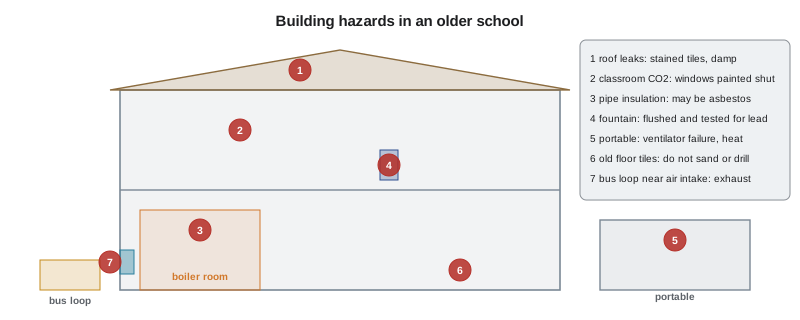
Worked problem
The stained ceiling tiles in Room 214
Hannah notices that three ceiling tiles in Room 214 are stained and one is sagging. There is a faint musty smell, and two students with asthma have been using their inhalers more often in that room. The tiles are in the 1968 wing. What should happen?
Show solution
- Report it as a hazard to the principal and enter a work order. Do not touch or remove the tiles: they are in the 1968 wing and may contain asbestos, and they may have mould on the back.
- Facilities checks the asbestos records for that area. The tiles are not asbestos-containing, but the sagging tile shows water damage.
- The leak, from a roof drain, is fixed first. Then trained staff remove the wet tiles and check the space above for mould, using containment because the area is larger than a small patch.
- The class moves to another room until the work is done, and the JHSC follows up to check that the smell has gone and there are no new stains.
Answer: Report without disturbing the tiles, check asbestos records, fix the leak first, have trained staff remove damaged material and follow up.
Common mistakes
MistakeBlocking vents and unit ventilators with displays or furniture.
InsteadKeep them clear and report units that are not working.
MistakePainting over mould or cleaning it without fixing the leak.
InsteadFix the water source first, then remove or clean the damaged material.
MistakePinning displays into old ceiling tiles or drilling into old walls.
InsteadAssume older materials may contain asbestos and do not disturb them.
MistakeAssuming a HEPA air cleaner adds fresh air.
InsteadIt removes particles but does not lower CO2; ventilation is still needed.
MistakeIgnoring heat in top-floor rooms and portables.
InsteadUse fans, blinds, water, cooler rooms and adjusted activities, and know the signs of heat illness.
Summary and key terms
- Poor indoor air quality causes headaches, tiredness and irritation that improve away from the building.
- CO2 readings are a cheap indicator of ventilation; levels well above about 1,000 ppm suggest it should be checked.
- Mould is a moisture problem: fix the water source, then clean or remove damaged material.
- Asbestos in good condition and left undisturbed is generally not a hazard; do not drill, sand, cut or pin into older materials.
- Ontario's asbestos regulation requires boards to know where asbestos is and to inform workers.
- Lead in older paint and plumbing is controlled by testing water and preventing dust from old paint.
- Heat in older schools needs practical controls and staff who know the signs of heat illness.
- Indoor air quality (IAQ)
- How clean and comfortable the air inside a building is.
- Carbon dioxide (CO2)
- A gas people breathe out, used as an indicator of ventilation.
- HEPA filter
- A high-efficiency filter that removes very small airborne particles.
- Asbestos-containing material
- A building material that contains asbestos fibres.
- Heat stress
- Strain on the body from working in a hot environment.
Practice problems
Work each problem on paper first, then reveal the answer to check.
What does a classroom CO2 reading of 2,000 ppm suggest?
Show answer
The room is getting too little fresh air.
Why does a HEPA air cleaner not solve a ventilation problem on its own?
Show answer
It removes particles but does not bring in fresh air or lower CO2.
What is the first step in dealing with mould?
Show answer
Find and fix the source of moisture.
When does asbestos become a hazard?
Show answer
When it is damaged, deteriorating or disturbed so fibres are released.
What should staff do if they notice stained or sagging ceiling tiles?
Show answer
Report them without touching or removing them.
Name two signs of serious heat illness that need urgent help.
Show answer
Any two of: confusion, stopping sweating, collapse, very high body temperature.
Lesson quiz · 5 questions
Score 60% or more to complete this lesson.
Create a free account to save your progress, take quizzes and earn a certificate.