
HSE-360 · Lesson 9 of 12 · 22 min
Workplace violence and student behaviour incidents
Workplace violence has become one of the most serious health and safety issues for school staff. Most of it comes from students, often young students or students with disabilities who are distressed and cannot express it in other ways. Some comes from parents and other adults, and some from intruders. The injuries range from bruises, scratches and bites to concussions, broken bones and lasting psychological harm. This lesson explains what the law requires, how schools assess and plan for violence, how staff can recognize and respond to escalating behaviour, and what happens after an incident. It is written with respect for the students involved: most behaviour that hurts staff is a sign that a student needs more or different support, and the safety measures in this lesson protect students as well as staff.
What counts as workplace violence
The OHSA defines workplace violence as the exercise of physical force by a person against a worker in a workplace that causes or could cause physical injury, an attempt to exercise such force, or a statement or behaviour that a worker could reasonably interpret as a threat to exercise such force. The definition does not depend on the intent of the person using the force. A seven-year-old who kicks an educational assistant during a meltdown has, for health and safety purposes, committed workplace violence, even though the child may not have meant to hurt anyone and would not be held responsible in any other sense. Recognizing this is not about blaming the child; it is what triggers the employer's duty to assess the risk and protect the worker.
What the law requires
Since 2010, the OHSA has required employers, including school boards, to deal with workplace violence through a set of specific duties:
- A written workplace violence policy, reviewed at least once a year.
- A risk assessment of the risks of workplace violence that may arise from the nature of the workplace, the type of work or the conditions of work, reassessed as often as necessary.
- A program that implements the policy, including measures and procedures to control the risks, to summon immediate assistance when violence occurs or is likely, for workers to report incidents or threats, and for investigating and dealing with incidents, complaints and threats.
- Information and instruction for workers on the policy and program.
- Where a worker can be expected to encounter a person with a history of violent behaviour, and the worker is likely to be at risk of physical injury, the employer must provide information about the risk, including personal information, but no more than is reasonably necessary to protect the worker.
- Workers can refuse work when they have reason to believe workplace violence is likely to endanger them, subject to the limit on teachers in Regulation 857 described in Lesson 2.
Assessing the risk
A board-wide assessment looks at the patterns: which schools, which programs, which roles and which times of day have the most incidents. Daniel's assessment shows, unsurprisingly, that the risk is highest in elementary schools, in specialized classes for students with significant behaviour needs, for educational assistants and kindergarten and primary teachers, and at transitions such as arrival, recess and dismissal. It also shows that some risk exists in every school: parents who become aggressive in the office, students fighting in secondary hallways, and people who enter the building without permission.
The most important assessments, though, are for individual students. When a student's behaviour has hurt staff or is likely to, the school develops a plan for that student.
In Ontario, this is usually called a safety plan, developed alongside the student's Individual Education Plan (IEP) where there is one. It is written by the principal with the teacher, educational assistants, special education staff, the family and, where involved, outside professionals.
A good plan answers practical questions: what are this student's known triggers; what are the early signs that the student is becoming distressed; what helps the student calm down; what staff should do at each stage; how many staff should be present and who; how staff summon help; whether staff need protective equipment such as long sleeves or kevlar arm guards; how the room is set up to give the student and staff space and exits; and what happens after an incident. Every person who works with the student, including supply staff, must know the parts of the plan they need.
Patterns in the incident log
Incident logs can reveal patterns that are hard to see day to day. Jenna and the resource room teacher at Willow Park keep a simple log of incidents with one student: the time, the activity, what happened just before, and the outcome. The program below summarizes six weeks of entries by time of day and by what happened just before.
# Summarize an incident log by time block and antecedent (what happened just before).
from collections import Counter

log = [
    ("08:50", "arrival"), ("08:55", "arrival"), ("10:40", "transition"), ("11:45", "noise"),
    ("08:45", "arrival"), ("13:10", "demand"), ("08:52", "arrival"), ("10:35", "transition"),
    ("14:20", "demand"), ("08:58", "arrival"), ("11:50", "noise"), ("10:42", "transition"),
    ("09:05", "arrival"), ("13:15", "demand"), ("08:48", "arrival"), ("11:40", "noise"),
]

def block(t):
    h = int(t[:2]) + int(t[3:]) / 60
    if h < 9.25: return "arrival (before 9:15)"
    if h < 11.5: return "morning"
    if h < 12.5: return "lunch"
    return "afternoon"

by_block = Counter(block(t) for t, _ in log)
by_cause = Counter(a for _, a in log)
print("Incidents by time of day:")
for k, n in by_block.most_common():
    print(f"  {k:22} {n:2} {'#' * n}")
print("Incidents by what happened just before:")
for k, n in by_cause.most_common():
print(f" {k:22} {n:2} {'#' * n}")Incidents by time of day: arrival (before 9:15) 7 ####### morning 3 ### lunch 3 ### afternoon 3 ### Incidents by what happened just before: arrival 7 ####### transition 3 ### noise 3 ### demand 3 ###
Nearly half the incidents happen at arrival, and the most common trigger is the arrival routine itself. That finding changed the plan: the student now arrives ten minutes after the main bell through a quiet side door, is met by the same staff member every day, and starts with a calming activity he chooses. Incidents at arrival dropped sharply over the next month. The log also showed that noise at lunch was a trigger, and the student now eats in a quieter room with two classmates.
Recognizing escalation
Most violent behaviour does not come out of nowhere. It usually follows a recognizable pattern of escalation, and staff who know the pattern can often step in early, when calm, low-key responses work best.
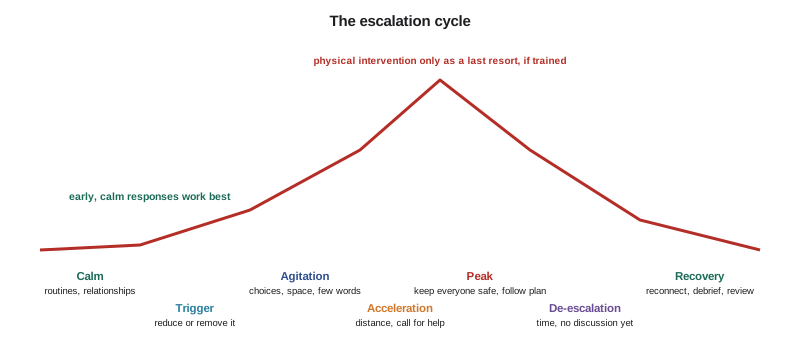
At each stage, the response is different:
- In the calm phase, the work is prevention: predictable routines, good relationships, clear expectations and an environment that suits the student.
- When something triggers the student, staff can often remove or reduce the trigger: lower the noise, change the task, give a break.
- In agitation, the student shows early signs, such as pacing, refusing, withdrawing or raising their voice. Calm, low-key responses work best here: offer choices, give space, use few words and a quiet tone, and avoid power struggles.
- In acceleration, the student is arguing, threatening or throwing things. Staff keep a safe distance, stay between the student and the door only if it is safe, move other students away, and call for help using the agreed method.
- At the peak, the student may hurt themselves or others. The priority is everyone's safety: follow the plan, clear the room of other students if needed, and use physical intervention only as a last resort, only if trained, and only in line with the board's rules.
- In de-escalation and recovery, the student begins to calm. This is not the time to discuss consequences. Give time and space, then reconnect.
Summoning help and staying safe
Every staff member who might face violence needs a reliable way to get help quickly. Depending on the school, that might be a classroom phone or intercom, a two-way radio, a personal alarm, a code word called to the office or a panic button. The method must actually work in every room, including portables, gyms and outdoor areas, and staff need to know who will come and how fast. At Willow Park, the resource room has a radio, and the response team, the principal, the vice-principal and two trained staff, aims to arrive within two minutes.
Simple measures make rooms safer: furniture arranged so staff are not trapped in a corner, heavy or sharp objects stored out of reach, a calm space for the student, and at least one clear exit for staff. Staff should take off lanyards, scarves and dangling jewellery that could be grabbed, and wear the protective equipment the plan calls for.
Violence from adults
Some violence comes from parents, guardians, former partners of staff, or strangers. Offices are where most of it starts: an angry parent demanding to see a teacher, a custody dispute at dismissal, or someone who will not leave. Controls include a single controlled entrance with a buzzer and camera, office layouts that keep a counter between staff and visitors and give staff a way out, a code word to call the principal, a clear rule that staff do not argue with an aggressive visitor but call for help, and, when needed, banning a person from school property and calling the police. Threats against staff, including threats on social media, are reported and taken seriously.
After an incident
What happens after an incident shapes whether staff keep reporting and whether the next incident is prevented. After any incident that injures a staff member or involves a significant threat:
- The injured worker gets first aid or medical care, and the incident is reported following the board's procedure.
- The worker is offered support: time to recover, a check-in from the principal, and information about the employee assistance program.
- The principal investigates what happened, with the staff involved, focusing on what can be learned rather than on blame.
- The student's plan is reviewed and updated, and the people who work with the student are told about the changes.
- Serious injuries are reported to the Ministry of Labour and the WSIB as the law requires, covered in Lesson 11.
- Patterns across incidents are reviewed by the JHSC and the board.
Worked problem
A new student with a history of hurting staff
A Grade 3 student is transferring to Willow Park from another school. His file shows several incidents of hitting and biting staff last year, and he has an Individual Education Plan (IEP). Jenna will be one of the educational assistants working with him. What should happen before his first day?
Show solution
- Under the OHSA, Jenna is likely to encounter a person with a history of violent behaviour and to be at risk of injury, so the board must give her the information she needs about the risk, limited to what is necessary to protect her.
- The principal arranges a meeting with the previous school, the family, the special education team, the teacher and the educational assistants to learn what triggers the student, what helps him calm and what has and has not worked.
- A plan is written covering triggers, early signs, responses at each stage, staffing, the method for summoning help, the room set-up and any protective equipment, and Jenna and the other staff are trained on it.
- The plan is shared, in the parts they need, with supply staff and others who work with the student, and it is reviewed after two weeks and after any incident.
Answer: Share the necessary risk information, learn from the previous school and family, write and train on a plan, and review it early and after any incident.
Common mistakes
MistakeTreating being hurt by students as part of the job.
InsteadViolence is a hazard to be assessed, planned for and reported like any other.
MistakeNot reporting incidents because the student did not mean it.
InsteadIntent does not matter for safety purposes; reports drive better plans and support.
MistakeArguing with or lecturing a student who is escalating.
InsteadUse few words, a calm voice, choices and space.
MistakeWorking with a student who has a safety plan without knowing what is in it.
InsteadEvery person who works with the student needs the parts of the plan they need, including supply staff.
MistakeDiscussing consequences while the student is still calming down.
InsteadGive time to recover, then reconnect and debrief later.
Summary and key terms
- Workplace violence includes physical force, attempts and threats, regardless of the intent of the person.
- Ontario requires a workplace violence policy reviewed yearly, a risk assessment, a program with ways to summon help, and information about people with a history of violence.
- Individual plans for students whose behaviour can be unsafe set out triggers, early signs, responses, staffing and how to get help.
- Incident logs reveal patterns, such as times and triggers, that lead to better plans.
- Behaviour usually escalates through recognizable stages; early, calm responses work best.
- Every staff member needs a reliable way to summon help quickly, in every room.
- After an incident: care, report, support, investigate without blame, and update the plan.
- Workplace violence
- Physical force, an attempt at force, or a threat of force against a worker at work.
- Safety plan
- A written plan for keeping staff and a student safe when the student's behaviour can be unsafe.
- Antecedent
- What happens just before a behaviour; often a trigger.
- Escalation cycle
- The stages a person moves through from calm to a peak of distress and back.
- De-escalation
- Calming a tense situation with low-key responses such as space, choices and few words.
Practice problems
Work each problem on paper first, then reveal the answer to check.
Does it matter whether a student meant to hurt a staff member for the incident to count as workplace violence?
Show answer
No; the definition does not depend on intent.
Name four things a student safety plan should cover.
Show answer
Any four of: triggers, early signs, what helps, responses at each stage, staffing, how to summon help, protective equipment, room set-up, what happens afterwards.
What did the incident log at Willow Park show, and what changed?
Show answer
Most incidents happened at arrival; the student now arrives later through a quiet door with the same staff member and a calming activity.
What responses work best in the agitation stage?
Show answer
Calm, low-key responses: choices, space, few words, a quiet tone and no power struggles.
When should physical intervention be used?
Show answer
Only as a last resort, only by trained staff and only in line with the rules.
What should happen after an incident that injures a staff member?
Show answer
Care for the worker, report it, offer support, investigate without blame and update the plan.
Lesson quiz · 5 questions
Score 60% or more to complete this lesson.
Create a free account to save your progress, take quizzes and earn a certificate.