
HSE-360 · Lesson 1 of 12 · 22 min
Hazards in schools: the staff view
Most people think of a school as one of the safest places in town, and for students it usually is. For the people who work there, the picture is more mixed. Teachers, educational assistants, custodians, office staff, cafeteria workers, bus drivers and principals are injured every year in ways that rarely make the news: a fall on a wet entrance floor in February, a back strain from helping a student out of a wheelchair, a bite or a kick during a behaviour incident, a burn in a science prep room, a strained voice that will not recover, or months off work with stress. This course is about those hazards and about the rules, habits and systems that keep school staff safe.
This first lesson sets the scene. It introduces the school board and the people who appear throughout the course, describes the main groups of hazards in a school, explains why schools are an unusual workplace from a safety point of view, and gives a simple way of looking at any school building with a safety eye.
Meet Riverbend District School Board
The course follows Riverbend District School Board, an invented board serving Riverbend, Ontario and the farm country around it. It runs 34 schools, employs about 3,100 people and teaches about 21,000 students. Two of its schools appear most often:
- Pinecrest Secondary School, a secondary school for about 1,150 students in a building opened in 1968, with additions in 1989 and 2011. It has science labs, a technology wing with wood, metal and auto shops, two gyms, a pool that closed in 2019, a cafeteria kitchen and a large boiler room.
- Willow Park Elementary, a kindergarten to Grade 8 school for about 480 students. Its original wing dates from 1958 and its newer wing from 2004. It has a resource room for students with special education needs, a playground, a small gym and a staff room that doubles as a lunch room.
The people you will meet are:
- Marion Clarke, principal of Pinecrest Secondary School, who has been a principal for nine years and a teacher for fifteen before that.
- Daniel Lefebvre, the board's health and safety officer, who visits schools, tracks injury reports and advises principals.
- Hannah Osei, a chemistry teacher at Pinecrest Secondary School and a worker member of the JHSC there.
- Victor Alvarez, the head custodian at Pinecrest Secondary School, responsible for a crew of six custodians on two shifts.
- Jenna Kowalchuk, an educational assistant in the resource room at Willow Park.
- Sam Whitford, a physical education teacher at Pinecrest Secondary School who also coaches.
- Priya Nair, the office administrator at Willow Park, who is often the first person to hear about an injury.
None of these people are safety specialists. That is deliberate. In a school, almost all of the day-to-day safety work is done by people whose main job is something else, and this course is written for them.
Why schools are an unusual workplace
A school shares hazards with many other workplaces: floors that get wet, chemicals in cupboards, boilers and ladders, heavy boxes and long days. But several features make schools different, and they shape everything in the rest of the course.
- The building is full of people who are not workers. On any day, students outnumber staff by roughly ten to one, and many of them are children who cannot be expected to look after their own safety. Staff are responsible for students as well as for themselves, and that can pull in two directions.
- Many staff work alone with a class. A teacher with 28 students in a portable classroom, or a custodian on the evening shift, may be the only adult in the area for long stretches.
- The work is emotional as well as physical. Supporting students who are distressed, angry or unwell is part of the job, and it carries real risks of physical and psychological injury.
- Buildings are old. Many schools were built in the 1950s, 1960s and 1970s, and they may contain asbestos, lead in old plumbing or paint, tired ventilation systems and stairs and floors that do not meet modern standards.
- The workforce is varied. Teachers, educational assistants, custodians, trades staff, food service workers, office staff, supply or substitute staff and volunteers all work in the same building, often employed under different agreements, with different training and different supervisors.
- Schools have a strong culture of putting students first. That is a strength, but it can also lead staff to accept risks they would never accept in another job, such as lifting a student alone, staying in a room with a student who is hurting them, or skipping a report because the paperwork feels like a distraction.
The main groups of hazards
A useful way to think about school hazards is to sort them into six groups. Every lesson in the course deals with one or more of them.
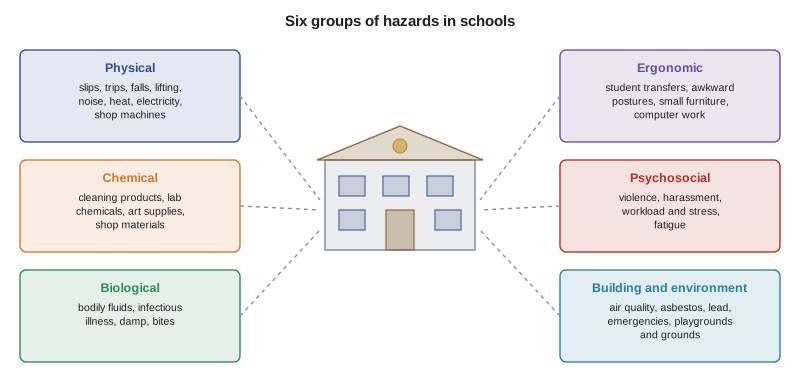
Physical hazards are the most common cause of injury for school staff. Slips, trips and falls lead the list in most injury data, followed by overexertion from lifting, pushing and carrying. Shops, kitchens and boiler rooms add machines, hot surfaces and electricity. Gyms and music rooms can be loud, and old buildings can be very hot in June and September.
Chemical hazards come from cleaning and disinfecting products, science lab chemicals, art materials such as glazes and solvents, shop materials such as wood dust, welding fumes and finishes, and occasionally pesticides or de-icing products on the grounds.
Biological hazards include contact with blood, vomit, urine and other bodily fluids, which is part of the daily work of custodians, educational assistants supporting students with personal care, and anyone giving first aid. They also include illnesses that spread easily in schools, such as influenza, norovirus and childhood infections, and mould growing where water has leaked.
Ergonomic hazards come from the way work is set up: lifting and transferring students who cannot move independently, kneeling and bending to work with young children, sitting on child-sized chairs, carrying sports equipment, pushing heavy carts and working at poorly arranged computer stations.
Psychosocial hazards are the ones that affect mental health, and increasingly physical health too: workplace violence, including violence by students; harassment by colleagues, parents or others; high workload and long hours; and the fatigue and stress that come from them. In many boards, injuries from student behaviour incidents are now one of the largest categories of lost-time claims for educational assistants and elementary teachers.
Building and environment hazards include indoor air quality, asbestos and lead in older buildings, extreme heat and cold, playground and grounds hazards, and emergencies such as fires, intruders, severe weather and medical events.
Ontario has seen a sharp rise in reports of violence against education workers. Surveys by education unions in 2023 and 2024 found that a large majority of members had experienced or witnessed violence at work, and a 2024 University of Ottawa study described the levels as distressing. The figures come from surveys rather than official injury statistics, but they match what boards see in their own reports.
Who gets hurt, and how
Daniel keeps a summary of every injury report filed in the board. Last year there were 412 reports from staff. The table shows how they broke down.
| Cause | Reports | Lost-time claims | Most affected groups |
|---|---|---|---|
| Slips, trips and falls | 118 | 31 | Custodians, teachers, office staff |
| Student behaviour incidents | 104 | 22 | educational assistants, elementary teachers |
| Lifting, pushing and pulling | 71 | 19 | Custodians, educational assistants, cafeteria staff |
| Struck by or against objects | 39 | 4 | Shop and gym teachers, custodians |
| Cuts and burns | 28 | 3 | Cafeteria staff, science and shop teachers |
| Chemical or bodily fluid exposure | 17 | 1 | Custodians, educational assistants |
| Psychological injury and stress | 12 | 9 | Teachers, principals |
| Other | 23 | 3 | Various |
Three things stand out. First, a small number of causes account for most injuries, so a school that gets slips, lifting and behaviour incidents under control has dealt with most of its problem. Second, the psychological injury reports are few but almost always lead to long absences. Third, educational assistants appear in several rows even though they are a small part of the workforce: they lift students, support students whose behaviour can be unsafe, and handle bodily fluids, often all in the same day.
Daniel also knows that these numbers undercount. Staff often do not report minor injuries, bites that did not break the skin, or verbal abuse. A reporting culture where people feel that reports lead to action, rather than to blame or paperwork, is one of the themes of Lesson 11.
Looking at a school with a safety eye
Hazards are easiest to see when you are new to a place. After a few months, the frayed carpet at the top of the stairs, the chemical cupboard that does not close and the stack of chairs behind the stage curtain fade into the background. A simple habit helps: walk through your own area as if you were seeing it for the first time, and ask four questions.
- What could make someone slip, trip, fall, strain, burn, cut or be struck?
- What could make someone ill, now or over many years?
- What could lead to someone being hurt by another person?
- What would happen here in an emergency, and could everyone get out?
When Hannah joined the JHSC at Pinecrest Secondary School, she walked her own science wing with these questions and found several things she had stopped noticing: an eyewash station whose cover was missing and whose water had not been run in months, a fume hood with a cracked sash, a box of old chemicals on top of a cupboard, and an extension cord running under a lab bench. None had caused an injury yet. All were fixed within a month.
Who is responsible?
Lesson 2 sets out the legal rights and duties in detail. For now, the basic idea is that everyone in the school has a part to play, and the parts fit together.
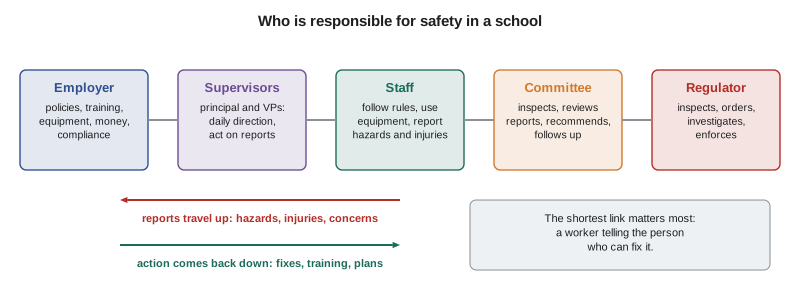
The employer, which here is Riverbend District School Board, has the widest duties. It must provide a safe workplace, safe equipment, information, training and supervision, and it must have the policies and programs the law requires. The principal and vice-principals act as supervisors: they direct the work in the school and are responsible for knowing the hazards and dealing with them. Staff must work safely, follow the rules and procedures, use the equipment and protective gear provided, and report hazards and injuries. The joint health and safety committee brings workers and management together to inspect, investigate and recommend. And the Ministry of Labour inspects and enforces the law.
In practice, the most important link is often the shortest one: a worker who notices something and tells the person who can fix it. Most of the improvements in this course start that way.
Worked problem
The loading dock door at Willow Park
Priya notices that the outside door by Willow Park's loading dock does not close by itself any more. Students sometimes use it as a shortcut at lunch, and the floor inside gets wet and muddy. On a rainy Tuesday, a custodian slips there but is not hurt. Which hazard groups are involved, and what should happen next?
Show solution
- The wet, muddy floor is a physical hazard: slips and falls. The broken door closer is a building hazard. The open door is also a security concern, because anyone can walk in.
- Priya tells the principal and enters a work order for the door closer the same morning. She also asks the custodian to fill in an incident report for the slip, even though there was no injury, because it is a near miss.
- The principal arranges for a mat inside the door and a sign asking students to use the main entrance until the door is fixed. The custodian puts out a wet floor sign and mops the area at the start of each lunch break.
- The JHSC reviews the near-miss report at its next meeting and checks that the door has been repaired.
Answer: Physical, building and security hazards together. Report the near miss, fix the door closer, add temporary controls and check that the repair was made.
Common mistakes
MistakeThinking school safety is mainly about students.
InsteadStaff safety is a legal duty in its own right, and staff injuries are common.
MistakeTreating behaviour incidents as part of the job that cannot be prevented.
InsteadWorkplace violence is a hazard to be assessed and controlled like any other.
MistakeNot reporting near misses or minor injuries.
InsteadReports are how hazards get found and fixed before someone is badly hurt.
MistakeAssuming an old building is safe because nobody has been hurt yet.
InsteadWalk your area with fresh eyes and ask the four questions.
MistakeLeaving safety to the JHSC or the health and safety officer.
InsteadEveryone has a part, and the shortest link, a worker telling a supervisor, matters most.
Summary and key terms
- School staff are injured every year by slips, lifting, behaviour incidents, chemicals, bodily fluids and stress.
- Schools are unusual workplaces: full of children, staffed by people who often work alone, emotionally demanding and often housed in old buildings.
- Hazards can be sorted into six groups: physical, chemical, biological, ergonomic, psychosocial, and building and environment.
- A few causes account for most injuries, so controlling them has a large effect.
- Injury numbers undercount, especially for minor injuries and verbal abuse.
- Walking your own area with four questions helps you see hazards you have stopped noticing.
- The employer, supervisors, staff, the committee and the regulator all have parts to play.
- Hazard
- Anything that could cause injury or illness.
- Near miss
- An event that could have caused an injury but did not.
- Lost-time claim
- A workers' compensation claim where the injured worker missed work beyond the day of the injury.
- Psychosocial hazard
- A hazard that affects mental health, such as violence, harassment or excessive workload.
- Supervisor
- A person who directs the work of others; in a school, usually the principal and vice-principals.
Practice problems
Work each problem on paper first, then reveal the answer to check.
Name the six groups of hazards used in this lesson.
Show answer
Physical, chemical, biological, ergonomic, psychosocial, and building and environment.
What is the most common cause of injury for school staff in most injury data?
Show answer
Slips, trips and falls.
Why do educational assistants appear in several rows of the injury table?
Show answer
They lift students, support students whose behaviour can be unsafe and handle bodily fluids.
Give two reasons why schools are unusual workplaces for safety.
Show answer
Any two of: full of children, staff often work alone, emotionally demanding work, old buildings, a varied workforce, a strong students-first culture.
What are the four questions for looking at your area with a safety eye?
Show answer
What could cause physical injury, what could make someone ill, what could lead to someone being hurt by another person, and what would happen in an emergency.
Why should a slip with no injury still be reported?
Show answer
It is a near miss, and reporting it lets the hazard be fixed before someone is hurt.
Lesson quiz · 5 questions
Score 60% or more to complete this lesson.
Create a free account to save your progress, take quizzes and earn a certificate.