
HSE-360 · Lesson 5 of 12 · 21 min
Lifting, student transfers and ergonomics
School work involves a surprising amount of lifting, carrying, pushing, pulling, bending and kneeling. Custodians move furniture, garbage and supplies. Cafeteria staff lift trays, pots and cases of food. Teachers carry boxes of books and equipment, kneel beside small children and sit on chairs made for seven-year-olds. educational assistants help students move between wheelchairs, toilets, change tables and standing frames. Office staff spend hours at computers. Over time, these tasks cause the musculoskeletal injuries, mainly to backs, shoulders, necks, wrists and knees, that make up a large share of school injury claims. This lesson explains how these injuries happen and how to prevent them, with a focus on student transfers, where the risks are highest.
How musculoskeletal injuries happen
A musculoskeletal injury, or MSI, is an injury to muscles, tendons, ligaments, joints, nerves or discs. Some happen suddenly, such as a back strain when a heavy box is lifted awkwardly or a student suddenly drops their weight during a transfer. Many build up slowly from repeated strain: a custodian's shoulder after years of mopping, a teacher's knees after years of kneeling, a secretary's wrist after years at a keyboard.
Three things raise the risk of an MSI:
- Force: how heavy the load is, how hard you push or pull, how tightly you grip.
- Posture: how far the load is from your body, whether you are twisting, bending, reaching above your shoulders or below your knees.
- Repetition and duration: how often you do the task and for how long without a break.
The risk is highest when all three combine: a heavy load, held away from the body, lifted from the floor while twisting, many times a day. Most of the controls in this lesson work by reducing one or more of the three.
Ontario does not have a single regulation on manual handling for schools, but the OHSA's general duty to take every reasonable precaution applies, and the Ministry of Labour publishes guidance on preventing MSIs and expects employers to assess and control the risks. Inspectors can and do write orders where lifting hazards are not controlled.
Safer lifting basics
Before lifting anything, the first question is whether it needs to be lifted by hand at all. Carts, dollies, hand trucks, lift tables and smaller loads remove most of the risk. When a manual lift is necessary:
- Plan the lift: check the weight, the route and where the load is going. Clear the path first.
- Get close: stand close to the load with feet apart, one slightly forward.
- Bend the knees and hips, not the back, and keep the back in its natural curves.
- Get a firm grip and lift smoothly, without jerking.
- Keep the load close to the waist.
- Turn with the feet, not by twisting the back.
- Set the load down the same way, and get help or equipment for anything heavy or awkward.
Training in these basics is useful, but research consistently shows that training alone does not prevent many injuries. Changing the task, by reducing the weight, raising the load off the floor, providing equipment and sharing heavy tasks, works much better.
Measuring a lift
Ergonomists use several tools to judge whether a lifting task is too risky. One widely used tool is the revised NIOSH lifting equation, developed by the US National Institute for Occupational Safety and Health. It starts from a load that most healthy workers can lift safely in ideal conditions, 23 kg (51 lb), and reduces it for each way the real task is less than ideal: the load being far from the body, starting low or high, being lifted a long way, twisting, frequent lifting and a poor grip. The result is a recommended weight limit for that task. Dividing the actual weight by the limit gives a lifting index: above 1 means increased risk, and above 3 means high risk for most workers.
The program below applies the equation to two of the cafeteria tasks at Pinecrest Secondary School: lifting a case of milk from the floor of the cooler to a cart, and lifting the same case from a shelf at waist height. The frequency and grip factors are taken from the published tables for these conditions.
# Revised NIOSH lifting equation (metric form) for two cafeteria lifts.
def rwl(h_cm, v_cm, d_cm, a_deg, fm, cm):
    LC = 23.0                                   # load constant, kg
    HM = min(1.0, 25.0 / h_cm)                  # horizontal distance from body
    VM = 1 - 0.003 * abs(v_cm - 75)             # vertical start height
    DM = min(1.0, 0.82 + 4.5 / d_cm)            # vertical travel distance
    AM = 1 - 0.0032 * a_deg                     # twisting angle
    return LC * HM * VM * DM * AM * fm * cm

case_kg = 18.0   # a case of milk cartons
tasks = {
    "from cooler floor to cart": dict(h_cm=45, v_cm=10, d_cm=70, a_deg=45, fm=0.88, cm=0.95),
    "from waist-high shelf to cart": dict(h_cm=35, v_cm=80, d_cm=10, a_deg=0, fm=0.88, cm=0.95),
}
for name, t in tasks.items():
    limit = rwl(**t)
    li = case_kg / limit
    risk = "high risk" if li > 3 else "increased risk" if li > 1 else "acceptable for most"
print(f"{name:30} limit {limit:5.1f} kg lifting index {li:4.2f} ({risk})")from cooler floor to cart limit 6.5 kg lifting index 2.77 (increased risk) from waist-high shelf to cart limit 13.5 kg lifting index 1.33 (increased risk)
Lifting the case from the floor, reaching and twisting gives a lifting index well above 2, a clear sign of risk. The same case lifted from waist height without twisting comes out well under the limit. The fix the cafeteria made was simple: the supplier now stacks cases on a rolling dolly in the cooler, and the bottom shelf is no longer used for heavy items. Nothing about the weight changed; only the posture did.
Student transfers
Moving students who cannot move independently is the highest-risk handling task in schools. Students may be heavy, may not be able to help, may move suddenly, and may have medical conditions that make them fragile. The work often happens in small spaces such as washrooms and change areas, at awkward heights, and several times a day. educational assistants and special education teachers are at the greatest risk.
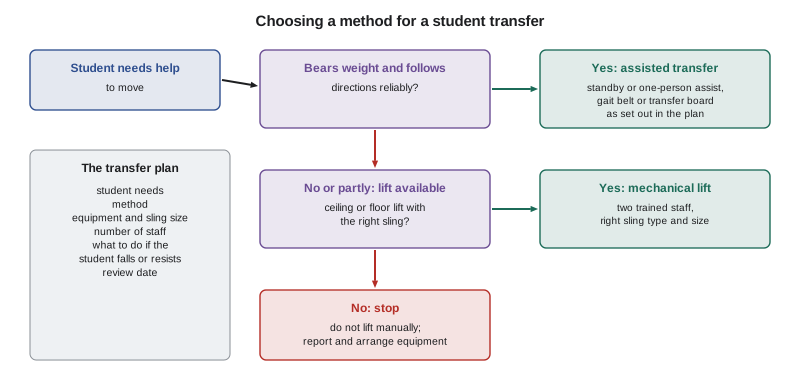
The principles of safe student transfers are:
- Every student who needs help moving has a written transfer plan, prepared with input from the family, the student's occupational therapist or physiotherapist where available, the teacher and the educational assistants who will do the work. The plan sets out the method, the equipment, the number of staff and what to do if things go wrong.
- Students who cannot bear weight are moved with mechanical lifts, either ceiling-mounted or mobile floor lifts, with slings of the right type and size. Manual lifting of these students should be avoided.
- Students who can bear some weight may use transfer aids such as gait belts, transfer boards, turning discs and standing aids, which reduce the force needed.
- Transfers that need two people are always done with two trained people. 'Just this once' alone is how many injuries happen.
- Staff are trained on the specific equipment and the specific student's plan, not just on general lifting.
- Equipment is inspected, slings are checked for wear and lifts are serviced on schedule.
- Plans are reviewed when the student grows, their condition changes or there is an incident.
At Willow Park, Jenna works with a student in the resource room who uses a wheelchair and cannot bear weight. For years, two educational assistants lifted him by hand for washroom visits, and both had back problems. After Daniel's assessment, the board installed a ceiling lift in the resource room washroom and bought a mobile floor lift for the classroom. The transfer plan now specifies the lift and two trained staff for every transfer. Neither educational assistant has had a back injury since, and the student finds the lift more comfortable and less frightening than being carried.
Kneeling, bending and small furniture
Kindergarten and primary teachers spend much of the day bent over low tables, kneeling on the floor or sitting on child-sized chairs. Over a career this adds up to knee, back and neck problems. Simple controls help: an adult-height stool on wheels that lets a teacher work at a low table without bending; kneeling pads; adjustable-height tables in some areas; and varying postures through the day rather than staying in one position for long.
Carts, garbage and furniture
Custodians push heavy carts, lift garbage bags into bins, move desks and chairs and carry floor machines up and down stairs. Controls include carts with large wheels that are kept in good repair, keeping garbage bags to a manageable size and using bins with tipping mechanisms, lifting bins rather than hoisting bags overhead, two-person lifts or dollies for furniture, and elevators or ramps for floor machines. Moving a classroom of desks at the end of the year is a job for a crew with dollies, not one custodian.
Computer work
Office staff, principals and teachers spend many hours at computers, and laptops on low tables or kitchen-height counters lead to neck, shoulder and wrist strain. The basics are: the top of the screen at or slightly below eye level, the keyboard and mouse at elbow height with wrists straight, feet flat on the floor or a footrest, a chair that supports the lower back, and regular breaks to stand and move. Teachers who work on laptops for long periods benefit from a separate keyboard, mouse and laptop stand.
Report discomfort early
Musculoskeletal injuries usually give warning. Aching shoulders at the end of each shift, a back that is stiff every morning after a heavy day, tingling fingers after hours at the keyboard: these are early signs that a task is causing strain. Staff often ignore them until the pain stops them working, by which time recovery takes much longer. Riverbend District School Board encourages staff to report discomfort before it becomes an injury, using the same hazard report form as for any other hazard. A report of discomfort leads to a quick look at the task by the principal or Daniel, and often to a simple change: a different cart, a stool, a rearranged shelf, a second person for a heavy job or a better chair. Early reports cost almost nothing to act on, while a back injury can mean months off work.
Worked problem
Moving the music room
The music department at Pinecrest Secondary School is moving to a different room over the summer. The job includes about 40 music stands, 60 chairs, a piano on wheels, risers, and 25 boxes of sheet music weighing up to 20 kg (44 lb) each. Sam has offered to help the music teacher do it on the last day of school. What should Marion arrange instead?
Show solution
- This is a major manual handling job, not a favour between colleagues. The piano and risers are heavy and awkward, and the boxes are close to the limit for one person.
- Marion asks Victor to schedule the move with the custodial crew, who have dollies, a piano dolly and training.
- The boxes of sheet music are repacked into smaller boxes of about 10 kg (22 lb) and moved on carts.
- The piano is moved by at least two people with a piano dolly, along a route checked for doorways and ramps, or by a professional mover.
- Staff help only with light items, such as music stands, using carts.
Answer: Treat it as a planned job for the custodial crew with equipment, reduce box weights and use proper movers for the piano.
Common mistakes
MistakeLifting a student who cannot bear weight by hand.
InsteadUse a mechanical lift with the right sling and two trained staff, as set out in the transfer plan.
MistakeDoing a two-person transfer alone because the other person is busy.
InsteadWait for the second trained person or call for help.
MistakeRelying on lifting training alone.
InsteadChange the task: lighter loads, better heights, equipment and shared work.
MistakeStoring heavy items on the floor or the top shelf.
InsteadStore heavy items at waist height.
MistakeWorking on a laptop on a low table all day.
InsteadRaise the screen and use a separate keyboard and mouse.
Summary and key terms
- Musculoskeletal injuries come from force, posture and repetition, and are most likely when all three combine.
- Avoid manual lifting where possible with carts, dollies, smaller loads and better storage heights.
- The NIOSH lifting equation shows how much posture, height and twisting matter, not just weight.
- Student transfers are the highest-risk handling task; every student who needs help has a written plan.
- Students who cannot bear weight are moved with mechanical lifts and two trained staff.
- Stools, kneeling pads and varied postures protect teachers of young children.
- Carts, dollies, two-person lifts and good workstation set-up protect custodians and office staff.
- Musculoskeletal injury (MSI)
- An injury to muscles, tendons, ligaments, joints, nerves or discs.
- Lifting index
- The actual load divided by the recommended weight limit; above 1 means increased risk.
- Transfer plan
- A written plan for how a particular student is moved, with method, equipment and staffing.
- Ceiling lift
- A lift mounted on a ceiling track that raises and moves a person in a sling.
- Gait belt
- A belt worn around a person's waist that staff hold to help them stand or walk.
Practice problems
Work each problem on paper first, then reveal the answer to check.
Name the three factors that raise the risk of a musculoskeletal injury.
Show answer
Force, posture, and repetition and duration.
What does a lifting index above 1 mean?
Show answer
The task carries increased risk of injury for many workers.
Why did the milk case lift change from risky to acceptable?
Show answer
It was moved to waist height without twisting; the weight did not change.
How should a student who cannot bear weight be moved?
Show answer
With a mechanical lift and the right sling, by two trained staff, following the transfer plan.
What should a student transfer plan include?
Show answer
The method, the equipment and sling size, the number of staff and what to do if the student falls or resists.
Give one control for teachers who work at low tables.
Show answer
An adult-height stool on wheels, kneeling pads, adjustable tables or varying postures.
Lesson quiz · 5 questions
Score 60% or more to complete this lesson.
Create a free account to save your progress, take quizzes and earn a certificate.