
HSE-360 · Lesson 2 of 12 · 22 min
Rights and duties of school staff in Minnesota
Every worker in a school has legal rights that protect their health and safety, and every worker, supervisor and employer has legal duties. Knowing them is not about being ready for a fight. It is about knowing what you can ask for, what is expected of you, and what to do when something is wrong. This lesson sets out the law that applies to school staff in Minnesota, explains the duties of the employer, supervisors and workers, and walks through the right to refuse unsafe work, which works a little differently in schools than in other workplaces.
In Minnesota, the main law is the Minnesota Occupational Safety and Health Act and the rules made under it. Unlike federal OSHA, which does not cover state and local government employees, Minnesota runs its own state plan, called MNOSHA, which covers public employers including school districts, along with private employers in the state. It applies to teachers, paraprofessionals, custodians, food service workers, office staff, bus drivers employed by the district and other staff. MNOSHA is part of the Minnesota Department of Labor and Industry, which also oversees workers' compensation. Minnesota adds some rules of its own, such as the requirement for a written workplace accident and injury reduction (AWAIR) program and joint safety committees, covered in Lesson 12.
Sharing responsibility inside the workplace
Minnesota's law does not use the phrase internal responsibility system, but its approach is similar: the employer has the main duty, employees have duties to follow the rules, and the AWAIR program and safety committee are meant to find and fix problems inside the workplace. MNOSHA inspections are a backstop. In a school, that means the district, principals, staff and the safety committee are expected to work together on hazards every day.
Duties of the employer
The employer here is Riverbend Public Schools as a whole, acting through its trustees, superintendents, managers and principals. Its duties are broad. The table sets out the main ones and what they look like in a school.
| Employer duty | What it looks like in a school |
|---|---|
| Furnish a place of employment free from recognized hazards that are causing or likely to cause death or serious harm | Assessing hazards in each school and putting controls in place, from wet floor procedures to safety plans for students whose behavior can be unsafe |
| Comply with MNOSHA standards | Following rules on hazard communication, bloodborne pathogens, lockout, ladders, machine guarding and more |
| Provide training and information | Orientation for new staff and training on lifting, chemicals, bloodborne pathogens and behavior incidents |
| Provide and maintain equipment and protective devices | Working eyewash stations, lifts for student transfers, gloves and other protective equipment |
| Have a written AWAIR program, reviewed at least yearly | A district program that sets out safety goals, responsibilities and how hazards and injuries are handled |
| Have a joint labor-management safety committee where required | A district or school committee that meets regularly and reviews injuries and inspections |
| Record and report injuries | Keeping injury and illness records and reporting serious injuries within the deadlines |
The 'general duty clause' in Minnesota's law requires employers to keep the workplace free from recognized hazards that are causing or likely to cause death or serious physical harm. It covers hazards for which there is no specific standard, and MNOSHA can use it for hazards such as workplace violence. When something goes wrong, the question an investigator asks is whether the hazard was known and whether there were feasible ways to reduce it that the employer did not use.
Duties of supervisors
Minnesota's law does not define supervisor duties in the same way, but in practice principals, assistant principals, head custodians and others who direct staff act for the district. The district is responsible for what they do and fail to do. A supervisor is expected to make sure staff follow the rules and procedures, use the protective equipment required, know about the hazards of their work, and are trained. When a supervisor knows about a hazard and does nothing, the district can be cited.
For Marion, this means she cannot treat safety as something the district office handles. If she knows the stairs to the music room have a loose tread, she must act: tape it off, ask for a repair, and warn staff and students. If Victor tells her a custodian on the night shift is mixing cleaning products, she must deal with it. And if Jenna's principal at Willow Park knows that a student has hurt staff before, she must make sure the staff who work with that student know about the risk and have a plan.
Duties of workers
Workers have duties too. In plain terms, every staff member must:
- Work in compliance with the law and the employer's procedures.
- Use or wear the equipment, protective devices and clothing the employer requires, such as gloves for bodily fluids or eye protection in a lab.
- Report any hazard or defect in equipment they know about to their supervisor.
- Report any injury, however small, and any violation of the law they know of.
- Not remove or make ineffective any guard or protective device.
- Not use equipment or work in a way that endangers themselves or others.
- Not engage in horseplay, pranks or rough behavior at work.
These duties apply to everyone, including principals as workers. They also explain why a teacher who props open a fire door, a custodian who takes the guard off a floor machine, or a coach who skips a spotter is not just making a personal choice: each is breaking a legal duty that protects others.
Three rights
Minnesota's law and rules give employees several basic rights. They are often summed up as the right to know, the right to participate and the right to refuse.
- The right to know: employees have the right to be told about hazards in their work, including the hazards of chemicals through labels, safety data sheets and training under the federal Hazard Communication standard and Minnesota's own Employee Right-to-Know rules. Minnesota's rules expect hazardous substance training to be refreshed at least once a year.
- The right to participate: employees can take part through the safety committee, can ask MNOSHA for an inspection, and can accompany an investigator during an inspection.
- The right to refuse: Minnesota law protects an employee who refuses in good faith to work under conditions they reasonably believe present an imminent danger of death or serious physical harm, after asking the employer to correct the hazard.
There is also protection against reprisal. An employer cannot fire, discipline, threaten or penalize a worker for following the law, asking for it to be followed, reporting a hazard or injury, or using their right to refuse properly.
In Minnesota, an employee who believes they have faced retaliation for a safety complaint or refusal can file a discrimination complaint with the Department of Labor and Industry within a short deadline, usually 30 days. Many school staff are covered by collective bargaining agreements and may also be able to grieve.
The right to refuse in schools
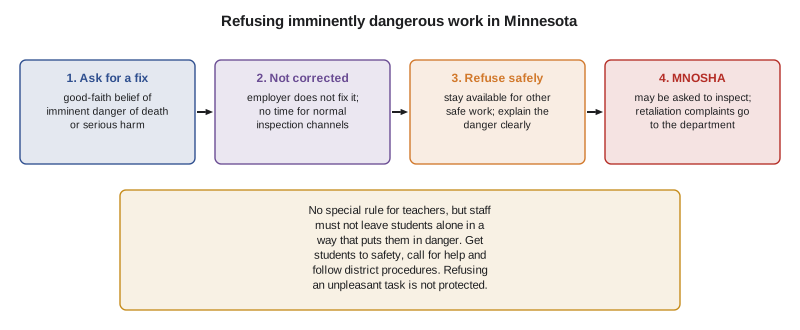
Minnesota's law protects an employee who refuses work in good faith when they reasonably believe there is an imminent danger of death or serious physical harm, have asked the employer to correct the hazard, and there is not enough time to remove the danger through normal channels such as an MNOSHA inspection. The employee should stay available for other safe work, explain the danger clearly and, if the problem is not fixed, may ask MNOSHA to inspect. The refusal is protected against retaliation, but only when those conditions are met. Refusing because a task is unpleasant or inconvenient is not protected.
Minnesota's law does not have a special rule for teachers, but the duty of care that every school employee owes to students still matters. A staff member who believes a situation is imminently dangerous should get students to safety, call for help and follow the district's procedures, rather than leaving students alone in a way that puts them at risk. In practice, refusals in schools most often involve equipment or building conditions, such as an electrical fault or a structural problem, or situations involving violence where the district has not put in place the plan or support that staff need.
In practice, formal refusals in schools are rare, and the better outcome is almost always that the problem is fixed before anyone needs to refuse. But knowing the process matters. Staff who do not know their rights tend either to keep working in conditions they should not accept, or to walk away in ways that are not protected.
Supply staff, student teachers and volunteers
Schools rely on people who are not there every day: occasional or substitute teachers and paraprofessionals, student teachers on placement, coop students, contractors and parent volunteers. The law's protections and duties reach most of them, and the gaps are where incidents tend to happen. A supply teacher who arrives at 8:20 for a class she has never met may not know that one student has a safety plan, where the eyewash station is, or how to call the office from the portable. A contractor fixing the gym lights may not know that the gym is booked for a class at 10:00.
Riverbend Public Schools uses three simple measures. Every school keeps a one-page orientation sheet for supply staff with the emergency procedures, how to call for help, and a note to check the day book for any safety plans. Principals or office staff point out any student safety plans before the day starts, giving only the information the supply worker needs to stay safe. And contractors sign in at the office, are told about any hazards in the area they will work in, such as asbestos or a class in session, and are told who to contact. Volunteers are not employees, but the district still has duties to them as people in its building, and it gives them a short briefing too.
Student teachers and other students on placement may not be district employees, but they work alongside staff and face the same hazards. Their placement agreement usually spells out who is responsible for training and for reporting injuries, and the district should brief them just as it would a new employee.
What an inspector can do
An MNOSHA investigator can enter a school at reasonable times, review records, take photographs and samples, interview employees in private and issue citations with penalties and dates by which hazards must be corrected. Inspections may be planned, prompted by a complaint or a serious injury, or follow up on earlier citations. A district that does not correct a cited hazard can face further penalties.
Worked problem
The broken fume hood
Hannah is due to run a lab with her tenth-grade class that involves heating a small amount of a chemical that gives off irritating vapor. The fume hood in her lab failed its airflow check last week and has a sign on it saying 'do not use'. Her department head tells her to go ahead anyway, with the windows open. What should Hannah do?
Show solution
- The fume hood is a protective device, and it has failed. The lab is likely to expose Hannah and her students to the vapor. This is a real hazard, not a matter of preference.
- Hannah tells her department head and the principal that she will not run that lab until the hood is fixed, and explains why. She offers to run a different lab that does not need a hood.
- There is no imminent danger yet, because the lab has not started, so this is not a formal refusal situation. Hannah raises the hazard, offers safe alternative work and asks for it to be fixed. If she were ordered to run the lab, she could refuse in good faith and contact MNOSHA. In this case, Marion agrees and the lab is rescheduled.
- Hannah also reports the delay in repairing the hood to the safety committee so it can follow up.
Answer: Raise the hazard, decline to run that lab until the hood is fixed, offer safe alternative work and follow up through the committee.
Common mistakes
MistakeThinking the law only covers teachers, or only support staff.
InsteadThe law covers almost every school employee, with only narrow differences.
MistakeAssuming a principal is not responsible for safety because the district office handles it.
InsteadPrincipals and vice-principals have supervisor duties every day.
MistakeNot reporting a hazard because someone else probably has.
InsteadEvery worker has a duty to report hazards they know about.
MistakeBelieving staff can refuse any task they dislike.
InsteadRefusal is protected only for good-faith belief in imminent danger, after asking the employer to fix it.
MistakeFearing punishment for raising a safety concern.
InsteadReprisal for raising safety concerns is against the law.
Summary and key terms
- Minnesota's state plan, MNOSHA, covers school districts and their staff, unlike federal OSHA.
- The employer has the main duty, including the general duty clause and Minnesota's AWAIR and committee rules.
- Employers must protect workers, provide training and equipment and have the required policies and programs.
- Supervisors, including principals, must know the hazards, enforce procedures and protect workers.
- Workers must follow the rules, use protective equipment and report hazards and injuries.
- Workers have the right to know, to participate and to refuse, and are protected from reprisal.
- Refusal is protected only for good-faith belief in imminent danger, and staff must not abandon students.
- MNOSHA
- Minnesota's occupational safety and health program, which covers public and private employers in the state.
- General duty clause
- The requirement to keep the workplace free of recognized serious hazards.
- AWAIR
- A workplace accident and injury reduction program that many Minnesota employers, including schools, must have in writing.
- Imminent danger
- A hazard that could cause death or serious physical harm before it can be removed through normal channels.
- Retaliation
- Punishing an employee for exercising their health and safety rights.
Practice problems
Work each problem on paper first, then reveal the answer to check.
Which program enforces health and safety for Minnesota school staff?
Show answer
MNOSHA, part of the Minnesota Department of Labor and Industry.
Name three duties of a school employer.
Show answer
Any three of: protect workers, provide training and information, provide and maintain equipment, have the required written policies and programs, support the committee, record and report injuries.
Who are the supervisors in a typical school?
Show answer
The principal and vice-principals, and others who direct staff such as head custodians.
What are the three basic worker rights?
Show answer
The right to know, the right to participate and the right to refuse.
When is a refusal of work protected in Minnesota?
Show answer
When the employee believes in good faith there is an imminent danger of death or serious harm, has asked the employer to fix it, and there is no time for normal channels.
What protection do workers have when they raise safety concerns?
Show answer
Protection against reprisal or retaliation, such as being fired or disciplined.
Lesson quiz · 5 questions
Score 60% or more to complete this lesson.
Create a free account to save your progress, take quizzes and earn a certificate.