
HSE-360 · Lesson 10 of 12 · 21 min
Harassment, stress, noise, voice and fatigue
Some of the hazards that most affect school staff leave no bruises. Harassment by colleagues, parents or students wears people down. Heavy workloads and constant demands lead to stress and burnout. Teachers lose their voices, music and shop teachers lose some of their hearing, and custodians on evening shifts and staff juggling second jobs or caregiving run short of sleep. This lesson covers harassment, work-related stress and mental health, noise and voice strain, and fatigue: what the law says, what schools can do, and what individual staff can do to protect themselves.
Workplace harassment
The OHSA defines workplace harassment as engaging in a course of vexatious comment or conduct against a worker in a workplace that is known or ought reasonably to be known to be unwelcome, and it includes workplace sexual harassment. Reasonable action taken by an employer or supervisor relating to the management and direction of workers, such as assigning work, giving feedback on performance or applying discipline fairly, is not harassment. Employers must have a written workplace harassment policy, reviewed at least once a year, and a program that sets out how workers can report incidents, including to someone other than the employer or supervisor if that person is the alleged harasser, how complaints will be investigated, how information will be kept confidential, and how the worker and the alleged harasser will be told the results of the investigation and any corrective action, in writing. Harassment can also be a human rights issue under the Ontario Human Rights Code when it is linked to a protected ground such as sex, race, disability or religion.
Harassment in schools can come from colleagues, supervisors, parents and students. Common examples include repeated belittling comments in staff meetings, spreading rumours, unwanted sexual comments or touching, abusive emails or social media posts from parents, and students making sexual or racist remarks to staff. Staff sometimes put up with harassment from parents and students because they feel it comes with the job. It does not have to. The board can set limits on how parents communicate with staff, deal with student behaviour through discipline and support, and take action against anyone, including a colleague or supervisor, who harasses staff.
Stress, burnout and mental health
Teaching and other school jobs are rewarding, but they are also demanding. Large classes, students with complex needs, limited support staff, paperwork, pressure from parents and administrators, and the emotional weight of caring for students who are struggling can add up. Surveys of educators in Canada and the United States have consistently found high levels of stress and burnout, and many teachers leave the profession in their first five years.
Work-related stress is not a personal weakness. It is the result of demands that exceed the resources people have to meet them, over a sustained period. The same factors that cause stress in other workplaces apply in schools: high demands, low control over how the work is done, poor support from supervisors and colleagues, unclear roles, poor relationships, change that is badly managed, and a sense that effort is not recognized.
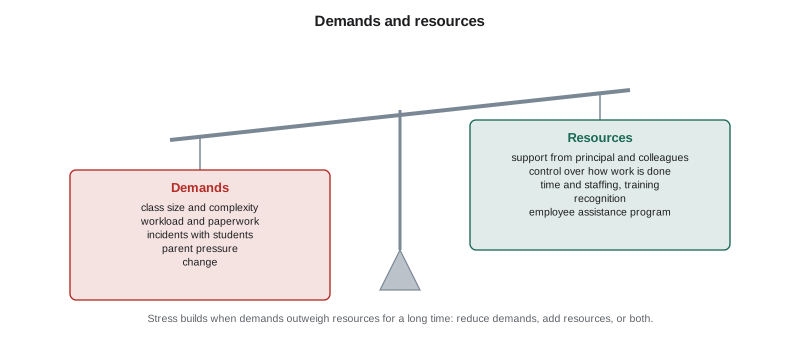
In Ontario, the WSIB has covered chronic mental stress caused by a substantial work-related stressor, such as harassment, since January 2018, as well as traumatic mental stress from a sudden and shocking event at work. Ordinary decisions by the employer about work, such as changes to assignments or discipline, are generally excluded. Psychological injuries in schools often lead to long absences, which is one reason boards are paying more attention to prevention.
Schools can reduce work-related stress by tackling the causes: fair distribution of classes and duties, protecting preparation time, reducing unnecessary paperwork, adequate support for students with complex needs, involving staff in decisions that affect them, recognizing good work, and dealing promptly with behaviour incidents and harassment. Principals play a large part: research consistently shows that supportive supervisors are one of the strongest protections against burnout.
At Pinecrest Secondary School, Marion asked staff in a short, anonymous survey which tasks took the most time for the least value. The top answers were duplicate data entry for attendance and marks, long email chains about scheduling, and supervision duties that fell unevenly on newer teachers. She worked with the department heads to drop one of the duplicate reports, moved scheduling into a shared calendar, and rebuilt the duty roster so that duties were shared fairly by seniority and timetable. None of these changes was dramatic, but staff said in the next survey that they noticed them, and that being asked had mattered as much as the changes themselves.
Individual staff can also look after their mental health: set boundaries on email outside working hours, take breaks, connect with colleagues, keep up activities outside work, and get help early. Most boards offer an employee and family assistance program (EFAP or EAP) that provides free, confidential counselling. Using it is a sign of good sense, not weakness.
Noise
Noise is a hazard in gyms, music rooms, technology shops, cafeterias and boiler rooms. Long-term exposure to loud noise causes permanent hearing loss and ringing in the ears (tinnitus). The damage depends on both the loudness and the length of exposure.
Ontario's noise regulation (Regulation 381/15) sets an exposure limit of 85 dBA averaged over an eight-hour day, using a 3 dB exchange rate: every 3 dB increase halves the allowed time. Where workers may be exposed above the limit, the employer must control the noise, starting with engineering controls, and provide hearing protection and training where needed.
The program below shows how quickly the allowed time drops as noise levels rise, using the Ontario rule, and estimates the daily noise dose for a music teacher at Pinecrest Secondary School from typical sound levels.
# Allowed exposure time at each sound level, and a daily noise dose.
def allowed_hours(level_dba, limit=85.0, exchange=3.0):
    return 8.0 / 2 ** ((level_dba - limit) / exchange)

rules = {"85 dBA / 3 dB (Ontario, NIOSH)": (85, 3), "90 dBA / 5 dB (OSHA limit)": (90, 5)}
for name, (lim, ex) in rules.items():
    print(name)
    for lvl in (85, 88, 91, 94, 97, 100):
        print(f"  {lvl} dBA: {allowed_hours(lvl, lim, ex):5.2f} h allowed")

# Music teacher's day: (activity, hours, typical level in dBA)
day = [("concert band rehearsal", 2.0, 94), ("small ensemble", 1.5, 88),
       ("classroom theory", 2.0, 72), ("prep and marking", 2.5, 60)]
for name, (lim, ex) in rules.items():
    dose = sum(h / allowed_hours(l, lim, ex) for _, h, l in day if l >= 80)
print(f"Music teacher daily dose under {name}: {dose:.0%}")85 dBA / 3 dB (Ontario, NIOSH) 85 dBA: 8.00 h allowed 88 dBA: 4.00 h allowed 91 dBA: 2.00 h allowed 94 dBA: 1.00 h allowed 97 dBA: 0.50 h allowed 100 dBA: 0.25 h allowed 90 dBA / 5 dB (OSHA limit) 85 dBA: 16.00 h allowed 88 dBA: 10.56 h allowed 91 dBA: 6.96 h allowed 94 dBA: 4.59 h allowed 97 dBA: 3.03 h allowed 100 dBA: 2.00 h allowed Music teacher daily dose under 85 dBA / 3 dB (Ontario, NIOSH): 238% Music teacher daily dose under 90 dBA / 5 dB (OSHA limit): 58%
Under the 85 dBA, 3 dB rule, two hours of band rehearsal at 94 dBA alone uses up the whole day's allowance, and the teacher's dose comes out well over the limit. Under the 90 dBA, 5 dB rule, the dose comes out lower but is still high enough to need a hearing conservation program. Controls include acoustic treatment of the band room, arranging the ensemble so the loudest instruments are not right beside the conductor, quieter rehearsal of loud sections, rest breaks in a quiet room, and musician's earplugs that reduce sound evenly across frequencies so music still sounds natural.
Voice strain
Teachers use their voices more than almost any other professionals, often over background noise, for hours a day. Studies have found voice problems are much more common in teachers than in the general population, and some teachers develop lasting damage such as nodules on the vocal folds. Gym teachers, music teachers, kindergarten teachers and teachers in noisy or echoing rooms are most at risk.
Controls include reducing background noise, through acoustic panels, felt pads on chair legs and turning off noisy equipment, and using classroom sound-field amplification systems or a personal voice amplifier. Teachers can protect their voices by using non-verbal signals to get attention instead of raising their voice, drinking water through the day, resting the voice at breaks, avoiding shouting outdoors and in gyms, and getting a sore or hoarse voice that lasts more than two weeks checked by a doctor or speech-language professional.
Fatigue
Fatigue is more than being tired. It is a state of mental and physical exhaustion that reduces alertness, slows reactions and impairs judgement. School staff become fatigued from long hours of work and preparation, evening events and coaching, shift work for custodians, second jobs, caregiving at home, and poor sleep caused by stress. Fatigued staff are more likely to slip, make mistakes with chemicals or equipment, react poorly in a tense situation with a student, or have a crash on the drive home.
Schools can reduce fatigue by spreading evening duties fairly, limiting very long days, giving custodians predictable shifts with enough time between them, and recognizing that a staff member who has just dealt with a serious incident may not be fit to carry on with a full day. Staff can protect their sleep, take breaks and tell their supervisor when fatigue is affecting their safety.
After a traumatic event
Schools sometimes face events that shake everyone: the death of a student or colleague, a serious injury on a field trip, a violent incident, a fire, or a threat that leads to a lockdown. Staff are expected to look after students through these events, often while dealing with their own shock and grief. Reactions such as trouble sleeping, replaying the event, irritability, difficulty concentrating and feeling numb are common in the days and weeks afterwards, and for most people they fade with time and support.
Riverbend District School Board has a critical incident response that sends a team of trained staff, such as social workers, psychologists and counsellors, to a school after a traumatic event. The team supports students, but it also checks in with staff, offers group and individual sessions, and makes sure staff know about the employee assistance program. Principals are encouraged to give staff who were closely involved some time away from the classroom, to avoid asking people to retell what happened more than necessary, and to check in again a few weeks later, when the first wave of support has passed. Staff whose reactions are getting worse rather than better after a month, or who are struggling to function, should be encouraged to get professional help.
Worked problem
Emails from a parent
A Grade 9 teacher at Pinecrest Secondary School has been receiving long, angry emails from a parent several times a week, sometimes late at night, with personal insults and threats to 'go to the media'. The teacher is losing sleep and dreads opening her inbox. What should happen?
Show solution
- The teacher reports the emails to Marion, as the principal and her supervisor, and keeps copies of them.
- Marion reviews the emails. Repeated insults and threats are not reasonable parent communication, and they may amount to workplace harassment. Any threat of physical harm would be treated as workplace violence and reported accordingly.
- Marion writes to the parent, setting out how communication will happen from now on: through the principal, during working hours, and in a respectful tone. She reminds the parent of the board's code of conduct for visitors and parents.
- Marion offers the teacher support, including the employee assistance program, and checks in with her over the next few weeks.
- If the emails continue, the board can take further steps, such as limiting the parent's contact with the school.
Answer: Report and keep records, have the principal set communication limits with the parent, support the teacher and escalate if the behaviour continues.
Common mistakes
MistakeTreating abuse from parents or students as part of the job.
InsteadReport it; the board can set limits and act.
MistakeCalling any feedback from a supervisor harassment.
InsteadReasonable management action, such as assigning work and fair performance feedback, is not harassment.
MistakeSeeing stress as a personal weakness.
InsteadWork-related stress comes from demands outweighing resources; tackle the causes and get help early.
MistakeIgnoring a hoarse voice for months.
InsteadReduce noise, use amplification and get a voice problem that lasts more than two weeks checked.
MistakeAssuming music is not noise.
InsteadRehearsals can exceed noise limits; use acoustic treatment, breaks and musician's earplugs.
Summary and key terms
- The OHSA requires a harassment policy reviewed yearly and a program for reporting, investigating and informing parties in writing.
- Reasonable management action is not harassment, but abuse from colleagues, parents or students should be reported.
- Work-related stress comes from demands outweighing resources; supportive principals and fair workloads help most.
- Employee assistance programs offer free, confidential counselling.
- Ontario's noise limit is 85 dBA over eight hours with a 3 dB exchange rate.
- Teachers' voices are protected by less background noise, amplification and good voice habits.
- Fatigue increases the risk of mistakes and injuries; fair duties and predictable shifts help.
- Workplace harassment
- A course of unwelcome comment or conduct against a worker that the harasser knows or should know is unwelcome.
- Burnout
- Long-term exhaustion and detachment from work caused by sustained stress.
- Exchange rate
- The increase in sound level that halves the allowed exposure time.
- Sound-field amplification
- A classroom system that amplifies the teacher's voice evenly across the room.
- Employee assistance program
- A free, confidential counselling and support service for employees.
Practice problems
Work each problem on paper first, then reveal the answer to check.
Is a principal assigning duties fairly a form of harassment?
Show answer
No; reasonable management action is not harassment.
Name three causes of work-related stress.
Show answer
Any three of: high demands, low control, poor support, unclear roles, poor relationships, badly managed change, lack of recognition.
Under Ontario's rule, how long can a worker be exposed to 91 dBA?
Show answer
Two hours.
Give two ways to protect a teacher's voice.
Show answer
Any two of: reduce background noise, use amplification, use non-verbal signals, drink water, rest the voice, get a lasting hoarse voice checked.
What is an employee assistance program?
Show answer
A free, confidential counselling and support service.
Why does fatigue matter for safety?
Show answer
It reduces alertness and judgement, making slips, mistakes and crashes more likely.
Lesson quiz · 5 questions
Score 60% or more to complete this lesson.
Create a free account to save your progress, take quizzes and earn a certificate.