
HSE-341 · Lesson 7 of 12 · 24 min
Aggressive customers: understanding escalation
Robbery is rare. Angry customers are not. Most retail workers deal with frustrated, rude or aggressive people every week, and some deal with them every shift. Most of these encounters calm down on their own or with a little skill. A few escalate to threats, thrown items or physical contact. Understanding how and why aggression builds, and recognizing the early signs, gives workers the best chance to calm things down or step away before anyone is hurt. HSE-108 explains escalation and de-escalation for workplaces in general; this lesson looks at what drives aggression in stores and how it tends to unfold at the counter, the service desk and the self-checkout.
Aggression usually builds
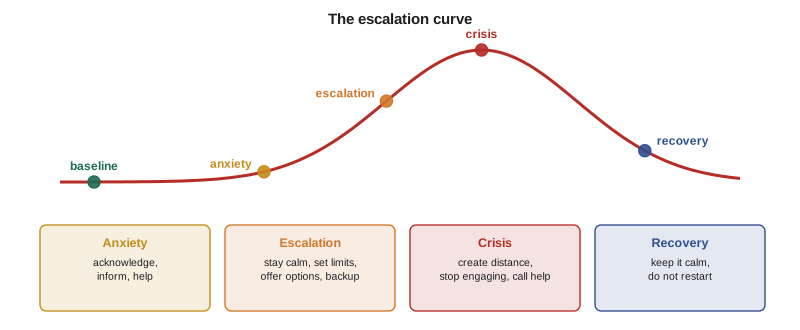
Aggression rarely appears out of nowhere. In most incidents, a person moves through stages, from frustration to anger to hostility, with signs along the way. Many training programs describe this as an escalation curve or cycle. A simple version has five stages:
- Baseline: the person is calm and going about their business.
- Trigger and anxiety: something frustrates or worries them, such as a long line, a declined card, a refused return or a price that does not match the shelf tag.
- Escalation: they become agitated and defensive. Their voice rises, they repeat demands, argue, use sarcasm or start swearing. Body language changes.
- Crisis: they lose control. They may threaten, throw items, damage property, push, grab or strike. Reasoning is very hard at this point.
- Recovery: the person begins to calm down, but tension stays high for a while and a new trigger can restart the cycle.
The stages are not always neat, and some people move through them very quickly, especially if they are intoxicated or in crisis. But the model is useful because each stage calls for a different response. During anxiety and early escalation, empathy and problem-solving work well. During crisis, the priority is safety: create distance, stop talking, and get help. During recovery, keep it calm and do not reopen the argument.
What triggers aggression in stores
Retail incidents tend to cluster around a few situations. Knowing them helps a store prevent many incidents and prepare for the rest.
| Trigger | Example | Prevention ideas |
|---|---|---|
| Waiting | Long lines at checkouts, a single worker at the service desk | Staff to the busiest times, open more lanes early, give information about waits |
| Refusals | Refused sale of alcohol, tobacco or cannabis without ID; refused return | Clear signs and policies, scripts, back-up from a supervisor (Lesson 9) |
| Money problems | Declined card, price differences, coupons not accepted | Price accuracy, discreet handling, simple ways to fix errors |
| Out of stock or not as advertised | Advertised item sold out, wrong size, product recall | Rain cheques or substitutes, honest information |
| Self-checkout | Machine errors, age checks, bag checks, accusations of theft | Well-staffed attendant station, neutral language, clear rules |
| Policies and rules | Bag checks, limits per customer, store dress or mask rules in the past | Explain the reason, apply consistently, involve a supervisor early |
| Intoxication | Customer affected by alcohol or drugs | Refuse alcohol sales, keep it short, get backup, call help if needed |
| Mental health crisis | Person confused, frightened, hearing or seeing things | Speak calmly, give space, call a crisis line or 911 if there is a risk |
Customer aggression rose sharply during the COVID-19 pandemic, when retail workers enforced mask rules, capacity limits and product limits, and many workers and unions reported a lasting increase in abuse afterwards. The lesson for stores is that rules workers must enforce are a predictable source of conflict, and they should be supported with clear signs, consistent application and supervisor backup rather than left to individual frontline workers.
Factors in the person
Some factors make a person more likely to become aggressive, though none of them predict aggression in any individual. They include intoxication with alcohol or drugs, which lowers inhibitions and makes people less able to reason; some mental health conditions, especially in a crisis; pain, hunger, exhaustion and stress; feeling disrespected or humiliated, especially in front of others; and a past experience of being treated unfairly. Most people with mental illness are not violent, and they are more likely to be victims of violence than perpetrators. The point is not to label customers but to recognize when someone is not in a state to reason and to adjust the response.
It is also important not to judge risk by appearance, race, accent, disability, age or how someone is dressed. Assumptions like these are unfair, can be unlawful discrimination, and often escalate situations by making people feel targeted. Judge risk by behaviour: what the person is saying and doing.
Factors in the store
Store conditions can make aggression more or less likely. Crowding, noise, heat, long waits, unclear signs, broken equipment and understaffing all raise frustration. Layouts that box in the customer service desk, or force a customer to stand close to a worker for a long time, can make tense interactions feel more threatening on both sides. Simple changes help: clear signage about policies, enough staff at busy times, working equipment, a quieter space for difficult conversations, and counters that allow a comfortable distance.
Factors in the worker's response
How workers respond can calm or inflame a situation. Workers are not to blame for customer aggression, and nothing in this section should be read that way. But under stress, anyone can respond in ways that escalate: using a flat "that's the policy" with no explanation, arguing about who is right, matching a raised voice, using sarcasm, crossing arms or rolling eyes, ignoring a customer while serving someone else, or making a customer lose face in front of others. Tired, stressed or unsupported workers are more likely to respond this way, which is another reason staffing and supervisor backup matter. Lesson 8 covers the skills that help.
Early warning signs
Spotting escalation early gives the most options. Signs fall into a few groups:
- Voice: louder, faster, higher, or suddenly very quiet and controlled; swearing; repeating the same demand.
- Words: insults, blaming, threats ("you'll be sorry"), statements about wanting to hurt someone, references to weapons.
- Body: clenched fists or jaw, pacing, pointing or jabbing, slamming items down, standing too close, red face, rapid breathing, staring.
- Behaviour: refusing to leave, following a worker, blocking the way, throwing or breaking things, filming the worker aggressively while making accusations.
Any threat, any mention of a weapon, any physical contact or any attempt to block a worker's way out should be treated as crisis-level, regardless of how calm the rest of the interaction seems. At that point the priority is distance and help, not resolution.
Classifying what you see
Training often uses scenarios where workers decide which stage a customer is at and what the right response is. The program below does a simple version of that: it takes a list of observed cues for several invented customers and assigns a stage using a few rules, with any red-flag cue moving the customer straight to crisis. It is a teaching aid, not a decision tool; real judgment uses much more information.
# Teaching aid: assign an escalation stage from observed cues (scenarios are invented).
RED = {"threat", "mentions weapon", "pushes or grabs", "throws item", "blocks exit", "follows worker"}
HIGH = {"shouting", "swearing", "repeats demand", "points or jabs", "slams item", "stands too close"}
LOW = {"sighs", "checks time", "frowns", "asks for manager", "complains about wait"}
def stage(cues):
    c = set(cues)
    if c & RED:
        return "crisis", "create distance, stop engaging, call for help"
    n_high = len(c & HIGH)
    if n_high >= 2:
        return "escalation", "stay calm, set limits, offer options, get backup nearby"
    if n_high == 1 or len(c & LOW) >= 2:
        return "anxiety", "acknowledge, explain, offer help"
    return "baseline", "serve as normal"
customers = {
    "A (long line)":         ["sighs", "checks time", "complains about wait"],
    "B (refused return)":    ["shouting", "repeats demand", "points or jabs"],
    "C (ID check)":          ["swearing", "stands too close", "threat"],
    "D (price difference)":  ["frowns", "asks for manager"],
    "E (self-checkout)":     ["repeats demand"],
    "F (banned customer)":   ["follows worker"],
}
for who, cues in customers.items():
    s, action = stage(cues)
print(f"{who:<22} {s:<10} -> {action}")A (long line) anxiety -> acknowledge, explain, offer help B (refused return) escalation -> stay calm, set limits, offer options, get backup nearby C (ID check) crisis -> create distance, stop engaging, call for help D (price difference) anxiety -> acknowledge, explain, offer help E (self-checkout) anxiety -> acknowledge, explain, offer help F (banned customer) crisis -> create distance, stop engaging, call for help
Customer C shows the importance of red flags: two escalation cues might suggest calm limit-setting, but the threat moves the situation to crisis, and the worker should stop trying to resolve the ID issue and focus on distance and help. Customer F is also crisis-level even though they have not said anything, because a banned customer following a worker is a direct risk. Customers A and D are in the anxiety stage, where a little acknowledgement and information usually works.
Riverside's evening incidents
Riverside Corner Market's two threatening incidents both happened in the evening. In one, a customer who had been refused cigarettes without ID came back twenty minutes later and stood at the counter shouting at the worker for several minutes, then said he would wait for her outside. In the other, a customer who appeared intoxicated was refused a beer sale and threw a bottle of water at the counter. In both cases the worker was alone at the counter while the second worker was stocking in the back. Both incidents involved predictable triggers, refusals, at a predictable time, when backup was not close by.
For supervisors: plan for the predictable
Look at where and when aggression happens in your store. If most incidents follow refusals of age-restricted sales, make sure ID checks happen with backup nearby in the evening and that the policy is clearly posted. If incidents cluster at the service desk during returns, look at the returns policy, the desk layout and staffing. If self-checkout disputes are common, staff the attendant station well and coach attendants on neutral language. Do not leave a worker alone to handle situations you know will trigger conflict.
Worked problem
Reading the signs at the service desk
A customer at Northfield's service desk wants to return an opened item without a receipt. When Ana explains the policy, the customer sighs and says he has been waiting twenty minutes. Ana repeats the policy. The customer raises his voice, says the policy is ridiculous and starts tapping the counter hard with his finger. Ana feels herself getting defensive. What stage is the customer at, and what should Ana do?
Show solution
- Stage: the customer moved from anxiety (sighing, frustration about the wait) to early escalation (raised voice, criticizing, tapping the counter).
- Watch her own reaction: Ana is getting defensive, which can feed the escalation.
- Acknowledge the frustration: 'I'm sorry you've had a long wait, and I can see this is frustrating.'
- Explain the reason and offer options: an exchange, store credit within the policy, or asking a supervisor to review.
- Signal for backup and keep the counter between them. If he threatens, approaches aggressively or throws something, stop engaging, step back and call for help.
Answer: He is in early escalation. Acknowledging the wait, explaining, offering options and getting a supervisor involved early give the best chance of calming him, while backup and distance protect Ana if it escalates.
Common mistakes
MistakeRepeating “that’s the policy” with no explanation.
InsteadAcknowledge the frustration, explain the reason and offer whatever options exist.
MistakeJudging which customers are dangerous by appearance or background.
InsteadJudge risk by behaviour: what the person says and does.
MistakeTrying to reason with a customer who has made a threat.
InsteadTreat threats as crisis-level: create distance, stop engaging and call for help.
MistakeLeaving one worker alone to handle refusals at night.
InsteadPlan backup for predictable triggers such as ID checks and returns.
MistakeRestarting the argument once the customer calms down.
InsteadKeep the recovery stage calm and let the person leave with dignity.
Summary and key terms
- Customer aggression is common in retail and usually builds through stages: baseline, trigger and anxiety, escalation, crisis and recovery.
- Each stage calls for a different response, from acknowledgement to distance and help.
- Common retail triggers include waiting, refusals, money problems, stock issues, self-checkout, policies, intoxication and mental health crises.
- Store conditions such as crowding, noise, poor signs and understaffing raise frustration.
- Worker responses can calm or inflame, but workers are never to blame for aggression.
- Watch voice, words, body and behaviour for early signs; any threat, weapon, contact or blocking is crisis-level.
- Judge risk by behaviour, never by appearance or background.
- Escalation
- The process by which frustration builds toward anger, hostility and possibly violence.
- Trigger
- An event that sets off frustration or anger, such as a refusal or a long wait.
- Crisis stage
- The point at which a person has lost control and reasoning is very difficult.
- Recovery stage
- The period after a crisis when the person is calming but tension remains high.
- Red flag
- A sign, such as a threat or blocking an exit, that calls for immediate distance and help.
Practice problems
Work each problem on paper first, then reveal the answer to check.
Name the five stages of the escalation curve.
Show answer
Baseline, trigger and anxiety, escalation, crisis, recovery.
What is the priority during the crisis stage?
Show answer
Safety: create distance, stop engaging and get help.
List four common retail triggers.
Show answer
Any four of: waiting, refusals, money problems, out of stock, self-checkout, policies, intoxication, mental health crisis.
Why should risk not be judged by appearance?
Show answer
It is unfair, can be unlawful discrimination and can escalate situations; judge by behaviour.
Give three worker responses that can escalate a situation.
Show answer
Any three of: flat policy statements, arguing, matching a raised voice, sarcasm, eye-rolling, ignoring, humiliating in front of others.
Give two early warning signs in a person’s body language.
Show answer
Any two of: clenched fists or jaw, pacing, pointing, slamming items, standing too close, rapid breathing, staring.
Which cues should move a situation straight to crisis level?
Show answer
A threat, a mention of a weapon, physical contact, throwing items, blocking the exit or following a worker.
What did Riverside’s two incidents have in common?
Show answer
Both followed refusals in the evening while the worker at the counter was alone.
Lesson quiz · 5 questions
Score 60% or more to complete this lesson.
Create a free account to save your progress, take quizzes and earn a certificate.