
HSE-341 · Lesson 11 of 12 · 23 min
After an incident: care, reporting and recovery
What a store does after a robbery, an assault or a frightening encounter shapes how well the people involved recover, whether they stay in their jobs, and whether the store learns enough to prevent the next one. Good follow-up is not complicated. It means caring for people first, reporting and investigating properly, and making changes. This lesson covers each of those steps for stores. HSE-109 covers psychological health and safety in general, HSE-103 covers first aid, and HSE-403 covers incident investigation methods.
People first
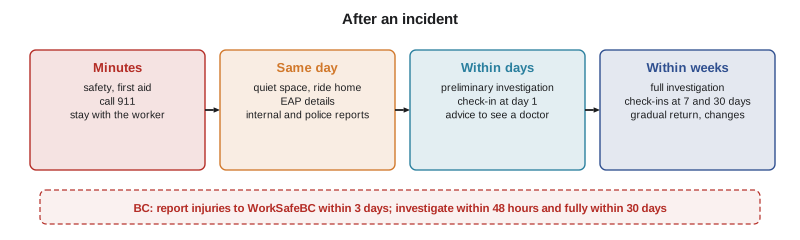
Immediately after an incident, the priorities are safety and care. Make sure the threat has passed, give first aid and call an ambulance for anyone injured, and make sure the workers involved are not left alone. Workers who were directly involved should be taken off the floor to a quiet place, offered water and a phone to call someone, and not expected to return to work that shift. A manager or trusted co-worker should stay with them until they are ready to go home, and the store should arrange safe transport if needed.
Psychological first aid
Psychological first aid is a simple, evidence-informed approach to supporting people in the hours and days after a frightening event. It is not therapy and does not require special training to start, though short courses are widely available. It is often summarized as look, listen and link:
- Look: check for safety, physical injuries and urgent needs, and notice who seems most affected.
- Listen: approach calmly, introduce yourself, ask what they need, and listen without pushing for details. Let people talk if they want to, and accept silence if they do not.
- Link: help with practical needs, such as calling family or getting home, give information about support services, and make sure someone follows up.
Things to avoid include pressing people to describe the event in detail, telling them how they should feel, saying "it could have been worse" or "at least nobody was hurt", and making promises you cannot keep. Older approaches that required everyone to attend a group session soon after an event to retell what happened, sometimes called mandatory debriefing, are no longer recommended; research found they do not prevent post-traumatic stress and may make some people worse. Voluntary support, offered and repeated, works better.
Normal reactions
After a robbery or assault, most people have strong reactions for days or weeks. These are normal responses to an abnormal event, not signs of weakness. Common reactions include:
| Type | Examples |
|---|---|
| Emotional | Fear, anxiety, anger, guilt, sadness, numbness, feeling on edge |
| Physical | Trouble sleeping, tiredness, headaches, stomach upset, a racing heart when reminded |
| Thinking | Replaying the event, trouble concentrating, memory gaps, blaming yourself |
| Behaviour | Avoiding the store or the counter, startling easily, irritability, withdrawing from others |
For most people these reactions fade over a few weeks, especially with support from co-workers, family and friends. A minority develop longer-lasting problems such as post-traumatic stress disorder, depression or anxiety. Signs that someone needs more help include reactions that are getting worse rather than better after two to four weeks, being unable to return to work or carry out daily tasks, heavy use of alcohol or drugs to cope, and thoughts of self-harm. Anyone with those signs should be encouraged to see a doctor or mental health professional, and anyone at risk of self-harm should be connected to help right away, including the 988 crisis line in both countries.
Co-workers who witnessed the incident, heard it over the radio or worked the next shift can also be affected. Support should be offered to them too.
Support services and time off
Many employers provide an employee and family assistance program (EFAP or EAP) that offers free, confidential counselling. After a serious incident, the store should give workers the program's contact details in writing, explain that it is confidential, and in some cases arrange for a counsellor to visit the store. Workers should be allowed reasonable time off, and the return to work should be planned with them. A gradual return, for example starting on a day shift, away from the counter where the event happened, with a co-worker nearby, often helps. Some workers want to return quickly to regain a sense of normality; others need more time. Both are normal.
Medical care and compensation
Workers who are injured or have symptoms after a violent incident should be advised to see a physician of their choice, as section 4.31 of BC's regulation requires. Injuries from violence at work, including mental disorders caused by a traumatic event at work, can be accepted as compensable by WorkSafeBC. The employer must report injuries that need medical treatment or cause time off to WorkSafeBC within three days of learning of them, and the worker should report the injury to the employer and make a claim. Workers should not be discouraged from claiming. Some occupations, such as first responders, have presumptions for certain mental disorders under BC law, but retail workers' psychological injury claims are assessed case by case.
Reporting
Every incident should be reported internally, using the store's incident form, as soon as possible. Reports should be factual and short: what happened, when and where, who was involved, any injuries, what was taken or damaged, and what was done. Robberies, assaults, threats with weapons, hate crimes and stalking-type behaviour should be reported to police. For less serious incidents, such as verbal abuse without threats, an internal report is enough, but the store should still record it so patterns can be seen.
Workers sometimes worry that reporting will get them in trouble or that they will be seen as unable to cope. Managers should make clear that reports are expected and welcomed, that the goal is to fix problems, not to blame people, and that reporting does not affect performance reviews.
Investigating
BC's Workers Compensation Act requires a preliminary investigation as soon as possible after an incident that causes injury or could have, with a report within 48 hours, and a full investigation with a report to WorkSafeBC within 30 days. The investigation should involve the joint committee or worker representative and look for causes and fixes, not someone to blame. For robberies, police will investigate the crime; the store's investigation is about what the store can change. HSE-403 covers investigation methods.
Useful questions include: Were the controls in place and working (cash limits, staffing, alarms, cameras, lighting)? Did workers know the procedures, and did the procedures work? What happened before the incident, such as a refusal or a long wait? Has this happened before at this location or time? What would have prevented it or reduced the harm? The answers should lead to specific actions with owners and dates.
Following up
Recovery is not a single event. A simple schedule of check-ins helps make sure nobody falls through the cracks. Northfield uses a check-in on the next day, after a week and after a month, done by the worker's supervisor or a manager the worker trusts. The check-in asks how the person is doing, whether they need anything, whether they have used the EAP, and whether they have concerns about returning to the counter. The program below tracks follow-up for a set of synthetic incidents and flags where the store fell short.
# Track follow-up after incidents (synthetic records). Day 0 is the day of the incident.
incidents = [
    # id, type, reported_day, eap_offered, checkins_done (days), investigation_closed_day
    ("R1", "attempted robbery", 0, True,  [1, 7, 30], 21),
    ("T1", "threat during theft", 2, True, [1, 7],     None),
    ("A1", "pushed at service desk", 0, False, [1],    12),
    ("V1", "verbal abuse", 5, False, [],               None),
    ("H1", "harassment at checkout", 1, True, [1, 7, 30], 9),
]
due = [1, 7, 30]
today = 35
for iid, kind, rep, eap, done, closed in incidents:
    problems = []
    if rep > 1: problems.append(f"reported late (day {rep})")
    if not eap and kind != "verbal abuse": problems.append("EAP not offered")
    missed = [d for d in due if d <= today and d not in done]
    if missed: problems.append("missed check-ins " + ",".join(map(str, missed)))
    if closed is None: problems.append("investigation still open")
    elif closed > 30: problems.append("investigation over 30 days")
print(f"{iid} {kind:<24} {'; '.join(problems) if problems else 'complete'}")R1 attempted robbery complete T1 threat during theft reported late (day 2); missed check-ins 30; investigation still open A1 pushed at service desk EAP not offered; missed check-ins 7,30 V1 verbal abuse reported late (day 5); missed check-ins 1,7,30; investigation still open H1 harassment at checkout complete
Only two of the five incidents had complete follow-up. The threat during a theft was reported on day 2, missed its 30-day check-in and still has an open investigation, the push at the service desk did not include an offer of EAP support and missed two check-ins, and the verbal abuse incident was reported late and never followed up. None of these are dramatic failures, but each makes it more likely that a worker struggles without support, or that a fixable problem is not fixed. A tracker like this, reviewed at each safety committee meeting, keeps follow-up on schedule.
Learning and changing
The most important outcome of follow-up is change. After Northfield's attempted robbery at the service desk, the review led to lower evening cash limits at the desk, a second worker at the desk after 7 p.m., a camera aimed at the desk, a second exit from behind the desk, and training on alarm timing. Workers were told what had changed and why. Telling workers about the changes matters: it shows that reporting leads to action and that the store takes their safety seriously.
For supervisors: the first conversation
In the first conversation after an incident, keep it simple. Make sure the worker is safe and has what they need. Say clearly that they did the right thing, especially if they handed over money or stepped away from an abusive customer. Do not ask them to explain the details again unless the police need them, and do not ask what they did to cause it. Give them the EAP information, tell them you will check in tomorrow, and do it.
Worked problem
Supporting Lee after the attempted robbery
After Northfield's attempted robbery, Lee, the service desk worker, went home that night. Two weeks later Lee is back at work but asks not to work the desk, is jumpy when people approach quickly, and says they are not sleeping well. The supervisor wants Lee back on the desk because staffing is short. What should happen?
Show solution
- Recognize that Lee's reactions are common two weeks after a robbery, but that poor sleep and avoidance continuing past two to four weeks are signs to encourage more help.
- Respect Lee's request: assign Lee to other duties for now and plan desk staffing another way.
- Remind Lee about the EAP and encourage a visit to a doctor; make sure the compensation report has been made if Lee needed treatment or time off.
- Agree on a gradual return plan with Lee, for example day shifts at the desk with a second worker present, when Lee feels ready.
- Keep the 30-day check-in, and tell Lee what has changed at the desk since the incident.
Answer: Lee's recovery comes before the staffing gap. Other duties, encouragement to get help, a planned gradual return and telling Lee about the changes support recovery and retention.
Common mistakes
MistakeAsking a worker to finish their shift after a robbery.
InsteadTake them off the floor, stay with them and arrange a safe way home.
MistakeRequiring everyone to attend a group session to retell the event.
InsteadOffer voluntary support and repeat the offer; avoid mandatory debriefing.
MistakeTelling a shaken worker it could have been worse.
InsteadListen, acknowledge their reaction and help with practical needs.
MistakeDiscouraging a worker from making a compensation claim.
InsteadExplain how to claim and make the employer report on time.
MistakeClosing the investigation without telling workers what changed.
InsteadMake specific changes and tell workers about them.
Summary and key terms
- Care for people first: safety, first aid, a quiet space, company and a safe way home.
- Use psychological first aid (look, listen, link); avoid mandatory debriefing.
- Strong reactions are normal for weeks; worsening reactions after two to four weeks signal a need for more help.
- Offer EAP counselling, time off and a planned, gradual return to work.
- Advise workers to see a physician (s. 4.31), report injuries to WorkSafeBC within three days and support claims.
- Report to police where needed; investigate within 48 hours and fully within 30 days, looking for fixes.
- Track follow-up with check-ins at 1, 7 and 30 days, make changes and tell workers about them.
- Psychological first aid
- Practical, supportive help in the hours and days after a distressing event, summarized as look, listen, link.
- Mandatory debriefing
- A required group session soon after an event to retell it; no longer recommended.
- EAP
- Employee (and family) assistance program offering free, confidential counselling.
- Post-traumatic stress disorder
- A mental health condition in which reactions to a traumatic event persist and interfere with daily life.
- Gradual return to work
- A planned return with adjusted duties, hours or support.
- Check-in
- A scheduled conversation with an affected worker to see how they are and what they need.
Practice problems
Work each problem on paper first, then reveal the answer to check.
What should happen to a worker directly involved in a robbery for the rest of that shift?
Show answer
They should be taken off the floor, not left alone, and helped to get home safely.
What do look, listen and link mean in psychological first aid?
Show answer
Check safety and needs, listen without pushing, and connect to practical help and support services.
Why is mandatory debriefing no longer recommended?
Show answer
Research found it does not prevent post-traumatic stress and may make some people worse.
Name three common reactions after a robbery.
Show answer
Any three of: fear, anxiety, anger, guilt, trouble sleeping, replaying the event, avoidance, startling easily.
Give two signs that someone needs more help.
Show answer
Any two of: reactions worsening after two to four weeks, unable to work or do daily tasks, heavy alcohol or drug use, thoughts of self-harm.
Within how many days must a BC employer report a qualifying injury to WorkSafeBC?
Show answer
Three days.
What are the BC investigation deadlines?
Show answer
A preliminary investigation report within 48 hours and a full investigation report within 30 days.
When does Northfield check in with affected workers?
Show answer
The next day, after a week and after a month.
Lesson quiz · 5 questions
Score 60% or more to complete this lesson.
Create a free account to save your progress, take quizzes and earn a certificate.