
HSE-341 · Lesson 12 of 12 · 25 min
Capstone: a violence risk assessment and response plan for an invented store
This final lesson puts the course together. We follow Marco Delgado, Northfield's safety lead, as he helps the owner of Riverside Corner Market, the small convenience store we have met throughout the course, carry out a violence risk assessment and write a response plan. Riverside has no robbery history, but it has had thefts, two threatening incidents after refusals, and many of the risk factors from Lesson 3. The aim is a plan that is practical for a small store with a modest budget, that meets the legal requirements from Lesson 2, and that workers understand and support.
Riverside Corner Market
Riverside is an invented convenience store in Kamloops. It is open from 6 a.m. to midnight every day, sells groceries, snacks, tobacco, vaping products, lottery tickets and prepaid cards, and is next to a busy road with a side parking lot. It has eight part-time workers and the owner, Dana Lau, who works most day shifts. Evenings usually have two workers; mornings sometimes have one for the first hour. The store is not licensed to sell alcohol. Its late-night hours mean BC's late-night retail rules apply between 11 p.m. and midnight, which HSE-352 covers in detail; this plan addresses them only at a high level.
Step 1: gather information
Marco and Dana start with what the store already knows and what workers think. They review two years of incident notes, police reports for thefts, and the store's two threatening incidents. They walk the store and lot at opening, at 9 p.m. and at closing. They also ask every worker to complete a short, anonymous survey about how safe they feel at different times and tasks, using a five-point scale from strongly disagree (1) to strongly agree (5). The program below summarizes the responses.
# Summarize Riverside's anonymous staff safety survey (responses are invented; 1 = strongly disagree, 5 = strongly agree).
survey = {
    "I feel safe working the morning opening":         [4, 3, 2, 4, 3, 2, 3, 4],
    "I feel safe working the evening shift":            [3, 2, 3, 2, 2, 3, 2, 3],
    "I feel safe during closing and leaving":           [2, 1, 2, 2, 3, 1, 2, 2],
    "I know what to do in a robbery":                   [3, 2, 2, 3, 2, 4, 2, 3],
    "I can get help quickly if a customer is abusive":  [2, 3, 2, 2, 3, 2, 3, 2],
    "I would be supported if I refused a sale":         [4, 4, 5, 3, 4, 4, 5, 4],
    "Reporting an incident is quick and worthwhile":    [2, 2, 3, 2, 1, 2, 3, 2],
}
rows = []
for item, r in survey.items():
    mean = sum(r) / len(r)
    agree = sum(1 for x in r if x >= 4) / len(r)
    rows.append((mean, item, agree))
for mean, item, agree in sorted(rows):
    flag = "PRIORITY" if mean < 2.5 else ("watch" if mean < 3.5 else "ok")
print(f"{mean:4.2f} agree {agree:4.0%} {flag:<8} {item}")1.88 agree 0% PRIORITY I feel safe during closing and leaving 2.12 agree 0% PRIORITY Reporting an incident is quick and worthwhile 2.38 agree 0% PRIORITY I can get help quickly if a customer is abusive 2.50 agree 0% watch I feel safe working the evening shift 2.62 agree 12% watch I know what to do in a robbery 3.12 agree 38% watch I feel safe working the morning opening 4.12 agree 88% ok I would be supported if I refused a sale
The survey results line up with the walk-throughs. Workers feel least safe during closing and leaving, do not think reporting is quick or worthwhile, are not confident they can get help quickly with an abusive customer, and are unsure what to do in a robbery. They do feel supported when refusing sales, which is a strength the owner has built by backing staff. The lowest scores become priorities for the plan.
Step 2: identify hazards and situations
From the information, Marco and Dana list the situations that could lead to harm. For each one they note when it happens, what controls already exist, and what could go wrong.
| Situation | When | Existing controls | Gaps found |
|---|---|---|---|
| Robbery at the counter | Evening and late night | Camera at counter, drop safe | Covered windows, counter faces away from door, cash builds up, side lot dark |
| Aggression after refusal (tobacco, lottery, ID) | Mostly evenings | Posted age signs, owner backs refusals | Second worker often in back, no quick way to call help |
| Threats during theft | Any time, more in evening | Policy not to chase | Policy unwritten; new workers unsure |
| Opening alone | 6 to 7 a.m. | Lights on timer | One worker unlocks alone; no check of the lot |
| Closing and leaving | Midnight | Two workers until 11:30 p.m. | Second worker leaves early; cash counted at front; staff park on dark side lot |
| Harassment of young workers | Evenings and weekends | First-name tags | No written process; no walk-outs |
Step 3: assess the risk
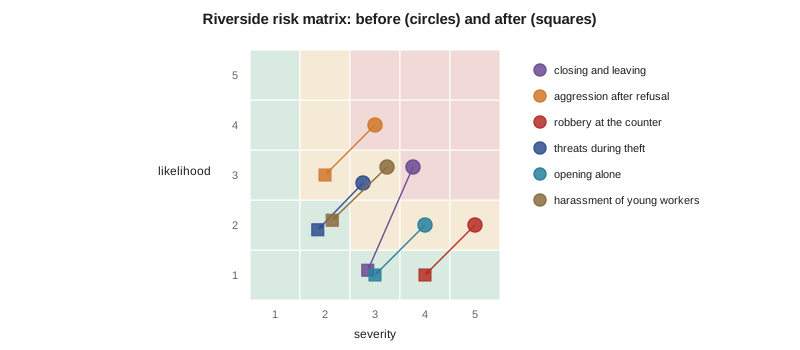
For each situation, Marco and Dana rate likelihood and severity on a simple 1 to 5 scale and multiply them to get a risk score, first with the current controls and then with the planned controls. The ratings are judgments, informed by the incident history, the walk-throughs, the survey and the risk factor checklist from Lesson 3. The program below calculates the scores and ranks the situations.
# Risk matrix for Riverside: likelihood x severity (1 to 5 each), before and after planned controls.
# Ratings are the assessors' judgments, not measurements.
risks = {
    "Robbery at the counter":          ((2, 5), (1, 4)),
    "Aggression after refusal":        ((4, 3), (3, 2)),
    "Threats during theft":            ((3, 3), (2, 2)),
    "Opening alone":                   ((2, 4), (1, 3)),
    "Closing and leaving":             ((3, 4), (1, 3)),
    "Harassment of young workers":     ((3, 3), (2, 2)),
}
def band(s):
    return "HIGH" if s >= 12 else ("MEDIUM" if s >= 6 else "LOW")
print(f"{'Situation':<32} {'now':>5} {'band':<7} {'after':>6} {'band':<7}")
for name, ((l0, s0), (l1, s1)) in sorted(risks.items(), key=lambda kv: -kv[1][0][0] * kv[1][0][1]):
    a, b = l0 * s0, l1 * s1
    print(f"{name:<32} {a:5d} {band(a):<7} {b:6d} {band(b):<7}")
before = sum(l * s for (l, s), _ in risks.values()); after = sum(l * s for _, (l, s) in risks.values())
print(f"Total score: {before} now, {after} after controls ({100 * (before - after) / before:.0f}% lower)")Situation now band after band Aggression after refusal 12 HIGH 6 MEDIUM Closing and leaving 12 HIGH 3 LOW Robbery at the counter 10 MEDIUM 4 LOW Threats during theft 9 MEDIUM 4 LOW Harassment of young workers 9 MEDIUM 4 LOW Opening alone 8 MEDIUM 3 LOW Total score: 60 now, 24 after controls (60% lower)
Two situations rank high with current controls: closing and leaving, and aggression after refusals. Robbery at the counter ranks medium because its likelihood is low, but it has the highest severity of any situation, which is why it still gets priority attention. With the planned controls, aggression after refusals drops to medium and every other situation to low, and the total score falls by 60%. The scores are rough, but they make the priorities clear and give a baseline for next year's review.
Step 4: choose controls
Following the hierarchy of controls from Lesson 2, Marco and Dana look first for ways to remove or reduce the hazard, then for design changes, then for procedures and training. They keep costs in mind; Riverside is a small business.
| Control | Type | Addresses | Cost and timing |
|---|---|---|---|
| Lower evening cash limit and a scheduled drop at 8 p.m.; time-delay safe sign | Reduce the hazard | Robbery | No cost; this week |
| Remove posters from the front window; keep a clear band at counter height | Design | Robbery, aggression | No cost; this week |
| Turn the counter to face the door and add a rear exit path | Design | Robbery, aggression | Moderate; within three months |
| Add two lights on the side lot and put lights on until 12:30 a.m. | Design | Closing, robbery | Moderate; within one month |
| Personal alarm and radio for each worker; code phrase for help | Design and procedure | Aggression, harassment | Low; within two weeks |
| Two workers on the floor from 8 p.m. to close; second worker stays until both leave | Procedure | Closing, aggression, robbery | Moderate labour cost; next schedule |
| Opening: second worker or owner arrives at 6 a.m.; check lot before unlocking | Procedure | Opening | Low; next schedule |
| Count cash in locked back office; staff park in front lot | Procedure | Closing, robbery | No cost; this week |
| Written policies: no chasing, refusals, harassment and bans, ending abusive calls | Procedure | All | Low; within two weeks |
| Training at hire and each year: robbery response, de-escalation, refusals, reporting | Training | All | Low; within one month, then yearly |
| One-page incident form and QR code; owner follows up within 24 hours | Procedure | Reporting | No cost; this week |
Several controls address more than one situation. Two workers on the floor in the evening reduce robbery risk, give backup during refusals and make closing safer. Clear windows help with robbery and with aggression, because people behave differently when they know they can be seen. That is typical: a small number of well-chosen controls usually covers most of the risk.
Step 5: write the response plan
Riverside's written plan is short, about four pages, so that workers will actually read it. It includes:
- The policy statement: violence, threats, harassment and abuse of staff are not accepted; workers are never expected to protect money or goods; workers will be supported when they refuse sales, step away or report.
- The risk assessment summary and the controls above, with owners and dates.
- Procedures for robbery (Lesson 6), aggressive customers and de-escalation (Lessons 7 and 8), refusals and suspected theft (Lesson 9), harassment, abusive calls and online abuse (Lesson 10), and opening, closing and cash handling (Lesson 5).
- Emergency contacts: 911, the owner's cell, the non-emergency police line, the EAP number and the 988 crisis line.
- Reporting and follow-up: the form, who to give it to, and the 1, 7 and 30-day check-ins (Lesson 11).
- Training: what new workers learn before their first shift, and the annual refresher.
- Review: the plan is reviewed every year and after any serious incident, with worker input.
| Legal item | Where it is met in Riverside’s plan |
|---|---|
| Risk assessment (s. 4.28) | Steps 1 to 3, reviewed each year and after serious incidents |
| Procedures and policies (s. 4.29) | Policy statement and written procedures |
| Instruction of workers (s. 4.30) | Training before first shift and each year |
| Advice to consult a physician (s. 4.31) | Follow-up procedure and incident form |
| Incident investigation (Workers Compensation Act) | Owner and worker representative investigate within 48 hours and fully within 30 days |
| Bullying and harassment policy (WorkSafeBC) | Harassment and bans procedure |
| Late-night retail rules (Grant’s Law) | Covered in detail through HSE-352; two workers on the floor to close |
Step 6: train, communicate and involve workers
Dana holds a short meeting with all workers to walk through the plan, explain why each change is being made, and ask for comments. The survey results are shared, and workers see that their concerns about closing and reporting are at the top of the list. New workers get the plan before their first shift and do a calm walk-through of robbery response and refusal scenarios with Dana. A worker representative is chosen to join the owner in incident investigations and the yearly review.
Step 7: measure and review
The plan includes a few simple measures, reviewed every three months:
- Leading: share of shifts with two workers on the floor after 8 p.m.; cash limit breaches; share of workers trained; days to follow up reports; survey scores repeated every six months.
- Lagging: incidents by type and rate per 10,000 transactions; injuries; thefts with threats.
Early in the plan, incident reports may rise because reporting has become easier. Dana and Marco expect this and treat it as a sign the program is working, not that the store has become more dangerous. Over time, they expect the share of serious incidents and the survey gaps to fall.
Looking ahead
This plan focuses on robbery, aggression and harassment. Two related areas are covered in other courses. HSE-352 covers working alone and late-night safety at convenience stores and fuel stations in depth, including the legal requirements for late-night staffing and barriers. HSE-342 covers the backroom: receiving, pallet jacks, racking, balers and compactors. Together with HSE-340, these courses cover the main hazards of retail work.
For supervisors: make the plan a habit
A plan that sits in a binder does nothing. Bring one part of it into each team huddle: the cash limit, the code phrase, the closing routine, how to report. Ask workers what is working and what is not. When something goes wrong, use the plan's follow-up steps and tell the team what changed. When something goes right, such as a worker handling an angry customer well or refusing a sale with backup, say so. Those small habits are what turn a written plan into a safer store.
Worked problem
Testing the plan with a scenario
A month after the plan starts, at 9:15 p.m., a customer at Riverside is refused cigarettes without ID. He shouts at Tariq at the counter and says he will be waiting outside at closing. Mei is on the floor stocking a nearby aisle. Walk through how the plan should work.
Show solution
- Tariq uses the code phrase on the radio; Mei comes to the front and stays within sight.
- Because the customer made a threat, Tariq stops trying to resolve the refusal, steps back behind the counter and says he is getting help.
- Mei calls the non-emergency police line and the owner; if the customer stays or escalates, she calls 911.
- At closing, both workers count cash in the back office, check the lot through the window, and leave together after confirming the customer is gone, with lights on.
- Tariq completes the incident form; Dana follows up within 24 hours, considers a ban and checks in with both workers.
Answer: The plan works as designed: backup arrives, the threat is treated as crisis-level, outside help is called, closing follows the safe routine, and the incident is reported and followed up.
Common mistakes
MistakeWriting a long plan from a template that nobody reads.
InsteadKeep the plan short and specific to the store, and walk workers through it.
MistakeAssessing risk without asking workers.
InsteadUse a survey and conversations; workers know where they feel unsafe.
MistakeTreating a rise in reports after the plan starts as a failure.
InsteadExpect more reports when reporting becomes easier; watch serious incidents and survey gaps.
MistakeChoosing only training because it is cheapest.
InsteadCombine low-cost design and procedure changes with training; many controls cover several risks.
MistakeNever reviewing the plan.
InsteadReview every year and after serious incidents, with worker input.
Summary and key terms
- A risk assessment starts with incident history, walk-throughs at different times and worker input.
- List situations, existing controls and gaps; rate likelihood and severity to rank them.
- Choose controls using the hierarchy; many low-cost controls address several risks at once.
- Write a short plan with policy, procedures, contacts, reporting, training and review.
- Map the plan to the legal requirements so nothing is missed.
- Train and involve workers, and share what changed and why.
- Measure leading and lagging indicators and review the plan regularly.
- Violence risk assessment
- A structured review of where, when and how violence could occur and how serious it would be.
- Risk matrix
- A grid rating likelihood against severity to rank risks.
- Response plan
- The written policy, procedures and contacts for preventing and responding to violence.
- Worker representative
- A worker chosen to represent others on health and safety matters in a smaller workplace.
- Baseline
- The starting measurements against which later results are compared.
Practice problems
Work each problem on paper first, then reveal the answer to check.
Name three sources of information for a store violence risk assessment.
Show answer
Any three of: incident reports, police reports, walk-throughs at different times, staff surveys, conversations with workers.
Which two situations ranked high at Riverside before controls?
Show answer
Closing and leaving, and aggression after refusals.
How is the risk score calculated in the matrix?
Show answer
Likelihood times severity, each rated 1 to 5.
Give two Riverside controls that cost nothing.
Show answer
Any two of: lower evening cash limit, removing window posters, counting cash in the back office, front-lot parking, a simple incident form.
Why might reports rise after the plan starts?
Show answer
Reporting has become easier and workers trust it will lead to action.
What should the written plan include?
Show answer
Policy, risk assessment and controls, procedures, emergency contacts, reporting and follow-up, training and review.
Give two leading measures in Riverside’s plan.
Show answer
Any two of: shifts with two on the floor after 8 p.m., cash limit breaches, share trained, days to follow up, survey scores.
Which course covers late-night lone work in depth?
Show answer
HSE-352.
Lesson quiz · 5 questions
Score 60% or more to complete this lesson.
Create a free account to save your progress, take quizzes and earn a certificate.