
HSE-341 · Lesson 10 of 12 · 24 min
Harassment, hate incidents and abuse by phone or online
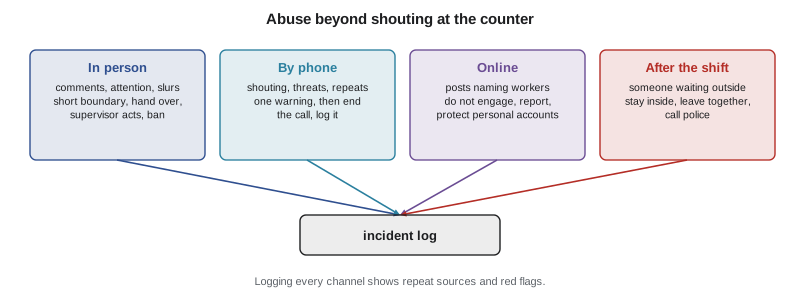
Not all customer abuse is loud. Some of it is sexual comments to a young cashier, a customer who keeps coming back to the same worker, racist remarks at the service desk, a caller who screams at the pharmacy line, or a video of a worker posted online with insults and the store's name. These behaviours can be as harmful as shouting and threats, sometimes more so, because they are targeted, repeated or public. This lesson covers harassment by customers, hate incidents, abuse by phone and online abuse, and what stores and workers can do about them. HSE-108 covers harassment and human rights law in depth.
Harassment by customers
Harassment usually means repeated or serious comments or conduct that a person knows, or should know, is unwelcome and that humiliates, intimidates or degrades. In stores it often takes the form of sexual comments, unwanted attention, asking a worker for personal information, waiting for a worker at the end of a shift, comments about appearance, race, religion, accent, disability, gender identity or sexual orientation, and persistent belittling. Younger workers and workers in their first job are often targeted, and they may not know they can say no or ask for help.
In British Columbia, the Human Rights Code prohibits discrimination and harassment related to protected grounds, and employers can be responsible for harassment of their workers by customers where they knew or should have known and did not act. WorkSafeBC's bullying and harassment policies also require employers to take steps to prevent and address bullying and harassment, including by people other than workers, through a policy, reporting and investigation procedures and training.
The practical rule is the same in both countries: when a worker reports harassment by a customer, the store must take it seriously and act. Acting can mean reassigning the worker away from that customer, having a supervisor serve the customer, speaking to the customer, banning them from the store, and in serious cases involving police. It should not mean telling the worker to ignore it, smile, or change their own shifts to avoid the customer unless they want to.
Responding in the moment
Workers who face harassing comments can use short, firm, neutral responses that set a boundary without inviting an argument, such as "Please don't speak to me like that" or "That's not appropriate; how can I help you with your purchase?" They can then hand the customer over to a co-worker or supervisor. They should not have to explain or justify their boundary. If a customer touches a worker, follows them, waits for them after a shift or makes a threat, it is a crisis-level situation: the worker should step away, tell a supervisor and, where there is risk, call police.
Stores can help by making it easy to hand over, by having a supervisor take over without question, and by walking workers to their cars or transit at the end of a shift when someone has been waiting for them. Workers should never be required to give out personal information such as their full name, schedule or social media accounts. Name tags with first names only, or a chosen name, are common for that reason.
Hate incidents
A hate incident is any behaviour motivated by hatred of a group, such as slurs, symbols, threats or harassment targeting a person's race, ethnicity, religion, sexual orientation, gender identity, disability or similar characteristics. When a hate incident is also a crime, such as an assault, a threat or damage to property, it is a hate crime, and police treat the motive as an aggravating factor. Police-reported hate crimes have risen in both countries over the past decade, and retail workers, who serve the public in visible roles, are among those affected.
Stores should treat hate incidents as serious violence and harassment incidents. Workers should not be expected to keep serving a customer who uses slurs. The customer should be served by someone else or asked to leave, the incident should be reported, and the store should consider a ban. Where there is a threat, an assault or damage, call police. Afterwards, check on the worker and any co-workers or customers who were also targeted, because hate incidents affect people beyond the person directly involved.
Abuse by phone
Customer service lines, pharmacy counters, curbside pickup and online order desks all take calls, and some callers become abusive. Workers on the phone cannot see the caller's body language and often feel they must stay on the line. Good practice is to give workers clear permission to end abusive calls. A typical policy is:
- Stay calm and try to help, using the de-escalation skills from Lesson 8.
- If the caller swears, insults or threatens, give one warning: "I want to help, but if the language continues I will end the call."
- If it continues, end the call politely: "I'm ending this call now. You're welcome to call back when we can talk respectfully."
- Log the call: time, number if shown, what was said and any threat.
- Report any threat to a supervisor right away; serious threats, such as a threat to come to the store and hurt someone, should be reported to police.
Repeated calls from the same person, or calls that target a particular worker, should be handled by a supervisor. Some stores route known abusive callers to a manager.
Abuse online
Customers sometimes film workers and post the videos online with insults or accusations, or name workers in reviews and social media posts. Some posts lead to further harassment from strangers, and in a few cases people have shared workers' personal information, such as home addresses, which is sometimes called doxxing. This can be frightening and can follow a worker outside work. Good practice for workers is:
- Do not respond to posts or comments, and do not argue with the person filming you; calmly end the interaction and get a supervisor.
- Tell your manager about any post that names you, insults you or shares personal information.
- Keep your personal social media accounts private and avoid posting where you work and your schedule.
- Take screenshots of threats before reporting them, and report threats to police.
Stores should have a process for responding: a manager who monitors and reports posts to the platform, a communications contact who handles public responses, support for the worker, and police reports for threats. Workers should not be disciplined for being filmed while following policy. Store policies on whether customers may film inside the store vary, and staff should not physically stop anyone filming.
Banning customers
Stores can ban customers who threaten, assault or harass workers. In British Columbia, the Trespass Act allows an occupier to give a person notice that they are prohibited from entering the premises, and a person who enters after notice commits an offence. A written notice, delivered in person or by mail, and a record of who was banned and why make enforcement easier. Workers should be told how to recognize a banned customer and what to do if they return, which is usually to stay away from them, tell a supervisor and call police if the person refuses to leave or is threatening.
Bans should be decided by managers, not frontline workers, and should be based on behaviour, not on who the person is. Briefings to staff should share only the information needed to stay safe, as Lesson 2 explained.
Tracking less visible abuse
Phone and online abuse often goes unreported because workers think nothing can be done. A simple log, filled in by the worker or supervisor, makes it visible and shows patterns such as repeat callers. The program below summarizes a synthetic three-month log from Northfield.
# Summarize a synthetic three-month log of phone, online and harassment incidents at Northfield.
from collections import Counter
log = [
    ("phone", "pharmacy line", "swearing", "caller A"), ("phone", "pharmacy line", "threat", "caller A"),
    ("phone", "service desk", "swearing", "caller B"), ("phone", "pharmacy line", "swearing", "caller A"),
    ("phone", "curbside", "insults", "caller C"), ("online", "review site", "names worker", "unknown"),
    ("online", "social video", "insults", "unknown"), ("online", "social video", "personal details", "unknown"),
    ("in person", "checkout 3", "sexual comments", "customer D"), ("in person", "checkout 3", "sexual comments", "customer D"),
    ("in person", "parking lot", "waiting after shift", "customer D"), ("in person", "service desk", "slurs", "customer E"),
    ("phone", "service desk", "threat", "caller F"), ("in person", "deli", "insults", "customer G"),
]
by_channel = Counter(c for c, _, _, _ in log)
print("By channel:", dict(by_channel))
repeat = {who: n for who, n in Counter(w for *_, w in log).items() if n >= 2 and who != "unknown"}
print("Repeat sources:", repeat)
red = {"threat", "personal details", "waiting after shift", "slurs"}
for c, where, what, who in log:
    if what in red:
print(f" RED FLAG: {what:<20} {c:<9} {where:<14} {who}")By channel: {'phone': 6, 'online': 3, 'in person': 5}
Repeat sources: {'caller A': 3, 'customer D': 3}
RED FLAG: threat phone pharmacy line caller A
RED FLAG: personal details online social video unknown
RED FLAG: waiting after shift in person parking lot customer D
RED FLAG: slurs in person service desk customer E
RED FLAG: threat phone service desk caller FThe log shows three things a single report would miss. Caller A has called the pharmacy line three times and once made a threat, which calls for a supervisor to handle that caller and a police report. Customer D's sexual comments at checkout 3 escalated to waiting in the parking lot after a shift, which is crisis-level: the store should ban the customer, walk the worker out, and consider a police report. And one online post shared a worker's personal details, which needs reporting to the platform and support for the worker.
For supervisors: act on the quiet reports
Workers often mention harassment in passing, as a joke or a complaint, rather than filing a report. Treat these mentions as reports. Ask what happened, ask what would help, and act: serve the customer yourself next time, arrange a walk-out after shifts, start the ban process if warranted, and record it. Check in with the worker a few days later. A worker who sees nothing happen after mentioning harassment is unlikely to mention it again.
Worked problem
A regular who will not take no for an answer
Jess, 17, works the evening checkout at Northfield. A regular customer has been making comments about her appearance for two weeks, asks which shifts she works and last night was standing by the staff entrance when she left. She mentions it to Sam as she clocks in, laughing it off. What should Sam do?
Show solution
- Take it seriously. Waiting near the staff entrance is crisis-level behaviour, and Jess is a young worker.
- Thank Jess for telling him, ask what happened and what would help, and tell her she does not have to serve this customer.
- Arrange for Jess to be walked to her ride or transit after every shift, and remind staff not to share schedules.
- Involve the store manager to issue a ban and notice, brief the front-end team privately and record the incident.
- Consider a police report given the waiting behaviour, and check in with Jess over the next week.
Answer: This is serious harassment with signs of stalking. Sam should act immediately to protect Jess, involve the manager in a ban and record and report it, not wait for Jess to file a formal complaint.
Common mistakes
MistakeTelling a worker to smile and ignore a customer’s sexual comments.
InsteadTake it seriously, hand over the customer and act to stop the harassment.
MistakeRequiring workers to stay on the line with an abusive caller.
InsteadAllow a warning and then ending the call, and log it.
MistakeArguing with a customer who is filming and insulting a worker.
InsteadEnd the interaction calmly, get a supervisor, and report any posts.
MistakeLeaving a frontline worker to decide whether to ban a customer.
InsteadManagers decide bans based on behaviour and give written notice.
MistakeTreating slurs as an ordinary complaint.
InsteadTreat hate incidents as serious, stop service, report and call police for threats or crimes.
Summary and key terms
- Harassment by customers includes sexual comments, unwanted attention, slurs and persistent belittling; young workers are often targeted.
- BC’s Human Rights Code and WorkSafeBC policy make employers responsible for acting on harassment by customers.
- Workers can set short, firm boundaries and hand over; touching, following or waiting after shifts is crisis-level.
- Hate incidents are serious; stop service, report, and call police for threats or crimes.
- Allow a warning and then ending abusive calls, and log them.
- For online abuse, do not engage, report to the manager and platform, protect personal accounts and report threats.
- Managers can ban customers with notice under the Trespass Act; brief staff only as needed.
- Harassment
- Unwelcome comments or conduct that humiliate, intimidate or degrade a person.
- Third-party harassment
- Harassment of a worker by someone who is not an employee, such as a customer.
- Hate incident
- Behaviour motivated by hatred of a group based on a characteristic such as race or religion.
- Hate crime
- A criminal offence motivated by hatred of a group.
- Doxxing
- Publishing someone’s personal information, such as a home address, without consent.
- Trespass notice
- A notice telling a person they are not allowed to enter or remain on the premises.
Practice problems
Work each problem on paper first, then reveal the answer to check.
Give three forms of customer harassment common in stores.
Show answer
Any three of: sexual comments, unwanted attention, asking for personal information, waiting after shifts, slurs, belittling.
When can an employer be responsible for harassment by a customer?
Show answer
When it knew or should have known and did not take appropriate action.
Give an example of a short boundary-setting response.
Show answer
For example: please don’t speak to me like that; how can I help with your purchase?
What is the difference between a hate incident and a hate crime?
Show answer
A hate crime is a criminal offence motivated by hatred; a hate incident may not be a crime.
Describe a typical policy for abusive calls.
Show answer
Try to help, give one warning, end the call if it continues, log it and report threats.
Give two things workers can do to protect themselves from online abuse.
Show answer
Any two of: do not engage, tell the manager, keep accounts private, avoid posting schedules, screenshot and report threats.
Who should decide to ban a customer?
Show answer
A manager, based on behaviour, with written notice.
In the log example, why was customer D crisis-level?
Show answer
Sexual comments escalated to waiting in the parking lot after a worker’s shift.
Lesson quiz · 5 questions
Score 60% or more to complete this lesson.
Create a free account to save your progress, take quizzes and earn a certificate.