
HSE-341 · Lesson 2 of 12 · 24 min
Law, duties and violence prevention programs
Robbery and customer aggression are not just bad luck. In both countries, the law treats violence from the public as a workplace hazard that employers must assess and control, the same way they must deal with wet floors or unguarded machines. This lesson explains the main legal duties that apply to stores, the parts of a violence prevention program, and the roles of the employer, supervisors, workers and the safety committee. HSE-108 covers violence and harassment law in depth for every kind of workplace; here we focus on what it means for a store like Northfield Market.
The general duty
Every province and territory has an occupational health and safety act that requires employers to take every reasonable precaution to protect the health and safety of workers. That general duty applies to violence from customers and members of the public even where no specific rule names it. On top of the general duty, most provinces now have specific violence rules. They differ in detail, but the core pattern is the same: assess the risk, put controls and procedures in place, inform and train workers, and respond to incidents.
The rules where Northfield operates
British Columbia's Occupational Health and Safety Regulation has a set of violence sections in Part 4. Section 4.27 defines violence for those sections as the attempted or actual exercise of physical force by a person other than a worker that can cause injury, including threatening statements or behaviour that give a worker reasonable cause to believe they are at risk of injury. Section 4.28 requires a risk assessment wherever a risk of injury from violence arising out of employment may be present, taking into account previous experience at the workplace, experience in similar workplaces and the location and circumstances of the work. Section 4.29 requires procedures and policies to eliminate the risk or, where that is not possible, to minimize it. Section 4.30 requires the employer to inform workers about the nature and extent of the risk and to instruct them in recognizing it, the procedures and controls in place, how to respond and how to report. Section 4.31 requires that workers who report injury or adverse symptoms from violence be advised to consult a physician of their choice.
Reporting and investigation follow the Workers Compensation Act. Employers must do a preliminary investigation as soon as possible after an incident that injures a worker or could have, and a full investigation with a report to WorkSafeBC within 30 days. Bullying and harassment are covered by separate WorkSafeBC policies that require employers to have a policy, procedures for reporting and investigating, and training. Late-night retail premises have additional working alone rules, known as Grant's Law after Grant De Patie, a 24-year-old gas station attendant killed in Maple Ridge in 2005. HSE-352 covers those rules in detail.
Other examples worth knowing
Rules elsewhere show the range of approaches and are useful for stores that operate in more than one place.
- Ontario: Bill 168, in force since 2010, amended the Occupational Health and Safety Act to require employers to have workplace violence and harassment policies, assess the risk of workplace violence, develop a program to control it, and provide information about a person with a history of violent behaviour where workers are likely to encounter that person. Later amendments strengthened the harassment duties.
- Alberta, Saskatchewan, Manitoba and other provinces: all have violence and harassment requirements built around hazard assessment, prevention plans, training and incident response, with details that differ.
- Federally regulated workplaces: the Canada Labour Code and its Work Place Harassment and Violence Prevention Regulations (2021) apply to banks, airports and similar workplaces, not to most stores, but they are a well-developed model.
- Criminal law: section 217.1 of the Criminal Code makes it a duty for anyone who directs work to take reasonable steps to prevent bodily harm to workers. HSE-108 explains how it applies.
The parts of a violence prevention program
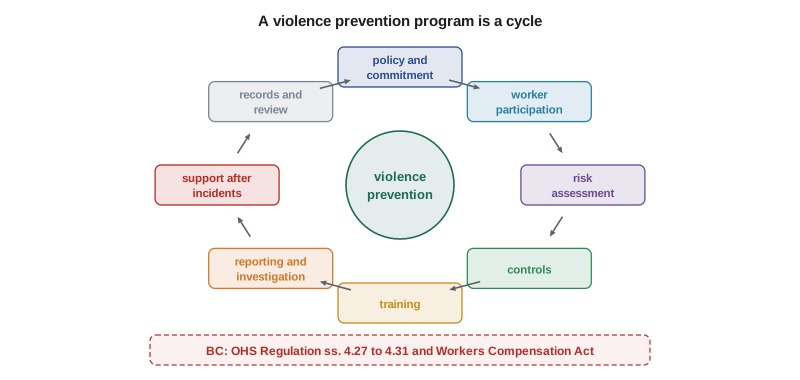
Whatever the jurisdiction, a good program for a store has the same building blocks. HSE-108 describes them for workplaces in general. In retail they look like this:
| Element | What it means in a store | Northfield example |
|---|---|---|
| Management commitment and policy | A written policy, signed by senior management, that says violence and abuse are not accepted and workers will be supported | Policy posted in the break room and at each desk; reviewed each year |
| Worker participation | Workers and the safety committee help identify risks, choose controls and review incidents | Front-end and customer service workers sit on a working group with the committee |
| Risk assessment | A written assessment of where, when and how violence may happen, using incident history and a walk-through | Lesson 12 shows the assessment for Riverside Corner Market |
| Prevention controls | Store design, cash handling, staffing, procedures and policies that reduce the risk | Lowered cash limits, clear sightlines at the service desk, two people at close |
| Training | Robbery response, de-escalation, refusals and reporting, at hire and regularly | Training at hire and every year, with short refreshers at team huddles |
| Reporting and investigation | A quick, safe way to report every incident, and a process to look into them | A one-page form and a QR code; supervisor follow-up within 24 hours |
| Support after incidents | First aid, medical care, time off, counselling and follow-up | Employee and family assistance program and a check-in at 1, 7 and 30 days |
| Records and review | Logs, investigation reports and an annual review of the whole program | Committee reviews the log quarterly and the program each year |
Hierarchy of controls applied to violence
The hierarchy of controls used for physical hazards also works for violence, with some adjustments. Elimination might mean not handling cash at a particular desk, or not opening a stand-alone kiosk late at night. Substitution might mean switching to cashless payment at self-checkouts or selling high-value items from locked cases. Engineering controls include store layout, sightlines, lighting, barriers, time-delay safes, cameras and alarm systems. Administrative controls include staffing levels, cash limits, procedures for refusals and returns, opening and closing routines and training. Personal protective equipment has a small role in retail; for security staff it may include protective vests or gloves, but for most store workers the main personal control is a way to call for help quickly, such as a radio, a personal alarm or a silent response button.
As with other hazards, controls higher up the list are more reliable because they do not depend on a worker doing the right thing under stress. Training in de-escalation is valuable, but it works best when the store design and procedures have already reduced the number of tense situations workers face.
Roles and responsibilities
The employer is responsible for the program: assessing risk, providing controls and training, keeping records and making sure incidents are followed up. Supervisors put the program into practice on each shift. They make sure staffing and cash limits are followed, back up workers in difficult interactions, take reports seriously, make sure injured or shaken workers get care, and pass information up the chain. Workers follow procedures, report incidents and concerns, take part in training and use the tools provided, such as alarms and radios. They also have the right to refuse work they reasonably believe is dangerous, which can include being sent alone to deal with a threatening person.
The joint health and safety committee (or worker representative in a smaller workplace) takes part in risk assessments, reviews incident reports and investigations, and recommends improvements. In British Columbia, workplaces with 20 or more workers need a committee and those with 10 to 19 need a representative, and the committee should see violence incident reports along with other injury reports.
Information about people with a history of violence
Some laws require employers to tell workers about a person with a known history of violence whom they are likely to meet at work, sharing only the information needed to protect them. In a store this might be a customer who has been banned after assaulting a worker, or a person subject to a no-trespass notice. A short, private briefing for affected staff, with a description and what to do if the person returns, meets the need without broadcasting personal information. Privacy law still applies, so the store should share only what workers need to stay safe and keep records secure.
A simple program gap check
A quick way to see where a store stands is to score each program element on a simple scale and look for the gaps. The program below does that for Northfield using the elements in the table. Scores are Marco's judgment from his first review: 0 means missing, 1 partly in place and 2 fully in place.
# Violence prevention program gap check for Northfield Market (Kamloops).
# Scores: 0 = missing, 1 = partly in place, 2 = fully in place (Marco's first review).
elements = {
    "Written policy (s. 4.29)": 2,
    "Risk assessment (s. 4.28)": 1,
    "Procedures and controls (s. 4.29)": 1,
    "Worker instruction (s. 4.30)": 1,
    "Advice to see a physician (s. 4.31)": 0,
    "Reporting and investigation (WCA)": 1,
    "Support after incidents": 1,
    "Committee review and annual review": 0,
}
total = sum(elements.values()); best = 2 * len(elements)
print(f"Program score: {total} of {best} ({100 * total / best:.0f}%)")
for name, s in sorted(elements.items(), key=lambda kv: kv[1]):
    flag = "GAP" if s == 0 else ("partial" if s == 1 else "ok")
    print(f"  {s}  {flag:<7} {name}")
gaps = [n for n, s in elements.items() if s == 0]
print("Fix first:", "; ".join(gaps))Program score: 7 of 16 (44%) 0 GAP Advice to see a physician (s. 4.31) 0 GAP Committee review and annual review 1 partial Risk assessment (s. 4.28) 1 partial Procedures and controls (s. 4.29) 1 partial Worker instruction (s. 4.30) 1 partial Reporting and investigation (WCA) 1 partial Support after incidents 2 ok Written policy (s. 4.29) Fix first: Advice to see a physician (s. 4.31); Committee review and annual review
Northfield scores about half. It has a policy, but the risk assessment is out of date, procedures exist only for some desks, training is inconsistent, injured workers are not routinely advised to see a doctor, and nobody reviews the program as a whole. The gaps are typical. Many stores have a policy written by head office but little behind it at the store level. The rest of this course fills those gaps one at a time.
For supervisors: what the law expects of you on a shift
You do not need to memorize section numbers. You do need to know that violence is a recognized hazard in your store, that procedures exist for robbery, refusals and aggressive customers, and that you are expected to follow them and make sure your team does. On each shift, check staffing against the plan, check that cash limits are being followed, know where the alarms are, back up workers who are dealing with difficult customers, and take every report seriously. If a worker is hurt or badly shaken, make sure they get care and that the incident is reported and investigated.
Worked problem
Answering a worker’s question
Rosa, a cashier, asks Sam, the front-end supervisor, whether the store is actually required to do anything about customers who swear at staff, or whether it is just company policy. What should Sam tell her?
Show solution
- Explain that the law treats violence and threats from customers as a workplace hazard, and BC's regulation requires a risk assessment, procedures, instruction and reporting.
- Explain that bullying and harassment, including abusive behaviour that is not a threat, is covered by WorkSafeBC policy and the store's harassment policy.
- Tell her she should report the incident, and show her the form.
- Tell her what the store does with reports: the committee reviews them, and patterns lead to changes such as staffing or desk layout.
- Remind her she can step away from an abusive customer and call for backup.
Answer: It is not just policy. The law requires the store to assess and control the risk of violence, and the store's program depends on workers reporting incidents like this one.
Common mistakes
MistakeAssuming there is no legal duty because no rule mentions robbery or customers by name.
InsteadThe general duty and specific violence rules cover violence from the public as a workplace hazard.
MistakeHaving a head office policy but no store-level risk assessment or procedures.
InsteadAssess the risk at each store and put procedures in place for its desks, hours and layout.
MistakeRelying on de-escalation training as the main control.
InsteadUse design, cash handling, staffing and procedures first; training supports them.
MistakeKeeping violence reports away from the safety committee.
InsteadShare reports with the committee so patterns are reviewed and controls improved.
MistakeTelling all staff everything about a banned customer’s history.
InsteadShare only what affected workers need to stay safe, privately, and keep records secure.
Summary and key terms
- Violence from customers and the public is a workplace hazard employers must assess and control.
- BC requires a risk assessment (s. 4.28), procedures (s. 4.29), worker instruction (s. 4.30) and advice to see a physician (s. 4.31).
- Incidents are investigated under the Workers Compensation Act, and late-night retail has extra rules covered in HSE-352.
- A program has eight parts: policy, participation, risk assessment, controls, training, reporting, support and review.
- The hierarchy of controls applies; design, cash handling and staffing come before training.
- Employers, supervisors, workers and the joint committee each have defined roles.
- Share information about people with a history of violence only as needed to protect workers.
- General duty
- The broad legal duty on employers to protect workers from hazards, including those not named in specific rules.
- Violence prevention program
- The written policy, assessment, controls, training, reporting and review that manage the risk of violence.
- Risk assessment
- A structured look at where, when and how violence could occur and how likely and serious it would be.
- Hierarchy of controls
- The ranking of controls from elimination to personal protective equipment, most to least reliable.
- Silent response button
- A discreet device a worker can use to summon help without alerting the aggressor.
- Safety committee
- A group of worker and employer members that reviews hazards, incidents and the safety program.
Practice problems
Work each problem on paper first, then reveal the answer to check.
What does section 4.28 of the BC regulation require?
Show answer
A risk assessment wherever a risk of injury from violence arising out of employment may be present.
What must workers be told and taught under section 4.30?
Show answer
The nature and extent of the risk, how to recognize it, the procedures and controls, how to respond and how to report.
What must happen when a worker reports injury or symptoms from violence?
Show answer
They must be advised to consult a physician of their choice (s. 4.31).
Name the eight elements of a violence prevention program.
Show answer
Policy and commitment, worker participation, risk assessment, controls, training, reporting and investigation, support after incidents, records and review.
Give one example each of elimination and engineering controls for robbery.
Show answer
Elimination: no cash at a desk or not opening late. Engineering: sightlines, lighting, time-delay safes, cameras or alarms.
When does a BC workplace need a joint committee?
Show answer
With 20 or more workers; 10 to 19 need a worker representative.
What did Ontario’s Bill 168 require?
Show answer
Violence and harassment policies, a violence risk assessment, a program, and information about people with a history of violence.
Who is Grant’s Law named after?
Show answer
Grant De Patie, a gas station attendant killed in Maple Ridge in 2005.
Lesson quiz · 5 questions
Score 60% or more to complete this lesson.
Create a free account to save your progress, take quizzes and earn a certificate.