
HSE-341 · Lesson 4 of 12 · 26 min
Designing a safer store
The layout of a store, the view from outside, the lighting and the way people move through the building all affect how attractive it is to a robber and how safe workers feel. Changing them is often the most reliable way to reduce risk, because a good layout keeps working on every shift without anyone having to remember to do anything. This lesson applies crime prevention through environmental design (CPTED) to stores. HSE-108 introduces environmental design for workplaces in general; here we look at counters, windows, lighting, cameras, barriers and alarms in a retail setting.
The CPTED principles
CPTED (usually pronounced sep-ted) grew out of work by criminologists and architects in the 1970s showing that the design of places affects crime. Its principles are widely used by police services, municipalities and retailers in both countries. Four of them are most useful in a store:
- Natural surveillance: arrange the space so that people can see and be seen. Clear windows, open sightlines across the sales floor, counters placed where staff can see the door and passers-by can see the counter, and good lighting all increase the chance that a crime will be noticed.
- Natural access control: guide people into and out of the store along clear routes, and limit access to back rooms, offices and the cash area. One clear entrance, controlled staff doors and a counter that separates the public from the cash all help.
- Territorial reinforcement: show that the space is cared for and owned. Clean, well-kept stores with clear signage and staff who greet customers send the message that someone is paying attention.
- Maintenance: keep it that way. Burnt-out lights, overgrown landscaping, graffiti and clutter signal that nobody is watching and undo the other principles over time.
CPTED works best as a combination. A counter with a clear view of the door does little if the window is covered with posters, and good lighting does little if the lights are left broken for weeks.
Greeting customers
One of the simplest and most effective measures costs nothing: greet every customer who comes in, make brief eye contact and speak to them. Greeting tells an honest customer they are welcome. It also tells a person thinking about robbery or theft that they have been noticed and could be described later. Many retailers train staff to greet within a few seconds of someone entering, and some position a worker near the entrance at busy times for that reason. Greeting should be friendly and natural, not suspicious or confrontational.
Windows and the view from outside
The view from outside into the cash area is one of the most important features of a store. Police and researchers recommend keeping windows clear of posters, displays and dark tinting so that the counter can be seen from the street and the parking lot. Florida's Convenience Business Security Act, for example, requires that window signs leave a clear view of the cash register and sales area from outside and prohibits tinting that blocks the view. Many retailers set a rule that window signs may cover only a limited share of the glass, placed high or low, so the middle band around the counter stays clear.
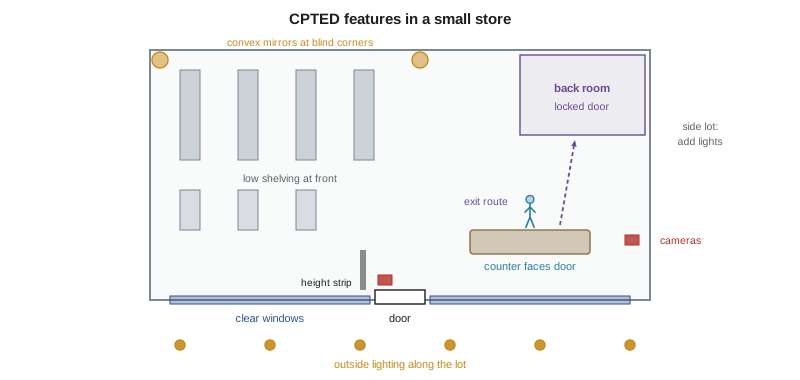
Inside, low shelving near the front of the store, convex mirrors at blind corners and displays kept below eye level near the counter all improve the view. The goal is that a worker at the counter can see the door and most of the front of the store, and that a person entering can see that the worker is visible to the outside.
Counter position and design
Where the counter sits and how it is built affect both robbery risk and how safe the worker is if a robbery happens. Good practice includes:
- Place the counter near the front, visible from outside, with the worker facing the door rather than with their back to it.
- Raise the counter floor slightly and make the counter wide enough that a customer cannot easily reach across or jump over.
- Give the worker a clear route away from the counter to a back room or exit that does not pass the customer.
- Keep the register and cash out of reach of the customer side, and keep back-up cash out of sight.
- Make sure the worker cannot be trapped behind the counter by a single person standing at the opening.
Barriers such as bullet-resistant enclosures or pass-through windows are used in some high-risk late-night stores, and some laws allow them as an option for late-night shifts. They reduce injury risk in a robbery but change how the store feels and how workers interact with customers. HSE-352 discusses them in the context of late-night convenience and fuel sales.
Lighting
Good lighting inside and outside makes it easier for staff to see who is coming, for passers-by and police to see in, and for cameras to record useful images. It also helps workers feel safer during opening and closing. Parking lots, entrances, side lots, garbage areas and the path to staff cars all need attention, and lights should be on timers or sensors so that they are on whenever the store is open and during opening and closing routines.
Some rules set minimum levels. Florida's convenience store law requires parking lot lighting of at least 2 foot-candles (about 20 lux) measured at 18 inches (about 46 cm) above the surface. Lighting design guidance from the Illuminating Engineering Society gives more detailed recommendations for parking areas and building entrances. A store that wants to check its own lighting can use a basic light meter, or a phone app as a rough guide, and compare readings to targets set with an electrician or lighting designer. The program below compares a set of readings to illustrative targets. The targets are examples for teaching, not code requirements.
# Compare light meter readings at Riverside Corner Market with illustrative targets (lux).
# Targets are teaching examples, not code requirements; set real targets with a lighting designer.
targets = {"entrance": 100, "front lot": 30, "side lot": 20, "path to staff parking": 20, "garbage area": 20}
readings = {
    "entrance":              [140, 155, 120],
    "front lot":             [42, 35, 18, 51, 38],
    "side lot":              [6, 3, 9, 14, 2],
    "path to staff parking": [12, 25, 8],
    "garbage area":          [4, 7],
}
for area, vals in readings.items():
    avg, low = sum(vals) / len(vals), min(vals)
    ok = avg >= targets[area]
    uniform = avg / low if low else float("inf")
    print(f"{area:<22} avg {avg:6.1f} lux  min {low:4d}  target {targets[area]:4d}  "
f"{'meets' if ok else 'BELOW'} avg/min {uniform:.1f}")entrance avg 138.3 lux min 120 target 100 meets avg/min 1.2 front lot avg 36.8 lux min 18 target 30 meets avg/min 2.0 side lot avg 6.8 lux min 2 target 20 BELOW avg/min 3.4 path to staff parking avg 15.0 lux min 8 target 20 BELOW avg/min 1.9 garbage area avg 5.5 lux min 4 target 20 BELOW avg/min 1.4
The entrance and front lot are fine on average, although one reading in the front lot is low. The side lot, the path to staff parking and the garbage area all fall well below the targets, and the side lot is also very uneven: the ratio of average to minimum shows bright and dark patches. Uneven lighting can be worse than uniformly modest lighting, because eyes adjusted to a bright area cannot see into the dark patches. Riverside's priorities are the side lot and the route staff use at closing.
Cameras and monitors
Cameras serve three purposes in a store: they deter some offenders, they record events for police and investigations, and they let staff see areas they cannot see directly. Deterrence depends on offenders noticing the cameras and believing the images will be used, which is why many stores place a public-view monitor near the entrance showing the person entering. Recording quality depends on camera placement and lighting; a camera mounted high and far away may show that a robbery happened without showing a usable face. Height strips by the door help witnesses and cameras estimate height.
Placement should cover the entrance and exit, the counter and register, the cash office and safe, the parking lot and any back doors. Cameras should be maintained, recordings kept for a set period, and access controlled. Privacy laws apply: signs should tell people that cameras are in use, cameras should not be placed in washrooms or change rooms, and recordings should be used only for the stated purposes. Video surveillance of workers is subject to privacy and labour rules that the store's privacy officer should review.
Camera coverage can be checked on a simple floor plan. The program below divides Riverside's sales floor into a grid, marks shelving as blocking, and counts how much of the open floor each camera can see along straight lines. It is a rough check; a real survey looks at the actual images.
# Rough camera coverage check on a grid floor plan of Riverside Corner Market.
# '#' = shelving that blocks the view, '.' = open floor. Each cell is about 1 m (3 ft).
plan = [
    "................",
    ".##.##.##.##....",
    ".##.##.##.##....",
    ".##.##.##.##....",
    "................",
    ".##.##.##.##....",
    ".##.##.##.##....",
    "................",
]
R, Cc = len(plan), len(plan[0])
def visible(cam, cell):
    (r0, c0), (r1, c1) = cam, cell
    steps = max(abs(r1 - r0), abs(c1 - c0)) * 4 or 1
    for k in range(1, steps):
        r = r0 + (r1 - r0) * k / steps; c = c0 + (c1 - c0) * k / steps
        if plan[round(r)][round(c)] == "#":
            return False
    return True
open_cells = [(r, c) for r in range(R) for c in range(Cc) if plan[r][c] == "."]
def coverage(cams):
    seen = {cell for cell in open_cells for cam in cams if visible(cam, cell)}
    return len(seen) / len(open_cells), seen
for name, cams in {"counter camera only": [(7, 15)],
                   "counter + back corner": [(7, 15), (0, 0)],
                   "counter + back corner + middle aisle": [(7, 15), (0, 0), (4, 0)]}.items():
    frac, seen = coverage(cams)
    print(f"{name:<36} sees {frac:5.1%} of open floor")
frac, seen = coverage([(7, 15), (0, 0), (4, 0)])
for r in range(R):
print(" " + "".join("#" if plan[r][c] == "#" else ("o" if (r, c) in seen else "x") for c in range(Cc)))counter camera only sees 51.1% of open floor counter + back corner sees 71.6% of open floor counter + back corner + middle aisle sees 83.0% of open floor oooooooooooooooo o##x##x##x##oooo o##x##x##x##oooo o##x##x##x##oooo oooooooooooooooo o##x##x##x##oooo o##x##x##x##oooo oooooooooooooooo
A single camera at the counter sees only part of the floor, because the shelving blocks the aisles. Adding a camera in the back corner raises coverage substantially, and a third at the end of the middle cross-aisle raises it further. The final map marks seen cells with o and blind cells with x, which shows where a mirror or a change in shelving would help. The same method works for staff sightlines: a worker standing at the counter is in effect a camera, and the map shows what they can and cannot see.
Alarms and ways to call for help
Workers need a quick, discreet way to call for help. Options include hold-up or panic alarms connected to a monitoring company or police, silent response buttons that alert managers or security inside the store, personal alarms, radios and phones. The right choice depends on the store's size and risk. An alarm is only useful if workers know where it is, can reach it without being seen, and know when to use it. During a robbery, the safest time to activate a silent alarm is usually after the robber has left, or only if it can be done without any visible movement (Lesson 6). False alarms should be reviewed rather than punished, so that workers are not afraid to use the system.
Access control and back rooms
Back doors, delivery doors, offices and stockrooms should be locked from the outside and opened only with a reason. A common robbery pattern involves a person knocking at the back door after dark or waiting for a worker taking out garbage. Good practice includes peepholes or cameras at delivery doors, a rule that delivery doors are not opened after dark unless a delivery is expected and the driver can be identified, garbage runs done in daylight or by two people, and an office door that is closed and locked when cash is being counted. Doors propped open for airflow or convenience undo all of these controls.
Maintenance and review
Every CPTED feature degrades over time. Posters creep back onto windows, light fixtures fail, cameras are knocked out of position, mirrors are removed during a reset, landscaping grows over sightlines. A short monthly checklist covering windows, lights, cameras, mirrors, locks and alarms keeps the design working. Changes such as a store reset, new displays or a renovation are good times to review the layout with CPTED in mind. Local police services in many areas offer free CPTED assessments for businesses.
For supervisors: a five-minute CPTED check
At the start of an evening shift, stand outside the store and look in. Can you see the counter and the worker? Are any outside lights out? Walk to the counter and look out. Can you see the door and the front of the store? Check that the back door is locked, the office door closed and the alarm or radio within reach. Fix what you can, report the rest and write it down. Five minutes a shift keeps the store's design doing its job.
Worked problem
Redesigning Northfield’s customer service desk
Northfield's customer service desk sits in a corner behind the self-checkouts. The worker stands with their back to a wall of lottery displays, the desk is low enough to lean over, the cash drawer is visible from the customer side and the only way out from behind the desk is past the customer counter. The attempted robbery happened here. How could the desk be redesigned using CPTED?
Show solution
- Natural surveillance: move or lower the displays between the desk and the front doors so that the desk can be seen from the entrance and the front checkouts.
- Counter design: raise and deepen the counter so it cannot be leaned across, and move the cash drawer out of sight of the customer side.
- Access control: add a second exit from behind the desk to the back corridor so the worker does not have to pass customers to leave.
- Cameras: add a camera aimed at the desk and a public-view monitor near the self-checkouts.
- Alarm: install a silent response button reachable without visible movement and train desk staff on when to use it.
Answer: A visible desk with a deeper counter, hidden cash, a second exit, a camera and a discreet alarm addresses visibility, reward, access and the worker's escape.
Common mistakes
MistakeCovering the front windows with sale posters.
InsteadKeep a clear band of glass so the counter can be seen from outside.
MistakePlacing the counter so the worker has their back to the door.
InsteadFace the counter toward the entrance and give the worker an exit route that does not pass customers.
MistakeMounting cameras high and far away so they only show the tops of heads.
InsteadPlace cameras to capture faces at the door and counter, with good lighting and a height strip.
MistakeLeaving burnt-out outside lights for weeks.
InsteadCheck lights at each evening shift and fix them promptly.
MistakePropping the back door open for airflow.
InsteadKeep delivery doors locked and open them only for expected, identified deliveries.
Summary and key terms
- CPTED uses natural surveillance, access control, territorial reinforcement and maintenance to reduce crime.
- Greeting every customer is a simple, effective deterrent.
- Clear windows and low displays let people outside see the counter.
- Counters should face the door, resist reaching across and give the worker a safe exit.
- Lighting inside and out should be adequate and even; check it against targets.
- Cameras deter, record and extend sightlines; place them for faces and respect privacy rules.
- Discreet alarms, locked back doors and regular maintenance keep the design working.
- CPTED
- Crime prevention through environmental design: designing places to reduce opportunities for crime.
- Natural surveillance
- Arranging a space so that people can easily see and be seen.
- Natural access control
- Using layout, doors and counters to guide and limit where people can go.
- Territorial reinforcement
- Showing that a space is cared for and watched over.
- Public-view monitor
- A screen near the entrance showing camera images of people entering.
- Height strip
- A marked scale beside a door that helps witnesses and cameras estimate a person’s height.
- Silent alarm
- An alarm that alerts help without making a noise at the store.
Practice problems
Work each problem on paper first, then reveal the answer to check.
Name the four CPTED principles used in this lesson.
Show answer
Natural surveillance, natural access control, territorial reinforcement and maintenance.
Why is greeting customers a robbery control?
Show answer
It tells a would-be offender they have been noticed and could be described later.
Where should the counter face?
Show answer
Toward the entrance, visible from outside.
What minimum parking lot lighting does Florida’s convenience store law set?
Show answer
At least 2 foot-candles (about 20 lux) measured 18 inches above the surface.
Why can uneven lighting be a problem?
Show answer
Eyes adjusted to bright areas cannot see into dark patches.
Give three places cameras should cover.
Show answer
Any three of: entrance and exit, counter and register, cash office and safe, parking lot, back doors.
When is it usually safest to activate a silent alarm during a robbery?
Show answer
After the robber has left, or only if it can be done without visible movement.
Give two back-door rules that reduce robbery risk.
Show answer
Any two of: keep it locked, do not open after dark unless a delivery is expected and identified, garbage runs in daylight or in pairs, use a peephole or camera.
Lesson quiz · 5 questions
Score 60% or more to complete this lesson.
Create a free account to save your progress, take quizzes and earn a certificate.