
HSE-341 · Lesson 5 of 12 · 24 min
Cash handling, staffing and procedures that deter
Store design changes how a store looks to a robber. Procedures change what a robber would actually get and how likely they are to succeed. Keeping little cash at the counter, staffing high-risk times properly and running opening, closing and deposit routines in a careful, unpredictable way are among the most effective robbery controls, and they also reduce the chance that a theft or argument turns violent. This lesson covers those procedures at the level a store worker and supervisor need. It describes what deters robbery, not how security systems work in detail.
Why cash limits work
Robbery is driven by reward. When a store keeps only a small amount of cash in each register and makes that obvious, the expected reward falls and the store becomes less attractive. Cash limits also reduce what is lost if a robbery does happen and make the event shorter, which lowers the risk to workers. Most retailers set a maximum amount per register and per desk, with lower limits at night, and require a drop to the safe as soon as the limit is reached. Signs at the entrance and counter tell customers that staff have little cash and cannot open the safe.
Florida's Convenience Business Security Act, which has been in force since 1990, is a well-known example of law built around these ideas. It requires convenience businesses to post a sign stating that the register holds $50 or less, to have a drop safe or similar cash management device, to keep a written policy limiting cash on hand after 11 p.m., and to have cameras, a silent alarm, lighting and clear windows. British Columbia's late-night retail rules take a different route, focusing on staffing, barriers and, since 2012, the option of timed-lock safes and video surveillance; HSE-352 covers them.
Safes and signage
Drop safes let workers deposit cash without being able to take it back out. Time-delay safes and timed-lock safes add a waiting period before they can be opened, which means a robber cannot get quick access to the store's main cash. Pharmacies use similar time-delay safes for opioids and other targeted drugs, and several pharmacy chains in both countries reported fewer pharmacy robberies after introducing them. The protection depends on two things: the safe being used consistently, and signs making it clear that staff cannot open it quickly. Staff should never be expected to try to open a safe faster or to explain how it works.
Signage should be simple and visible at the entrance and the counter, for example: staff cannot open the safe; registers hold limited cash; this store is monitored by cameras. Signs that promise things the store does not do, such as cameras that are not installed, undermine trust and can create legal problems.
Keeping register cash low in practice
Cash builds up faster than people expect, especially at the customer service desk and during busy periods. Good practice includes setting clear limits for each register and desk, prompting workers when the register reaches the limit (many point-of-sale systems can do this), keeping large bills under the drawer tray or dropping them immediately, encouraging card payments, keeping lottery and money transfer cash separate and dropping it often, and never counting cash in view of customers.
The program below checks a week of synthetic register readings at Northfield's customer service desk against its limits. It counts how often the limit was exceeded and for how long, which is a useful leading measure for the program.
# Cash-on-hand compliance at a customer service desk from synthetic readings (invented data).
# Readings every 30 minutes; day limit $600 until 18:00, evening limit $300 after.
import random
random.seed(7)
DAY, EVE = 600, 300
over = {}
total_checks = breaches = 0
by_period = {"day": 0, "evening": 0}
for day in ["Mon","Tue","Wed","Thu","Fri","Sat","Sun"]:
    cash, longest, run = 150, 0, 0
    for half in range(16, 44):          # 08:00 to 21:30
        hour = half / 2
        cash += random.randint(10, 70) + (40 if day in ("Fri", "Sat") and hour >= 17 else 0)
        limit = DAY if hour < 18 else EVE
        total_checks += 1
        if cash > limit:
            breaches += 1; run += 1; longest = max(longest, run)
            by_period["day" if hour < 18 else "evening"] += 1
            if random.random() < 0.6:   # drop made on most checks once over the limit
                cash = 120; run = 0
        else:
            run = 0
    over[day] = longest
print(f"Checks: {total_checks}  Over limit: {breaches} ({100 * breaches / total_checks:.0f}%)")
print(f"  breaches before 18:00: {by_period['day']}, after 18:00: {by_period['evening']}")
for d, l in over.items():
    print(f"  {d}: longest run over limit = {l * 30} minutes")
print("Worst day:", max(over, key=over.get))Checks: 196 Over limit: 27 (14%) breaches before 18:00: 11, after 18:00: 16 Mon: longest run over limit = 30 minutes Tue: longest run over limit = 30 minutes Wed: longest run over limit = 30 minutes Thu: longest run over limit = 30 minutes Fri: longest run over limit = 60 minutes Sat: longest run over limit = 120 minutes Sun: longest run over limit = 30 minutes Worst day: Sat
In this synthetic week, the desk was over its limit on 27 of 196 checks (14%), and on Friday and Saturday evenings the cash stayed over the limit for an hour or more, two hours on Saturday. Most breaches (16 of 27) happened after 6 p.m., when the limit drops while sales continue. That points to a specific fix: a scheduled drop just before the evening limit takes effect and a point-of-sale prompt, rather than a general reminder to everyone about cash limits.
Staffing for safety
Staffing affects robbery risk, the risk that an argument escalates, and the ability to follow procedures. The aim is to avoid situations where one worker is alone at a high-risk desk or in the store at high-risk times, and to make sure there is always someone who can back up a worker in a tense interaction.
- Schedule at least two people during opening, closing and late evening, and at high-risk desks such as the customer service desk in the evening.
- Plan breaks so that they do not leave one worker alone at the front during busy or high-risk periods.
- Avoid sending a worker to the back for long tasks when only two people are on shift in the evening.
- Give workers at isolated desks a radio or other way to call for backup, and make sure someone is assigned to respond.
- Check staffing against the plan at the start of each shift, and escalate when callouts leave a gap.
Coverage can be checked against the schedule. The program below compares Riverside Corner Market's evening schedule with a rule of at least two workers on the floor after 8 p.m. and reports the gaps, including those caused by breaks.
# Check Riverside Corner Market's evening schedule against a two-on-the-floor rule after 20:00.
# Times are in quarter hours. Breaks take a worker off the floor. Data are invented.
def q(t):  # "20:30" -> quarter-hour index
    h, m = map(int, t.split(":")); return h * 4 + m // 15
shifts = {"Jordan": ("14:00", "22:00", [("18:00", "18:30")]),
          "Mei":    ("17:00", "24:00", [("21:15", "21:45")]),
          "Tariq":  ("20:00", "24:00", [("22:30", "22:45")])}
start, end = q("20:00"), q("24:00")
gaps = []
for t in range(start, end):
    on = 0
    for name, (s, e, breaks) in shifts.items():
        if q(s) <= t < q(e) and not any(q(b0) <= t < q(b1) for b0, b1 in breaks):
            on += 1
    if on < 2:
        gaps.append((t, on))
def hm(t): return f"{t // 4:02d}:{(t % 4) * 15:02d}"
print(f"Quarter hours checked: {end - start}, below two on the floor: {len(gaps)}")
for t, on in gaps:
print(f" {hm(t)} only {on} on the floor")Quarter hours checked: 16, below two on the floor: 1 22:30 only 1 on the floor
The check finds one gap: when Tariq takes his break at 10:30 p.m., Jordan has already left, so Mei is alone on the floor in the highest-risk part of the evening. The fix is straightforward: move Tariq's break before 10 p.m., while Jordan is still there to cover. A schedule that looks fine on paper often has gaps once breaks are included.
Opening and closing routines
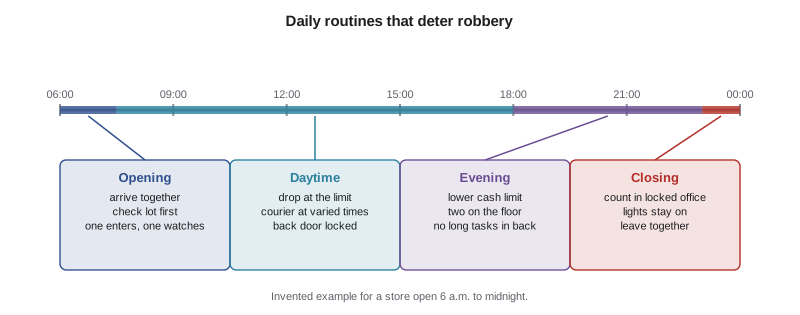
Opening and closing are among the highest-risk times, because doors are being unlocked or locked, cash is being counted or moved, staff may be alone and the area around the store may be quiet. Good routines are simple and consistent:
- Arrive together where possible. Before unlocking, look around the building and parking lot. If anything looks wrong, such as a broken window or someone waiting nearby, do not go in; call the manager or police.
- One person unlocks and enters while the other watches from a safe place, then signals that all is well.
- Lock the door again behind you until the store opens.
- At closing, keep outside lights on until everyone has left. Lock the front door at closing time and do not reopen it for late customers.
- Count cash in a locked office, out of view of windows and doors, and never on the sales floor.
- Leave together, check the lot before walking out, and walk each other to cars.
Deposits and cash pickups
Carrying cash to the bank is a known robbery risk. Many retailers use armoured car or courier services; where staff make deposits, the trip should be varied in time and route, done by two people where possible, and never discussed in front of customers. Deposit bags should not be visible, for example carried in an ordinary bag rather than a bank bag. Workers should not stop on the way, and if they feel they are being followed they should go to a busy public place or a police station. Cash pickups by courier should happen at varied times and only after the courier has been identified.
Other procedures that help
- Back doors locked at all times and opened only for identified, expected deliveries, as Lesson 4 described.
- Garbage runs in daylight or by two people.
- A clear policy that workers do not chase, detain or confront shoplifters (Lesson 9).
- A known code word or signal that tells co-workers a worker needs help without alerting the customer.
- Regular checks that alarms, radios and cameras work, and that new workers know where they are.
- A rule that keys and safe combinations are given only to those who need them, and changed when people leave.
Training
Procedures only work if people know them. Robbery prevention and response training should happen before a worker's first shift on a register, desk or evening shift, and be refreshed regularly. Washington's late-night retail rule, for example, requires training for new employees and annual retraining. Good training is short, practical and specific to the store: where the alarms are, what the cash limits are, how drops are done, what the opening and closing routines are, and what to do during and after a robbery (Lesson 6). Short refreshers at team huddles, especially before busy seasons, keep it fresh.
For supervisors: three things to check every shift
First, staffing: is anyone alone at a high-risk desk or time, and are breaks planned so they do not create gaps? Second, cash: are registers and the desk under their limits, and is the evening drop happening? Third, doors: is the back door locked and the office closed? These three checks take a couple of minutes and address the biggest procedural risk factors in most stores.
Worked problem
Fixing Riverside’s closing routine
At Riverside Corner Market, the closing worker usually counts the cash at the front counter after locking the door, then takes the garbage out the back, turns off the outside lights and walks alone to a car parked on the dark side lot. The second worker often leaves at 11:30 p.m. What should change?
Show solution
- Keep the second worker until the store is fully closed and both leave together.
- Move the cash count to the locked back office, out of sight of windows.
- Take the garbage out before dark or as a pair before the lights go off.
- Leave the outside lights on until both workers are in their cars, and fix the side-lot lighting.
- Have staff park in a lit area near the front and check the lot before walking out.
Answer: Two people at close, cash counted out of view, garbage before dark, lights on until everyone leaves and lit parking remove the main risks of the current routine.
Common mistakes
MistakeLetting cash build up in the register during a busy evening.
InsteadDrop to the safe as soon as the limit is reached and schedule a drop before the evening limit applies.
MistakeCounting cash at the front counter after closing.
InsteadCount cash in a locked office out of view of windows and doors.
MistakeTaking the deposit to the bank at the same time each day in a bank bag.
InsteadUse a courier or vary times and routes, go in pairs and keep the bag out of sight.
MistakeScheduling two people but leaving one alone during breaks.
InsteadCheck coverage including breaks and adjust so no one is alone at high-risk times.
MistakeReopening the door for a late customer after closing.
InsteadLock the door at closing time and do not reopen it.
Summary and key terms
- Low cash limits, drop safes, time-delay safes and clear signs reduce the reward and shorten any robbery.
- Florida’s convenience store law and late-night retail rules show how these measures are built into law.
- Keep register cash low with clear limits, prompts and scheduled drops, and track breaches.
- Staff high-risk times and desks with at least two people, and check coverage including breaks.
- Run opening and closing routines that avoid being alone, keep lights on and keep cash out of sight.
- Use couriers or varied, two-person deposit trips with hidden bags.
- Train workers before their first shift and refresh regularly.
- Cash limit
- The maximum amount of cash allowed in a register or desk before a drop must be made.
- Drop safe
- A safe that accepts cash deposits but cannot be opened by the worker making the drop.
- Time-delay safe
- A safe that opens only after a set waiting period, limiting quick access to cash or drugs.
- Deposit
- Cash taken from the store to the bank, by staff or by courier.
- Coverage check
- Comparing a schedule with a staffing rule to find times when too few people are present.
Practice problems
Work each problem on paper first, then reveal the answer to check.
Why do cash limits reduce robbery risk?
Show answer
They lower the reward, reduce losses and shorten any robbery.
What must Florida convenience businesses post about cash?
Show answer
A sign stating the register holds $50 or less.
What is a time-delay safe for?
Show answer
It cannot be opened quickly, which denies a robber fast access to cash or drugs.
In the cash example, when did most breaches happen and why?
Show answer
In the evening, because the limit drops at 6 p.m. while sales continue.
Give three steps for a safe opening routine.
Show answer
Any three of: arrive together, check the area before unlocking, one enters while the other watches, lock the door again until opening.
Where should cash be counted at closing?
Show answer
In a locked office out of view of windows and doors.
Give two ways to make deposits safer.
Show answer
Any two of: use a courier, vary times and routes, go in pairs, keep the bag hidden, do not stop on the way.
Why can a schedule with two people still leave someone alone?
Show answer
Breaks and staggered start and end times can create gaps.
Lesson quiz · 5 questions
Score 60% or more to complete this lesson.
Create a free account to save your progress, take quizzes and earn a certificate.