
HSE-341 · Lesson 6 of 12 · 24 min
During a robbery
Prevention lowers the chance of a robbery, but it cannot remove it. If a robbery happens, what workers do in the next minute or two has a large effect on whether anyone is hurt. The guidance in this lesson comes from police services, workplace safety regulators and retail security professionals in both countries, and it is remarkably consistent: stay calm, cooperate, do not resist, do not chase, and focus on getting everyone through it safely. Money and merchandise can be replaced; people cannot.
This lesson describes how workers should respond to a robbery to stay safe. It is meant to be practised in training, as calm walk-throughs, not by surprise.
The goal is to get it over quickly and safely
Most robberies last a minute or less. Robbers are usually nervous, often in a hurry, and sometimes affected by drugs or alcohol. The more smoothly the robbery goes from the robber's point of view, the less likely they are to use violence. Research on store robberies has found that injuries are much more likely when workers or customers resist, argue, make sudden movements or try to stop the robber. That is why every credible source tells workers not to resist, and why store policy should say clearly that no worker is ever expected to protect money or goods.
What to do
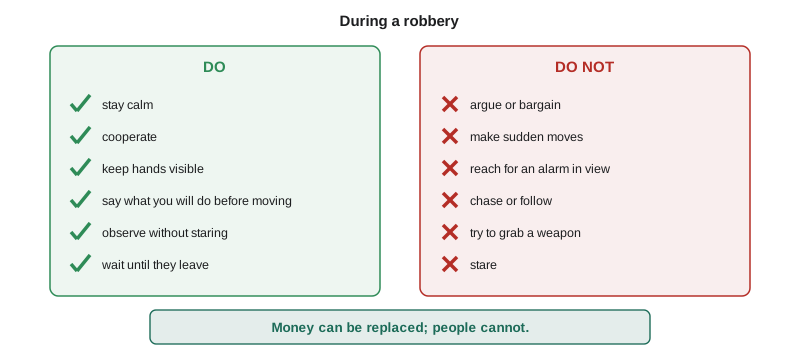
- Stay as calm as you can. Breathe slowly. It is normal to feel fear; your training will help.
- Cooperate. Do what you are told, and give the robber what they ask for. Do not argue, bargain or stall.
- Keep your hands visible and still unless you are asked to move them.
- Tell the robber what you are going to do before you do it, especially if you need to reach into a drawer or move: "I'm going to open the register now." Unexpected movements can be mistaken for reaching for a weapon or an alarm.
- Speak only when necessary, in a calm, even voice. Do not make jokes or threats.
- Do not make sudden moves, and do not try to grab a weapon.
- If there is a time-delay safe, say so calmly and point to the sign, but do not try to explain how it works or try to open it faster.
- Observe, but do not stare. Take in what you can about the robber, any weapon, words used, and the direction they leave in, without making the robber feel watched.
- Do not follow or chase. Stay inside until the robber is well away.
Alarms
Store policies differ on when to activate an alarm. The common guidance is to activate a silent alarm only if it can be done without the robber noticing, and otherwise to wait until the robber has left. A robber who sees a worker reach under the counter may think they are reaching for a weapon. Many stores now train workers to call 911 or the police first once the robber has gone, because a phone call gives police better information than an alarm. If the store has a silent response button that calls internal help, the same rule applies: use it only when it is safe to do so.
Weapons
Assume any weapon the robber shows or claims to have is real and could be used. Do not test whether a gun is loaded or whether a hidden weapon really exists. Keep your distance where possible, keep your hands visible and follow instructions. If a weapon is pointed at you, keep your eyes on the robber's face rather than the weapon only if you can do so without staring; many people find they remember the weapon in detail and the face poorly, which is normal and not something to feel bad about.
Customers and co-workers
Customers in the store may panic, try to intervene or not realise what is happening. If you can do so safely and calmly, keep customers out of the way, but do not draw attention to them or give instructions that might alarm the robber. Co-workers in other parts of the store should stay out of sight and away from the robbery, should not come to the front to see what is happening, and should call 911 only if they can do so without being seen or heard. A co-worker who walks into a robbery unexpectedly can startle the robber and increase the danger.
If something goes wrong
Rarely, a robbery escalates: the robber becomes more agitated, demands that workers move to another area, or tries to take someone with them. General guidance from police is to stay as calm as possible, continue to cooperate where you can, avoid sudden movements, and look for safe chances to get away from the robber, for example by moving toward an exit or a lockable room if the robber leaves you alone. Being moved to a back room or a vehicle is a sign of greater danger. Police are trained to manage hostage and barricade situations; workers should not try to negotiate or overpower the robber. If someone is injured, give first aid only when the robber has left and it is safe.
Right after the robber leaves
The first few minutes after a robbery matter for safety, for the police investigation and for the people involved. Most stores use a short checklist like this:
| Step | What to do | Why |
|---|---|---|
| 1. Lock the doors | Lock the front door and do not let anyone in except police and emergency services | Prevents the robber returning and protects the scene |
| 2. Call 911 | Give the address, what happened, any injuries, weapons, a description and direction of travel | Police can act fastest on fresh information |
| 3. Care for anyone hurt | Give first aid and call for an ambulance if needed | Injuries come first |
| 4. Call the manager | Tell the store manager or on-call manager | They organize support and reporting |
| 5. Protect the scene | Do not touch the counter, notes, items the robber handled, or clean up | Preserves evidence such as fingerprints and DNA |
| 6. Write down what you saw | Each witness fills in a description form on their own, before talking it over | Memories change when people compare notes |
| 7. Ask witnesses to stay | Ask customers who saw the robbery to wait for police; do not force them | Witness accounts help the investigation |
| 8. Keep it simple with others | Do not post on social media or speak to reporters; refer them to the manager | Protects the investigation and the people involved |
Describing the robber
A good description helps police, but it should never come at the cost of safety. Witnesses tend to remember general features best: height compared with a height strip or the door frame, build, clothing, voice, accent, any distinctive marks, the weapon, what was said and the direction and means of escape. Starting at the head and working down is a common method for remembering clothing and features. Each witness should write their own account as soon as possible, without discussing it with others first, because people unconsciously adjust their memories to match what they hear. It is normal not to remember much, and workers should not feel they have failed if their description is incomplete.
Many stores keep a one-page description form at each register. The program below scores a set of completed forms for completeness, which can be used in training to show which features people tend to miss. The forms are invented for a practice drill.
# Score practice description forms from a robbery drill for completeness (invented forms).
fields = ["height", "build", "age range", "hair or headwear", "face or marks", "upper clothing",
          "lower clothing", "shoes", "voice or accent", "weapon", "words used", "direction left", "vehicle"]
forms = {
    "Ana":   {"height": "near top of height strip", "build": "slim", "upper clothing": "black hoodie", "weapon": "said he had a gun",
              "words used": "give me the cash", "direction left": "toward the bus stop"},
    "Rosa":  {"height": "tall", "build": "slim", "age range": "20s", "hair or headwear": "black cap",
              "upper clothing": "charcoal hoodie", "lower clothing": "jeans", "shoes": "white sneakers",
              "voice or accent": "quiet, no accent", "direction left": "east on foot"},
    "Omar":  {"upper clothing": "dark jacket", "weapon": "hand in pocket", "direction left": "east"},
}
missed = {f: 0 for f in fields}
for who, form in forms.items():
    done = [f for f in fields if f in form]
    print(f"{who:<5} {len(done):2d} of {len(fields)} fields ({100 * len(done) / len(fields):.0f}%)")
    for f in fields:
        if f not in form:
            missed[f] += 1
print("Fields missed by every witness:", ", ".join(f for f, n in missed.items() if n == len(forms)))
# where the witnesses disagree
print("Upper clothing:", {w: f.get("upper clothing") for w, f in forms.items()})Ana 6 of 13 fields (46%)
Rosa 9 of 13 fields (69%)
Omar 3 of 13 fields (23%)
Fields missed by every witness: face or marks, vehicle
Upper clothing: {'Ana': 'black hoodie', 'Rosa': 'charcoal hoodie', 'Omar': 'dark jacket'}Rosa, who was furthest from the counter in the drill, gave the most complete description; Ana, who was face to face with the robber, focused on the weapon and the words. Nobody noted a vehicle or facial features, which is common. The witnesses also disagreed on the colour of the top, which is why each person should write their own account: police can weigh different accounts, but they cannot undo a description that has been blended. In training, results like this help workers know what to look for without putting themselves at risk.
Closing the store and taking care of people
After a robbery, the store should usually close, at least until police have finished and the workers involved have been looked after. Workers who were directly involved should not be expected to keep working that shift. The manager should arrange for someone to stay with them, offer to call a family member, arrange safe transport home and make sure they know about support services. Lesson 11 covers care and follow-up in more detail, including the kinds of reactions people often have in the days and weeks afterwards.
Practising the response
People under stress tend to do what they have practised. Short walk-throughs, where a supervisor describes a scenario and the team talks through what they would do, help workers remember the key points without frightening them. Surprise robbery drills with fake weapons are not recommended, because they can cause real fear and harm, and some workers have experienced violence before. Training should be calm, respectful and voluntary in tone, with a chance to ask questions and an option to step out.
For supervisors: make the policy unmistakable
Workers need to hear clearly, from you, that they will never be blamed for handing over money or goods in a robbery, and that no amount of cash is worth their safety. Say it at hire, at training and after any incident. Make sure every worker who works a register, the service desk or an evening shift knows the steps in this lesson before their first shift, knows where the description forms and phone numbers are, and knows that after a robbery the store will close and they will be looked after.
Worked problem
Talking through the attempted robbery at the service desk
In Northfield's attempted robbery, a man came to the service desk at 9:40 p.m., said he had a gun in his pocket and demanded cash. The cashier, Lee, handed over the lottery drawer cash. Lee then pressed the silent response button while the man was still walking toward the door, and a manager came running from the back toward the front entrance. The man left without further incident. Which actions were right, and what should change?
Show solution
- Right: Lee cooperated, did not argue and handed over the cash.
- Risky: pressing the button while the man was still in the store could have been noticed.
- Risky: the manager running toward the front could have met the robber at the door and startled him.
- Change: train staff to wait until the robber has left before using the alarm, and to call 911 first.
- Change: train other staff and managers to stay back and out of sight when an alarm sounds during a robbery, and to come forward only once the robber has gone.
Answer: Lee's cooperation was exactly right. The timing of the alarm and the manager's response raised the risk, and training should address both.
Common mistakes
MistakeArguing or stalling to protect the store’s cash.
InsteadCooperate and hand over what is asked for; no money is worth a person’s safety.
MistakeReaching under the counter for the alarm while the robber is watching.
InsteadUse the alarm only if it can be done unseen, or wait until the robber has left and call 911.
MistakeChasing the robber to see where they go.
InsteadStay inside, lock the doors and note the direction from a safe place.
MistakeWitnesses talking it over before writing down what they saw.
InsteadEach witness writes their own account first.
MistakeRunning a surprise robbery drill with a fake weapon.
InsteadUse calm, announced walk-throughs that respect workers’ experiences.
Summary and key terms
- Stay calm, cooperate and give the robber what they ask for; resistance raises the risk of injury.
- Keep hands visible, say what you are going to do before moving and avoid sudden movements.
- Use alarms only if it can be done unseen, otherwise after the robber leaves; call 911 once it is safe.
- Treat any weapon as real, and never chase or follow.
- After the robbery: lock doors, call 911, care for the injured, call the manager, protect the scene and write separate accounts.
- Close the store and look after the workers involved.
- Practise with calm walk-throughs, not surprise drills.
- Compliance
- Cooperating with a robber’s demands to get through the event safely.
- Silent response button
- A discreet button that summons help without alerting the robber.
- Scene preservation
- Leaving the area the robber touched undisturbed until police have examined it.
- Description form
- A one-page form for recording what a witness saw, filled in alone and soon after.
- Walk-through
- A calm, spoken practice of what to do in a scenario, without acting it out by surprise.
Practice problems
Work each problem on paper first, then reveal the answer to check.
Why should workers not resist a robber?
Show answer
Injuries are much more likely when workers resist, argue or make sudden moves.
What should you do before reaching into a drawer during a robbery?
Show answer
Tell the robber calmly what you are going to do.
When is it safest to activate a silent alarm?
Show answer
Only if it can be done unseen; otherwise after the robber has left.
What should co-workers in the back of the store do during a robbery?
Show answer
Stay out of sight and away from the front, and call 911 only if they can do so unseen and unheard.
List the first four steps after the robber leaves.
Show answer
Lock the doors, call 911, care for anyone hurt, call the manager.
Why should each witness write their account before talking it over?
Show answer
Memories change when people compare notes.
Give three things to try to notice about a robber, if it is safe.
Show answer
Any three of: height, build, clothing, voice, marks, weapon, words used, direction or vehicle.
Why are surprise robbery drills not recommended?
Show answer
They can cause real fear and harm, especially for people who have experienced violence.
Lesson quiz · 5 questions
Score 60% or more to complete this lesson.
Create a free account to save your progress, take quizzes and earn a certificate.