
HSE-341 · Lesson 3 of 12 · 25 min
Robbery risk factors
Robbers choose. Interviews with people convicted of robbery, studies of robbery patterns and decades of police and insurance data all point the same way: most robberies of stores are planned, at least loosely, and offenders pick targets that seem to offer a good reward, a low chance of being seen or caught, and an easy way in and out. That is good news for prevention, because many of the features that make a store attractive to a robber can be changed. This lesson describes the main robbery risk factors. Lessons 4 and 5 deal with the controls.
This lesson is about understanding risk so it can be reduced. It does not describe how robberies are carried out, and nothing here should be read as a guide to defeating store security.
How offenders size up a store
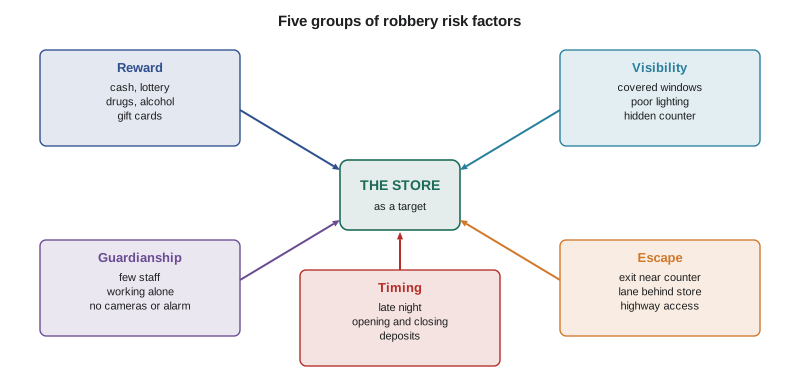
Research on robbery, including the work behind crime prevention through environmental design (Lesson 4), suggests offenders weigh a few simple questions, often in a matter of minutes:
- Is there something worth taking? Cash, lottery funds, high-value goods, prescription drugs, alcohol or cannabis.
- Will anyone see me? Can people outside see in? Are there other customers, staff or passers-by? Are there cameras?
- Will anyone stop me? How many staff are there? Is there a barrier, a guard or another obstacle?
- Can I get away? Is the store near a major road, a lane or a dark lot? Is the exit clear and close?
- Is it the right time? Late at night, at opening or closing, or at shift change when staff are distracted.
Each question points to a group of risk factors. The more of them a store has at a given time, the more attractive a target it becomes.
Cash and valuables
The more cash a store holds and the more obvious that is, the higher the risk. Cash builds up in registers, at customer service desks that handle money transfers, bill payments and lottery, and in the office before deposits. Stores that sell lottery tickets, cash cheques, sell prepaid cards or offer money transfer services often hold more cash than their size suggests. Counting cash in view of customers, carrying deposits through the store or to the bank at the same time each day, and leaving the office door open while the safe is open all advertise the reward.
Valuables other than cash matter too. Pharmacies are targets because of prescription opioids and other drugs. Liquor and cannabis stores, tobacco counters and electronics sections carry goods that are easy to resell. Gift cards and prepaid phone cards are effectively cash. In recent years, some retailers have also seen robberies aimed at high-value goods rather than cash, including group thefts where staff are threatened if they intervene.
Hours and staffing
Robbery risk is strongly linked to time of day. Late evening and the hours after midnight are the highest-risk period for convenience stores and gas stations, followed by early morning around opening. Fewer customers, darkness and fewer staff all raise the risk. Opening and closing routines are especially exposed: staff may be alone, doors may be unlocked for deliveries or garbage runs, and cash is being counted and moved.
Staffing levels matter for two reasons. One worker alone is easier to intimidate and has no one to call for help or witness the event, and some studies of convenience store robberies found lower robbery rates where two or more clerks were on duty at night, although the evidence is mixed and depends on other controls. Staffing also affects how well the store can watch the floor, back up a worker in a tense situation and follow cash-handling procedures. Working alone and late-night staffing rules are covered in HSE-352.
Visibility and layout
A store where the cash area cannot be seen from outside or from the sales floor is more attractive to a robber. Windows covered with posters, displays stacked high in front of the counter, poor lighting inside or outside, and a cash desk tucked behind a corner all reduce the chance that someone will notice a robbery in progress. A counter placed so that the worker has their back to the door, or so that a robber can stand between the worker and the only exit, makes the situation more dangerous.
Layout also affects escape. A store with an exit close to the cash desk, near a lane or a busy road with many turn-offs, is easier to leave quickly. A store with a long walk from the counter to the door, in clear view of the street and the parking lot, is less attractive.
Location and surroundings
Stores in areas with more crime generally see more robberies, but location is more than neighbourhood. Isolated stores, stores next to vacant lots or poorly lit parking areas, stores with easy access to highways, and stores with lanes or alleys behind them carry more risk. A history of robbery is itself a strong risk factor: stores that have been robbed once are more likely to be robbed again, sometimes by the same people, unless something changes. That is why reviewing and improving controls after any robbery or attempt matters so much.
Worker-related factors
Some risk factors relate to how work is done rather than to the building. Workers who are new, untrained or unsure of procedures are more likely to react in ways that raise the danger, such as arguing, resisting or chasing. Workers who handle cash in predictable ways, take deposits to the bank alone at the same time each day, or open the back door to anyone who knocks also raise the risk. These are not faults of the worker. They are signs that procedures and training need attention, and Lessons 5 and 6 address them.
Risk factors for different kinds of store
| Type of store | Main robbery risk factors | Typical priority controls |
|---|---|---|
| Convenience store or gas station kiosk | Late hours, few staff, cash and lottery, tobacco, easy road access | Cash limits and time-delay safes, two staff or barriers at night, clear windows, lighting (see HSE-352) |
| Pharmacy counter | Prescription opioids and other drugs, cash | Time-delay drug safes, limited stock on hand, signage, clear sightlines |
| Liquor, beer and wine, or cannabis store | High-value, easily resold goods; refusals; cash | Product security, staffing at peak times, ID check procedures (Lesson 9) |
| Grocery or general merchandise store | Service desk with lottery and money transfers, cash office, deposits | Desk design, cash office access control, varied deposit routines |
| Electronics or specialty store | High-value goods, group thefts | Locked display cases, staff not intervening, cameras |
Northfield and Riverside compared
Northfield Market is a large store with many staff and customers, long opening hours and good visibility on most of the sales floor. Its higher-risk points are the customer service desk, which handles lottery, money transfers and returns and can hold a lot of cash, the cash office, the pharmacy counter (run by a separate company but sharing the building), and the closing routine. The attempted robbery last year happened at the service desk at about 9:40 p.m., when only one worker was there.
Riverside Corner Market is very different. It is small, open until midnight, often has only two workers in the evening and sometimes one for short periods, sells lottery and tobacco, and is on a corner beside a busy road with a dimly lit side lot. Its front windows are covered with posters, and the counter faces the back of the store. It has no record of robbery, but it has had several thefts and two incidents where a customer threatened staff. On almost every risk factor, Riverside scores higher than Northfield.
Scoring robbery risk
A weighted checklist turns these factors into a rough score that can be used to compare locations and track changes over time. It is not a prediction; a store with a low score can still be robbed, and a high score does not mean a robbery will happen. Its value is in showing which factors contribute most and which controls would reduce the score fastest. The program below applies an illustrative checklist to the Northfield service desk and to Riverside in the evening. The weights are examples that a store would adjust to its own situation.
# Illustrative robbery risk checklist. Each factor is scored 0 (absent) to 3 (strongly present).
# Weights are examples for teaching; adjust them to your own situation.
weights = {
    "cash or valuables on hand": 3, "late-night hours": 3, "one worker alone at times": 3,
    "poor view in from outside": 2, "poor outside lighting": 2, "exit close to counter": 1,
    "easy getaway route": 1, "no cameras or alarm": 2, "untrained or new staff": 2,
    "previous robbery or threats": 2,
}
sites = {
    "Northfield service desk": {"cash or valuables on hand": 2, "late-night hours": 1, "one worker alone at times": 2,
        "poor view in from outside": 1, "poor outside lighting": 0, "exit close to counter": 1, "easy getaway route": 1,
        "no cameras or alarm": 0, "untrained or new staff": 1, "previous robbery or threats": 3},
    "Riverside evening": {"cash or valuables on hand": 2, "late-night hours": 3, "one worker alone at times": 2,
        "poor view in from outside": 3, "poor outside lighting": 2, "exit close to counter": 2, "easy getaway route": 3,
        "no cameras or alarm": 1, "untrained or new staff": 2, "previous robbery or threats": 1},
}
maximum = 3 * sum(weights.values())
for site, sc in sites.items():
    score = sum(weights[f] * sc[f] for f in weights)
    top = sorted(weights, key=lambda f: weights[f] * sc[f], reverse=True)[:3]
    print(f"{site}: {score} of {maximum} ({100 * score / maximum:.0f}%)")
    print("   biggest contributors:", ", ".join(top))
# effect of three controls at Riverside
after = dict(sites["Riverside evening"])
after.update({"poor view in from outside": 0, "poor outside lighting": 0, "untrained or new staff": 0})
s0 = sum(weights[f] * sites["Riverside evening"][f] for f in weights)
s1 = sum(weights[f] * after[f] for f in weights)
print(f"Riverside after clearing windows, adding lighting and training: {s1} (down {s0 - s1})")Northfield service desk: 27 of 63 (43%) biggest contributors: cash or valuables on hand, one worker alone at times, previous robbery or threats Riverside evening: 44 of 63 (70%) biggest contributors: late-night hours, cash or valuables on hand, one worker alone at times Riverside after clearing windows, adding lighting and training: 30 (down 14)
Riverside scores much higher than the Northfield desk, and the biggest contributors are the late hours, the cash on hand, the poor view from outside and the times one worker is alone. The last lines show something useful for planning: three relatively cheap controls, clearing the windows, improving the lighting and training the staff, cut the score substantially. Cutting the late hours or making sure two workers are always present would cut it further, but at a higher cost. Lesson 12 uses this kind of comparison to build a plan.
Risk changes during the day
A single score for a store hides how risk moves through the day. Riverside's risk is moderate in the morning, low at lunchtime when the store is busy, higher in the evening and highest in the last hour before closing and during the closing routine. Northfield's service desk is busiest and safest on weekday afternoons and most exposed on weekday evenings when only one worker staffs it. Good risk assessments look at specific times and tasks: opening, closing, cash pickups, deliveries, the last hour before close and shift change.
For supervisors: notice the risk factors you control
You cannot move the store, but you control many risk factors on each shift. Keep cash in the registers and at the desk below the limit and make drops as soon as you reach it. Do not let posters and displays block the view of the counter. Make sure the outside lights are working and report any that are out. Avoid leaving one worker alone at a high-risk desk in the evening. Vary the timing of deposits and cash pickups. Make sure new workers know the robbery procedure before their first evening shift. These steps cost little and change the answers to the questions an offender asks.
Worked problem
Spotting risk factors on a walk-through
Marco walks through Riverside Corner Market at 10 p.m. He notes posters covering most of the front window, the counter facing the back wall, one outside light out on the side lot, about the equivalent of a full day's lottery sales in the register, one worker on the floor while the second is in the back stocking, and the back door propped open for airflow. Which risk factors does he see, and which can be fixed tonight?
Show solution
- Visibility: posters block the view in from the street, and the counter faces away from the door.
- Lighting: one outside light is out on the side lot.
- Reward: too much cash in the register for the time of night.
- Guardianship: effectively one worker on the floor.
- Access: the back door is propped open, giving an unseen way in.
- Tonight: make a cash drop, close and lock the back door, bring the second worker to the front, and report the light. Remove the posters tomorrow and plan to turn the counter.
Answer: He sees risk factors in every group. Cash, staffing and the back door can be fixed tonight; posters, lighting and the counter layout need follow-up within days.
Common mistakes
MistakeAssuming a store that has never been robbed is low risk.
InsteadAssess the risk factors; a clean history does not remove reward, poor visibility or late hours.
MistakeCovering the front window with posters and displays.
InsteadKeep a clear view of the counter from outside and from the sales floor.
MistakeTaking deposits to the bank at the same time each day by the same route.
InsteadVary times and routes, use a courier where possible, and never advertise the trip.
MistakeTreating a robbery as a one-off and changing nothing afterwards.
InsteadReview and improve controls; stores that have been robbed are at higher risk of being robbed again.
MistakeUsing a risk score as a prediction.
InsteadUse it to compare locations and choose controls, not to forecast robberies.
Summary and key terms
- Most store robberies are planned at least loosely; offenders weigh reward, visibility, guardianship, escape and timing.
- Cash, lottery, drugs, alcohol, cannabis, tobacco and gift cards raise the reward.
- Late hours, opening and closing, and few staff raise the risk.
- Poor visibility from outside, hidden counters and exits near the counter make a store more attractive.
- Location matters, and a previous robbery raises the risk of another unless controls change.
- Weighted checklists help compare locations and choose controls but are not predictions.
- Risk changes through the day; assessments should look at specific times and tasks.
- Risk factor
- A feature of a store, task or time that makes robbery or violence more likely or more serious.
- Guardianship
- The presence of people, barriers or systems that could notice or stop a crime.
- Repeat victimization
- The tendency of places that have been targeted once to be targeted again.
- Cash drop
- Moving cash from a register or desk into a safe once a set limit is reached.
- Weighted checklist
- A list of factors scored and multiplied by weights to give a rough overall score.
Practice problems
Work each problem on paper first, then reveal the answer to check.
Name the five questions an offender asks about a store.
Show answer
Is there something worth taking, will anyone see me, will anyone stop me, can I get away, and is it the right time.
Give three kinds of valuables other than cash that make a store a target.
Show answer
Any three of: prescription drugs, alcohol, cannabis, tobacco, electronics, gift cards, prepaid cards.
Which times of day carry the highest robbery risk for convenience stores?
Show answer
Late evening and after midnight, followed by opening and closing times.
Why do covered windows raise the risk?
Show answer
They stop people outside from seeing a robbery in progress.
Why does a previous robbery matter?
Show answer
Stores that have been robbed are more likely to be robbed again unless controls change.
Name two risk factors a supervisor can change on a shift.
Show answer
Any two of: cash on hand, blocked views, staffing at high-risk desks, timing of deposits, doors left open, lights out.
What is the main value of a robbery risk score?
Show answer
Comparing locations and showing which controls cut the risk most.
In the Riverside example, which three cheap controls lowered the score?
Show answer
Clearing the windows, improving outside lighting and training staff.
Lesson quiz · 5 questions
Score 60% or more to complete this lesson.
Create a free account to save your progress, take quizzes and earn a certificate.