
HSE-242 · Lesson 8 of 12 · 28 min
Lead law and exposure limits
Lead is regulated by two families of law. Occupational health and safety law protects workers by setting airborne exposure limits and requiring assessment, controls, hygiene and medical surveillance. Environmental and consumer law controls lead in paint and products and, in the United States especially, regulates renovation work in older homes to protect children and occupants. A supervisor on a renovation job may need to follow both. This lesson summarizes the rules as they stood in October 2026; always check the current regulation and any guidance from your regulator.
Airborne exposure limits
Most jurisdictions set the airborne limit for lead and its inorganic compounds at 0.05 mg/m³ (50 µg/m³) as an 8-hour time-weighted average. This is also the ACGIH TLV. Unlike silica, the limit applies to inhalable lead rather than only the respirable fraction, so samples are collected with a closed-face cassette or an inhalable sampler rather than a cyclone. Because lead is also absorbed by swallowing, and because blood lead integrates both routes, airborne limits are always paired with hygiene rules and biological monitoring.
Lead rules in Canada
As with silica, the rules depend on the province or territory. The table summarizes the main requirements.
| Jurisdiction | Airborne limit | Key requirements |
|---|---|---|
| Ontario, non-construction workplaces (O. Reg. 490/09, Designated Substances) | 0.05 mg/m³ | Assessment; written control program where workers are likely to be exposed; hygiene measures; medical surveillance under the regulation's code, including blood lead testing |
| Ontario, construction projects | Limits in O. Reg. 833 apply | General duty under s. 25(2)(h); the ministry guideline on lead on construction projects classifies operations by expected exposure and specifies controls, respirators and hygiene for each type |
| British Columbia (OHS Regulation Part 5) | 0.05 mg/m³; lead treated as a reproductive toxin to keep as low as reasonably achievable | Written exposure control plan where exposure may exceed 50 per cent of the limit; WorkSafeBC guidance on lead-containing paints and coatings in construction |
| Alberta (OHS Code Part 4) | 0.05 mg/m³ | Hazard assessment and control; exposure kept as low as reasonably practicable; health monitoring where required |
| Federal (COHSR) | ACGIH TLV, 0.05 mg/m³ | Hazard investigation and control; records |
| Other provinces | 0.05 mg/m³ in most | Details vary; check the current regulation |
Ontario's construction guideline is widely used outside Ontario as a practical reference. It groups lead operations into types from lower to higher expected exposure: for example, applying lead-containing coatings with a brush or removing them with chemical strippers are lower-exposure operations, while abrasive blasting and torch cutting of lead-painted steel are among the highest. For each type it specifies respirators, protective clothing, hygiene facilities and work practices.
Adjusting for long shifts
Canadian jurisdictions that adjust limits for long shifts apply the same methods to lead as to silica, such as the Brief and Scala model or a regulator's own method, described in Lesson 3.
def osha_lead_limit(hours):
    return 400 / hours if hours > 8 else 50.0

def brief_scala(limit, hours):
    return limit * (8 / hours) * ((24 - hours) / 16)

for h in (8, 10, 12):
    print(f"{h:2d} h shift: OSHA lead limit {osha_lead_limit(h):5.1f} ug/m3, "
f"Brief and Scala on 50 ug/m3 {brief_scala(50, h):5.1f} ug/m3")8 h shift: OSHA lead limit 50.0 ug/m3, Brief and Scala on 50 ug/m3 50.0 ug/m3 10 h shift: OSHA lead limit 40.0 ug/m3, Brief and Scala on 50 ug/m3 35.0 ug/m3 12 h shift: OSHA lead limit 33.3 ug/m3, Brief and Scala on 50 ug/m3 25.0 ug/m3
The OSHA formula reduces the limit in proportion to hours worked, while Brief and Scala also allows for shorter recovery time and so reduces it further. Both show that a 12-hour shift needs a substantially lower airborne concentration to give the same protection.
Biological limits and guidance values
Blood lead is the best measure of how much lead a worker has absorbed, so several bodies publish blood lead values. They have different purposes and should not be confused.
| Value | Level | Purpose |
|---|---|---|
| ACGIH biological exposure index (BEI) | 20 µg/dL (about 0.97 µmol/L) | Guidance level for industrial hygiene practice, adopted or referenced by some provinces |
| Provincial medical removal levels | Set in provincial codes, regulations or guidelines; vary by jurisdiction | Removal of the worker from lead exposure until blood lead falls |
| Typical adult background | Around 1 µg/dL (0.05 µmol/L) | Comparison with the general population |
| Pregnancy and children | No known safe level | Exposure should be kept as low as possible |
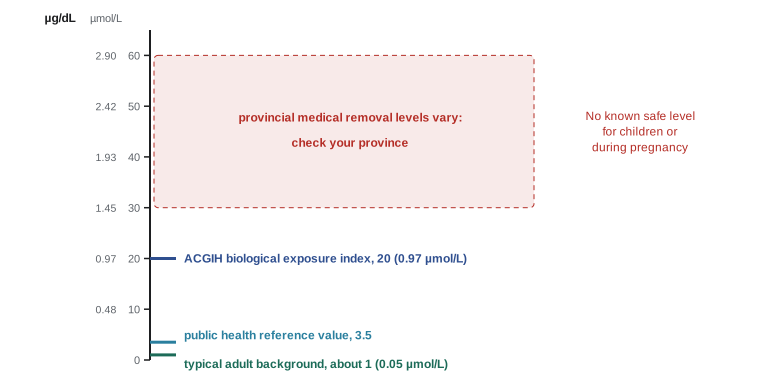
Many occupational physicians and public health agencies now recommend keeping workers' blood lead well below the old regulatory triggers, for example below about 10 µg/dL and lower for workers who are or may become pregnant. Employers can and often do set internal action levels lower than the legal minimum.
Lead in paint and renovation
Canada controls lead in new products through the Canada Consumer Product Safety Act; the Surface Coating Materials Regulations limit total lead in paints and other surface coatings to 90 mg/kg. These rules do not cover existing paint in buildings. For renovation of older buildings, worker protection comes from provincial occupational health and safety law and guidance, while Health Canada provides public guidance for homeowners and renovators on reducing lead exposure, especially for children and pregnant people. Because there is no Canadian equivalent of the US certification scheme for renovators, the employer's assessment and control plan carry the main responsibility.
Under Health Canada's and provincial guidance, any paint in a building constructed before about 1980 should be presumed to contain lead until tested, and many provincial guidelines treat paint with any detectable lead as requiring precautions when it will be disturbed by methods that create dust or fume.
Other duties
Lead regulations and guidelines typically also require:
- Hazard signs at the boundaries of areas where exposure may exceed the limit.
- Protective clothing provided, cleaned and replaced by the employer, never taken home for laundering.
- Training on the hazards, controls, hygiene, medical surveillance and the worker's rights.
- Records of exposure assessments, blood lead results and medical removal, kept for long periods.
- Waste management under environmental rules for lead-containing debris, paint chips, blasting media, filters and wash water.
Worked problem
Matching a task to the rules
A contractor will remove lead-painted window frames from a 1920s school in Ontario during summer break, using heat guns below 1,100 °F and hand scraping. What rules and guidance apply?
Show solution
- The work is a construction project, so the OHSA general duty and O. Reg. 833 limits apply, and the ministry's lead on construction projects guideline is the practical reference.
- The guideline classifies operations by expected exposure; heat-gun removal and scraping fall in its moderate-exposure categories, with specified respirators, clothing, hygiene and clean-up.
- An exposure assessment should confirm actual exposures, and blood lead testing should follow the applicable requirements.
- Clean-up must leave the school safe for children before they return, using HEPA vacuums and wet cleaning, with waste handled under environmental rules.
Answer: Ontario occupational law and the construction guideline govern worker protection; the employer must also make sure the school is left clean for children. Lesson 10 covers the work practices in detail.
Going beyond the minimum
Legal limits for lead were set decades ago and lag behind current health evidence, so many employers adopt stricter internal policies. These policies are usually simple to write and cheap to follow, and they protect the company as well as its workers, because a crew whose blood lead stays low is a crew whose controls are working.
| Internal policy | Typical content | Why it helps |
|---|---|---|
| Internal blood lead action levels | Investigation at about 10 µg/dL, increased testing at about 20 µg/dL, reassignment well before the legal removal level | Problems are corrected while blood lead is still low |
| Prohibited methods | No open-flame burning, no dry power sanding or grinding without HEPA collection, no dry sweeping, no compressed air | Removes the highest-exposure methods from the job entirely |
| Pre-job lead survey | Testing or presumption of lead for every coating that will be disturbed | Ensures precautions start on day one |
| Reproductive health protection | Confidential access to the physician for workers who are pregnant, planning pregnancy or breastfeeding, with reassignment without loss of pay | Protects the fetus and supports workers who might otherwise hide a pregnancy |
| Hygiene audits | Supervisor checklist for washing, eating areas, clothing and vehicles at least weekly | Catches the slow drift away from good habits |
Lead exposure outside the workplace
When a worker's blood lead is high, the cause is not always the job. Hobbies such as casting fishing weights or bullets, shooting at indoor ranges, stained glass, renovating an older home, some traditional remedies and cosmetics, and imported ceramic dishware with lead glazes can all raise blood lead. Programs should ask about these sources in a respectful, confidential way. Finding an off-work source does not end the employer's responsibility: the worker still needs support, and the workplace controls should still be checked, because both sources may be contributing.
Lead in non-construction workplaces in Canada
Outside construction, Ontario's designated substance regulation sets out a clear sequence that is useful anywhere. The employer assesses whether workers are likely to be exposed, considering the processes, the amount of lead handled and any sampling results, and records the assessment. Where exposure is likely, the employer develops a written control program in consultation with the joint health and safety committee or representative, covering engineering controls, work practices, hygiene facilities, monitoring, medical surveillance and training. The program must be reviewed when conditions change. Battery recycling, secondary smelting, scrap processing, radiator repair, some foundries and indoor firing ranges are typical non-construction workplaces where these requirements apply. Other provinces reach similar results through their general chemical hazard rules and, in BC, through exposure control plans. In every province, laboratories or physicians may report elevated blood lead results to public health authorities, which can lead to follow-up with the employer.
Worked problem
Setting an internal blood lead policy
A painting contractor with 30 workers does regular repainting of older buildings and bridges. Its current practice is simply to follow the legal minimum. What internal blood lead policy would you propose?
Show solution
- Baseline testing for every worker before their first lead job, and at least every two to three months while doing lead work.
- An investigation level of 10 µg/dL: the supervisor and safety staff review the worker's tasks, respirator fit and hygiene within a week.
- An increased-testing level of 20 µg/dL: test monthly, correct controls and consider temporary reassignment to non-lead work.
- Reassignment, with pay protected, at a level well below the legal removal level, as advised by the program physician.
- Confidential reproductive health counselling, and reassignment on request for workers who are pregnant or planning pregnancy.
Answer: A tiered internal policy keeps blood lead low, finds control failures early and protects workers who are most vulnerable, at modest cost.
Common mistakes
MistakeSampling lead with a respirable cyclone.
InsteadUse a closed-face cassette or inhalable sampler; the lead limit is not limited to the respirable fraction.
MistakeTreating the legal medical removal level as a safe blood lead level.
InsteadAim to keep blood lead much lower; current evidence shows harm well below old regulatory triggers.
MistakeComparing a 12-hour lead result with the 8-hour limit.
InsteadApply the adjustment method your regulator accepts.
MistakeAssuming paint below a consumer product limit is safe to burn or blast.
InsteadAssess worker exposure; high-energy methods can create harmful exposures from low-lead paint.
MistakeLetting workers take lead-contaminated clothing home to wash.
InsteadProvide, launder and dispose of protective clothing at the employer's expense.
Summary and key terms
- Most jurisdictions set an airborne lead limit of 0.05 mg/m³ (50 µg/m³) as an 8-hour TWA, applied to inhalable lead.
- Ontario regulates lead as a designated substance outside construction and uses a construction guideline that classifies operations by exposure; BC requires exposure control plans and treats lead as a reproductive toxin.
- Long-shift adjustments use the same methods as for silica.
- Blood lead removal levels are set provincially; the ACGIH BEI is 20 µg/dL (about 0.97 µmol/L).
- Current health evidence supports keeping blood lead far below old regulatory triggers, especially for workers who may become pregnant.
- Canada limits lead in new coatings to 90 mg/kg, but worker protection in renovation relies on provincial OHS law and guidance.
- Lead rules also require signs, protective clothing, training, records and proper waste handling.
- Inorganic lead
- Metallic lead and its inorganic compounds, such as oxides and salts, the forms covered by most occupational limits.
- Action level (lead)
- In US rules, 30 µg/m³; a concentration that triggers monitoring and surveillance.
- Medical removal protection
- Removal of a worker with high blood lead from exposure, with protection of pay and benefits where the law provides it.
- Trigger task
- In OSHA construction rules, a task presumed to produce high lead exposure until assessed.
- Lead-based paint
- Paint containing significant lead; Canadian guidance treats older paint as lead-containing until tested.
- RRP Rule
- The US EPA Renovation, Repair and Painting Rule for work disturbing paint in pre-1978 housing and child-occupied facilities.
- Dust-lead action level
- The EPA clearance value for dust-lead loading after abatement, such as 5 µg/ft² on floors.
- Surface Coating Materials Regulations
- Canadian regulations limiting total lead in new paints and coatings to 90 mg/kg.
- Biological exposure index (BEI)
- An ACGIH guidance value for blood lead of 20 µg/dL.
- Closed-face cassette
- A filter holder used to sample total or inhalable airborne dust such as lead.
Practice problems
Work each problem on paper first, then reveal the answer to check.
What is the usual airborne limit for lead?
Show answer
0.05 mg/m³ (50 µg/m³) as an 8-hour TWA.
Why is lead sampled without a respirable cyclone?
Show answer
The limit applies to inhalable lead, and larger particles are also absorbed after being swallowed.
What does Ontario's construction lead guideline do?
Show answer
It classifies lead operations by expected exposure and specifies controls, respirators and hygiene for each type.
Convert the ACGIH BEI of 20 µg/dL to µmol/L.
Show answer
About 0.97 µmol/L.
What does Brief and Scala give for a 50 µg/m³ limit on a 12-hour shift?
Show answer
25 µg/m³.
What is the Canadian limit for lead in new paint?
Show answer
90 mg/kg total lead under the Surface Coating Materials Regulations.
Why do many physicians recommend keeping blood lead below about 10 µg/dL?
Show answer
Evidence shows harm to blood pressure, kidneys, the nervous system and reproduction at levels below old regulatory triggers.
Who should launder lead-contaminated work clothing?
Show answer
The employer, through a proper laundry service, never the worker at home.
Why can low-lead paint still produce high exposures?
Show answer
Torch cutting and blasting release large amounts of fine fume and dust even from low concentrations.
List three other duties found in lead rules.
Show answer
Hazard signs, protective clothing, training, records and waste management.
Lesson quiz · 5 questions
Score 60% or more to complete this lesson.
Create a free account to save your progress, take quizzes and earn a certificate.