
HSE-242 · Lesson 9 of 12 · 26 min
Assessing lead exposure
Assessing lead exposure means answering several questions at once. Is lead present in the material being worked on, and how much? How much lead is in the air workers breathe? How much has settled on surfaces, where it can be swallowed or carried home? And how much has actually been absorbed by workers? This lesson covers the tools used to answer each question: paint and material testing, air sampling, surface wipe sampling and, briefly, blood lead monitoring, which Lesson 11 covers in detail.
Step 1: is lead present?
Before work starts, find out whether the materials to be disturbed contain lead. For buildings and structures, the main concern is paint and coatings, but solder, flashing, pipes, ceramic tile glazes and some window putties can also contain lead.
| Method | How it works | Strengths and limits |
|---|---|---|
| Portable X-ray fluorescence (XRF) | A hand-held analyzer measures lead in paint in place, reporting mg/cm² of surface | Fast, non-destructive and measures all layers; needs a trained, licensed operator because of the X-ray source; less reliable on some substrates and curved surfaces |
| Paint chip analysis | Samples of all paint layers are scraped off and analyzed in a laboratory, reporting per cent by weight or mg/kg | Accurate and widely accepted; destructive and slower; must include every layer down to the substrate |
| Chemical spot test kits | A swab changes colour in contact with lead | Cheap and quick; can give false positives and negatives; useful mainly to confirm lead is present, not that it is absent |
| Presumption | Treat the coating as containing lead without testing | Saves testing costs and time; requires full precautions |
Lead content can be expressed in different units, which causes confusion. Laboratory results for paint chips are usually reported as per cent by weight or as mg/kg, which is the same as parts per million (ppm). XRF reports the mass of lead per area of surface, in mg/cm², which depends on how thick the paint layers are.
def pct_to_mgkg(pct):
    return pct * 10_000          # 1 % = 10,000 mg/kg

for pct in (0.009, 0.06, 0.5, 2.0, 12.0):
    print(f"{pct:6.3f} % by weight = {pct_to_mgkg(pct):9,.0f} mg/kg (ppm)")

# Rough link between weight fraction and areal loading for one paint system
# (illustrative only: real paint layers vary in thickness and density).
thickness_um = 250        # total thickness of all layers, um
density_g_cm3 = 2.5       # density of old lead paint, g/cm3
for pct in (0.5, 2.0, 12.0):
    mass_paint_mg_cm2 = thickness_um * 1e-4 * density_g_cm3 * 1000   # mg of paint per cm2
    lead_mg_cm2 = mass_paint_mg_cm2 * pct / 100
print(f"{pct:5.1f} % lead in {thickness_um} um of paint is about {lead_mg_cm2:.2f} mg/cm2")0.009 % by weight = 90 mg/kg (ppm) 0.060 % by weight = 600 mg/kg (ppm) 0.500 % by weight = 5,000 mg/kg (ppm) 2.000 % by weight = 20,000 mg/kg (ppm) 12.000 % by weight = 120,000 mg/kg (ppm) 0.5 % lead in 250 um of paint is about 0.31 mg/cm2 2.0 % lead in 250 um of paint is about 1.25 mg/cm2 12.0 % lead in 250 um of paint is about 7.50 mg/cm2
Canada's Surface Coating Materials Regulations limit new paint to 90 mg/kg, equal to 0.009 per cent. Older paints often contained several per cent lead or more. For worker protection, many provincial guidelines advise treating any detectable lead as requiring precautions when the paint will be disturbed by methods that create dust or fume, because the exposure depends on the method as much as on the concentration.
Step 2: how much lead is in the air?
Air sampling for lead uses a pump and a 37 mm filter cassette, usually with a mixed cellulose ester filter, worn in the breathing zone. Unlike silica sampling, no cyclone is used, because the lead limit covers inhalable particles. Typical flow rates are 1 to 4 litres per minute. The laboratory digests the filter and analyzes it by inductively coupled plasma or atomic absorption methods, such as NIOSH Methods 7300 and 7303 or OSHA Method ID-121. Lead is easy to detect at low levels, so detection limits are rarely a problem for full-shift samples.
The concentration and TWA calculations are the same as for silica, described in Lesson 4: mass divided by air volume, then time-weighted over 8 hours.
def conc(mass_ug, lpm, minutes):
    return mass_ug / (lpm * minutes / 1000)

samples = [
    ("hand scraping, wet", 6.0, 2.0, 420),
    ("heat gun stripping", 41.0, 2.0, 400),
    ("power sanding, no HEPA shroud", 690.0, 2.0, 380),
    ("torch cutting painted steel", 2950.0, 2.0, 300),
]
for task, m, q, t in samples:
    c = conc(m, q, t)
    flag = "above 50" if c > 50 else ("above 30" if c > 30 else "below 30")
print(f"{task:32s} {c:8.1f} ug/m3 ({flag})")hand scraping, wet 7.1 ug/m3 (below 30) heat gun stripping 51.2 ug/m3 (above 50) power sanding, no HEPA shroud 907.9 ug/m3 (above 50) torch cutting painted steel 4916.7 ug/m3 (above 50)
These illustrative results follow the pattern seen in published studies: wet hand methods produce low exposures, heat-gun stripping moderate ones, while power sanding without dust collection and torch cutting produce exposures tens to hundreds of times the limit. The method of removal matters more than almost anything else, which is why many rules restrict or prohibit the highest-exposure methods.
Initial assessment
Before starting lead work, Canadian guidance expects employers to estimate the exposure expected from each operation, using air sampling from similar past work, objective data or guidance such as Ontario's construction guideline, which links operations to expected exposure levels. Precautions should match the expected exposure from the start; sampling during the job then confirms whether the controls are adequate.
Step 3: how much lead is on surfaces?
Lead dust settles on floors, windowsills, equipment, lunch tables and vehicles. Surface wipe sampling measures how much is there. A moist wipe is used to wipe a measured area, usually marked with a template, in a set pattern. The laboratory reports the mass of lead on the wipe, which is divided by the area to give a loading in µg/ft² or µg/m².
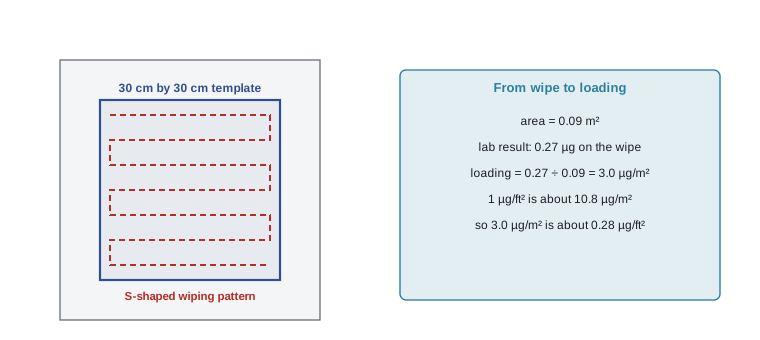
Wipe sampling is used for several purposes: checking that clean-up after lead work is adequate (clearance), checking that lunchrooms, change rooms and vehicles remain clean, and investigating take-home contamination. US federal clearance levels are expressed in µg/ft²; Canadian guidance often uses the same values, sometimes converted to µg/m². One square foot is 0.0929 m², so 1 µg/ft² is about 10.8 µg/m².
SQFT_PER_M2 = 10.764

dlal = {"floor": 5, "window sill": 40, "window trough": 100}   # EPA 2024, ug/ft2

wipes = [
    ("floor, classroom 2", 0.30, 0.09),     # (location, ug on wipe, area m2)
    ("window sill, classroom 2", 2.9, 0.06),
    ("floor, hallway", 0.85, 0.09),
]
for loc, ug, area_m2 in wipes:
    per_m2 = ug / area_m2
    per_ft2 = per_m2 / SQFT_PER_M2
    surface = "window sill" if "sill" in loc else "floor"
    limit = dlal[surface]
    verdict = "passes" if per_ft2 < limit else "fails"
print(f"{loc:26s} {per_m2:6.1f} ug/m2 = {per_ft2:5.1f} ug/ft2 -> {verdict} ({limit} ug/ft2)")floor, classroom 2 3.3 ug/m2 = 0.3 ug/ft2 -> passes (5 ug/ft2) window sill, classroom 2 48.3 ug/m2 = 4.5 ug/ft2 -> passes (40 ug/ft2) floor, hallway 9.4 ug/m2 = 0.9 ug/ft2 -> passes (5 ug/ft2)
In this illustration the hallway floor fails a 5 µg/ft² clearance value and must be cleaned again and re-tested. Canada has no national dust-lead clearance standard for occupational settings, so the clearance criteria should be written into the contract and control plan before work begins, often by adopting the US values.
Step 4: how much lead have workers absorbed?
Air and surface sampling show how much lead is around workers. Blood lead testing shows how much they have actually absorbed, by both inhalation and ingestion, so it reflects the combined effect of controls, respirators and hygiene. A worker whose air samples are low but whose blood lead is rising may be eating with contaminated hands, using a poorly fitting respirator or being exposed off the job, for example through a hobby such as casting fishing weights or shooting at an indoor range. Lesson 11 explains blood lead programs.
Putting the assessment together
A full lead assessment for a job usually combines all four steps:
| Question | Tool | Timing |
|---|---|---|
| Is lead present, and how much? | XRF, paint chip analysis or presumption | Before the job is priced and planned |
| How much is in the air? | Personal air sampling, objective data | At the start of each new operation and when methods change |
| Are surfaces clean? | Wipe sampling | In hygiene areas during the job and for clearance at the end |
| How much have workers absorbed? | Blood lead testing | Before starting, during the job and at its end, as Lesson 11 describes |
Worked problem
Investigating a rising blood lead result
A painter on a bridge repainting project has blood lead results of 12, 19 and 27 µg/dL over three months. Air sampling during abrasive blasting showed low exposure inside the supplied-air helmet. What should be checked?
Show solution
- Respirator use: is the helmet worn the whole time, including during clean-up when blasting stops? Is it being removed inside the containment?
- Hygiene: does the worker wash hands and face before eating, drinking or smoking? Are the decontamination unit, showers and clean lunch area being used?
- Clothing and vehicles: is work clothing left at the site? Wipe samples from the worker's car could reveal contamination.
- Other tasks: is the worker also doing tasks with less protection, such as handling spent abrasive or changing filters?
- Off-work exposure: does the worker have hobbies involving lead, such as shooting or casting?
Answer: Rising blood lead with low air results inside the respirator points to ingestion, unprotected tasks or off-work sources. The investigation should look at the whole day, not only the main task.
Soil and exterior surfaces
Lead does not stay on the building. Decades of exterior paint weathering, past use of leaded gasoline and earlier careless removal work can leave soil around older buildings, bridges and industrial sites contaminated. Exterior work such as scraping siding, blasting a water tank or demolishing a garage can add more. Soil sampling, usually composite samples from the drip line around a building and from play areas, gives a baseline before work and confirms that the work did not add contamination. Ground sheeting under exterior work, careful collection of paint chips and HEPA vacuuming of the sheeting at the end of each day prevent most soil contamination. Because children play in soil, results near homes, schools and daycares matter most.
Quality in sampling
Lead results can only be trusted if samples are collected and analyzed properly. A few habits make a large difference:
- Use a laboratory accredited for lead analysis in the relevant matrix: air filters, wipes, paint or soil.
- Record exactly where each sample was taken, the area wiped or the air volume, and the conditions at the time.
- Include blank samples, wipes or filters handled the same way but not exposed, to detect contamination of the sampling materials.
- Change gloves between wipe samples and never touch the wipe surface with bare hands.
- Keep a chain-of-custody record so that the results can be relied on if they are challenged.
Good records also allow results to be compared over time and between projects, which builds the objective data that make future assessments faster and cheaper.
Common mistakes
MistakeAssuming paint is lead-free because a spot test kit was negative.
InsteadConfirm negatives with XRF or laboratory analysis, or presume lead is present.
MistakeTesting only the top layer of paint.
InsteadInclude all layers down to the substrate; older lower layers usually contain the most lead.
MistakeConfusing per cent by weight with mg/cm².
InsteadRemember laboratory chips report concentration by weight, XRF reports loading per area.
MistakeRelying only on air sampling.
InsteadAdd wipe sampling of hygiene areas and blood lead testing to capture ingestion and take-home routes.
MistakeComparing a µg/m² wipe result with a µg/ft² criterion without converting.
InsteadConvert: 1 µg/ft² is about 10.8 µg/m².
Summary and key terms
- Determine whether materials contain lead using XRF, paint chip analysis or presumption; spot test kits are mainly useful for confirming presence.
- Paint chip results are in per cent by weight or mg/kg; XRF results are in mg/cm²; 1 per cent is 10,000 mg/kg.
- Air sampling uses a 37 mm cassette without a cyclone, analyzed for lead, with TWAs calculated as for silica.
- Removal method strongly affects exposure: torch cutting and dry power sanding produce far higher exposures than wet hand methods.
- Canadian employers should estimate expected exposure for each operation before starting and confirm with sampling.
- Wipe sampling measures surface loading for clearance and hygiene checks; 1 µg/ft² is about 10.8 µg/m².
- Blood lead shows absorbed lead from all routes and helps find failures in hygiene and respirator use.
- X-ray fluorescence (XRF)
- A method of measuring lead in paint in place, reported in mg/cm².
- Paint chip analysis
- Laboratory analysis of paint samples including all layers, reported by weight.
- Parts per million (ppm)
- One part in a million by weight, equal to mg/kg.
- Spot test kit
- A chemical swab that changes colour in contact with lead.
- Wipe sample
- A sample collected by wiping a measured surface area to determine lead loading.
- Lead loading
- The mass of lead per unit area of surface, in µg/ft² or µg/m².
- Clearance
- Testing after lead work to confirm surfaces are clean enough for reoccupation.
- Initial determination
- Under OSHA, the first assessment of whether workers may be exposed at or above the action level.
- Mixed cellulose ester (MCE) filter
- A filter commonly used to collect airborne lead for laboratory analysis.
- Substrate
- The surface under the paint, such as wood, plaster or steel.
Practice problems
Work each problem on paper first, then reveal the answer to check.
Convert 0.5 per cent lead by weight to mg/kg.
Show answer
5,000 mg/kg.
Why must paint chip samples include every layer?
Show answer
Older lower layers usually contain the most lead.
Why is a negative spot test not reliable proof that paint is lead-free?
Show answer
Spot tests can give false negatives, for example when lead is in lower layers.
A filter holds 160 µg of lead after 400 minutes at 2.0 L/min. What is the concentration?
Show answer
160 ÷ 0.8 = 200 µg/m³.
Why is no cyclone used for lead air sampling?
Show answer
The lead limit covers inhalable particles, not only the respirable fraction.
A wipe of 0.09 m² holds 0.6 µg of lead. What is the loading in µg/ft²?
Show answer
0.6 ÷ 0.09 ≈ 6.7 µg/m², or about 0.62 µg/ft².
What is the EPA dust-lead action level for floors?
Show answer
5 µg/ft².
Give two uses of wipe sampling on a lead job.
Show answer
Clearance after clean-up and checking hygiene areas or vehicles for contamination.
Why can blood lead rise when air results are low?
Show answer
Ingestion from poor hygiene, respirator misuse, unprotected tasks or off-work exposure.
When should paint testing be done?
Show answer
Before the job is priced and planned.
Lesson quiz · 5 questions
Score 60% or more to complete this lesson.
Create a free account to save your progress, take quizzes and earn a certificate.