
HSE-242 · Lesson 6 of 12 · 25 min
Engineered stone and other high-risk silica work
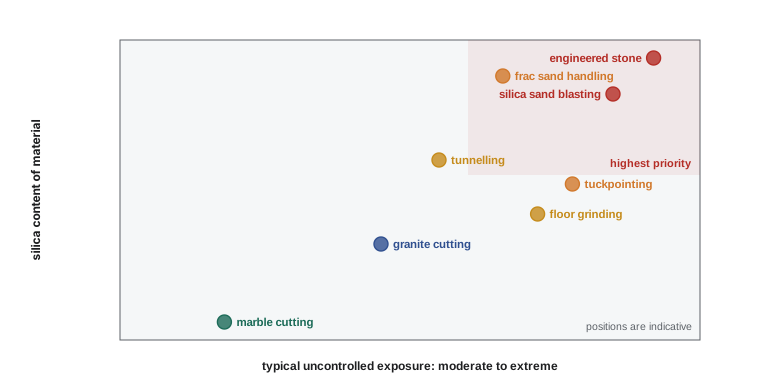
Some silica tasks produce far higher exposures than others, either because the material contains a lot of silica, because the process generates large amounts of fine dust, or because it happens in confined or poorly ventilated spaces. This lesson looks closely at engineered stone fabrication, which has caused an international outbreak of severe silicosis in young workers, and then at other high-risk work: tuckpointing, abrasive blasting, concrete floor grinding, tunnelling and underground work, hydraulic fracturing and foundry work. For each it describes why exposure is high and what controls are expected.
What engineered stone is
Engineered stone, sold under names such as quartz surfacing or artificial stone, is made by binding crushed quartz or other silica with resin and pigments, then pressing and curing it into slabs. It became very popular for kitchen and bathroom countertops from the early 2000s because it is hard, non-porous and available in many colours. Its crystalline silica content is often above 90 per cent, compared with roughly 10 to 45 per cent for natural granite and under 5 per cent for marble.
When engineered stone is cut, edged, polished or drilled, it releases dust that is very rich in respirable crystalline silica. Some research also suggests the dust particles may be especially harmful because of their size, freshly fractured surfaces and the resin and metal additives, although the main driver is the high silica content.
The outbreak
Clusters of accelerated and acute silicosis among engineered stone workers were reported first in Israel and Spain and then in Australia, the United States and elsewhere. Many patients were in their 20s to 40s, some had worked in the trade for less than ten years, and a significant number needed lung transplants or died. The disease was often found late because the workers were young and the illness was not expected.
| Place | What happened |
|---|---|
| Australia | Screening programs found high rates of silicosis among stone benchtop workers. A national ban on the use, supply and manufacture of engineered stone took effect on 1 July 2024, with limited exceptions for repair and removal of existing installations under strict controls. |
| California | The California Department of Public Health had identified more than 560 silicosis cases among stone fabrication workers since 2019 by mid-2026, including at least 31 deaths and nearly 60 lung transplants. Cal/OSHA adopted an emergency standard in December 2023 and a permanent standard in early 2025. In May 2026 the Standards Board voted to begin rulemaking that could prohibit fabricating engineered stone with more than 1 per cent crystalline silica. |
| United States, federal | OSHA has emphasized engineered stone fabrication in its silica enforcement and outreach since 2023. Federal OSHA has not banned the material. |
| Canada | Provincial regulators and worker health centres have issued guidance and warnings about engineered stone, and advocates have called for stronger action. As far as we could find, no Canadian jurisdiction had banned engineered stone as of October 2026. |
Whether to ban engineered stone or control it tightly is debated. Supporters of bans argue that small fabrication shops cannot reliably maintain the very high level of control needed and that lower-silica alternatives exist. Opponents argue that well-controlled shops can work safely, that bans shift work to other high-silica materials, and that enforcement of existing limits is the real problem. Both sides agree that dry cutting and polishing of engineered stone is unacceptable.
Why exposure is so high
The key reason is simple arithmetic: for the same amount of respirable dust in the air, a material with three times the silica content produces about three times the silica exposure.
# Same respirable dust concentration, different materials (illustrative).
respirable_dust = 0.5    # mg/m3 of respirable dust during an edging task

materials = {
    "marble (3% silica)": 0.03,
    "granite (30% silica)": 0.30,
    "engineered stone (90% silica)": 0.90,
}
limits = {"ACGIH TLV / most provinces": 0.025, "OSHA PEL": 0.050}

for name, frac in materials.items():
    rcs = respirable_dust * frac
    ratios = ", ".join(f"{rcs/lim:4.1f}x {lab}" for lab, lim in limits.items())
print(f"{name:30s} {rcs*1000:6.0f} ug/m3 ({ratios})")marble (3% silica) 15 ug/m3 ( 0.6x ACGIH TLV / most provinces, 0.3x OSHA PEL) granite (30% silica) 150 ug/m3 ( 6.0x ACGIH TLV / most provinces, 3.0x OSHA PEL) engineered stone (90% silica) 450 ug/m3 (18.0x ACGIH TLV / most provinces, 9.0x OSHA PEL)
Fabrication shops add to the problem. Work is often done in small, enclosed spaces with several workers near each other, using hand-held grinders and polishers at high speed. Many shops are small businesses with little access to occupational hygiene support. Installation crews may also cut and adjust slabs on site in kitchens without controls.
Controls for engineered stone fabrication
Because exposures can be so high, engineered stone requires the full set of controls, rigorously maintained:
| Control | What good practice looks like |
|---|---|
| Substitution | Consider lower-silica alternatives such as porcelain, sintered stone or solid surface products, checking the safety data sheet; some low-silica engineered products are now marketed |
| Automated wet processing | Use computer-controlled wet saws and water-jet cutters in enclosures for most cutting and shaping |
| Wet hand tools | Use only hand-held tools with integrated water feed for edging, polishing and adjustments; no dry methods at all |
| Ventilation | Provide general ventilation to dilute residual mist and local exhaust where practical; keep wet areas separate from offices and lunchrooms |
| Water management | Collect and recycle or settle water; clean up slurry before it dries; wet-clean floors at least daily |
| Respirators | Provide respirators selected for the measured exposure, often powered air-purifying respirators, under a full respirator program |
| Exposure monitoring | Sample regularly, because small changes in technique or equipment can raise exposure sharply |
| Health surveillance | Provide baseline and periodic medical examinations with chest imaging read by trained readers, as covered in Lesson 11 |
| Installation | Plan cut-outs and adjustments at the shop; if site cutting is unavoidable, use wet or shrouded tools and keep occupants away |
In Canada, regulators expect these controls under the general silica requirements, and WorkSafeBC and Ontario worker health organizations have published specific guidance for stone fabricators.
Tuckpointing and mortar removal
Tuckpointing, grinding out old mortar joints before repointing, is one of the highest-exposure construction tasks. Mortar can contain a lot of silica, the grinder throws dust directly toward the worker's face, and work is often done at height on scaffolds where the worker cannot step away. Uncontrolled exposures many times the limit have been measured. Lesson 5 worked through the control set: shrouded grinders with properly sized vacuums, respirators even with controls, access restrictions and HEPA clean-up.
Abrasive blasting
Blasting with silica sand to clean or prepare surfaces generated some of the worst historical silicosis outbreaks, including acute silicosis. The sand fractures on impact into fine, freshly broken respirable particles, and the coating being removed may add other hazards, such as lead. Many jurisdictions now restrict or prohibit silica sand for blasting or require alternative abrasives. Where blasting is unavoidable, it should be done in an enclosed blast room or cabinet with ventilation, and blasters need supplied-air blasting helmets. Workers nearby must also be protected.
Concrete floor grinding and polishing
Grinding and polishing concrete floors is common in commercial, warehouse and residential work. Walk-behind and ride-on grinders abrade large areas of silica-rich concrete. Wet grinding or dry grinding with an integrated, high-capacity dust collection system with a HEPA filter is essential. Dry grinding without collection, or using a collector that is too small or poorly maintained, produces very high exposures for the operator and anyone else in the building.
Tunnelling, mining and underground work
Drilling, blasting, mucking and shotcreting in tunnels and mines can produce high silica exposures in confined spaces where ventilation is the main control. Controls include wet drilling, water sprays at transfer points, enclosed and filtered cabs on equipment, adequate ventilation airflow designed by a specialist, and good scheduling so that workers are not in the dust plume after blasting. Mining is often regulated under separate mining regulations, such as MSHA rules in the United States and mining-specific provincial regulations in Canada.
Hydraulic fracturing
Hydraulic fracturing uses large quantities of silica sand, called frac sand, pumped into wells to hold fractures open. Moving the sand with pneumatic transfer, conveyors and sand movers at the well site releases respirable dust. NIOSH field studies in the early 2010s found that a large share of samples at well sites exceeded the silica limits, prompting controls such as enclosed transfer systems, dust collection on sand movers, closing fill ports, reducing drop heights and using alternative proppants where practical.
Foundries
Foundries use silica sand for moulds and cores. Shake-out, where castings are knocked out of sand moulds, and fettling and cleaning castings with grinders and blasting are high-exposure tasks. Heating can convert some quartz to cristobalite. Controls include enclosed and ventilated shake-out stations, local exhaust on grinding benches, mechanized handling, substitute mould materials where feasible and good housekeeping.
Demolition and renovation
Demolition of concrete and masonry structures can release large quantities of silica dust, especially with breakers, crushers and saws. Water sprays and misting cannons, enclosed cabs and keeping workers away from the active zone are the main controls. Renovation adds another complication: older buildings may contain lead paint and asbestos alongside silica, so a pre-work hazard assessment must look for all three. Lessons 7 to 10 cover lead, and HSE-246 covers asbestos.
Worked problem
Reviewing a fabrication shop
A small countertop shop cuts engineered stone slabs on a wet bridge saw, then edges and polishes them with hand-held grinders. Two of the four grinders have water feeds; the other two are used dry for quick touch-ups. Floors are swept at the end of the day. Workers wear disposable filtering facepieces with no fit testing. Air sampling has never been done. What should change first?
Show solution
- Stop all dry grinding and polishing immediately: replace or retrofit the two dry grinders with integrated water feeds.
- Change housekeeping from dry sweeping to wet cleaning or HEPA vacuuming, and clean up slurry before it dries.
- Arrange personal air sampling to find out how high exposures are with the improved controls.
- Set up a respirator program under HSE-240, including medical evaluation and fit testing, with respirators selected for the measured exposure; powered air-purifying respirators are often needed.
- Arrange medical surveillance for all fabricators, including workers who have left, where possible.
- Consider lower-silica alternative materials and automated wet cutting for more of the work.
Answer: The most urgent change is to eliminate dry methods and dry sweeping. Then measure, fix the respirator program, start health surveillance and look at substitution.
Common mistakes
MistakeTreating engineered stone like granite.
InsteadRecognize that engineered stone often has two to three times the silica content and needs stricter controls.
MistakeAllowing occasional dry touch-ups on engineered stone.
InsteadProhibit all dry cutting, grinding and polishing of engineered stone.
MistakeUsing silica sand for abrasive blasting because it is cheap.
InsteadUse alternative abrasives and enclosed blasting with supplied-air helmets.
MistakeAssuming a dust collector works because it is running.
InsteadCheck airflow, filter condition and pre-separator, and sample to confirm exposure is controlled.
MistakeLooking only for silica in renovation work.
InsteadCheck for lead paint and asbestos too before work starts.
Summary and key terms
- Engineered stone often contains more than 90 per cent crystalline silica and has caused severe silicosis in young fabricators internationally.
- Australia banned engineered stone from 1 July 2024; California adopted a permanent standard in 2025 and began rulemaking on a possible prohibition in 2026.
- For the same respirable dust level, silica exposure rises in proportion to silica content.
- Engineered stone needs substitution where possible, automated wet processing, wet hand tools only, wet housekeeping, respirators, monitoring and health surveillance.
- Tuckpointing, abrasive blasting, floor grinding, tunnelling, frac sand handling and foundry work are other high-risk tasks.
- Each high-risk task has recognized controls, but they must be maintained and verified by sampling.
- Renovation and demolition can involve silica, lead and asbestos together.
- Engineered stone
- A manufactured surfacing material made of crushed quartz bound with resin, often over 90 per cent crystalline silica.
- Accelerated silicosis
- Silicosis that develops within about 5 to 10 years of high exposure.
- Tuckpointing
- Removing and replacing mortar between bricks, usually with grinders.
- Abrasive blasting
- Cleaning or preparing surfaces by propelling abrasive particles at high speed.
- Supplied-air blasting helmet
- A respirator hood supplied with clean breathing air, used for abrasive blasting.
- Frac sand
- Silica sand used in hydraulic fracturing to keep fractures in rock open.
- Shake-out
- The foundry process of removing castings from sand moulds.
- Fettling
- Cleaning and finishing castings by grinding and chipping.
- Proppant
- A material, often silica sand, that holds open fractures in hydraulic fracturing.
- Sintered stone
- A surfacing material made by fusing minerals at high temperature, often lower in crystalline silica than engineered stone.
Practice problems
Work each problem on paper first, then reveal the answer to check.
Respirable dust during edging is 0.3 mg/m³. What is the silica exposure for a 92 per cent silica product?
Show answer
0.276 mg/m³, or 276 µg/m³.
Why were many engineered stone silicosis patients young?
Show answer
Very high exposures caused accelerated silicosis within a few years of starting work.
When did Australia's engineered stone ban take effect?
Show answer
1 July 2024.
Give two arguments made against banning engineered stone.
Show answer
Well-controlled shops can work safely, and bans may shift work to other high-silica materials rather than improving enforcement.
Why is tuckpointing a high-exposure task?
Show answer
Mortar can be high in silica, the grinder throws dust toward the face, and work at height limits movement away from dust.
What respiratory protection is used for abrasive blasting?
Show answer
A supplied-air blasting helmet.
What makes frac sand handling a silica hazard?
Show answer
Pneumatic transfer and conveyors release respirable dust from large amounts of silica sand.
Why can foundry work involve cristobalite?
Show answer
Heating quartz sand to high temperatures converts some of it to cristobalite.
What other hazards should be checked before renovating an older building?
Show answer
Lead paint and asbestos.
What is the single most important rule for engineered stone fabrication?
Show answer
No dry cutting, grinding or polishing at all.
Lesson quiz · 5 questions
Score 60% or more to complete this lesson.
Create a free account to save your progress, take quizzes and earn a certificate.