
HSE-242 · Lesson 12 of 12 · 27 min
Capstone: a silica and lead exposure control plan
This capstone brings the course together. You will work through a combined silica and lead exposure control plan for the renovation of an older building, from hazard identification to clearance, and then review a weak draft plan to find its gaps. The building, the company and all figures are invented for the exercise. Treat the result as a model for the kind of thinking a plan needs, not as a template to copy without professional review.
The project
Maple Ridge Community Hall is a two-storey brick building constructed in 1938, with a concrete block addition from 1962 and a steel-framed gymnasium. The owner plans an eight-week renovation while the building is closed. The work includes:
- Removing and replacing 40 original wooden windows and their trim, painted many times since 1938.
- Cutting a new doorway through a 200 mm concrete block wall in the addition.
- Cutting two openings in the original brick walls for new ventilation ducts.
- Chasing grooves in plaster-on-brick walls for new electrical conduit.
- Grinding the concrete floor of the gymnasium before applying a new finish.
- Cutting and removing two painted steel beams in the gymnasium to make way for a mezzanine.
- Daily clean-up and final cleaning before the building reopens to the public, including a daycare program.
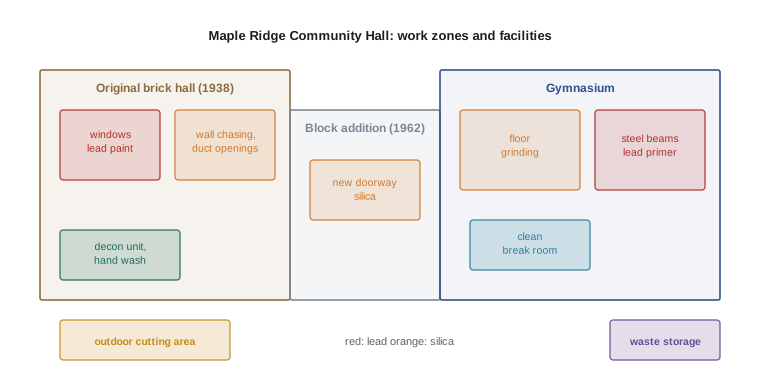
Step 1: identify the hazards
Before any planning, the project team commissions a hazardous materials survey. The survey finds lead in the window paint (XRF readings of 2.4 to 9.8 mg/cm²) and in the primer on the gymnasium steel beams (laboratory result 6.1 per cent by weight). The plaster and joint compounds tested negative for asbestos, but the survey recommends stopping work and re-testing if suspect materials are found during demolition, as HSE-246 describes. The brick, block, mortar and concrete are presumed to contain crystalline silica.
| Task | Silica | Lead | Expected exposure without controls |
|---|---|---|---|
| Window and trim removal | Low | Yes, paint up to 9.8 mg/cm² | Moderate lead if scraped dry or heat-stripped |
| New doorway in block wall | Yes | Possibly, if wall is painted; test | Very high silica with dry saw |
| Duct openings in brick | Yes | No | Very high silica with dry saw or chipping |
| Wall chasing | Yes | Check paint on plaster | High silica with dry chaser |
| Floor grinding | Yes | No | Very high silica without dust collection |
| Steel beam removal | No | Yes, 6.1 per cent primer | Extreme lead fume if torch cut |
| Clean-up | Yes | Yes | High if dry swept |
Step 2: estimate exposure
With no sampling data for this exact job, the team uses task-based guidance and published data for similar tasks to estimate exposure with and without the planned controls. The estimates are deliberately conservative and will be checked by sampling in the first week.
# Illustrative task exposure estimates (ug/m3, during the task) with and without controls.
tasks = [
    # task, agent, uncontrolled, fraction remaining with controls, hours per day
    ("block doorway, wet walk-behind saw", "silica", 1500, 0.08, 2),
    ("brick openings, wet saw and shrouded chipping", "silica", 1200, 0.12, 3),
    ("wall chasing, shrouded chaser + HEPA vac", "silica", 900, 0.06, 4),
    ("floor grinding, integrated HEPA collector", "silica", 2000, 0.03, 6),
    ("window trim, wet scraping", "lead", 120, 0.25, 6),
    ("steel beams, cold cutting after strip-back", "lead", 3000, 0.02, 3),
]
limits = {"silica": 25, "lead": 50}   # ug/m3 8-h TWA used for this plan

print(f"{'task':46s} {'controlled':>10s} {'8-h TWA':>8s} {'x limit':>8s}")
for task, agent, unc, frac, hrs in tasks:
    controlled = unc * frac
    twa = controlled * hrs / 8          # assume no other exposure that day
print(f"{task:46s} {controlled:10.0f} {twa:8.1f} {twa / limits[agent]:8.1f}")task controlled 8-h TWA x limit block doorway, wet walk-behind saw 120 30.0 1.2 brick openings, wet saw and shrouded chipping 144 54.0 2.2 wall chasing, shrouded chaser + HEPA vac 54 27.0 1.1 floor grinding, integrated HEPA collector 60 45.0 1.8 window trim, wet scraping 30 22.5 0.5 steel beams, cold cutting after strip-back 60 22.5 0.5
Even with good engineering controls, several silica tasks are estimated to remain above the 25 µg/m³ limit used for the plan, and the steel beam removal remains above the lead limit. Respirators will therefore be required for those tasks, and sampling will check the estimates. The plan uses 25 µg/m³ for silica and 50 µg/m³ for lead as its internal limits.
These are the ACGIH values adopted in most provinces. If the project were in Ontario, the legal quartz limit would be higher, but using the lower value gives better protection and is good practice.
Step 3: choose controls task by task
| Task | Primary controls | Respirator | Notes |
|---|---|---|---|
| Window and trim removal | Replace whole windows rather than strip in place; remove trim intact; wet scraping only where paint must be removed; no torches or high-temperature heat guns; HEPA-shrouded sanders only | Half-facepiece with P100 filters until sampling confirms low exposure | Plastic sheeting under and around each window; work area signs |
| New doorway in block wall | Wet walk-behind saw for the outline; wet hand saw for corners; pre-plan cuts to minimize cutting | Half-facepiece with P100 filters | Restrict access within the zone; clean slurry while wet |
| Duct openings in brick | Wet saw; shrouded chipping hammer connected to HEPA vacuum; core drill with water where possible | Half-facepiece with P100 filters; higher protection if sampling shows need | Seal openings to adjacent rooms |
| Wall chasing | Shrouded wall chaser with HEPA vacuum sized to the tool; consider surface-mounted conduit to eliminate some chasing | Half-facepiece with P100 filters | Check paint on plaster for lead first |
| Floor grinding | Grinder with integrated shroud and HEPA dust collector of adequate capacity; or wet grinding with slurry control | Half-facepiece with P100 filters, or PAPR for full-shift operators | Keep others out of the gymnasium during grinding |
| Steel beam removal | Strip primer back from cut lines with HEPA-shrouded needle gun; cold-cut with saws or hydraulic shears; no torch cutting | PAPR with HEPA filters during strip-back; half-facepiece P100 during cold cutting | Containment around each cut; decontamination required |
| Clean-up | HEPA vacuums and wet wiping; no dry sweeping or compressed air | Half-facepiece with P100 filters during heavy clean-up | Daily and final clean-up |
Note how elimination and substitution appear first in several rows: replacing whole windows, eliminating some chasing with surface-mounted conduit and replacing torch cutting with cold cutting each remove large exposures before engineering controls are even considered.
Step 4: hygiene, access and waste
Because both lead and silica are present, the plan sets up hygiene facilities from the first day:
- A decontamination unit at the main work entrance with dirty, shower and clean rooms, used by anyone leaving the steel beam and window zones.
- Hand-wash stations with soap, warm water and paper towels at each zone exit.
- A clean break room in a separate office, entered only after removing coveralls and washing.
- Employer-supplied disposable coveralls and boot covers, bagged as lead waste.
- Work zones marked with signs and barriers; entry limited to trained workers wearing required protection.
- Lead waste (paint chips, sheeting, coveralls, filters) in sealed, labelled bags, stored in a locked outdoor container and tested or disposed of as hazardous waste as required. Silica slurry settled and disposed of with construction waste, never washed into storm drains.
Step 5: monitoring, surveillance and training
| Element | Plan |
|---|---|
| Air sampling | Personal sampling for silica on the doorway, brick opening, chasing and floor grinding tasks in week 1, and for lead during window work and steel strip-back; repeat when tasks or controls change |
| Surface sampling | Weekly wipe samples in the break room and decontamination clean room; final clearance wipes in all rooms before reopening |
| Clearance criteria | Written into the contract: floors below 5 µg/ft² (about 54 µg/m²), window sills below 40 µg/ft² and troughs below 100 µg/ft², because a daycare program will use the building |
| Blood lead | Baseline before work, at 4 weeks and at the end of the project for workers in lead zones; internal investigation level 10 µg/dL |
| Silica surveillance | Confirm workers are enrolled in the employer's or union's silica surveillance program as required |
| Respirator program | Medical evaluation, fit testing and training under HSE-240 before work starts |
| Training | Pre-job training on both hazards, controls, hygiene, signs of lead poisoning and the plan; daily tailgate briefings |
Step 6: cost and schedule
Controls cost money and time, and the plan is more likely to be followed if those costs are built into the bid and schedule rather than discovered on site.
# Illustrative cost of the control plan for an 8-week project (currency units)
costs = {
    "HEPA vacuums, shrouds and wet saws (rental)": 9_800,
    "floor grinder with HEPA collector (rental)": 6_500,
    "decontamination unit and hand-wash stations": 7_200,
    "containment materials and signs": 3_400,
    "disposable coveralls, boot covers, filters": 4_100,
    "PAPRs (purchase, reusable)": 5_600,
    "air and wipe sampling with laboratory fees": 6_800,
    "blood lead tests (3 rounds x 6 workers)": 1_350,
    "training and fit testing": 2_900,
    "hazardous waste disposal": 3_700,
}
total = sum(costs.values())
contract = 640_000
for item, c in costs.items():
    print(f"{item:46s} {c:>8,}")
print(f"{'total control cost':46s} {total:>8,}")
print(f"share of an illustrative {contract:,} contract: {total / contract:.1%}")
extra_days = 4
print(f"allowance for set-up, decontamination and clean-up: {extra_days} working days")HEPA vacuums, shrouds and wet saws (rental) 9,800 floor grinder with HEPA collector (rental) 6,500 decontamination unit and hand-wash stations 7,200 containment materials and signs 3,400 disposable coveralls, boot covers, filters 4,100 PAPRs (purchase, reusable) 5,600 air and wipe sampling with laboratory fees 6,800 blood lead tests (3 rounds x 6 workers) 1,350 training and fit testing 2,900 hazardous waste disposal 3,700 total control cost 51,350 share of an illustrative 640,000 contract: 8.0% allowance for set-up, decontamination and clean-up: 4 working days
In this illustration, the controls cost under a tenth of the contract value. Building that cost into the bid protects workers, protects the children who will use the building afterwards and avoids the much larger costs of stoppages, re-cleaning, claims and penalties.
Reviewing a weak draft plan
Before the plan above was written, a subcontractor submitted the draft below. Reviewing it is good practice for spotting the gaps that appear again and again.
| Draft plan statement | Problem | Correction |
|---|---|---|
| "Workers will wear dust masks when cutting." | Dust masks are not defined; no engineering controls; respirators are the only control | Specify wet or shrouded tools for each task and respirators selected under a program |
| "Steel beams will be removed with an oxy-fuel torch for speed." | Torch cutting lead-primed steel creates extreme lead fume | Strip back and cold-cut; prohibit torch cutting on lead coatings |
| "Sweep up at the end of each day." | Dry sweeping re-suspends silica and lead dust | HEPA vacuum and wet wipe |
| "Workers may eat in the gym during breaks." | Eating in a lead and silica work area causes ingestion | Provide a clean break room entered only after washing |
| "Air sampling will be done if workers complain." | Complaints are a poor trigger; silica and lead are often symptomless | Sample at the start of each high-exposure task and when conditions change |
| "Workers will take coveralls home to wash." | Take-home lead can poison children | Use disposable coveralls or employer laundering |
| "Final cleaning by visual inspection." | Lead dust is invisible at levels that harm children | Clearance wipe sampling against written criteria |
| No mention of blood lead testing or asbestos | Absorption and other hazards go undetected | Baseline and periodic blood lead tests; asbestos survey and stop-work procedure |
Worked problem
Responding to the first week's sampling
In week 1, personal sampling shows the floor grinder operator at 46 µg/m³ of respirable silica as an 8-hour TWA, against an estimate of about 45 µg/m³. The operator wears a half-facepiece respirator with P100 filters (assigned protection factor 10). A wipe sample in the break room shows 18 µg/ft² of lead. What should the supervisor do?
Show solution
- Silica: the result matches the estimate and exceeds the 25 µg/m³ plan limit, so the respirator is needed. Inside an APF 10 respirator the estimated exposure is about 4.6 µg/m³, acceptable if the respirator is fitted and worn correctly. Check the collector's airflow and filter, and consider a PAPR for comfort over a full shift.
- Lead in the break room: 18 µg/ft² shows lead is being tracked in. Re-clean the room, reinforce the rule that coveralls are removed and hands washed before entry, check the decontamination unit is being used and repeat the wipe sample.
- Blood lead: bring forward testing for workers in the lead zones if the break room contamination has gone on for some days.
- Communicate the results to the crew and the joint health and safety committee or representative, explaining what will change.
Answer: The silica result confirms respirators are needed and the controls are performing as expected; the break room result shows a hygiene failure that must be fixed immediately and verified by re-sampling.
Common mistakes
MistakeWriting one generic plan for all tasks.
InsteadPlan controls task by task, because exposures and controls differ widely.
MistakeStarting with respirators.
InsteadStart with elimination and substitution, then engineering controls, then respirators for what remains.
MistakeAssuming estimates are correct without sampling.
InsteadVerify estimates with air sampling early in the job and when conditions change.
MistakeLeaving clearance criteria undefined.
InsteadWrite numeric clearance criteria into the contract before work begins.
MistakeLeaving control costs out of the bid.
InsteadInclude controls, hygiene, sampling, surveillance and waste costs in the bid and schedule.
Summary and key terms
- A combined plan starts with a hazardous materials survey for lead, silica and asbestos before work is planned.
- Exposure is estimated task by task from guidance and data, then verified with sampling early in the job.
- Controls follow the hierarchy: replacing whole components, eliminating cuts and cold cutting steel remove the largest exposures.
- Engineering controls, respirators, hygiene facilities, access control and proper waste handling work together.
- Monitoring includes air and wipe sampling, written clearance criteria, blood lead testing and silica surveillance.
- Control costs are modest relative to contract value and should be built into the bid and schedule.
- Reviewing weak plans for vague respirator statements, torch cutting, dry sweeping, eating in work areas and take-home clothing catches common failures.
- Hazardous materials survey
- An inspection and testing of a building to identify materials such as lead paint, asbestos and silica-containing materials before work.
- Exposure control plan
- A written plan describing tasks, expected exposures, controls, hygiene, monitoring and responsibilities.
- Internal limit
- An exposure limit an employer adopts that is stricter than the legal requirement.
- Strip-back
- Removing coatings from the area of a cut before cutting, to avoid creating fume.
- Clearance criteria
- Numeric surface or air levels that must be met before an area is reoccupied.
- Tailgate briefing
- A short safety meeting at the work site, usually at the start of a shift.
- Sentinel finding
- A sampling or health result that signals a control failure needing immediate action.
- Work zone
- A marked area where specific hazards and controls apply.
- Decontamination unit
- A facility with dirty, shower and clean rooms used when leaving lead work areas.
- Hazardous waste
- Waste regulated because of its potential to harm health or the environment, such as some lead debris.
Practice problems
Work each problem on paper first, then reveal the answer to check.
Why should a hazardous materials survey come before planning?
Show answer
The plan depends on knowing which materials contain lead, silica or asbestos.
Give two elimination or substitution choices from the Maple Ridge plan.
Show answer
Replacing whole windows, surface-mounted conduit instead of chasing, and cold cutting instead of torch cutting.
A task's controlled exposure is 120 µg/m³ for 3 hours with no other exposure. What is the 8-hour TWA?
Show answer
45 µg/m³.
What is the exposure inside an APF 10 respirator if the outside concentration is 46 µg/m³?
Show answer
About 4.6 µg/m³, if the respirator is fitted and worn correctly.
Why are clearance criteria written into the contract?
Show answer
So there is an agreed numeric standard for when the work is finished, instead of relying on visual inspection.
What does a lead wipe result of 18 µg/ft² in the break room indicate?
Show answer
Lead is being tracked into the clean area, showing a hygiene failure.
Why is "workers will wear dust masks" a weak plan statement?
Show answer
It does not specify respirators, a program or the engineering controls that should come first.
Why must torch cutting of lead-primed steel be prohibited?
Show answer
It produces extreme lead fume exposures.
When should blood lead tests be done on this project?
Show answer
Baseline before work, partway through and at the end, plus sooner if hygiene problems are found.
Why include control costs in the bid?
Show answer
So controls are funded and scheduled rather than cut when they appear as surprise costs.
Lesson quiz · 5 questions
Score 60% or more to complete this lesson.
Create a free account to save your progress, take quizzes and earn a certificate.