
HSE-242 · Lesson 8 of 12 · 28 min
Lead law and exposure limits
Lead is regulated by two families of law. Occupational health and safety law protects workers by setting airborne exposure limits and requiring assessment, controls, hygiene and medical surveillance. Environmental and consumer law controls lead in paint and products and, in the United States especially, regulates renovation work in older homes to protect children and occupants. A supervisor on a renovation job may need to follow both. This lesson summarizes the rules as they stood in October 2026; always check the current regulation and any guidance from your regulator.
Airborne exposure limits
Most jurisdictions set the airborne limit for lead and its inorganic compounds at 0.05 mg/m³ (50 µg/m³) as an 8-hour time-weighted average. This is also the ACGIH TLV. Unlike silica, the limit applies to inhalable lead rather than only the respirable fraction, so samples are collected with a closed-face cassette or an inhalable sampler rather than a cyclone. Because lead is also absorbed by swallowing, and because blood lead integrates both routes, airborne limits are always paired with hygiene rules and biological monitoring.
OSHA lead standards
OSHA has two lead standards: 29 CFR 1910.1025 for general industry and 29 CFR 1926.62 for construction. Both set a PEL of 50 µg/m³ and an action level of 30 µg/m³ as 8-hour TWAs, and both contain detailed requirements for exposure assessment, compliance programs, respirators, protective clothing, hygiene facilities, medical surveillance and medical removal protection.
| Requirement | General industry (1910.1025) | Construction (1926.62) |
|---|---|---|
| PEL and action level | 50 and 30 µg/m³ | 50 and 30 µg/m³ |
| Shifts longer than 8 hours | PEL reduced to 400 ÷ hours worked | PEL reduced to 400 ÷ hours worked |
| Initial assessment | Determine whether any employee may be exposed at or above the action level | Same, plus interim protection (respirators, clothing, hygiene, blood tests) for listed trigger tasks such as abrasive blasting, torch cutting, dry scraping and manual demolition until assessment shows lower exposure |
| Written compliance program | Required where exposure exceeds the PEL | Required where exposure exceeds the PEL, reviewed at least every 6 months |
| Hygiene | Change rooms, showers where feasible above the PEL, lunchrooms, no eating or smoking in exposed areas | Change areas, hand-washing facilities, showers where feasible, eating areas |
| Medical surveillance | Blood lead monitoring for workers at or above the action level more than 30 days a year | Blood lead monitoring for workers at or above the action level on any day, and medical exams for those exposed more than 30 days a year |
| Medical removal | At 60 µg/dL, or an average of the last three tests at 50 µg/dL or more | At 50 µg/dL or more |
| Return to work | After two consecutive results below 40 µg/dL | After two consecutive results below 40 µg/dL |
OSHA's lead standards date from 1978 for general industry and 1993 for construction, and their blood lead triggers reflect the science of that time. In 2022 OSHA published an advance notice of proposed rulemaking asking about lowering the blood lead levels that trigger medical removal, but no proposal to change them had followed by October 2026. Separately, in July 2025 OSHA proposed revisions intended to reduce compliance burdens and align the respirator provisions with its respiratory protection standard; the record was reopened for comment in July 2026, and the proposal was not final.
Adjusting for long shifts
OSHA's lead standards include their own adjustment: for shifts longer than 8 hours, the maximum permissible limit in µg/m³ equals 400 divided by the hours worked. For a 10-hour shift, the limit is 40 µg/m³; for 12 hours, about 33 µg/m³. The action level is not adjusted by this formula.
def osha_lead_limit(hours):
    return 400 / hours if hours > 8 else 50.0

def brief_scala(limit, hours):
    return limit * (8 / hours) * ((24 - hours) / 16)

for h in (8, 10, 12):
    print(f"{h:2d} h shift: OSHA lead limit {osha_lead_limit(h):5.1f} ug/m3, "
f"Brief and Scala on 50 ug/m3 {brief_scala(50, h):5.1f} ug/m3")8 h shift: OSHA lead limit 50.0 ug/m3, Brief and Scala on 50 ug/m3 50.0 ug/m3 10 h shift: OSHA lead limit 40.0 ug/m3, Brief and Scala on 50 ug/m3 35.0 ug/m3 12 h shift: OSHA lead limit 33.3 ug/m3, Brief and Scala on 50 ug/m3 25.0 ug/m3
The OSHA formula reduces the limit in proportion to hours worked, while Brief and Scala also allows for shorter recovery time and so reduces it further. Both show that a 12-hour shift needs a substantially lower airborne concentration to give the same protection.
Biological limits and guidance values
Blood lead is the best measure of how much lead a worker has absorbed, so several bodies publish blood lead values. They have different purposes and should not be confused.
| Value | Level | Purpose |
|---|---|---|
| OSHA medical removal | 60 µg/dL general industry (or 3-test average 50); 50 µg/dL construction | Mandatory removal with pay and benefits protected |
| OSHA return to work | Two consecutive results below 40 µg/dL | End of removal |
| ACGIH biological exposure index (BEI) | 20 µg/dL | Guidance for industrial hygiene practice |
| CSTE and CDC reference value | 3.5 µg/dL | Identifies adults and children with blood lead higher than most of the population |
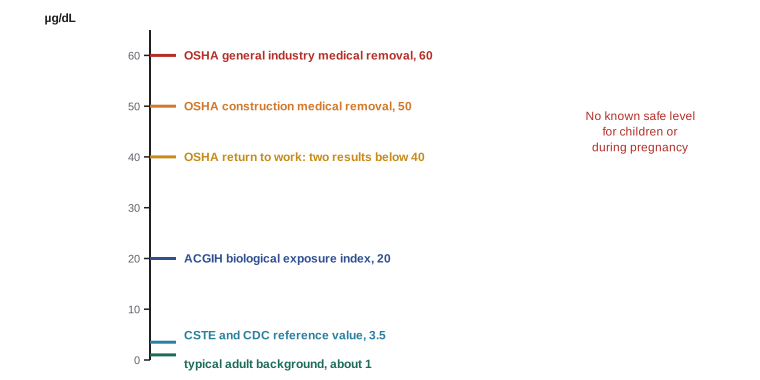
Many occupational physicians and public health agencies now recommend keeping workers' blood lead well below the old regulatory triggers, for example below about 10 µg/dL and lower for workers who are or may become pregnant. Employers can and often do set internal action levels lower than the legal minimum.
EPA rules for renovation and abatement
The Environmental Protection Agency regulates work on lead paint in housing built before 1978 and in child-occupied facilities such as schools and daycares. The Renovation, Repair and Painting (RRP) Rule requires firms to be certified and work to be supervised by a certified renovator using lead-safe work practices whenever renovation disturbs more than 6 square feet of painted surface per room inside or more than 20 square feet outside. It prohibits open-flame burning, heat guns at 1,100 °F or higher, and high-speed machine removal such as sanding, grinding or blasting without HEPA exhaust control. Separate abatement rules govern projects designed to permanently eliminate lead paint hazards. In November 2024 the EPA tightened the dust-lead standards used after abatement: the new clearance values, called dust-lead action levels, are 5 µg/ft² for floors, 40 µg/ft² for window sills and 100 µg/ft² for window troughs, effective January 2025 with compliance from January 2026 for some elements. The Department of Housing and Urban Development has related rules for federally assisted housing.
Under federal US definitions, lead-based paint is paint containing at least 1.0 mg/cm² of lead or 0.5 percent lead by weight. The OSHA standards, however, apply to any lead exposure regardless of paint concentration: even paint below the EPA definition can produce exposures above the action level when it is torch-cut or blasted.
Other duties
Lead regulations and guidelines typically also require:
- Hazard signs at the boundaries of areas where exposure may exceed the limit.
- Protective clothing provided, cleaned and replaced by the employer, never taken home for laundering.
- Training on the hazards, controls, hygiene, medical surveillance and the worker's rights.
- Records of exposure assessments, blood lead results and medical removal, kept for long periods.
- Waste management under environmental rules for lead-containing debris, paint chips, blasting media, filters and wash water.
Worked problem
Applying OSHA and EPA rules to a renovation
A contractor will remove lead-painted window frames from a 1920s school during summer break, using heat guns below 1,100 °F and hand scraping. What rules apply?
Show solution
- The work is construction, so OSHA 1926.62 applies. Heat-gun stripping and manual scraping are trigger tasks requiring interim protection until exposure is assessed.
- The school is a child-occupied facility built before 1978, so the EPA RRP Rule also applies: a certified firm, a certified renovator, lead-safe work practices and cleaning verification.
- An exposure assessment should confirm actual exposures, and blood lead testing should follow the applicable requirements.
- Clean-up must leave the school safe for children before they return, using HEPA vacuums and wet cleaning, with waste handled under environmental rules.
Answer: Both OSHA's construction lead standard and the EPA RRP Rule apply. The contractor needs worker protection under OSHA and certification and lead-safe practices under the EPA.
Going beyond the minimum
Legal limits for lead were set decades ago and lag behind current health evidence, so many employers adopt stricter internal policies. These policies are usually simple to write and cheap to follow, and they protect the company as well as its workers, because a crew whose blood lead stays low is a crew whose controls are working.
| Internal policy | Typical content | Why it helps |
|---|---|---|
| Internal blood lead action levels | Investigation at about 10 µg/dL, increased testing at about 20 µg/dL, reassignment well before the legal removal level | Problems are corrected while blood lead is still low |
| Prohibited methods | No open-flame burning, no dry power sanding or grinding without HEPA collection, no dry sweeping, no compressed air | Removes the highest-exposure methods from the job entirely |
| Pre-job lead survey | Testing or presumption of lead for every coating that will be disturbed | Ensures precautions start on day one |
| Reproductive health protection | Confidential access to the physician for workers who are pregnant, planning pregnancy or breastfeeding, with reassignment without loss of pay | Protects the fetus and supports workers who might otherwise hide a pregnancy |
| Hygiene audits | Supervisor checklist for washing, eating areas, clothing and vehicles at least weekly | Catches the slow drift away from good habits |
Lead exposure outside the workplace
When a worker's blood lead is high, the cause is not always the job. Hobbies such as casting fishing weights or bullets, shooting at indoor ranges, stained glass, renovating an older home, some traditional remedies and cosmetics, and imported ceramic dishware with lead glazes can all raise blood lead. Programs should ask about these sources in a respectful, confidential way. Finding an off-work source does not end the employer's responsibility: the worker still needs support, and the workplace controls should still be checked, because both sources may be contributing.
State rules and public health reporting
Many states require laboratories to report blood lead results to the state health department, and state adult blood lead surveillance programs, often supported by NIOSH, follow up elevated results with workers and employers. Some state plans have adopted stricter lead rules than federal OSHA; California, for example, adopted revised lead standards in February 2024, effective from January 2025, that lower the PEL to 10 µg/m³ and the action level to 2 µg/m³ and require medical removal at a single result of 30 µg/dL or two consecutive results of 20 µg/dL or more. Employers operating in several states should check each state's requirements. Public health follow-up is not an enforcement action, but it often leads to workplace visits and recommendations, and OSHA may receive referrals.
Worked problem
Setting an internal blood lead policy
A painting contractor with 30 workers does regular repainting of older buildings and bridges. Its current practice is simply to follow the legal minimum. What internal blood lead policy would you propose?
Show solution
- Baseline testing for every worker before their first lead job, and at least every two to three months while doing lead work.
- An investigation level of 10 µg/dL: the supervisor and safety staff review the worker's tasks, respirator fit and hygiene within a week.
- An increased-testing level of 20 µg/dL: test monthly, correct controls and consider temporary reassignment to non-lead work.
- Reassignment, with pay protected, at a level well below the legal removal level, as advised by the program physician.
- Confidential reproductive health counseling, and reassignment on request for workers who are pregnant or planning pregnancy.
Answer: A tiered internal policy keeps blood lead low, finds control failures early and protects workers who are most vulnerable, at modest cost.
Common mistakes
MistakeSampling lead with a respirable cyclone.
InsteadUse a closed-face cassette or inhalable sampler; the lead limit is not limited to the respirable fraction.
MistakeTreating the legal medical removal level as a safe blood lead level.
InsteadAim to keep blood lead much lower; current evidence shows harm well below old regulatory triggers.
MistakeComparing a 12-hour lead result with the 8-hour limit.
InsteadUse the OSHA formula of 400 ÷ hours for shifts over 8 hours.
MistakeAssuming paint below a consumer product limit is safe to burn or blast.
InsteadAssess worker exposure; high-energy methods can create harmful exposures from low-lead paint.
MistakeLetting workers take lead-contaminated clothing home to wash.
InsteadProvide, launder and dispose of protective clothing at the employer's expense.
Summary and key terms
- Most jurisdictions set an airborne lead limit of 0.05 mg/m³ (50 µg/m³) as an 8-hour TWA, applied to inhalable lead.
- OSHA 1910.1025 and 1926.62 set a PEL of 50 µg/m³ and action level of 30 µg/m³, with interim protection for construction trigger tasks.
- For shifts over 8 hours, OSHA's lead limit is 400 ÷ hours worked.
- OSHA requires medical removal at 60 µg/dL in general industry and 50 µg/dL in construction, with return below 40 µg/dL.
- Current health evidence supports keeping blood lead far below old regulatory triggers, especially for workers who may become pregnant.
- The EPA RRP Rule governs renovation of pre-1978 housing and child-occupied facilities, and the EPA tightened dust-lead clearance levels in 2024.
- Lead rules also require signs, protective clothing, training, records and proper waste handling.
- Inorganic lead
- Metallic lead and its inorganic compounds, such as oxides and salts, the forms covered by most occupational limits.
- Action level (lead)
- Under OSHA, 30 µg/m³ as an 8-hour TWA; it triggers monitoring, training and medical surveillance.
- Medical removal protection
- Removal of a worker with high blood lead from exposure, with protection of pay and benefits where the law provides it.
- Trigger task
- In OSHA construction rules, a task presumed to produce high lead exposure until assessed.
- Lead-based paint
- Under federal US definitions, paint with at least 1.0 mg/cm² or 0.5 percent lead by weight.
- RRP Rule
- The US EPA Renovation, Repair and Painting Rule for work disturbing paint in pre-1978 housing and child-occupied facilities.
- Dust-lead action level
- The EPA clearance value for dust-lead loading after abatement, such as 5 µg/ft² on floors.
- Surface Coating Materials Regulations
- Canadian regulations limiting total lead in new paints and coatings to 90 mg/kg.
- Biological exposure index (BEI)
- An ACGIH guidance value for blood lead of 20 µg/dL.
- Closed-face cassette
- A filter holder used to sample total or inhalable airborne dust such as lead.
Practice problems
Work each problem on paper first, then reveal the answer to check.
What is the usual airborne limit for lead?
Show answer
0.05 mg/m³ (50 µg/m³) as an 8-hour TWA.
Why is lead sampled without a respirable cyclone?
Show answer
The limit applies to inhalable lead, and larger particles are also absorbed after being swallowed.
What is the OSHA lead action level?
Show answer
30 µg/m³ as an 8-hour TWA.
What is the OSHA lead limit for a 10-hour shift?
Show answer
400 ÷ 10 = 40 µg/m³.
What does Brief and Scala give for a 50 µg/m³ limit on a 12-hour shift?
Show answer
25 µg/m³.
At what blood lead level does OSHA require removal in construction?
Show answer
50 µg/dL.
Why do many physicians recommend keeping blood lead below about 10 µg/dL?
Show answer
Evidence shows harm to blood pressure, kidneys, the nervous system and reproduction at levels below old regulatory triggers.
When does the EPA RRP Rule apply?
Show answer
When renovation disturbs more than 6 ft² per room inside or 20 ft² outside in pre-1978 housing or child-occupied facilities.
Why can low-lead paint still produce high exposures?
Show answer
Torch cutting and blasting release large amounts of fine fume and dust even from low concentrations.
List three other duties found in lead rules.
Show answer
Hazard signs, protective clothing, training, records and waste management.
Lesson quiz · 5 questions
Score 60% or more to complete this lesson.
Create a free account to save your progress, take quizzes and earn a certificate.