
HSE-242 · Lesson 5 of 12 · 26 min
Controlling silica dust
Silica dust can be controlled very effectively with tools and methods that are widely available. Water, well-designed vacuum dust collection and good planning can reduce exposure by 90 per cent or more for most common tasks. This lesson works through the hierarchy of controls for silica, explains how wet methods and local exhaust ventilation work, shows how to size a dust collector, and describes housekeeping, administrative controls and the place of respirators. HSE-240 covers respirator selection and fit testing; this lesson only explains how respirators fit into a silica control plan.
The hierarchy of controls applied to silica
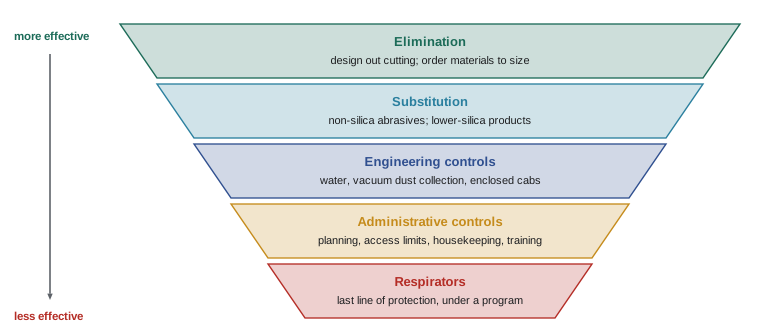
Controls at the top of the hierarchy are more reliable because they do not depend on people remembering to use them. In practice, most silica tasks need a combination: an engineering control at the source, supported by work practices and housekeeping, with respirators where the remaining exposure is still too high.
Elimination and substitution
The most effective control is to avoid creating silica dust at all. This often has to be decided at the design or planning stage, long before workers arrive on site.
- Design out cutting and drilling. Cast-in anchors, sleeves and openings in concrete avoid later coring and drilling. Ordering block, pavers and stone cut to size at a controlled facility moves the dust to a place where it can be controlled better.
- Choose methods that make less dust. Splitting pavers with a block splitter instead of cutting them; using powder-actuated fasteners or adhesive instead of drilling; bursting or crushing concrete instead of jackhammering where feasible.
- Substitute materials. Use non-silica abrasives for blasting, such as steel grit, garnet with low free silica, crushed glass or dry ice. Choose lower-silica products where they meet the design need, such as porcelain or sintered surfaces in place of high-silica engineered stone, and check their silica content on the safety data sheet.
Wet methods
Water suppresses dust by wetting particles at the point where they are created, making them heavier so that they fall rather than become airborne. Wet methods are simple, cheap and effective when done properly. Studies of wet cutting with masonry saws commonly report reductions in respirable silica of 80 to over 90 per cent compared with dry cutting.
For wet methods to work:
- Water must reach the point of cutting or grinding continuously, through an integrated water feed on the tool or a nozzle aimed at the blade or bit, not by occasionally spraying the surface.
- The flow must be enough to wet the dust throughout the task. Follow the tool manufacturer's recommended flow rate; too little water produces a fine mist of dusty droplets that can dry and become airborne.
- Slurry must be cleaned up before it dries, because dried slurry turns back into respirable dust.
- Electrical safety must be managed with ground-fault protection and tools designed for wet use. Water also creates slip hazards and, in cold weather, ice.
Local exhaust ventilation and vacuum dust collection
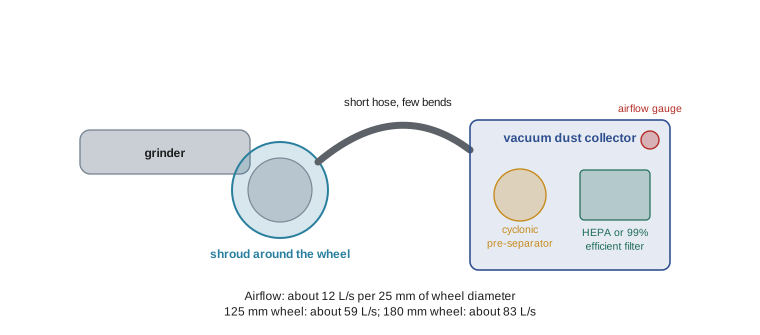
Local exhaust ventilation (LEV) captures dust at the source before it reaches the worker's breathing zone. For hand tools, this means a shroud around the blade, wheel or bit connected to a vacuum dust collector. For stationary equipment, it may mean a hood connected to a fan and filter. An effective tool-mounted system has four parts working together:
| Part | What it must do |
|---|---|
| Shroud or hood | Enclose as much of the cutting point as possible, fitted to the specific tool and blade size |
| Hose | Be the right diameter and as short and straight as practical, because bends and length reduce airflow |
| Vacuum unit | Provide enough airflow for the tool, as specified by the tool manufacturer or recognized guidance |
| Filter | Capture fine particles with high efficiency: a HEPA filter or one rated at least 99 per cent efficient, with a cyclonic pre-separator or filter-cleaning mechanism to maintain airflow |
Sizing the vacuum
Recognized guidance for hand-held grinders used for mortar removal and surface grinding calls for a vacuum providing at least 25 cubic feet per minute of airflow per inch of wheel diameter, about 11.8 litres per second for each 25 millimetres. The figure comes from OSHA's Table 1 and is widely used in Canadian guidance and by tool manufacturers. A 125 mm (5-inch) grinder therefore needs about 59 L/s, and a 180 mm (7-inch) grinder about 83 L/s. Vacuums are often rated by their maximum airflow with no hose or filter load, so the airflow delivered at the shroud is usually lower than the label suggests.
CFM_PER_INCH = 25          # recognized airflow guidance for grinders
LPS_PER_CFM = 0.4719       # 1 cfm = 0.4719 L/s

def required_airflow(wheel_inches):
    cfm = CFM_PER_INCH * wheel_inches
    return cfm, cfm * LPS_PER_CFM

for wheel_in, wheel_mm in ((4.5, 115), (5, 125), (7, 180), (9, 230)):
    cfm, lps = required_airflow(wheel_in)
    print(f"{wheel_mm} mm ({wheel_in} in) wheel: at least {cfm:5.1f} cfm = {lps:5.1f} L/s")

# Effect of losses: a vacuum rated at 150 cfm open-flow may deliver far less.
rated = 150
for loss, cause in ((0.25, "long hose"), (0.40, "long hose and partly loaded filter")):
    delivered = rated * (1 - loss)
    ok = "enough" if delivered >= 175 else "not enough"
print(f"rated {rated} cfm, {cause}: about {delivered:.0f} cfm delivered, {ok} for a 7 in grinder")115 mm (4.5 in) wheel: at least 112.5 cfm = 53.1 L/s 125 mm (5 in) wheel: at least 125.0 cfm = 59.0 L/s 180 mm (7 in) wheel: at least 175.0 cfm = 82.6 L/s 230 mm (9 in) wheel: at least 225.0 cfm = 106.2 L/s rated 150 cfm, long hose: about 112 cfm delivered, not enough for a 7 in grinder rated 150 cfm, long hose and partly loaded filter: about 90 cfm delivered, not enough for a 7 in grinder
The loss figures in the script are illustrative, but the point is real: check the tool and vacuum manufacturers' combined specifications, keep hoses short, empty the pre-separator and clean or change filters as instructed. Some vacuums include an airflow indicator or alarm that warns when airflow falls too low; use one where you can.
Capture velocity and hood placement
For fixed hoods on benches and stationary equipment, what matters is the air speed at the point where dust is released, called the capture velocity. Air speed falls off very quickly with distance from the hood opening; for a simple open hood, the speed at one hood-diameter away is only about a tenth of the speed at the face. Hoods must be placed as close as possible to the source and enclose it where practical. A hood a metre away from a grinding wheel is almost useless.
Enclosed cabs and control rooms
On heavy equipment such as drill rigs, crushers, excavators breaking concrete and milling machines, an enclosed cab with filtered, pressurized air can protect the operator. The cab must be sealed, with doors and windows closed during dusty work, a filtration system with high-efficiency filters, positive pressure to keep dust out, and heating and cooling so that operators do not open windows. Cabs must be kept clean; a dusty cab floor becomes a source of exposure.
Combining controls
Controls work together. If one control removes 90 per cent of the dust and a second removes 50 per cent of what remains, the combined reduction is 95 per cent, not 140 per cent. Each control acts on what the previous one left behind, so the fractions remaining multiply.
uncontrolled = 1200   # ug/m3, illustrative dry-cutting exposure during the task

controls = [
    ("integrated water feed", 0.90),
    ("cutting outdoors, worker upwind", 0.30),
    ("reduced cutting time by pre-ordering sizes", 0.50),
]

remaining = uncontrolled
for name, reduction in controls:
    remaining *= (1 - reduction)
    print(f"after {name:42s} {remaining:7.1f} ug/m3")

overall = 1 - remaining / uncontrolled
print(f"overall reduction {overall:.1%}")

for apf, resp in ((10, "half-facepiece, APF 10"), (25, "loose-fitting PAPR, APF 25")):
print(f"inside {resp}: about {remaining / apf:.1f} ug/m3 if worn and fitted correctly")after integrated water feed 120.0 ug/m3 after cutting outdoors, worker upwind 84.0 ug/m3 after reduced cutting time by pre-ordering sizes 42.0 ug/m3 overall reduction 96.5% inside half-facepiece, APF 10: about 4.2 ug/m3 if worn and fitted correctly inside loose-fitting PAPR, APF 25: about 1.7 ug/m3 if worn and fitted correctly
Even after a 96 per cent reduction, a very dusty uncontrolled task can still leave exposure above the limit during the task, which is why respirators are still needed for some tasks. The respirator calculation depends on the assigned protection factors and fit testing covered in HSE-240.
Administrative controls and work practices
Administrative controls change how work is organized rather than the equipment used. For silica they include:
- Planning and sequencing so that dusty tasks happen when fewer people are nearby, for example cutting before other trades arrive.
- Restricting access to areas where dusty work is under way, with signs, barriers or a designated cutting area set up downwind and away from air intakes.
- Positioning workers upwind of outdoor cutting and away from the dust plume.
- Maintenance schedules for water feeds, shrouds, hoses and filters.
- Training and supervision so that workers know how to set up controls and supervisors check they are used.
Job rotation, moving workers between dusty and clean tasks to reduce each person's exposure, is generally not recommended for carcinogens like silica. It spreads the risk across more people rather than reducing the total.
Housekeeping
Settled dust is a reservoir of future exposure. Clean up with wet methods, such as wetting the dust and scooping or mopping it up, or with a vacuum fitted with a HEPA filter. Do not dry sweep, dry brush or use compressed air on silica dust, as Lesson 3 explained. Clean up slurry before it dries. Dispose of collected dust in sealed bags or containers so that it does not become airborne again.
Respirators in the silica control plan
Respirators are needed where engineering and administrative controls cannot keep exposure low enough, during the time it takes to install other controls, and in emergencies. For silica, typical choices are filtering facepiece or elastomeric half-facepiece respirators with particulate filters, full-facepiece respirators and powered air-purifying respirators, chosen according to the expected exposure and the assigned protection factor. A respirator program with medical evaluation, fit testing, training and maintenance must be in place, as described in HSE-240. Respirators should never be the only control for a task where engineering controls are available.
Worked problem
Building a control set for tuckpointing
A crew will remove mortar from the brick walls of a three-storey building with hand-held grinders for several weeks. What combination of controls should the plan include?
Show solution
- Elimination or substitution: consider whether some joints can be raked out with less dusty methods, but grinding will still be needed for most of the work.
- Engineering: grinders with commercially available shrouds connected to vacuums providing about 12 L/s per 25 mm of wheel diameter, with HEPA or 99 per cent filters and cyclonic pre-separators.
- Work practices: keep the shroud flush against the wall, avoid tilting the grinder, empty the pre-separator and check airflow regularly.
- Administrative: restrict access below and around the work area, schedule work when building occupants are away, and train the crew.
- Respirators: because tuckpointing remains a high-exposure task even with controls, provide respirators selected under the employer's program; provincial guidance commonly calls for at least a half-facepiece with P100 filters and a higher level of protection for longer durations.
- Housekeeping: HEPA vacuuming and wet clean-up of scaffold boards and the ground below at the end of each shift.
Answer: The plan combines source capture, work practices, access control, respirators and housekeeping. No single control is enough for this high-exposure task.
Common mistakes
MistakeSpraying the surface occasionally while cutting dry.
InsteadFeed water continuously to the point of cutting at the manufacturer's recommended rate.
MistakeUsing a shop vacuum without a high-efficiency filter.
InsteadUse a vacuum with a HEPA or 99 per cent efficient filter and a pre-separator, sized for the tool.
MistakeTrusting the vacuum's open-flow rating.
InsteadCheck the delivered airflow with the hose and filter in place, and keep hoses short and filters clean.
MistakeRotating workers through dusty tasks to keep each one under the limit.
InsteadReduce the exposure itself; rotation spreads carcinogen risk across more workers.
MistakeLeaving slurry to dry and sweeping it up later.
InsteadClean up slurry while wet, or vacuum dried residue with a HEPA vacuum.
Summary and key terms
- The hierarchy of controls applies: eliminate, substitute, engineer, administer, then protect with respirators.
- Planning can eliminate much cutting and drilling through cast-in features and ordering materials to size.
- Wet methods reduce respirable silica by 80 to over 90 per cent when water reaches the cutting point continuously.
- Vacuum dust collection needs a fitted shroud, short hose, enough airflow (about 12 L/s per 25 mm of grinder wheel) and a high-efficiency filter with a pre-separator.
- Hood capture velocity falls rapidly with distance, so hoods must be close to or enclose the source.
- Combined controls multiply the fractions remaining; even large reductions may leave high-exposure tasks needing respirators.
- Housekeeping uses wet methods and HEPA vacuums, never dry sweeping or compressed air, and job rotation is not a substitute for reducing exposure.
- Wet method
- A control that applies water at the point of dust generation to prevent dust from becoming airborne.
- Local exhaust ventilation (LEV)
- A system that captures contaminants at the source with a hood, ductwork, filter and fan.
- Shroud
- A cover around a blade, wheel or bit that connects to a vacuum to capture dust.
- HEPA filter
- A high-efficiency particulate air filter that captures at least 99.97 per cent of particles at the most penetrating size.
- Cyclonic pre-separator
- A device that removes most dust before it reaches the filter, keeping airflow high.
- Capture velocity
- The air speed needed at the dust source to draw dust into the hood.
- Enclosed cab
- A sealed equipment cab with filtered, pressurized air that protects the operator.
- Job rotation
- Moving workers between tasks to reduce individual exposure, not recommended for carcinogens.
- Slurry
- The wet mixture of water and dust produced by wet cutting, which becomes respirable dust when dry.
- Assigned protection factor (APF)
- The expected level of protection a properly used respirator provides, covered in HSE-240.
Practice problems
Work each problem on paper first, then reveal the answer to check.
Give two ways to eliminate drilling in concrete at the design stage.
Show answer
Cast-in anchors and sleeves, or openings formed before the concrete is placed.
Why must water be fed continuously to the cutting point?
Show answer
Intermittent spraying lets dust escape between applications and can leave dry spots.
What airflow is recommended for a 115 mm grinder?
Show answer
About 53 L/s (112.5 cfm).
A control removes 85 per cent of dust and a second removes 60 per cent of the rest. What is the combined reduction?
Show answer
1 − (0.15 × 0.40) = 94 per cent.
Why is a vacuum's open-flow rating misleading?
Show answer
The hose, shroud and filter reduce airflow, so delivered airflow is lower.
What does a cyclonic pre-separator do?
Show answer
Removes most dust before the filter, keeping airflow from dropping as the filter loads.
Why is job rotation discouraged for silica?
Show answer
It spreads carcinogen exposure across more workers instead of reducing it.
What makes an enclosed cab effective?
Show answer
A sealed cab, high-efficiency filtration, positive pressure, climate control so windows stay shut, and a clean interior.
Why should slurry be cleaned up before it dries?
Show answer
Dried slurry becomes respirable dust when disturbed.
When are respirators needed in a silica control plan?
Show answer
When other controls cannot keep exposure low enough, while installing other controls, and in emergencies.
Lesson quiz · 5 questions
Score 60% or more to complete this lesson.
Create a free account to save your progress, take quizzes and earn a certificate.