
HSE-242 · Lesson 1 of 12 · 27 min
Why silica and lead are still a problem
Crystalline silica and lead are two of the oldest known occupational hazards. Miners and stonecutters in ancient Greece and Rome were described as short of breath, and Roman writers noted the pallor and weakness of workers who smelted lead. Two thousand years later, both substances still damage the lungs, kidneys, brains and blood of workers every year. This course explains why, and what supervisors, workers and safety representatives can do about it. It is an awareness course: it will help you recognize silica and lead hazards, understand the rules and judge whether controls are adequate. It does not qualify you to design ventilation systems, carry out lead abatement or perform medical surveillance, which need specialists.
This first lesson sets the scene. It explains what makes the two hazards unusual, why they persist despite strong regulation, who is exposed today and how the rest of the course is organized.
What makes these hazards different
Most workplace injuries are sudden and visible: a fall, a cut, a burn. Silica and lead are different in four ways that make them easy to ignore.
| Feature | Silica | Lead | Why it matters |
|---|---|---|---|
| Invisible at harmful levels | The dangerous particles are too small to see; a visible cloud means the exposure is already very high | Lead fume from cutting or burning painted steel is invisible; fine dust settles unseen | Workers judge risk by what they can see, so harmful exposures feel safe |
| Delayed effects | Chronic silicosis usually appears 10 or more years after exposure begins | Chronic effects on kidneys, nerves and blood pressure develop over years | By the time disease appears, the exposure that caused it is long past |
| Irreversible damage | Silicosis scarring does not heal and often keeps progressing after exposure stops | Some nerve and kidney damage is permanent | Prevention is the only effective strategy |
| Common materials | Concrete, brick, mortar, stone, sand, tile and many soils contain silica | Lead is in old paint, solder, batteries, ammunition, scrap and some alloys | Exposure happens in ordinary trades, not only in specialized industries |
These features explain a pattern that occupational hygienists see repeatedly. A crew cuts concrete without water for years with no obvious harm; the risk seems exaggerated; controls are dropped to save time. When a worker is finally diagnosed, the connection to that work is hard to prove and the damage cannot be undone.
Silica in brief
Silica is silicon dioxide, one of the most common compounds in the Earth's crust. In its crystalline forms, mainly quartz, the atoms are arranged in a regular lattice. Quartz makes up a large share of sand, sandstone and granite and is a major ingredient of concrete, mortar, brick and many manufactured products. Silica is harmless in a solid block. It becomes dangerous when work breaks the material into a fine dust that can reach the deepest parts of the lungs. Cutting, grinding, drilling, chipping, sanding, blasting and dry sweeping all do this. Lesson 2 explains which particles matter and what they do inside the body.
Lead in brief
Lead is a soft, heavy metal that has been used for thousands of years in pipes, paint, solder, batteries, radiation shielding, ammunition and fuel additives. It has no known useful role in the human body. Workers absorb lead mainly by breathing fume or dust and by swallowing dust that gets onto hands, food, cigarettes or phones. Once absorbed, lead travels in the blood, affects almost every organ system and is stored in bone for decades. Lesson 7 covers how lead enters and harms the body.
Who is exposed today
The best Canadian estimates come from CAREX Canada, a national program that estimates how many workers are exposed to carcinogens. Its figures are modelled from census and industry data rather than counted directly, so treat them as orders of magnitude.
| Hazard | Estimated Canadian workers exposed | Main groups |
|---|---|---|
| Respirable crystalline silica | About 380,000, including about 142,000 in Ontario | Construction trades (labourers, cement finishers, bricklayers, tile setters), mining and quarrying, foundries, stone fabrication |
| Lead | About 273,000 (2016 data) | Welders (about 72,000), police officers using firing ranges, auto mechanics, plumbers, pipefitters |
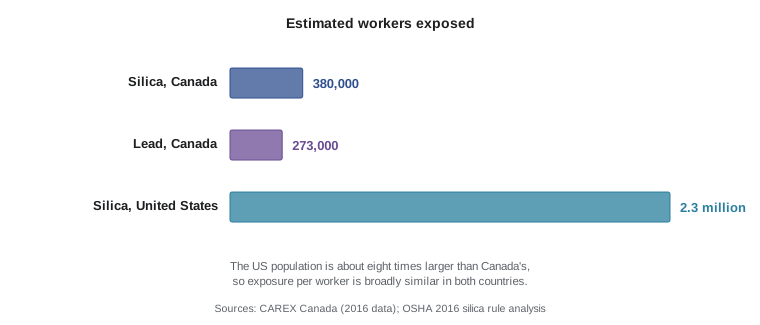
These figures cover workers exposed above background levels, not only those above the legal limits. Many are exposed only occasionally. But even occasional, uncontrolled tasks can produce very high short-term exposures: a single hour of dry cutting with a hand-held saw can deliver more silica than many weeks of controlled work.
Why the problem persists
If the hazards are so well known, why are workers still getting sick? Several reasons come up again and again in investigations and research.
Long latency hides the cost. Employers, workers and insurers see the cost of controls today but the cost of disease decades later, often after the worker has moved on. Compensation systems may never link the disease to its cause.
Small and mobile employers. Much exposure happens in small construction and renovation firms that move from site to site, with limited access to occupational hygiene advice and no in-house monitoring.
Tools have outpaced controls. Modern cordless and high-speed tools cut and grind faster than ever, generating more dust per minute. Without integrated water or vacuum controls, they produce exposures far above older estimates.
New materials and processes. Engineered stone countertops contain much more silica than natural granite and have caused a wave of severe silicosis among young fabricators in several countries since the 2010s. Lesson 6 covers this in detail.
Legacy lead. Lead paint was widely used on homes before the 1960s and on steel bridges, tanks and industrial structures for much longer. Every renovation, demolition or repainting of these surfaces can release lead, and much of the building stock still contains it.
Take-home contamination. Lead dust carried home on clothing, boots and cars can poison children, who are far more sensitive than adults. Silica can also be carried home, though the main risk is to the worker.
The cost of doing nothing
Occupational disease is expensive even when measured only in money. Silicosis and lung cancer claims, lost workdays, medical removal for high blood lead and the replacement of skilled workers all have direct costs. A simple way to see the scale is to compare the cost of controls with the cost of a single case of disease. The figures below are illustrative, not actual claim costs, but the pattern holds in most analyses.
# Illustrative comparison of control costs and disease costs for a small
# concrete-cutting contractor over ten years. All figures are hypothetical.
crew = 8
years = 10

controls = {
    "water-fed saws and grinders (one-time)": 18_000,
    "HEPA vacuums with shrouds (one-time)": 12_000,
    "replacement parts and filters per year": 3_000 * years,
    "training per year": 1_500 * years,
    "air sampling every two years": 2_500 * (years // 2),
}
total_controls = sum(controls.values())

one_case = {
    "lost productivity and replacement": 150_000,
    "claim and medical costs": 400_000,
    "investigation, penalties and legal": 75_000,
}
total_case = sum(one_case.values())

for item, cost in controls.items():
    print(f"{item:42s} ${cost:>9,}")
print(f"{'total control cost over 10 years':42s} ${total_controls:>9,}")
print(f"{'cost per worker per year':42s} ${total_controls / crew / years:>9,.0f}")
print()
print(f"{'cost of one serious case (illustrative)':42s} ${total_case:>9,}")
print(f"cases avoided needed to break even: {total_controls / total_case:.2f}")water-fed saws and grinders (one-time) $ 18,000 HEPA vacuums with shrouds (one-time) $ 12,000 replacement parts and filters per year $ 30,000 training per year $ 15,000 air sampling every two years $ 12,500 total control cost over 10 years $ 87,500 cost per worker per year $ 1,094 cost of one serious case (illustrative) $ 625,000 cases avoided needed to break even: 0.14
In this illustration, the full cost of controls for a crew over ten years is less than a third of the cost of a single serious case. The human cost, which no table can capture, is the stronger argument: silicosis and lead poisoning shorten lives and take away the ability to work, play with children or climb stairs.
Cumulative exposure
For chronic diseases such as silicosis and lung cancer, risk depends mainly on cumulative exposure: the concentration multiplied by the length of time it lasts, summed over a working life. Epidemiologists express this in units such as milligram-years per cubic metre. The idea is simple and useful for supervisors because it shows that both intensity and duration matter, and that a few years of very high exposure can do as much harm as decades of moderate exposure.
Here C is the average concentration during period i, usually in mg/m³, and t is the duration of that period in years of full-time work.
Worked problem
Comparing two careers
Worker A cut concrete dry for 4 years at an average of 0.5 mg/m³ of respirable silica, then worked with controls for 20 years at 0.02 mg/m³. Worker B worked with controls for 30 years at 0.03 mg/m³. Who has the higher cumulative exposure?
Show solution
- Worker A: 0.5 × 4 = 2.0 mg-years/m³ during the dry years.
- Worker A: 0.02 × 20 = 0.4 mg-years/m³ during the controlled years. Total 2.4.
- Worker B: 0.03 × 30 = 0.9 mg-years/m³.
Answer: Worker A has more than two and a half times Worker B's cumulative exposure, almost all of it from the 4 dry years. Short periods of uncontrolled work can dominate a career's exposure.
Cumulative exposure is not the whole story. Acute and accelerated silicosis follow very intense exposures over shorter periods, and blood lead responds to recent exposure within weeks. But the concept explains why controls must be used every day, not only when an inspector or a hygienist is present.
How the course is organized
The course follows the same pattern for each hazard: what it is and how it harms people, what the law requires, how exposure is assessed and how it is controlled. It then covers medical surveillance for both and finishes with a capstone exercise.
| Lessons | Topic |
|---|---|
| 1 | Why silica and lead are still a problem |
| 2 to 6 | Silica: health effects, law and limits, assessing exposure, controls, and engineered stone and other high-risk work |
| 7 to 10 | Lead: sources and health effects, law and limits, assessing exposure, and controls and hygiene |
| 11 | Medical surveillance and health monitoring for both hazards |
| 12 | Capstone: a combined silica and lead exposure control plan for an older building |
Respirators appear in several lessons, but this course does not repeat the selection, fit testing and program requirements covered in HSE-240 Respiratory Protection. Asbestos, which often turns up in the same older buildings as lead paint, has its own course, HSE-246 Working with Asbestos. HSE-104 covers personal protective equipment in general.
Roles and responsibilities
Under provincial occupational health and safety acts, employers must take every precaution reasonable in the circumstances to protect workers, supervisors must ensure workers follow safe procedures and use controls, and workers must use the equipment and procedures provided and report hazards. Joint health and safety committees and representatives have the right to be consulted on exposure assessments and control plans. Lesson 3 covers the specific silica rules and Lesson 8 the lead rules.
Whatever the jurisdiction, the practical duties are similar. Someone must identify where silica and lead are present, estimate how much workers are breathing or swallowing, choose and maintain controls, train workers, check that the controls are used and arrange health monitoring where it is needed. The supervisor is usually the person who sees whether the water is turned on, the vacuum is attached and the wash station is used, so supervisors are central to preventing these diseases.
Common mistakes
MistakeJudging silica exposure by whether visible dust is present.
InsteadAssume any cutting, grinding or drilling of silica-containing material can create harmful respirable dust, visible or not.
MistakeTreating a lack of current illness as proof that past work was safe.
InsteadRemember that silicosis and many lead effects appear years after exposure; absence of disease now proves little.
MistakeAssuming lead is only a problem in factories that make lead products.
InsteadExpect lead in old paint, solder, scrap, batteries and firing ranges, especially during renovation, demolition and repair.
MistakeUsing controls only for long jobs.
InsteadUse controls for short tasks too; brief uncontrolled tasks can dominate cumulative exposure.
MistakeExpecting respirators to replace engineering controls.
InsteadUse respirators as the last line of protection, after elimination, substitution and engineering controls, as covered in HSE-240.
Summary and key terms
- Silica and lead are ancient hazards that still cause irreversible disease in large numbers of workers.
- Both are often invisible at harmful levels, produce delayed effects and are found in common materials.
- CAREX Canada estimates about 380,000 Canadian workers are exposed to silica and about 273,000 to lead; OSHA estimated about 2.3 million US workers exposed to silica.
- The problem persists because of long latency, small and mobile employers, powerful tools, new materials such as engineered stone, legacy lead paint and take-home contamination.
- Chronic disease risk depends on cumulative exposure, so short periods of uncontrolled work can dominate a career.
- Controls cost far less than disease, and supervisors play a central role in making sure they are used.
- This course builds on HSE-240 for respirators and points to HSE-246 for asbestos.
- Crystalline silica
- Silicon dioxide with atoms arranged in a regular lattice, mainly quartz, cristobalite and tridymite.
- Respirable dust
- Dust fine enough to reach the gas-exchange region of the lungs.
- Latency
- The time between the start of exposure and the appearance of disease.
- Cumulative exposure
- The sum of concentration multiplied by duration over a working life.
- CAREX Canada
- A national program that estimates the number of Canadian workers exposed to known and suspected carcinogens.
- Legacy lead
- Lead in existing paint, pipes and structures from past use, released during renovation and demolition.
- Take-home exposure
- Contamination carried from the workplace to the home on clothing, skin, tools or vehicles.
- Silicosis
- Scarring of the lungs caused by inhaling respirable crystalline silica.
- Lead poisoning
- Harm caused by absorbed lead, affecting the blood, nerves, kidneys, reproduction and other systems.
- Awareness training
- Training that helps people recognize a hazard and understand controls, without qualifying them for specialist tasks.
Practice problems
Work each problem on paper first, then reveal the answer to check.
Name three ways silica and lead differ from hazards such as falls or cuts.
Show answer
They are often invisible at harmful levels, their effects are delayed, and the damage is often irreversible.
Why does a visible dust cloud mean silica exposure is already very high?
Show answer
The harmful respirable particles are too small to see, so a visible cloud means a large mass of dust, including respirable particles, is in the air.
List four common materials that contain crystalline silica.
Show answer
Concrete, brick, mortar, sandstone, granite, tile, sand and many soils.
List four places a renovation worker might meet lead.
Show answer
Old paint, solder on pipes, lead flashing, old batteries, scrap metal and contaminated soil.
Worker C worked 2 years at 0.4 mg/m³ and 25 years at 0.025 mg/m³. What is the cumulative exposure?
Show answer
0.8 + 0.625 = 1.425 mg-years/m³.
Why might compensation systems undercount silica disease?
Show answer
Disease appears years after exposure, workers change employers, and the link to work may never be made.
Why has engineered stone caused concern in recent years?
Show answer
It contains much more silica than natural stone and has caused severe silicosis in young fabricators.
Why is take-home lead a particular concern?
Show answer
Children are much more sensitive to lead than adults and can be poisoned by dust brought home.
What does this course not qualify you to do?
Show answer
Design ventilation, perform lead abatement as a specialist or carry out medical surveillance.
Which course covers respirator selection and fit testing in detail?
Show answer
HSE-240 Respiratory Protection.
Lesson quiz · 5 questions
Score 60% or more to complete this lesson.
Create a free account to save your progress, take quizzes and earn a certificate.