
HSE-242 · Lesson 11 of 12 · 25 min
Medical surveillance and health monitoring
Controls aim to prevent exposure; medical surveillance checks whether they have succeeded and catches early harm in individual workers. For silica, surveillance looks for early lung changes and tuberculosis, and provides a baseline for later comparison. For lead, blood lead testing measures how much lead workers are absorbing, often before any symptoms appear, and drives decisions about removing workers from exposure. This lesson explains what each program involves, how results are used and how workers' rights and confidentiality are protected. It is written for supervisors and safety staff, not clinicians: the medical decisions belong to physicians, but the people who organize the program need to understand it.
Why surveillance matters
Surveillance has three purposes. For the individual worker, it detects disease or excessive absorption early, when action can still help. For the employer, it checks whether controls are working: rising blood lead in a crew, or early silicosis in a fabricator, is a signal that exposure is higher than assessments suggested. And for the wider system, surveillance data feed public health programs and research. Surveillance does not prevent disease by itself; it is only useful if results lead to action.
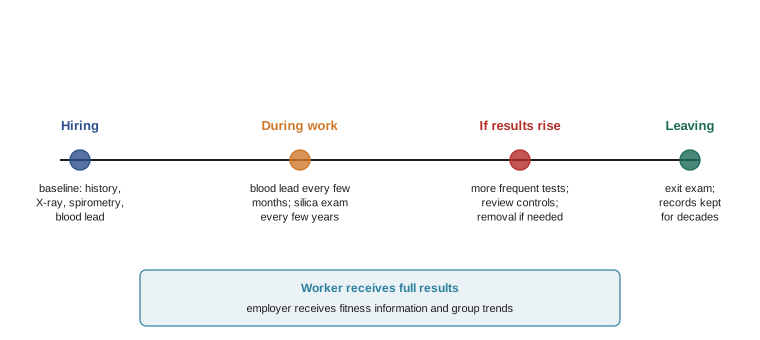
Silica surveillance: what it includes
A silica medical surveillance program usually includes:
| Component | Purpose |
|---|---|
| Occupational and medical history | Records past dust exposure, smoking, respiratory symptoms and conditions that affect risk or respirator use |
| Physical examination | Focuses on the respiratory system |
| Chest X-ray read with the ILO classification | Detects small rounded opacities typical of silicosis and records their profusion in a standard way |
| Spirometry | Measures lung function, including FEV1 and FVC, and tracks decline over time |
| Tuberculosis testing | Detects latent tuberculosis, which silica exposure makes more likely to become active |
| Other tests as indicated | For example CT scans, kidney function tests or referral to a specialist |
Chest X-rays for silica are classified using the International Labour Office (ILO) system. Readers compare the film with standard images and record the profusion of small opacities on a 12-point scale from 0/0 (none) to 3/+ (very many). A profusion of 1/0 or higher is generally considered consistent with pneumoconiosis such as silicosis in a worker with exposure. Because early silicosis may not show on X-ray, and because readings vary between readers, programs use trained readers, and some use CT scans for workers at high risk, such as engineered stone fabricators.
Silica surveillance requirements in Canada
Requirements vary by province. Ontario's designated substance regulation for silica requires medical surveillance for workers likely to be exposed in non-construction workplaces, following the code that accompanies the regulation. Other provinces require health monitoring where a worker's exposure warrants it or where the regulator orders it, and some workers' compensation boards run screening programs for high-risk groups. In construction, surveillance is often organized through unions, worker health centres or employers' voluntary programs. Physicians should be told about workers' silica exposure so that they can watch for silicosis and related diseases.
Interpreting spirometry over time
A single spirometry test is compared with predicted values for a person of the same age, height, sex and ancestry. More useful for surveillance is the trend in an individual's results over time. Lung function declines slowly with age; a faster decline suggests that exposure, smoking or disease is damaging the lungs. One widely used guideline from occupational medicine treats a fall in FEV1 of more than about 15 per cent from baseline, beyond the expected effect of age, as a significant decline that needs follow-up.
# Longitudinal FEV1 review for one worker (illustrative values, L)
baseline_year, baseline_fev1 = 2014, 4.20
normal_decline_per_year = 0.030          # typical age-related decline, L/year (illustrative)

tests = [(2017, 4.11), (2020, 4.02), (2023, 3.71), (2026, 3.38)]

for year, fev1 in tests:
    years = year - baseline_year
    expected = baseline_fev1 - normal_decline_per_year * years
    change = (fev1 - baseline_fev1) / baseline_fev1
    excess = (expected - fev1) / expected
    flag = "follow up" if excess > 0.15 else "within expected range"
    print(f"{year}: FEV1 {fev1:.2f} L, change from baseline {change:+.1%}, "
f"shortfall against age-expected {excess:.1%} -> {flag}")2017: FEV1 4.11 L, change from baseline -2.1%, shortfall against age-expected 0.0% -> within expected range 2020: FEV1 4.02 L, change from baseline -4.3%, shortfall against age-expected 0.0% -> within expected range 2023: FEV1 3.71 L, change from baseline -11.7%, shortfall against age-expected 5.6% -> within expected range 2026: FEV1 3.38 L, change from baseline -19.5%, shortfall against age-expected 12.0% -> within expected range
In this illustration, the worker's lung function tracks the expected age-related decline until about 2020, then falls faster. By 2026 the shortfall exceeds 15 per cent and needs medical follow-up, including review of the worker's exposures and smoking. A trend like this in several workers would also point to a control failure.
Lead surveillance: blood lead testing
Blood lead is the core of lead surveillance. It is measured from a venous blood sample by an accredited laboratory. Many programs also measure zinc protoporphyrin (ZPP), which rises when lead interferes with haemoglobin production and reflects exposure over the past few months. A baseline blood lead test before starting lead work is essential: without it, later results cannot be interpreted, and pre-existing exposure from other jobs or hobbies may be wrongly attributed.
Lead surveillance requirements in Canada
Requirements vary. Ontario's designated substance regulation for lead requires medical surveillance, including blood lead testing, for workers likely to be exposed in non-construction workplaces, and its code specifies testing frequencies and the actions physicians take at different blood lead levels, including removal from exposure. Ontario's construction guideline recommends blood lead testing for workers in higher-exposure lead operations. Other provinces require or recommend biological monitoring where exposure warrants it. Because removal levels and frequencies vary, check the applicable regulation, code or guideline and follow the physician's advice. Many employers adopt internal action levels well below the regulatory triggers.
Using blood lead results
Blood lead results should trigger action well before the legal removal level. A practical approach uses tiers: an internal investigation level where controls and hygiene are reviewed, a higher level where testing becomes more frequent and work practices are corrected, and the removal level where the worker is taken out of lead work.
def review(results_ugdl, internal=10, investigate=20, increased=40, removal=50):
    last = results_ugdl[-1]
    trend = last - results_ugdl[0]
    actions = []
    if last >= removal:
        actions.append("remove from lead exposure; test at least monthly")
    elif last >= increased:
        actions.append("test every 2 months; medical exam; correct controls urgently")
    elif last >= investigate:
        actions.append("investigate controls, respirator use and hygiene; retest sooner")
    elif last >= internal:
        actions.append("above internal target: review controls and hygiene")
    else:
        actions.append("continue routine testing")
    if trend >= 10:
        actions.append(f"rising by {trend} ug/dL since first test: look for a change in tasks or practices")
    return last, actions

workers = {
    "A": [4, 6, 5],
    "B": [8, 14, 22],
    "C": [26, 38, 44],
    "D": [35, 47, 53],
}
for w, res in workers.items():
    last, acts = review(res)
print(f"worker {w}: latest {last} ug/dL -> " + "; ".join(acts))worker A: latest 5 ug/dL -> continue routine testing worker B: latest 22 ug/dL -> investigate controls, respirator use and hygiene; retest sooner; rising by 14 ug/dL since first test: look for a change in tasks or practices worker C: latest 44 ug/dL -> test every 2 months; medical exam; correct controls urgently; rising by 18 ug/dL since first test: look for a change in tasks or practices worker D: latest 53 ug/dL -> remove from lead exposure; test at least monthly; rising by 18 ug/dL since first test: look for a change in tasks or practices
The thresholds in the script are illustrative: the removal and increased-testing levels mirror OSHA's construction rule, while the internal target and investigation levels reflect common good practice. Your program should use the levels required in your jurisdiction and recommended by the program physician.
Pregnancy and reproductive health
Lead crosses the placenta and harms the developing brain, and stored bone lead is released during pregnancy. Workers who are pregnant, planning pregnancy or breastfeeding should be able to discuss their situation confidentially with the program physician, who may recommend keeping blood lead very low, often below about 5 µg/dL, or reassignment away from lead work. Lead also affects male fertility. Information about reproductive risk should be part of training so that workers can make informed decisions.
Confidentiality and workers' rights
Medical surveillance only works if workers trust it. Key principles are:
- The worker receives full results and an explanation from the physician.
- The employer receives limited information, such as fitness for work, any restrictions and aggregate trends, not detailed diagnoses, unless the worker consents. Privacy laws and medical confidentiality rules apply.
- No penalty for participation. Workers must not lose pay or be disciplined because of results; where medical removal protection applies, pay and seniority are protected.
- Records are kept for decades, because diseases such as silicosis and lung cancer appear long after exposure. Retention periods are set by the applicable rules and are often 30 years or more after employment ends.
Aggregate data: finding control failures
Individual results protect individuals; group results protect crews. Reviewing blood lead results by job, crew or project, and silica surveillance findings by task, can reveal control failures that air sampling missed. A crew whose average blood lead rose from 8 to 18 µg/dL over a project has a problem with controls or hygiene, even if no one reached a regulatory trigger. Aggregate, anonymized results should be shared with the joint health and safety committee or representative.
Worked problem
Responding to a silica surveillance finding
A 34-year-old countertop fabricator's periodic chest X-ray is read as ILO profusion 1/1, and spirometry shows FEV1 has fallen 18 per cent from baseline over six years. The worker has been in the trade for eight years. What should happen?
Show solution
- Medical: the physician refers the worker to a respiratory specialist for further assessment, possibly including a CT scan, and explains the findings to the worker.
- Worker: the worker receives counselling on reducing further exposure, smoking cessation if relevant, tuberculosis screening and vaccinations, and information about workers' compensation.
- Workplace: the finding is treated as a sentinel event: review controls, sample exposure and offer surveillance to co-workers.
- Reporting: report the case as required to the regulator or public health authority, and consider whether it qualifies as an occupational disease claim.
- Work placement: discuss options to remove the worker from further silica exposure while protecting income where possible.
Answer: The finding requires specialist referral and support for the worker, and an urgent review of controls in the shop, because one case often means others are at risk.
Common mistakes
MistakeStarting lead work without a baseline blood lead test.
InsteadTest before exposure begins so later results can be interpreted.
MistakeTreating surveillance as a substitute for controls.
InsteadUse surveillance to check that controls work; act on rising results.
MistakeWaiting until blood lead reaches the legal removal level before acting.
InsteadInvestigate controls and hygiene at much lower levels using internal action levels.
MistakeSharing detailed medical results with supervisors.
InsteadGive the employer only the information the rules allow or the worker authorizes; keep medical records confidential.
MistakeLooking only at individual results.
InsteadReview aggregate results by task, crew or project to find control failures.
Summary and key terms
- Medical surveillance detects early harm and excessive absorption in individuals and checks whether controls are working.
- Silica surveillance includes a history, physical exam, chest X-ray read with the ILO classification, spirometry and tuberculosis testing.
- Silica and lead surveillance requirements vary by province; Ontario requires surveillance for designated substances outside construction.
- Spirometry trends matter more than single results; a decline of more than about 15 per cent beyond the age-expected change needs follow-up.
- Blood lead, often with ZPP, is the core of lead surveillance; a baseline test is essential.
- Tiered action levels well below legal removal levels allow early correction of controls and hygiene.
- Workers receive full results, employers limited information, records are kept for decades and aggregate data reveal control failures.
- Medical surveillance
- Systematic health monitoring of exposed workers to detect early harm and check controls.
- ILO classification
- A standard system for reading chest X-rays for pneumoconiosis, recording the profusion of small opacities.
- Profusion
- The density of small opacities on a chest X-ray, graded from 0/0 to 3/+.
- B Reader
- In the United States, a physician certified by NIOSH to classify chest X-rays using the ILO system.
- Spirometry
- A breathing test that measures how much and how fast air can be exhaled.
- FEV1
- Forced expiratory volume in one second, the volume exhaled in the first second of a forced breath.
- FVC
- Forced vital capacity, the total volume exhaled in a forced breath.
- Zinc protoporphyrin (ZPP)
- A blood measure that rises when lead interferes with haemoglobin production.
- Medical removal
- Removing a worker from lead exposure because of high blood lead until it falls.
- Sentinel event
- A case of occupational disease that signals that others may be at risk.
Practice problems
Work each problem on paper first, then reveal the answer to check.
Name the main components of silica medical surveillance.
Show answer
History, physical exam, chest X-ray with ILO classification, spirometry, tuberculosis testing and other tests as indicated.
What ILO profusion is generally considered consistent with silicosis in an exposed worker?
Show answer
1/0 or higher.
Why is tuberculosis testing part of silica surveillance?
Show answer
Silica exposure and silicosis increase the risk of latent tuberculosis becoming active.
A worker's FEV1 was 4.0 L at baseline and the age-expected value now is 3.85 L. The measured value is 3.2 L. Is follow-up needed?
Show answer
Yes: the shortfall is about 17 per cent of the expected value.
Why is a baseline blood lead test essential?
Show answer
Without it, later results cannot be interpreted or attributed correctly.
What does ZPP reflect?
Show answer
Lead's effect on haemoglobin production over the past few months.
Where does Ontario require lead medical surveillance?
Show answer
For workers likely to be exposed in non-construction workplaces under the designated substance regulation.
What blood lead level is often recommended for workers who are pregnant?
Show answer
Very low, often below about 5 µg/dL, as advised by the physician.
What information should the employer receive from surveillance?
Show answer
Limited information such as fitness, restrictions and aggregate trends, unless the worker consents to more.
Why should aggregate results be reviewed?
Show answer
To find control failures affecting groups of workers that individual results or air sampling may miss.
Lesson quiz · 5 questions
Score 60% or more to complete this lesson.
Create a free account to save your progress, take quizzes and earn a certificate.