
HSE-214 · Lesson 9 of 12 · 28 min
De-energizing, lockout and test before touch
The single most effective way to prevent electrical injury is to work on equipment only after it has been de-energized, locked out and proven dead. Workplace electrical safety standards call this establishing an electrically safe work condition, and they make it the default: energized work is the exception that must be justified. This lesson explains what the process involves, what unqualified workers' roles are, and why 'test before touch' matters so much. HSE-210 covers lockout in depth for all forms of hazardous energy; this lesson focuses on the electrical side.
Why de-energize?
De-energizing removes the shock and arc flash hazard at its source. Once a circuit is disconnected from every source of supply, locked so that it cannot be re-energized, and tested to confirm there is no voltage, work can proceed without approach boundaries or arc-rated PPE for the shock and arc flash hazards of that circuit. Many incidents happen because someone believed a circuit was off when it was not: the wrong breaker was opened, a second source was missed, a switch failed, or someone switched it back on.
CSA Z462 requires that energized electrical conductors and circuit parts be put into an electrically safe work condition before an employee works within the limited approach boundary or interacts with equipment where an increased likelihood of injury from arc flash exists, unless energized work is justified. Provincial regulations, such as Ontario's industrial and construction regulations and BC's Part 19, require de-energizing and lockout before work on electrical equipment, with limited exceptions for qualified workers following specific procedures. CSA Z460 covers lockout and other methods of hazardous energy control.
Establishing an electrically safe work condition
A qualified person establishes an electrically safe work condition by following a defined sequence. The steps below summarize the process described in the standards.
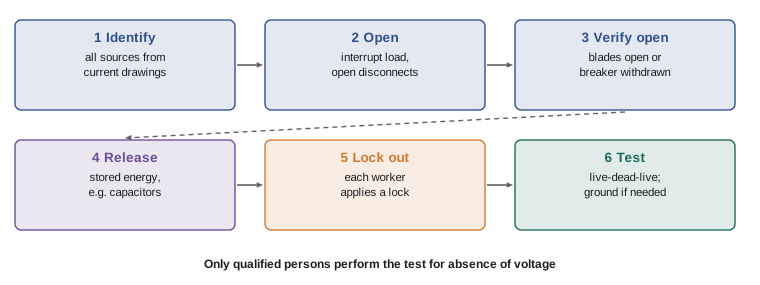
- Identify all possible sources of electrical supply, using up-to-date drawings, diagrams and identification tags. Equipment may have more than one feed, a backup generator, a UPS, or control power from another panel.
- After properly interrupting the load current, open the disconnecting device for each source.
- Where possible, visually verify that all blades of the disconnect are fully open or that drawout breakers are withdrawn to the fully disconnected position.
- Release stored electrical energy, for example from capacitors, and block or release stored mechanical energy.
- Apply lockout devices according to the documented lockout program, with each worker applying their own lock.
- Using an adequately rated test instrument, test each phase conductor or circuit part to verify that it is de-energized. Test phase to phase and phase to ground. Check the tester on a known live source before and after the test.
- Where conductors could become re-energized or induced voltage could appear, apply temporary protective grounding equipment.
Only qualified persons may perform the testing step. Unqualified workers may be affected employees whose equipment is locked out, or may be authorized for lockout of specific machines under a machine-specific procedure, but they must not test for absence of voltage on electrical conductors or work inside electrical equipment.
Test before touch: the live-dead-live check
A voltage tester is only useful if it works. A tester with a dead battery, a broken lead or the wrong range can show zero volts on a live circuit. The live-dead-live method catches this. First, test the tester on a known live source of similar voltage to prove it works. Second, test the circuit you are about to work on, every phase and between phases and ground. Third, test the tester again on the known live source to prove it did not fail during the test. Only then is the circuit treated as dead.
Worked problem
Counting the tests on a three-phase disconnect
A qualified electrician is verifying absence of voltage on the load side of a three-phase, four-wire disconnect (phases A, B, C and neutral N, plus ground G). How many tests are needed, including the live-dead-live checks?
Show solution
- Phase to phase: A-B, B-C, C-A, so 3 tests.
- Phase to ground: A-G, B-G, C-G, so 3 tests.
- Phase to neutral: A-N, B-N, C-N, so 3 tests, and often N-G as well, 1 test.
- Tester checks: 1 before and 1 after on a known source, 2 tests.
- Total: \( 3 + 3 + 3 + 1 + 2 = 12 \) tests.
Answer: About 12 tests. It takes only a minute or two, and it is the step that proves the circuit is really dead.
Test instruments must be rated for the voltage and the measurement category of the location, marked for example CAT III 600 V or CAT IV 600 V, and certified or listed. A non-contact voltage indicator, the pen-style device that beeps near live wires, is useful for a quick check but is not accepted as proof of absence of voltage, because it can miss shielded or DC conductors and can fail silently. Some facilities install permanently mounted absence of voltage testers on equipment, which automate the live-dead-live sequence; they are covered by product standards and can be used as part of the verification where the workplace standard allows.
Stored energy in electrical equipment
Capacitors in variable frequency drives, power supplies, welders, power factor correction banks and large motor circuits can hold a lethal charge after power is removed. Most have bleed resistors that discharge them over a few minutes, but resistors can fail. Equipment labels often state how long to wait before opening, and qualified workers verify discharge with a meter.
Worked problem
Energy in a drive capacitor
A variable frequency drive has a DC bus capacitance of 2,000 µF charged to 650 V. Its bleed resistor is 50 kΩ. Estimate the stored energy and how long it takes the voltage to fall to about 5 % of its starting value (about three time constants).
Show solution
- Energy: \( E = \tfrac{1}{2} \times 0.002 \times 650^2 = 0.001 \times 422{,}500 \approx 423 \) J.
- Time constant: \( \tau = 50{,}000 \times 0.002 = 100 \) s.
- Three time constants: \( 3 \times 100 = 300 \) s, about 5 minutes, after which the voltage is about 5 % of 650 V, roughly 32 V.
- That is why drive labels warn to wait several minutes and to verify zero volts before touching terminals.
Answer: About 420 J stored, and about 5 minutes to fall to roughly 32 V. If the bleed resistor has failed, the charge can remain much longer.
When energized work is justified
Working on or near exposed energized parts is allowed only when it can be justified. The standards recognize two main justifications. First, de-energizing would introduce additional or increased hazards, for example shutting down life-support equipment, emergency alarm systems or ventilation in a hazardous location. Second, de-energizing is infeasible because of equipment design or operational limits, for example diagnostic testing and troubleshooting that can only be done with power on. Inconvenience, cost or production schedules are not acceptable reasons.
Where energized work is justified, the standards require an energized electrical work permit for most tasks, signed by management, describing the work, the justification, the shock and arc flash risk assessment, the boundaries, the PPE, the safe work practices, how unqualified persons will be kept out, and the job briefing. Some tasks, such as testing, troubleshooting and voltage measurement by qualified persons, can be done without a permit when the right safe work practices and PPE are used. Unqualified workers are never part of the energized work itself.
Worked problem
Is energized work justified?
Decide whether each request justifies energized work: (A) replacing a breaker in a panel that feeds the office lights, because shutting down would disturb staff; (B) measuring voltage to troubleshoot a fault on a control circuit that cannot be diagnosed de-energized; (C) adding a circuit to a panel feeding a hospital's life-support equipment in an operating room that is in use.
Show solution
- A: Inconvenience is not a justification. Schedule the work after hours and de-energize.
- B: Diagnostic testing that cannot be done de-energized is an accepted justification, done by qualified persons with appropriate PPE and safe practices.
- C: Shutting down life support would introduce an increased hazard, so energized work may be justified, but the first choice is to plan a safe shutdown with the facility, use alternate feeds, or wait until the room is not in use.
Answer: A is not justified; B is justified; C may be justified but should be avoided through planning if at all possible.
The unqualified worker's role in lockout
Unqualified workers are often affected employees: they operate or work near the equipment that is locked out. They must understand the purpose of lockout, recognize locks and tags, never try to start locked-out equipment, and never remove or tamper with someone else's lock or tag. When work is finished, the authorized person restores the equipment and tells affected employees before re-energizing. Where an unqualified worker is authorized under a machine-specific procedure to lock out a machine, for example at its main disconnect, they apply their own lock and verify that the machine will not start using its normal controls, but they do not open electrical enclosures or test conductors.
Job briefings and communication
Before any work on electrical equipment, the qualified person in charge holds a job briefing with everyone involved. It covers the hazards, the procedures, any special precautions, the energy sources and how they will be controlled, the PPE and the emergency plan. Affected employees are told what will be shut down, for how long and how they will know when it is safe to restart. Good briefings prevent the classic failures of lockout: someone switching equipment back on because they did not know work was under way, or a second source being missed because no one checked the drawings. If anything changes during the job, the briefing is repeated.
Unqualified workers can help by asking questions at briefings, by reporting anything unusual they notice about the equipment, and by keeping clear of the work area until they are told it is safe.
Locks and tags also have to be the right ones. Lockout devices should be durable, standardized and identifiable as belonging to a specific person, and tags should state who applied them and why. Electrical lockout often needs special devices: breaker lockouts that clamp onto a handle, plug lockouts that enclose a cord cap, and group lock boxes for jobs with many isolation points.
Common mistakes
MistakeTurning off a breaker and starting work because the lights went out.
InsteadLock out every source and have a qualified person test for absence of voltage.
MistakeTrusting a non-contact voltage pen to prove a circuit is dead.
InsteadUse a rated tester and the live-dead-live method.
MistakeJustifying energized work because a shutdown is inconvenient.
InsteadOnly increased hazard or true infeasibility justifies energized work.
MistakeAssuming a drive is safe to open right after power is removed.
InsteadWait the labelled time and verify the capacitors are discharged.
MistakeRemoving someone else’s lock to finish a job.
InsteadOnly the person who applied a lock may remove it, except under a formal procedure.
Summary and key terms
- De-energizing, locking out and proving dead is the most effective electrical safety control.
- An electrically safe work condition follows defined steps, ending with testing and grounding where needed.
- The live-dead-live test proves that the tester works before and after checking the circuit.
- Non-contact voltage indicators are not proof of absence of voltage.
- Capacitors store energy after power is removed; E = ½CV².
- Energized work needs a justification of increased hazard or infeasibility, and usually a permit.
- Unqualified workers respect locks and tags and never test or work inside electrical equipment.
- Electrically safe work condition
- A state in which conductors are disconnected, locked out, tested for absence of voltage and grounded if needed.
- Disconnecting means
- A switch or breaker that disconnects a circuit from its supply.
- Live-dead-live test
- Checking a tester on a known live source before and after testing a circuit.
- Absence of voltage
- Confirmation by testing that no voltage is present on a conductor.
- Non-contact voltage indicator
- A pen-style device that senses voltage near a conductor without contact.
- Temporary protective grounding
- Equipment that connects de-energized conductors to ground to protect against re-energization.
- Energized electrical work permit
- A signed document authorizing and planning justified energized work.
- Bleed resistor
- A resistor that discharges a capacitor after power is removed.
- Time constant
- The time, RC, for a capacitor’s voltage to fall to about 37 % of its starting value.
- Measurement category
- A rating, such as CAT III or CAT IV, for the transient protection of test instruments.
Practice problems
Work each problem on paper first, then reveal the answer to check.
What is the first step in establishing an electrically safe work condition?
Show answer
Identify all possible sources of supply from up-to-date drawings.
What are the three parts of the live-dead-live test?
Show answer
Test on a known live source, test the circuit, test on the known source again.
Why is a non-contact voltage pen not proof of absence of voltage?
Show answer
It can miss shielded or DC conductors and can fail without warning.
What energy is stored in a 1,000 µF capacitor at 400 V?
Show answer
E = ½ × 0.001 × 400² = 80 J.
What is the time constant of 1,000 µF with a 100 kΩ resistor?
Show answer
100 s.
Name the two accepted justifications for energized work.
Show answer
Increased hazard from de-energizing, or infeasibility.
Is a production deadline a justification for energized work?
Show answer
No.
Who may test conductors for absence of voltage?
Show answer
Only qualified persons.
What should an affected employee never do?
Show answer
Start locked-out equipment or remove or tamper with someone else’s lock or tag.
When are temporary grounds applied?
Show answer
Where conductors could be re-energized or induced voltage could appear.
Lesson quiz · 5 questions
Score 60% or more to complete this lesson.
Create a free account to save your progress, take quizzes and earn a certificate.