
HSE-214 · Lesson 4 of 12 · 26 min
Cords, plugs and portable electric tools
Portable cord-and-plug equipment is where most workers meet electricity every day. Drills, grinders, saws, floor machines, pressure washers, fans, heaters, pumps and work lights all depend on a flexible cord that is dragged, coiled, stepped on and pulled. Because cords move, they wear out far faster than fixed wiring. This lesson covers how to choose, inspect, use and care for cords, plugs and portable tools so that they do not become the weak link.
How a cord and plug protect you
A typical 120 V cord for tools has three conductors inside a tough outer jacket. Two carry current: the hot (line) conductor, usually black, and the neutral, usually white. The third, usually green, is the equipment grounding conductor. It connects the metal frame of a tool to the grounding pin of the plug and, through the outlet, to ground. If a hot wire touches the metal case, the grounding conductor gives the fault current an easy path back to the source, so the breaker or GFCI trips instead of the case staying live.
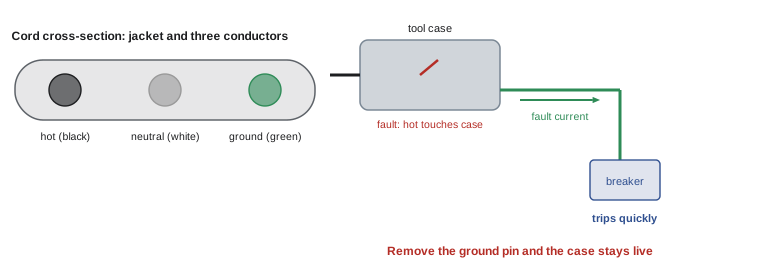
Removing or bending the grounding pin, or using an adapter that leaves it unconnected, breaks this path. The tool may still run, but a fault will leave its case live, waiting for someone to complete the circuit through their body.
Many modern tools are double insulated instead of grounded. They have two layers of insulation, or reinforced insulation, between live parts and anything a user can touch, so they use a two-pin plug. They are marked with a square-within-a-square symbol. Double insulation is effective, but only if the housing is intact. A cracked housing, water inside the tool or metal dust can defeat it.
Choosing the right cord
Cords are rated for current, voltage, temperature and the conditions they can survive. Using a light household cord for heavy tools or outdoor work is a common cause of overheating and damage.
| Choose for | What to look for |
|---|---|
| Current | A gauge and rating at least equal to the tool’s current; heavier gauge (smaller number) for longer runs |
| Conditions | Hard or extra-hard usage jacket for construction and industrial work; outdoor and oil-resistant ratings where needed |
| Grounding | Three-conductor cords with grounding pins for grounded tools |
| Certification | A recognized certification mark (for example CSA, cUL or cETL) and the cord type printed on the jacket |
| Length | The shortest cord that reaches; long cords increase voltage drop and tripping hazards |
Jacket markings tell you a lot. In North American cord designations, S means service grade (extra-hard usage) and SJ means junior service (hard usage); O means oil-resistant; W means suitable for wet locations and outdoor use; and T or E indicate thermoplastic or elastomer jackets. An SJOW cord is a hard-usage, oil-resistant, outdoor-rated cord, and SOOW is the heavier extra-hard-usage version. Household cords marked SPT are light-duty and do not belong on a work site.
Voltage drop on long cords
Every metre of copper has resistance. On a long, thin cord, that resistance causes the voltage at the tool to fall when current flows. The tool then draws more current to do the same work, runs hotter and may stall. The cord itself also heats.
Here \( L \) is the one-way length of the cord, the factor of 2 accounts for the current going out on one conductor and returning on another, and \( r \) is the resistance of the conductor per unit length.
Worked problem
Voltage drop on an extension cord
A 12 A circular saw is run at the end of a 30 m extension cord. Compare a 14 AWG cord (about 8.3 Ω per kilometre per conductor) with a 12 AWG cord (about 5.2 Ω per kilometre). Supply voltage is 120 V.
Show solution
- Round-trip length: \( 2 \times 30 = 60 \) m, or 0.060 km.
- 14 AWG: \( R = 0.060 \times 8.3 \approx 0.50 \) Ω, so \( V_{drop} = 12 \times 0.50 = 6.0 \) V, about 5 %.
- 12 AWG: \( R = 0.060 \times 5.2 \approx 0.31 \) Ω, so \( V_{drop} = 12 \times 0.31 \approx 3.7 \) V, about 3 %.
- Power lost as heat in the cord: \( P = I^2 R \), about 72 W for 14 AWG and about 45 W for 12 AWG.
Answer: The 12 AWG cord drops about 3 % instead of about 5 % and wastes less heat. For long runs or heavy tools, choose a heavier gauge or a shorter cord.
Inspect before every use
CSA Z462 and provincial regulations expect portable equipment to be inspected before use and kept in good condition, and many employers add periodic inspections with a colour tag or dated label.
A pre-use inspection takes less than a minute:
- Run the cord through your hands from end to end, feeling for cuts, bulges, flat spots, stiffness or exposed conductors.
- Check that the outer jacket enters the plug and the tool fully, held by strain relief, with no coloured inner insulation visible.
- Check the plug: blades straight and tight, grounding pin present, no cracks, burns or melting.
- Check the tool housing for cracks, missing screws, damaged switches and guards.
- Check for tags showing the last periodic inspection, if your workplace uses them.
- Plug into a GFCI-protected outlet where required and test the GFCI with its test button.
Anything damaged is removed from service, tagged 'Do not use' with the date and the problem, and handed in for repair by a competent person or replacement. Cord repairs must restore the jacket to its original strength; electrical tape is not a repair.
Using cords and tools safely
- Plug in and unplug by gripping the plug, never by pulling the cord.
- Keep cords out of walkways and doorways; if they must cross, use cord protectors or route them overhead.
- Do not run cords through doors, windows, holes in walls or ceilings, or under rugs where damage cannot be seen.
- Do not tie cords in knots or hang them over nails or sharp edges.
- Keep cords away from heat, oil, solvents and sharp edges.
- Do not carry tools by their cords or lower them by the cord.
- Unplug tools before changing blades, bits or accessories.
- Keep tools and cords out of water unless they are rated for it, and never use a tool that has been dropped in water until it has been checked.
- Use battery-powered tools where practical, especially in wet or confined locations.
Power bars, adapters and relocatable power taps
Power bars, also called power strips or relocatable power taps, are designed for low-power office equipment such as computers and chargers. They are not designed for heaters, kettles, microwaves, refrigerators, air compressors or power tools, and they must not be plugged into each other or into extension cords. Look for a certification mark and a built-in breaker, mount them off the floor if they might be kicked or wet, and replace them if they become warm or damaged.
Generators and portable power
Portable generators are common on construction sites, at events and during outages. Their receptacles must be protected by GFCIs where the rules require it, and the generator must be bonded or grounded according to the manufacturer's instructions. A generator must never be connected to a building's wiring unless a qualified electrician has installed a transfer switch, because back-feeding can energize utility lines and kill line workers. Generators also produce carbon monoxide and must run outdoors, well away from doors, windows and air intakes.
Worked problem
How many tools can one generator run?
A portable generator is rated 5,000 W running. A crew wants to run a 15 A table saw, a 6 A drill and two 1 A work lights at 120 V. Will it cope?
Show solution
- Total current: \( 15 + 6 + 1 + 1 = 23 \) A.
- Total power: \( 23 \times 120 = 2{,}760 \) W.
- Starting a saw motor can briefly draw two to three times its running current, so allow for a starting surge of perhaps \( 2{,}760 + 2 \times 1{,}800 = 6{,}360 \) W if the saw starts while everything else runs.
- Start the saw first, then add the other loads, or use a larger generator.
Answer: The running load of about 2,760 W is within the 5,000 W rating, but the saw's starting surge may exceed it if everything else is already on. Plan the starting sequence or size up.
Cord reels, cord sets and portable distribution
Cord reels are convenient, but a cord left coiled on a reel cannot shed heat well. Under heavy load, a fully wound reel can overheat and melt, even when the same cord would run cool laid out straight. Many reels carry two ratings: one for the cord fully unwound and a lower one for the cord wound on the reel. Unwind the cord fully for heavy loads, and use reels with built-in thermal protection or GFCIs where possible.
On larger sites, portable power distribution units, sometimes called spider boxes or temporary power centres, supply several receptacles from one feeder. They must be installed by qualified electricians, protected by GFCIs where required, kept off wet ground and protected from vehicle traffic. Workers should check that the unit's covers are closed and its cords are in good condition before plugging in.
Choosing tools that reduce risk
Good tool selection prevents many cord problems. Battery-powered tools remove line-voltage cords entirely and are a strong choice for wet, outdoor and confined locations. Tools with brakes, guards, lock-off switches and dead-man triggers protect against other injuries. Low-voltage tools, such as 24 V or 42 V tools supplied through isolating transformers, are used in some especially hazardous locations such as inside metal tanks. When buying tools, check the certification mark and the manufacturer's instructions for use in wet locations.
Storing and caring for cords
Store cords loosely coiled, without kinks, in a dry place away from heat, oil and chemicals. Hang them on wide hooks rather than nails. Clean off mud, oil and paint, which can hide damage and degrade the jacket. Do not leave cords in standing water or snow. A cord that has been run over, crushed or exposed to fire should be inspected by a competent person before reuse, even if it still works.
Common mistakes
MistakeRemoving the grounding pin so a plug fits a two-slot outlet.
InsteadUse a properly grounded outlet; never defeat the grounding conductor.
MistakeRepairing a cut jacket with electrical tape.
InsteadRemove the cord from service and have it replaced or properly repaired.
MistakeUsing a light household cord for a heavy tool on a long run.
InsteadChoose a hard or extra-hard usage cord of adequate gauge and the shortest practical length.
MistakeRunning a heater from a power bar plugged into an extension cord.
InsteadPlug heating appliances directly into a suitable outlet.
MistakeBack-feeding a building from a generator through a dryer outlet.
InsteadOnly connect through a transfer switch installed by a qualified electrician.
Summary and key terms
- The grounding conductor carries fault current from a tool case so that protection operates.
- Double-insulated tools rely on an intact housing.
- Choose cords for current, length, conditions and certification; household cords do not belong on work sites.
- Long, thin cords cause voltage drop and heat; heavier gauge reduces both.
- Inspect cords and tools before every use and remove damaged items from service.
- Power bars are for low-power office equipment, never heaters or tools, and never daisy-chained.
- Generators need ground fault protection, outdoor use and a proper transfer switch for buildings.
- Equipment grounding conductor
- The conductor that connects equipment metal parts to ground.
- Double insulation
- Two layers of insulation between live parts and accessible surfaces, marked with a square within a square.
- Strain relief
- A clamp or moulding that holds the cord jacket where it enters a plug or tool.
- AWG
- American Wire Gauge, the system of conductor sizes; smaller numbers are larger wires.
- Voltage drop
- The fall in voltage along a conductor caused by its resistance.
- Hard usage cord
- A flexible cord type such as SJ rated for hard service.
- Extra-hard usage cord
- A flexible cord type such as S or SO rated for severe service.
- Relocatable power tap
- A power bar or power strip with several outlets on a cord.
- Back-feeding
- Sending power from a generator into building or utility wiring without a transfer switch.
- Transfer switch
- A switch that isolates building wiring from the utility before a generator supplies it.
Practice problems
Work each problem on paper first, then reveal the answer to check.
What colour is the equipment grounding conductor in a cord?
Show answer
Usually green.
What symbol marks a double-insulated tool?
Show answer
A square within a square.
What is the voltage drop for 10 A on a cord with 0.4 Ω total resistance?
Show answer
4 V, from 10 × 0.4.
What does the W in SJOW mean?
Show answer
Suitable for wet locations and outdoor use.
Name three things to check in a pre-use cord inspection.
Show answer
Jacket, strain relief, plug blades and grounding pin, housing, inspection tag, GFCI test.
Why must a generator never be back-fed into a building without a transfer switch?
Show answer
It can energize utility lines and kill line workers.
How much heat does a 15 A load lose in a cord with 0.5 Ω resistance?
Show answer
About 112 W, from 15² × 0.5.
Should power bars be used for space heaters?
Show answer
No; heaters should plug directly into a suitable outlet.
What should happen to a damaged cord?
Show answer
Remove it from service, tag it and send it for repair or replacement.
Why are battery tools a good choice in wet areas?
Show answer
They remove the cord and line-voltage shock hazard from the task.
Lesson quiz · 5 questions
Score 60% or more to complete this lesson.
Create a free account to save your progress, take quizzes and earn a certificate.