
HSE-214 · Lesson 11 of 12 · 29 min
Electrical rooms, panels and responding to electrical emergencies
Most workers will never work inside electrical equipment, but many will walk past panels, use electrical rooms for storage access, reset a tripped breaker, or be the first person on the scene when something goes wrong. This lesson covers how electrical rooms and panels must be kept, what unqualified workers may and may not do with breakers and disconnects, and how to respond safely to electrical shocks, burns and fires.
Working space around electrical equipment
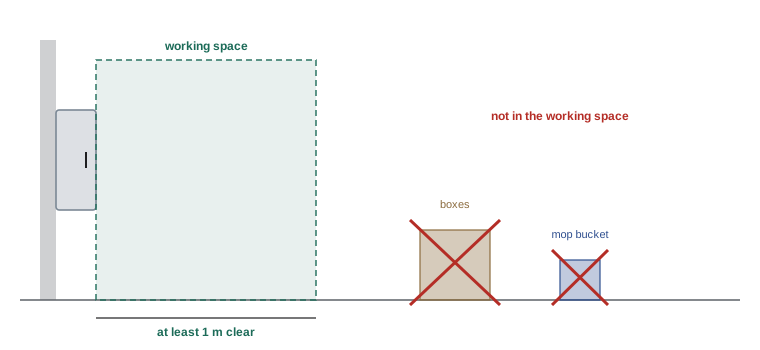
Electrical codes and safety regulations require a clear working space in front of panels, switchboards, disconnects and other equipment that may need examination, adjustment or maintenance while energized. The space lets qualified workers stand safely, move back from an arc and escape quickly, and lets anyone reach a disconnect in an emergency.
The Canadian Electrical Code (Rule 2-308) requires a minimum working space of 1 m in front of electrical equipment such as switchboards and panelboards, with greater distances for higher voltages and for equipment with exposed live parts on both sides of the space. The space must be kept clear and must not be used for storage. Headroom and lighting must be adequate, and electrical rooms must have suitable exits.
Worked problem
Is the working space clear?
A storeroom has a 120/208 V panelboard on one wall. A shelving unit 0.6 m deep has been placed against the opposite wall, which is 1.5 m from the panel face. Is the 1 m working space maintained?
Show solution
- Clear distance: \( 1.5 - 0.6 = 0.9 \) m.
- Required: 1 m. The space is 0.1 m short.
- Move the shelving or narrow it so that at least 1 m stays clear for the full width of the panel.
Answer: No. Only 0.9 m is clear; the shelving must be moved or reduced.
Electrical rooms and panels
Good housekeeping around electrical equipment is everyone's job. Keep electrical room doors closed, and locked where required, so that only authorized people enter. Never store combustible materials, cleaning chemicals, ladders or equipment in electrical rooms or in front of panels. Keep panel doors closed and latched. Report missing panel covers, missing breaker filler plates, scorch marks, buzzing, burning smells or water near electrical equipment. Keep the panel directory, the list of which breaker serves which circuit, accurate, because during an emergency or lockout a wrong label can send someone to the wrong breaker.
Panels and disconnects should be clearly identified, and equipment rooms often carry signs warning that entry is restricted to authorized persons. If you need something from an electrical room, ask the person responsible for it, and do not prop doors open.
Resetting breakers and operating switches
Many workplaces allow trained unqualified workers to reset a tripped breaker in a panel with its cover in place, or to operate a disconnect switch as part of normal operations. This is generally considered low risk only when the equipment is properly installed and maintained, its doors and covers are closed and secured, and there are no signs of impending failure. Your employer decides whether you may do this and trains you.
- Before resetting a breaker, think about why it tripped. Unplug or switch off the equipment that was running.
- Stand to the side of the panel if you can, and use your left hand to operate a breaker or switch on the right, so that your face and body are not directly in front of the equipment.
- Reset the breaker by moving the handle fully to off, then firmly to on.
- If it trips again, do not keep resetting it. Report it.
- Never reset a breaker or operate a switch that is hot, buzzing, smoking, scorched, wet or damaged.
- Never open a panel's inner cover (dead front), remove a breaker or touch anything behind the cover.
Responding to an electrical shock
When someone has been shocked, the first rule is to protect yourself. A person who is still in contact with a live source is part of the circuit, and touching them can put you in it too.
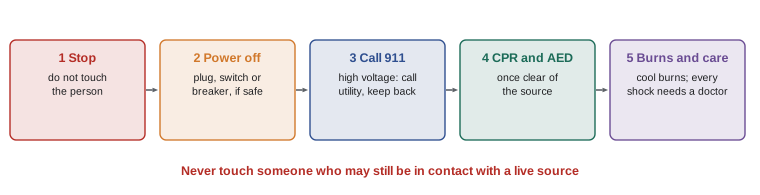
- Stop and look. Do not touch the person or anything they are touching.
- If it is low voltage, such as a plug-in tool or appliance, turn off the power at the switch, unplug the equipment or open the breaker, if you can do so safely and quickly.
- If the source is high voltage, such as an overhead or underground line, utility equipment or industrial switchgear, do not approach. Keep yourself and others well back, call 911 and the utility, and wait until the power has been shut off and the site declared safe.
- If the power cannot be turned off and the source is low voltage, a trained person may separate the victim from the source with a dry non-conductive object such as a wooden broom handle, while standing on a dry insulating surface. This is a last resort and is never attempted for high voltage.
- Once the person is clear of the source, call 911 if not already done. Check for responsiveness and breathing. If they are not breathing normally, start CPR and send someone for an AED. HSE-111 covers CPR and AED use.
- Treat burns by cooling them with clean, cool running water and covering them with a clean dressing, as covered in HSE-110. Electrical burns often have entry and exit wounds and deep damage.
- Every person who has had an electric shock should be assessed by a medical professional, because heart rhythm problems and internal injuries may appear hours later.
Worked problem
Why seconds matter
Survival from cardiac arrest is often said to fall by roughly 7 to 10 % for each minute without CPR and defibrillation. If a co-worker in ventricular fibrillation after a shock receives no CPR and the ambulance arrives after 9 minutes, roughly how much has the chance of survival fallen, using 10 % per minute?
Show solution
- Simple estimate: \( 9 \times 10\,\% = 90\,\% \) reduction.
- A more realistic model compounds the decline, but either way the chance of survival becomes very small.
- If a trained co-worker starts CPR within one minute and applies an AED within three minutes, the decline slows dramatically.
Answer: Survival falls by roughly 90 % with no help for 9 minutes. Prompt CPR and an AED make the difference, which is why first aid training and AED placement matter.
Electrical fires
Electrical fires start from overloaded circuits, faulty equipment, damaged cords, loose connections and arcing. If you see smoke or flames from electrical equipment:
- Raise the alarm and call the fire department.
- If it is safe and you are trained, shut off power to the equipment at the switch or breaker.
- Never use water on an energized electrical fire. Water conducts electricity.
- Use an extinguisher rated for electrical fires, marked Class C, such as carbon dioxide or a multipurpose ABC dry chemical extinguisher, only if the fire is small, you are trained and you have a clear escape route.
- Leave immediately if the fire grows, the room fills with smoke, or the fire involves large electrical equipment, battery systems or switchgear. Lithium-ion battery fires in particular can reignite and release toxic gases.
HSE-105 covers fire safety and extinguisher use in more detail.
Reporting electrical incidents
Electrical incidents must be reported internally and, in many cases, to regulators. In Ontario, critical injuries and deaths must be reported to the Ministry of Labour under section 51 of the OHSA, and serious electrical incidents must also be reported to the Electrical Safety Authority. Other provinces have similar requirements, involving the OHS regulator and the electrical safety authority. Near misses, such as a shock with no injury or a flash with no one hurt, should be reported internally and investigated, because they are warnings of what could happen next time.
Worked problem
Investigating a near miss
A worker felt a tingle when touching a metal sink in a break room where a kettle was plugged in. No one was hurt. List the questions an investigation should answer.
Show solution
- What equipment was involved, and was it damaged or wet? Check the kettle and its cord.
- Was the outlet GFCI protected, and did the GFCI work when tested?
- Is the sink or other metal properly bonded and grounded? This needs a qualified electrician.
- Have there been other reports of tingles in the area?
- What immediate controls are needed: take the kettle out of service, close the area, call an electrician.
Answer: A tingle from a metal sink is a warning of a ground fault or a bonding problem. Stop using the area, test the GFCI, and have a qualified electrician investigate before anyone is hurt.
Preparing for electrical emergencies
Workplaces should plan for electrical emergencies before they happen. Emergency plans should identify who has authority to shut off power, where the main disconnects are, how to reach the utility and the electrical contractor after hours, and where the nearest AED and first aid kit are. Main disconnects and emergency shutdown switches should be clearly labelled and accessible. Workers who may need to operate them should be trained and should practise in drills. After any incident, the scene should be preserved for investigation once people are safe, and equipment involved should not be returned to service until a qualified person has checked it.
First aid and CPR training should include electrical scenarios, especially the rule to check for a live source before touching a victim. Many rescuers have been killed by rushing to help. Training builds the habit of pausing for a moment to look for cords, wires and equipment before stepping in.
Supervisors play a key role. They should check working spaces during routine inspections, make sure electrical room doors are kept closed, confirm that only trained workers reset breakers, and follow up on every report of a tingle, a hot outlet or a burning smell. Quick responses to small reports show workers that raising concerns is worthwhile and keep minor problems from becoming serious incidents.
In Ontario, ESA's data show that about half of electrical deaths occur in workplaces and that repair and maintenance is the most common activity at the time of death, which is why the basic emergency and reporting habits in this lesson matter for every worker, not just electricians.
Common mistakes
MistakeStacking boxes in front of a panel because the room is short of space.
InsteadKeep the required working space clear at all times.
MistakeResetting a breaker repeatedly until it holds.
InsteadReset once at most; if it trips again, report it.
MistakeGrabbing a co-worker who is being shocked.
InsteadShut off the power first, or use a dry non-conductive object for low voltage only.
MistakeThrowing water on an electrical fire.
InsteadDe-energize if safe and use a Class C extinguisher only if trained and the fire is small.
MistakeIgnoring a tingle from a metal surface because no one was hurt.
InsteadReport near misses and have an electrician investigate.
Summary and key terms
- Keep a clear working space of at least 1 m in front of electrical equipment.
- Keep electrical rooms closed, uncluttered and free of storage, and keep panel directories accurate.
- Only trained workers reset breakers, standing to the side, and only once.
- After a shock, protect yourself first: shut off power, never touch the victim while in contact.
- For high voltage, keep back and call 911 and the utility.
- Start CPR and use an AED when needed, treat burns and get medical assessment for every shock.
- Never use water on electrical fires; report all incidents and near misses.
- Working space
- The clear area required in front of electrical equipment.
- Panel directory
- The list identifying which breaker serves which circuit.
- Dead front
- The inner cover of a panel that shields live parts.
- Filler plate
- A blank that closes an unused breaker opening in a panel.
- Class C fire
- A fire involving energized electrical equipment.
- AED
- An automated external defibrillator, which can restore a normal heart rhythm.
- CPR
- Cardiopulmonary resuscitation, chest compressions and rescue breaths.
- Near miss
- An event that could have caused injury but did not.
- Electrical room
- A room that houses electrical distribution equipment.
- Authorized person
- Someone permitted by the employer to enter a restricted area or do a task.
Practice problems
Work each problem on paper first, then reveal the answer to check.
What is the minimum working space in front of a panel under the Canadian Electrical Code?
Show answer
1 m.
Why should you stand to the side when resetting a breaker?
Show answer
So your face and body are not directly in front of the equipment if it fails.
What should you do if a breaker trips again after one reset?
Show answer
Stop and report it.
What is the first thing to do when you see someone being shocked?
Show answer
Stop; do not touch them; shut off the power if you safely can.
What should you do if the source is an overhead power line?
Show answer
Keep back, keep others back and call 911 and the utility.
Why must every shock victim see a medical professional?
Show answer
Heart rhythm problems and internal injuries may appear later.
Which extinguisher class is for energized electrical fires?
Show answer
Class C.
Why must water not be used on an energized electrical fire?
Show answer
Water conducts electricity.
Name two things that should never be stored in electrical rooms.
Show answer
Combustibles, chemicals, ladders or equipment.
What does a tingle from a metal sink suggest?
Show answer
A ground fault or bonding problem that an electrician must investigate.
Lesson quiz · 5 questions
Score 60% or more to complete this lesson.
Create a free account to save your progress, take quizzes and earn a certificate.