
HSE-214 · Lesson 5 of 12 · 27 min
Ground fault protection, grounding and bonding
Lesson 1 showed that a current of only tens of milliamperes through the body can kill, while breakers and fuses only trip at many amperes. Ground fault circuit interrupters were invented to close that gap. Together with good grounding and bonding, they are among the most effective engineering controls for shock. This lesson explains how they work, where they are required, what they cannot do, and how to test them.
Grounding, bonding and overcurrent protection
Grounding connects parts of an electrical system to the earth. Bonding connects metal parts to each other so that they stay at the same voltage. Together they give fault current a low-resistance path back to the source. When a hot conductor touches a grounded, bonded metal enclosure, a large fault current flows through the grounding path and the breaker or fuse opens quickly. Without that path, the enclosure would simply sit at line voltage until someone touched it.
Overcurrent devices, breakers and fuses, protect conductors and equipment from overloads and short circuits. They are sized in amperes, typically 15 or 20 A for ordinary branch circuits, and they take time to trip on moderate overloads. They do nothing to stop the few hundredths of an ampere that can kill a person, because to a breaker that current is invisible.
How a GFCI works
A ground fault circuit interrupter (GFCI), called a residual current device (RCD) in many other countries, compares the current going out on the hot conductor with the current coming back on the neutral. In a healthy circuit they are equal. If some current leaks to ground, for example through a person's body, the two no longer match. A small sensing coil detects the difference, and when it exceeds the trip level the device opens the circuit, usually within a few hundredths of a second at shock-level currents.
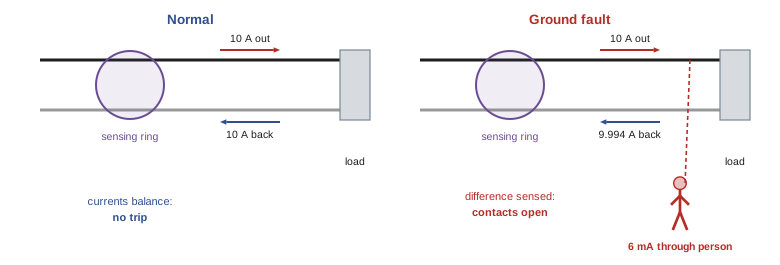
Class A GFCIs, the type used for personnel protection in North America, are designed to trip when the imbalance reaches about 5 mA, with a tolerance of about 1 mA, under CSA C22.2 No. 144.1 and the harmonized UL 943. That is below the let-go threshold for most adults. Ground fault protection of equipment (GFPE), used on larger circuits to protect equipment from fire, trips at a much higher level, often around 30 mA or more, and is not personnel protection. In Europe and many other countries, RCDs for personal protection trip at 30 mA.
Worked problem
Will the GFCI trip?
A worker touches a faulty pump housing while standing in water. The pump is on a 120 V circuit protected by a Class A GFCI. The path resistance through the worker to ground is about 1,500 Ω. Estimate the leakage current and decide whether the GFCI trips.
Show solution
- Leakage current: \( I = 120 / 1{,}500 = 0.08 \) A, or 80 mA.
- Compare with the trip level of about 5 mA: 80 mA is sixteen times higher.
- The GFCI trips within a few hundredths of a second, limiting the shock to a brief jolt.
- Without the GFCI, a 15 A breaker would not trip at 80 mA, and the shock would continue.
Answer: About 80 mA flows, far above the 5 mA trip level, so a working GFCI trips quickly. The worker feels a painful shock but is very likely to survive.
What a GFCI cannot do
A GFCI is very effective but not magic. It cannot detect current that flows from hot to neutral through a person, because that current goes out and comes back through the device. A worker who touches both the hot and neutral conductors of a circuit, while insulated from ground, can be electrocuted on a GFCI-protected circuit. GFCIs do not protect against arc flash, overloads or fires. They can fail, and older devices may fail in the closed position, leaving power on with no protection. And they only protect the circuit downstream of where they are installed.
Where ground fault protection is required
The Canadian Electrical Code, as adopted in each province, requires Class A GFCI protection for receptacles in many locations, including bathrooms, near sinks and tubs, outdoors, in some garages and basements, near pools and hot tubs, and on construction and temporary installations. The exact list depends on the code edition and provincial amendments. On construction sites, receptacles supplied from temporary wiring generally need GFCI protection, and portable GFCIs can be used where permanent protection is not available. CSA Z462 and provincial OHS rules also expect employers to assess whether ground fault protection is needed for portable equipment in wet or conductive locations.
| Location or use | Typical requirement | Notes |
|---|---|---|
| Bathrooms, near sinks and tubs | Class A GFCI for receptacles | Distance rules vary by code edition |
| Outdoor receptacles | Class A GFCI | Weatherproof covers also required |
| Construction and temporary installations | Class A GFCI | Portable GFCI where needed |
| Pools, hot tubs and fountains | Class A GFCI and special bonding | Strict separation distances |
| Wet or conductive work areas | Assess and provide GFCI or battery tools | CSA Z462 risk assessment |
Types of GFCI
- Receptacle GFCIs replace a standard outlet and protect it and any outlets wired downstream from it. They have test and reset buttons on the face.
- Breaker GFCIs are installed in the panel and protect an entire circuit.
- Portable GFCIs plug into an outlet and provide protection for a cord or tool. They are useful on job sites and in older buildings, and many open automatically if power is lost and must be reset, which is a safety feature.
- Cord-end GFCIs are built into the plug of equipment such as pressure washers, hair dryers and some heaters.
Testing GFCIs
Because GFCIs can fail, they must be tested. Manufacturers recommend pressing the test button at least monthly, and many employers require a test before each use of portable GFCIs on construction sites. When you press test, the device should trip with a click and power should go off. Pressing reset should restore power. If the device does not trip, or will not reset, it has failed: stop using the circuit and report it. Plug-in testers with a GFCI test button are also available, but on some older wiring without a ground they may not work properly, so the built-in test button is the most reliable user check.
Worked problem
Planning GFCI tests on a construction site
A site has 14 portable GFCIs and 6 temporary power distribution boxes with 4 GFCI receptacles each. The site rule is a test before each shift for portable units and a weekly documented test for receptacles. How many tests are done in a 5-day week of single shifts?
Show solution
- Portable GFCIs: \( 14 \times 5 = 70 \) tests.
- Distribution box receptacles: \( 6 \times 4 = 24 \) receptacles, tested once a week, so 24 tests.
- Total: \( 70 + 24 = 94 \) tests.
- Each test takes seconds; the record shows who tested, when, and what was removed from service.
Answer: 94 tests a week. A simple log or a sticker on each device makes the routine easy to follow and to audit.
The assured equipment grounding conductor program
Some North American employers, particularly those working on US projects, use an assured equipment grounding conductor program as an alternative to GFCIs on construction sites. It relies on regular testing of cords and tools for continuity and correct connection of the grounding conductor, with records and colour codes. In Canada, GFCI protection is the normal approach for temporary construction receptacles, and an assured grounding program is not a substitute where the code requires GFCIs.
Bonding in special locations
Bonding is especially important around pools, hot tubs and fountains, in livestock buildings, on metal structures and around fuel handling. Bonding all metal parts together keeps them at the same voltage so that a person touching two of them at once does not complete a circuit. Static bonding and grounding of containers during flammable liquid transfers prevents sparks that could ignite vapours. These systems are designed and installed by qualified persons, but unqualified workers should recognize bonding jumpers and clamps, leave them in place and report any that are missing or broken.
Ground fault protection in practice
On a typical renovation, temporary power might come from a distribution box fed by a generator or a temporary service. Each receptacle on the box should be GFCI protected, and workers should test the protection before plugging in tools. Where an existing building's outlets are old and unprotected, a portable GFCI at the outlet provides protection for everything downstream. On outdoor and wet work, such as pressure washing, concrete work or landscaping, GFCI protection is especially important because the conditions lower skin resistance.
Nuisance tripping is a common complaint. A GFCI that trips repeatedly is usually telling you something: a damaged cord, moisture in a connector, a tool with leaking insulation, or too many tools with small leakage currents on one protected circuit. The answer is to find and fix the cause, not to bypass the GFCI or plug into an unprotected outlet. Long cord runs and heating elements can also contribute small leakage currents, so spread loads across circuits where possible.
Isolation transformers and other options
In a few special situations, other protective methods are used instead of or alongside GFCIs. Isolating transformers supply equipment from a winding that is not connected to ground, so a single contact to ground does not complete a circuit. Extra-low-voltage systems keep voltages low enough that shock risk is greatly reduced. Hospitals use isolated power systems with line isolation monitors in some areas. These systems are designed by engineers and maintained by qualified workers, but recognizing them helps unqualified workers understand why equipment in some areas looks different.
A quick way to remember the difference between the devices is to ask what each one is watching. A breaker watches for too much current. A GFCI watches for current that is going somewhere it should not. An arc fault circuit interrupter, required for many dwelling circuits, watches for the electrical signature of dangerous arcing in wiring and cords. Each protects against a different failure, and none replaces the others.
Common mistakes
MistakeAssuming a 15 A breaker protects people from shock.
InsteadBreakers protect wiring; only a GFCI trips at shock-level currents of about 5 mA.
MistakeBelieving a GFCI protects against every kind of shock.
InsteadIt cannot detect current passing from hot to neutral through a person, or protect against arc flash.
MistakeNever testing GFCIs because they look fine.
InsteadPress the test button monthly, or before use on construction sites.
MistakeUsing equipment ground fault protection as if it protected people.
InsteadGFPE trips at about 30 mA or more and is for equipment, not personnel.
MistakeRemoving a bonding jumper because it is in the way.
InsteadLeave bonding in place and report damaged or missing jumpers.
Summary and key terms
- Grounding and bonding give fault current a low-resistance path so breakers and fuses operate.
- Breakers and fuses protect wiring and equipment, not people.
- A Class A GFCI compares outgoing and returning current and trips at about 5 mA.
- GFCIs cannot detect hot-to-neutral current through a person and do not prevent arc flash.
- The Canadian Electrical Code requires GFCIs in many wet and temporary locations, including construction sites.
- Test GFCIs with the test button regularly and stop using any that fail.
- Bonding keeps metal parts at the same voltage and controls static during fuel transfers.
- Grounding
- Connecting parts of an electrical system to the earth.
- Bonding
- Connecting metal parts together so they stay at the same voltage.
- Ground fault
- An unintended path for current from a live conductor to ground.
- GFCI
- A ground fault circuit interrupter, which trips on a small imbalance between hot and neutral current.
- Class A GFCI
- A GFCI for personnel protection that trips at about 5 mA.
- RCD
- A residual current device, the international term for a GFCI.
- GFPE
- Ground fault protection of equipment, set at a higher trip level for equipment protection.
- Portable GFCI
- A plug-in GFCI used to protect cords and tools.
- Assured equipment grounding conductor program
- A documented program of testing cords and tools as an alternative to GFCIs on US construction sites.
- Overcurrent device
- A breaker or fuse that opens a circuit when current exceeds its rating.
Practice problems
Work each problem on paper first, then reveal the answer to check.
What does a GFCI compare?
Show answer
The current going out on the hot conductor and coming back on the neutral.
At about what imbalance does a Class A GFCI trip?
Show answer
About 5 mA.
What leakage current flows at 120 V through a 2,400 Ω path?
Show answer
50 mA, far above the GFCI trip level.
Name one shock a GFCI cannot prevent.
Show answer
A shock where current passes from hot to neutral through a person who is insulated from ground.
How often should a GFCI be tested with its test button?
Show answer
At least monthly, and before each use for portable units on construction sites.
What should you do if a GFCI will not trip when tested?
Show answer
Stop using the circuit and report the failed device.
Why does bonding matter around pools?
Show answer
It keeps metal parts at the same voltage so people touching two of them are not shocked.
What is GFPE used for?
Show answer
Protecting equipment from ground faults that could cause fires, not protecting people.
Why do many portable GFCIs open when power is lost?
Show answer
So power does not return unexpectedly; they must be reset deliberately.
What does a breaker protect?
Show answer
Wiring and equipment from overloads and short circuits.
Lesson quiz · 5 questions
Score 60% or more to complete this lesson.
Create a free account to save your progress, take quizzes and earn a certificate.