
HSE-214 · Lesson 6 of 12 · 28 min
Overhead power lines and limits of approach
Overhead power lines are everywhere: along streets, across parking lots, behind buildings, over farm fields and into construction sites. Most are bare conductors, not insulated cables. The coating you might see on some distribution lines is weather protection, not insulation that will protect you. Contact with overhead lines is one of the leading causes of electrical death in both Canada and the United States, and most of the victims are not electrical workers. They are painters, roofers, tree workers, truck drivers, crane and boom operators, labourers and farmers.
How power line contacts happen
Many incidents follow a few familiar patterns:
- Raising a dump truck box, boom, crane, concrete pump, excavator arm or aerial lift into or near a line.
- Carrying or raising a ladder, scaffold pole, eavestrough, pipe or long tool under a line.
- Working on a roof, sign, billboard or scaffold near a line.
- Trimming trees whose branches touch lines.
- Moving irrigation pipe, grain augers or tall farm equipment.
- Approaching a downed line after a storm or vehicle collision.
High-voltage electricity does not need direct contact. As voltage rises, it can arc across an air gap to a conductive object or person that comes close enough. That is why the rules set minimum distances, called limits of approach or minimum approach distances, rather than simply saying 'do not touch'.
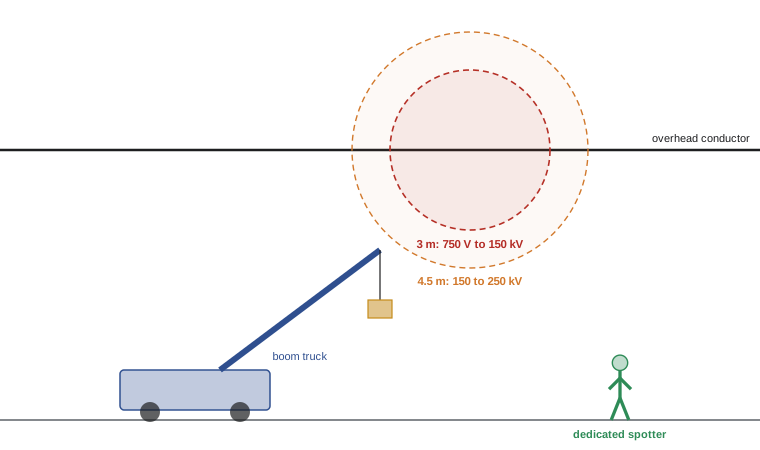
The minimum distances
Each province sets its own limits of approach for workers and equipment who are not qualified electrical workers. The values below are the most common ones. They apply to any part of a person, tool, load, boom, rope or equipment.
| Voltage (phase to phase) | Ontario construction (O. Reg. 213/91 s. 188) | British Columbia (OHSR Table 19-1A) |
|---|---|---|
| 750 V to 75 kV | 3 m | 3 m |
| Over 75 kV to 150 kV | 3 m | 4.5 m |
| Over 150 kV to 250 kV | 4.5 m | 4.5 m |
| Over 250 kV | 6 m | 6 m (to 550 kV) |
When you do not know the voltage, assume it is high and use the largest distance that could apply, or call the utility to find out. Even low-voltage service drops to buildings, usually below 750 V, must not be touched; they are covered by general rules against contact with energized parts.
Worked problem
What distance applies?
A crew in Ontario plans to work near a 115 kV transmission line on a construction project. What is the minimum distance under O. Reg. 213/91? What would apply to the same line in British Columbia?
Show solution
- Ontario: 115 kV falls in the 750 V to 150 kV band, so the limit is 3 m.
- British Columbia: 115 kV falls in the over 75 kV to 250 kV band, so the limit is 4.5 m.
- A company working in both provinces should use the more protective value, 4.5 m, as its standard.
Answer: 3 m in Ontario and 4.5 m in British Columbia. Using the larger value everywhere simplifies training.
Planning work near overhead lines
Before work begins, the employer or constructor must identify every overhead line on or near the site, its voltage and its owner. The first choice is always to avoid the hazard:
- Ask the utility to de-energize and ground the line, or to relocate it, for the duration of the work. This takes time to arrange, so start early.
- Plan the work so that equipment and materials never come within the limit of approach: choose a different crane position, a smaller machine, or a different method.
- If work must happen near a live line, the utility may install insulating covers, sometimes called line hoses or blankets, but these reduce risk only for incidental contact and do not change the required distance unless the utility and regulation allow it.
When equipment could reach a line, more controls are needed:
- Assign a competent signaller or spotter whose only job is to watch the distance and warn the operator. The spotter must be able to see the line and the equipment and communicate instantly.
- Mark the limit of approach with warning signs, flags, barricades or range-limiting devices on the equipment.
- Use proximity alarms, range limiters or insulating links where appropriate, but treat them as backups to planning and spotting.
- Keep people away from equipment that could become energized, and keep the area around outriggers and ground contact points clear.
- Carry long objects horizontally, low and with two people when near lines, and never raise ladders or poles near them.
Ontario's construction regulation requires a written procedure, a competent signaller and warning devices when equipment could encroach on the limits of approach, and BC and Alberta have similar requirements. The utility must be contacted for assistance where work will be within the limits.
Worked problem
Will the ladder reach the line?
A painter carries a 7.3 m aluminium extension ladder upright along a building. An overhead distribution line runs parallel to the wall, 6 m above the ground and 2.5 m out from the wall. The painter walks 1.5 m out from the wall holding the ladder vertically, with its foot 0.3 m off the ground. Is the painter within the 3 m limit of approach?
Show solution
- Top of ladder: \( 0.3 + 7.3 = 7.6 \) m above ground, which is higher than the line at 6 m.
- Horizontal distance from ladder to line: \( 2.5 - 1.5 = 1.0 \) m.
- Because the ladder passes the height of the line, the closest distance is the horizontal gap, 1.0 m.
- 1.0 m is far inside the 3 m limit, and an aluminium ladder is an excellent conductor.
Answer: Yes. The ladder comes within about 1 m of the line. Lower it and carry it horizontally, choose a non-conductive ladder, and plan a route away from the line.
If equipment contacts a line
When a boom or vehicle touches a power line, the equipment and the ground around it may become energized. The ground near a grounded object carries a voltage that falls off with distance, like ripples spreading from a stone dropped in water. A person standing in this area can be shocked by step potential, the voltage between their two feet, or by touch potential, the voltage between their hand on the equipment and their feet.
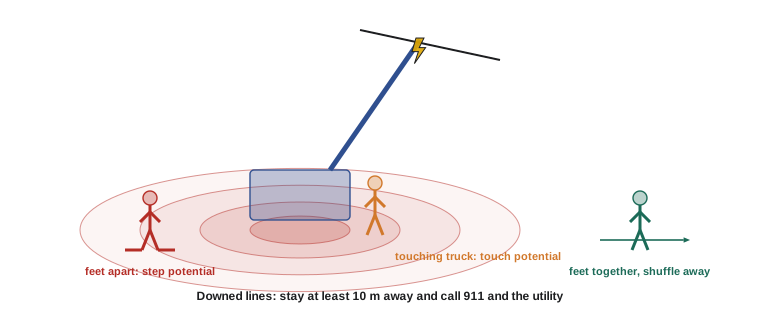
If you are in a vehicle or machine that contacts a line:
- Stay inside unless there is fire or another immediate danger. The cab is usually the safest place.
- Try to move the equipment away from the line if you can do so safely.
- Warn others to stay back. Call 911 and the utility to de-energize the line.
- If you must leave, jump clear so that no part of your body touches the machine and the ground at the same time. Land with your feet together, then shuffle away with small steps, keeping both feet in contact with the ground, until you are well clear.
- Never return to the machine until the utility confirms the line is de-energized and grounded.
If you are on the ground nearby, do not approach the machine or the person in it, and do not try to rescue someone in contact with the line. Keep others back and call for help. Rescuers become victims when they touch an energized person or vehicle.
Downed lines
Treat every downed line as live, even if it is not sparking. Utilities in Canada generally advise staying at least 10 m, about the length of a school bus, away from a downed line and anything it touches, including fences, puddles and vehicles. Call 911 and the utility, keep others away, and wait for the utility to make it safe.
Worked problem
Estimating step potential
Suppose the ground voltage falls from 2,000 V to 1,400 V across one metre near an energized pole after a fault. A worker standing with feet one metre apart in this zone has a body path resistance, foot to foot, of about 2,000 Ω including footwear. Estimate the current.
Show solution
- Step voltage: \( 2{,}000 - 1{,}400 = 600 \) V.
- Current: \( I = 600 / 2{,}000 = 0.3 \) A, or 300 mA.
- Even though the path is leg to leg and does not cross the heart, 300 mA can cause loss of muscle control and a fall, which can bring the hands or chest into contact with the ground and a more dangerous path.
- With feet together, the step voltage is much smaller because both feet are at nearly the same potential.
Answer: About 300 mA, enough to cause a fall and a lethal second contact. Feet together and small shuffling steps keep the voltage across the body small.
Working near lines at home and on farms
Many power line deaths happen outside traditional workplaces: a homeowner cleaning eavestroughs with an aluminium ladder, a farmer moving a grain auger, a student carrying a pole for a sailboat, a person flying a drone or kite near lines. The same rules apply. Look up before you raise anything, plan routes for tall equipment, lower augers and booms before moving, and keep ladders and poles well away from lines. Utilities offer free advice and, in many areas, will cover or de-energize lines for planned work.
Trees near lines are a special hazard. Only qualified utility arborists may trim trees within the limits of approach. Homeowners and general tree workers must stay clear and contact the utility.
Weather affects power line hazards too. Lines sag lower in hot weather and under heavy loads, and they swing in wind, so a clearance measured on a cool, calm morning may shrink in the afternoon. Ice and snow can bring lines and branches down. Wet conditions make arc-over and ground conduction more likely. Plan clearances with a margin and recheck them when conditions change.
Common mistakes
MistakeAssuming a covered overhead line is insulated.
InsteadTreat all overhead lines as bare and energized; coverings are weather protection.
MistakeThinking electricity must be touched to cause harm.
InsteadHigh voltage can arc across an air gap; keep the required distance.
MistakeRaising a dump box or boom without checking for lines overhead.
InsteadLook up and plan the work; use a spotter when equipment could reach a line.
MistakeRunning to help someone in contact with a power line.
InsteadStay back, keep others away, call 911 and the utility.
MistakeStepping normally away from a machine that has contacted a line.
InsteadJump clear, land feet together and shuffle away with both feet on the ground.
Summary and key terms
- Contact with overhead lines is a leading cause of electrical death, often among non-electrical workers.
- High voltage can arc across an air gap, so rules set minimum distances, not just a ban on contact.
- Ontario requires 3 m for 750 V to 150 kV lines on construction sites; BC requires 4.5 m from 75 kV.
- De-energize or relocate lines first; otherwise plan, mark limits and use a dedicated spotter.
- Step and touch potential can injure people near energized equipment and downed lines.
- Stay in a vehicle that contacts a line unless there is fire; if you must leave, jump clear and shuffle away.
- Keep at least 10 m from downed lines and call 911 and the utility.
- Limit of approach
- The minimum distance that must be kept between energized conductors and people, tools or equipment.
- Minimum approach distance
- The US term for the minimum safe distance from energized conductors.
- Arc-over
- Electrical breakdown of air that lets current jump a gap.
- Spotter
- A competent person whose only duty is to watch clearance and warn the operator.
- Step potential
- The voltage between a person’s feet in an energized ground zone.
- Touch potential
- The voltage between a person’s hand on energized equipment and their feet.
- Line hose
- An insulating cover placed over a conductor by utility workers.
- Proximity alarm
- A device that warns when equipment approaches an energized line.
- Service drop
- The overhead conductors running from the utility pole to a building.
- De-energize and ground
- Disconnect a line from all sources and connect it to ground so it cannot become live.
Practice problems
Work each problem on paper first, then reveal the answer to check.
What is the Ontario construction limit of approach for a 69 kV line?
Show answer
3 m.
Why are distances set rather than just banning contact?
Show answer
High voltage can arc across an air gap.
What is the first choice for controlling an overhead line hazard?
Show answer
Have the utility de-energize and ground or relocate the line.
What is the spotter’s only job?
Show answer
To watch the clearance between equipment and the line and warn the operator.
What should an operator do if a boom touches a line and there is no fire?
Show answer
Stay in the cab, warn others away and call for the line to be de-energized.
How should you leave a vehicle that is in contact with a line, if you must?
Show answer
Jump clear, land with feet together and shuffle away.
How far should you stay from a downed line?
Show answer
At least 10 m.
What is touch potential?
Show answer
The voltage between a hand on energized equipment and the feet.
How should long objects be carried near overhead lines?
Show answer
Horizontally, low, ideally by two people, never raised upright.
What should you assume if the line voltage is unknown?
Show answer
That it is high, and use the largest distance or ask the utility.
Lesson quiz · 5 questions
Score 60% or more to complete this lesson.
Create a free account to save your progress, take quizzes and earn a certificate.