
HSE-214 · Lesson 10 of 12 · 28 min
Arc flash labels, risk assessment and PPE awareness
Arc flash hazards are invisible until the moment they become catastrophic. Workers see arc flash labels on panels, switchboards and motor control centres every day, and qualified workers wear arc-rated clothing and face protection when they work on energized equipment. This lesson explains what those labels mean, how the arc flash risk assessment works at a high level, and what arc-rated protection does, so that unqualified workers can read the signs around them and understand why certain areas are off limits.
The arc flash risk assessment
CSA Z462 requires employers to perform an arc flash risk assessment for electrical equipment that could be worked on while energized. The assessment identifies arc flash hazards, estimates the likelihood that an injury could occur and how severe it could be, and decides whether additional protective measures, including PPE, are needed. It also sets the arc flash boundary. Engineers usually calculate the available incident energy at each piece of equipment using a standard method such as IEEE 1584, based on the available fault current, the time the protective devices take to clear the fault, the working distance and the equipment configuration. The assessment must be reviewed periodically, at intervals not exceeding five years, and whenever major changes occur.
Incident energy is measured in calories per square centimetre (cal/cm²) or joules per square centimetre (J/cm²). One calorie equals about 4.184 joules. The onset of a second-degree burn on bare skin is usually taken as 1.2 cal/cm², or 5 J/cm². The arc flash boundary is the distance from the equipment at which the incident energy falls to that value. Inside it, a person without protection could receive at least a second-degree burn if an arc occurs.
Worked problem
Converting incident energy units
An arc flash label shows an incident energy of 33.5 J/cm² at a working distance of 455 mm (18 in). What is this in cal/cm², and is it above the burn threshold?
Show solution
- Divide by 4.184: \( 33.5 / 4.184 \approx 8.0 \) cal/cm².
- Compare with the 1.2 cal/cm² threshold for a second-degree burn: 8.0 is about 6.7 times higher.
- Anyone within the arc flash boundary during energized work would need arc-rated PPE rated at least 8 cal/cm².
Answer: About 8 cal/cm², well above the burn threshold. Protection rated at least 8 cal/cm² would be needed inside the arc flash boundary.
Reading an arc flash label
Equipment such as switchboards, panelboards, industrial control panels, meter socket enclosures and motor control centres that is likely to be examined, adjusted, serviced or maintained while energized must be field marked with a label. The label tells qualified workers what they are facing before they open the equipment, and it tells everyone else that the equipment contains serious hazards.
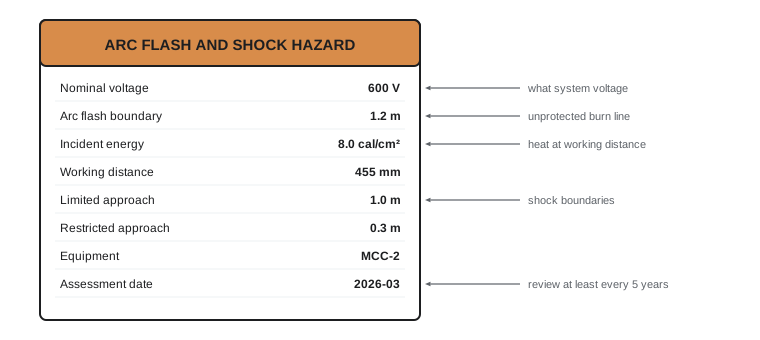
The workplace standards require the label to show at least the nominal system voltage, the arc flash boundary, and either the available incident energy with its working distance, or the arc flash PPE category, but not both in a way that conflicts. Many labels also show the minimum arc rating of clothing, the shock approach boundaries, the equipment identification and the date of the assessment. Labels often carry a signal word in capital letters, such as danger for higher hazards or warning for lower ones, following product safety sign conventions. The employer must keep labels accurate and update them when the assessment changes.
For unqualified workers, a label is a clear message: this equipment can produce a dangerous arc, do not open it, and keep your distance when qualified workers have it open. The arc flash boundary printed on the label tells you where to stand if you must be in the area while work is under way.
Arc flash PPE categories
When engineers have not calculated the incident energy for a task, the standards allow employers to use a table method, which assigns an arc flash PPE category based on the type of equipment, its voltage, the available fault current and the clearing time. Each category has a minimum arc rating and a list of required protection.
| PPE category | Minimum arc rating | Typical protection |
|---|---|---|
| 1 | 4 cal/cm² (16.75 J/cm²) | Arc-rated long-sleeve shirt and pants or coverall, arc-rated face shield or hood, hard hat, safety glasses, hearing protection, heavy-duty leather gloves or rubber insulating gloves with protectors, leather footwear |
| 2 | 8 cal/cm² (33.5 J/cm²) | As category 1, plus an arc-rated balaclava with face shield, or an arc-rated flash suit hood |
| 3 | 25 cal/cm² (104.7 J/cm²) | Arc-rated flash suit jacket, pants and hood, arc-rated gloves or rubber insulating gloves with protectors, hard hat, glasses, hearing protection, leather footwear |
| 4 | 40 cal/cm² (167.5 J/cm²) | As category 3, with clothing rated at least 40 cal/cm² |
Arc-rated clothing is tested to find the incident energy it can block before the wearer would likely suffer a second-degree burn, or before the fabric breaks open. That value is the arc rating, shown on the garment label as the arc thermal performance value (ATPV) or the energy break-open threshold (EBT). Arc-rated clothing will not ignite and continue to burn, and it insulates the skin. It does not make the wearer immune to shock, blast pressure, flying debris or hearing damage, and it does not protect parts of the body it does not cover.
Worked problem
Does the PPE match the hazard?
Three panels in a plant have labels showing incident energies of 2.6, 11 and 32 cal/cm². The maintenance department has everyday arc-rated work wear rated 8 cal/cm² and a flash suit rated 40 cal/cm². Which PPE is adequate for energized work at each panel?
Show solution
- 2.6 cal/cm²: the 8 cal/cm² work wear exceeds the hazard, so it is adequate, with the required face, head, hand and hearing protection.
- 11 cal/cm²: 8 cal/cm² is not enough; the 40 cal/cm² flash suit is adequate.
- 32 cal/cm²: only the 40 cal/cm² flash suit is adequate.
- Whenever possible, the better choice is to de-energize, or to reduce the incident energy through engineering, such as faster protective settings during maintenance.
Answer: Work wear for the 2.6 cal/cm² panel; the 40 cal/cm² suit for the 11 and 32 cal/cm² panels, or better, de-energize.
What to wear, and not wear, near electrical equipment
Even unqualified workers who never open equipment benefit from knowing a few clothing rules, because they may be near equipment that fails during normal operation. Synthetic fabrics such as polyester, nylon, acrylic and spandex can melt and stick to skin when exposed to an arc, turning a minor burn into a severe one. Under arc-rated clothing, workers must wear non-melting natural fibres such as cotton or wool. Conductive jewellery, watches, metal-framed glasses and key chains must be removed or made non-conductive before working near exposed energized parts.
Reducing the hazard through design and maintenance
PPE is the last line of defence. Employers can reduce arc flash hazards through engineering and maintenance: arc-resistant switchgear that directs blast energy away from the front, remote racking and switching devices that let workers operate equipment from a distance, infrared windows that allow thermal scanning without opening covers, maintenance switches that speed up breaker tripping during work, current-limiting fuses, and good maintenance of breakers and connections so that protective devices clear faults as quickly as the study assumed. Poorly maintained breakers that clear slowly can make the incident energy far higher than the label says.
Worked problem
How clearing time affects incident energy
For a given system, incident energy is roughly proportional to the time the arc lasts. A label assumes a clearing time of 0.1 s and shows 6 cal/cm². If a poorly maintained breaker takes 0.5 s to clear, estimate the incident energy.
Show solution
- Ratio of times: \( 0.5 / 0.1 = 5 \).
- Estimated energy: \( 6 \times 5 = 30 \) cal/cm².
- That would exceed category 2 and even category 3 protection rated 25 cal/cm².
Answer: About 30 cal/cm², five times the labelled value. Maintenance of protective devices is part of arc flash safety.
The unqualified worker and arc flash
For unqualified workers, the rules are simple. Do not open labelled equipment. Do not operate equipment that shows signs of damage, overheating or arcing. Stay outside the arc flash boundary when qualified workers have equipment open, unless you are escorted and wearing appropriate protection for a specific reason. Report missing or unreadable labels, missing covers and unusual noises or smells. And never borrow arc-rated PPE to do work you are not qualified for: PPE does not make an unqualified person qualified.
Other protective equipment for electrical work
Arc-rated clothing is only part of the protection qualified workers use. Rubber insulating gloves, rated by voltage class and worn with leather protectors, protect against shock and must be air-tested before each use and electrically tested at regular intervals. Insulated and insulating tools are rated for use near energized parts. Insulating blankets, mats and line hoses provide temporary barriers. Safety glasses and hearing protection are worn under face shields and hoods because arc blasts can damage eyes and ears. Footwear with dielectric ratings provides some secondary protection but is never relied on alone.
All this equipment needs care. Arc-rated garments must be laundered according to the manufacturer's instructions, kept free of flammable contaminants such as oil and grease, and retired when damaged. Rubber goods must be stored away from sunlight, heat and ozone, and checked for cuts, holes and swelling. A worker in damaged or contaminated PPE may be far less protected than the label suggests.
For unqualified workers, the presence of this equipment is a signal. If you see someone suited up in a flash hood and rubber gloves, they are working on or near energized equipment with a significant hazard. Keep your distance, respect the barricade, and do not interrupt them.
Finally, the label is only as good as the study behind it. If an electrician notices that equipment has been changed, a transformer replaced or protective settings altered since the label was printed, the label may no longer be accurate. The change should be reported so that the risk assessment can be reviewed. Unqualified workers can help by reporting labels that are faded, damaged, missing or obviously out of date.
Common mistakes
MistakeTreating arc flash labels as decoration.
InsteadRead them: they show voltage, the arc flash boundary and the energy or PPE category.
MistakeWearing polyester or nylon under arc-rated clothing.
InsteadWear non-melting natural fibres such as cotton or wool underneath.
MistakeBelieving arc-rated clothing protects against shock and blast.
InsteadArc-rated clothing protects against heat only; shock and blast need other controls.
MistakeUsing PPE as a substitute for de-energizing.
InsteadDe-energize first; PPE is the last line of defence.
MistakeBorrowing arc-rated gear to do a job you are not trained for.
InsteadPPE does not make an unqualified person qualified; call a qualified worker.
Summary and key terms
- The arc flash risk assessment estimates incident energy and sets the arc flash boundary.
- The arc flash boundary is where incident energy falls to about 1.2 cal/cm² (5 J/cm²).
- Labels show voltage, arc flash boundary and either incident energy or PPE category.
- PPE categories 1 to 4 correspond to minimum arc ratings of 4, 8, 25 and 40 cal/cm².
- Arc-rated clothing protects against heat, not shock or blast; melting synthetics must not be worn beneath.
- Engineering and maintenance reduce incident energy; slow breakers increase it.
- Unqualified workers keep out of the arc flash boundary and never open labelled equipment.
- Arc flash risk assessment
- A process to identify arc flash hazards, estimate likelihood and severity, and decide on protective measures.
- Incident energy
- Thermal energy at a working distance from an arc, in cal/cm² or J/cm².
- Arc flash boundary
- The distance at which incident energy equals about 1.2 cal/cm².
- Arc rating
- The incident energy a material can block before a likely second-degree burn or break-open.
- ATPV
- Arc thermal performance value, one way of expressing an arc rating.
- PPE category
- A level from 1 to 4 that sets minimum arc-rated protection in the table method.
- IEEE 1584
- A standard method for calculating arc flash incident energy.
- Clearing time
- The time a protective device takes to interrupt a fault.
- Arc-resistant switchgear
- Equipment designed to direct arc blast energy away from people in front of it.
- Signal word
- A word such as danger or warning on a safety label that indicates hazard severity.
Practice problems
Work each problem on paper first, then reveal the answer to check.
What is 16.75 J/cm² in cal/cm²?
Show answer
About 4 cal/cm².
What incident energy defines the arc flash boundary?
Show answer
About 1.2 cal/cm², or 5 J/cm².
What minimum arc rating does PPE category 2 require?
Show answer
8 cal/cm².
Name three items that must appear on an arc flash label.
Show answer
Nominal voltage, arc flash boundary, and incident energy with working distance or the PPE category.
Why must synthetic fabrics not be worn under arc-rated clothing?
Show answer
They can melt and stick to skin, worsening burns.
Does arc-rated clothing protect against shock?
Show answer
No; it protects against heat.
If clearing time doubles, roughly what happens to incident energy?
Show answer
It roughly doubles.
How often must the arc flash risk assessment be reviewed?
Show answer
At intervals not exceeding five years, and after major changes.
Name two engineering controls that reduce arc flash hazards.
Show answer
Arc-resistant switchgear, remote racking, maintenance switches, infrared windows, current-limiting fuses.
What should an unqualified worker do about a missing label?
Show answer
Report it and do not open the equipment.
Lesson quiz · 5 questions
Score 60% or more to complete this lesson.
Create a free account to save your progress, take quizzes and earn a certificate.