
HSE-214 · Lesson 7 of 12 · 27 min
Underground utilities and digging safely
Beneath most work sites lies a hidden network: electrical cables, natural gas lines, telecommunication and fibre-optic cables, water mains, sewers, and sometimes oil, steam or district energy pipes. Underground electrical cables can carry thousands of volts. Striking one with a shovel, an excavator bucket, an auger, a ground rod or a fence post can kill the operator or anyone touching the equipment, cause an arc flash, cut power to hospitals and homes, and ignite gas from a nearby line. This lesson covers how to find buried utilities before you dig and how to dig around them safely.
Who digs, and why strikes happen
Excavation is not just for construction crews. Landscapers, fence installers, sign installers, farmers, homeowners, irrigation contractors, telecom installers and maintenance staff installing posts or anchors all disturb the ground. Damage to buried utilities is common. In the United States, the Common Ground Alliance's damage information reporting tool analyzed 196,977 unique damage reports for 2024, and the single largest root cause, at about a quarter of damages, was failure to notify the one-call centre before digging. The next largest causes were excavators not maintaining clearance after the lines were marked, and lines that were missed or marked inaccurately by locators. Canadian damage prevention organizations publish similar reports, and their findings point the same way.
Call or click before you dig
Every province has a one-call or 'click before you dig' service that takes a single request and notifies the utility owners in the area so they can locate and mark their buried lines. Examples include Ontario One Call, BC 1 Call, Utility Safety Partners in Alberta, Sask 1st Call, Info-Excavation in Quebec and the national portal ClickBeforeYouDig.com for other regions. In Ontario, the Ontario Underground Infrastructure Notification System Act, 2012 makes it mandatory for excavators to request locates through Ontario One Call, and municipalities advise submitting the request at least 5 business days before work starts. Locates are generally valid for a limited period, often 60 days in Ontario, and must be renewed if the work is delayed or the marks are lost. Locate services are free to the excavator.
Utility owners locate and mark only the lines they own, typically up to the meter or the property line. Private lines beyond that point, such as power to a detached garage, parking lot lights, a sign, a gate operator or a well pump, belong to the property owner and are not marked by the one-call system. They must be located by a private locating company hired by the owner or contractor. Many strikes happen on these private lines because the crew assumed everything had been marked.
Reading the marks
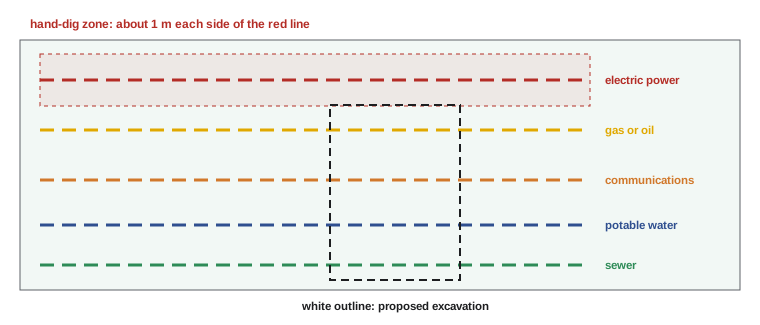
Locators mark the approximate location of buried lines with paint, flags or stakes in a uniform colour code used across North America.
| Colour | Meaning |
|---|---|
| Red | Electric power lines, cables, conduit and lighting cables |
| Yellow | Gas, oil, steam, petroleum or other gaseous or flammable material |
| Orange | Communication, alarm or signal lines, cables or conduit, including fibre |
| Blue | Potable water |
| Green | Sewers and drain lines |
| Purple | Reclaimed water, irrigation and slurry lines |
| Pink | Temporary survey markings |
| White | Proposed excavation |
Marks show the approximate horizontal position of a line, not its depth. Depth varies with grading, frost, erosion and how carefully the line was installed, and a line may have been moved since it was put in. Several lines may share a trench. Marks also fade, wash away or get scraped off by traffic, so keep them visible and request a re-mark if they are lost. The excavator can mark the proposed dig area in white before calling, which helps locators focus on the right place.
Tolerance zones and hand digging
Because marks are approximate, digging rules require extra care in a band on either side of the marks. Canadian practice, reflected in CSA Z247 Damage prevention for the protection of underground infrastructure and in provincial rules and owner requirements, generally calls for hand digging or hydro-vacuum excavation within about 1 m of a marked line until the line is exposed and its position confirmed. Some owners, especially for high-pressure gas and transmission cables, set larger zones and require their own staff to be present.
Safe practices in and near the zone include:
- Expose the line by careful hand digging or vacuum excavation, also called potholing or daylighting, before using machines nearby.
- Use blunt or rounded hand tools and gentle prying; do not stab or jab with picks, bars or sharp spades.
- Once the line is exposed, protect and support it so it cannot sag, be struck or be damaged when the trench is backfilled.
- Keep machine buckets and augers outside the zone, and keep a spotter watching where marks are close to the work.
- Watch for warning tape, concrete caps, sand bedding or conduit, which often lie above cables.
- Remember that trenchless methods such as boring and drilling also strike lines; their path must be planned and the line exposed where the bore crosses it.
Worked problem
Where may the machine dig?
An excavator must dig a 1.2 m wide trench that crosses a marked electrical cable at right angles. The hand-dig zone is 1 m on each side of the mark. How long a section of trench must be hand-dug or vacuum-excavated before the machine can work freely?
Show solution
- The zone extends 1 m on each side of the mark, so the protected band is about 2 m wide along the trench.
- The trench crosses this band, so about 2 m of trench length, centred on the mark, must be exposed by hand or vacuum.
- Once the cable is exposed and its exact position and depth confirmed, the machine can dig up to it with care, keeping the bucket clear and the cable supported.
Answer: About 2 m of trench, centred on the mark.
If you strike or expose a line
If equipment contacts an underground electrical cable, treat it like contact with an overhead line. The operator should stay on the machine if it is safe to do so, move the bucket away only if that can be done safely, warn others to keep away and call 911 and the utility. If the operator must leave, they should jump clear, land with feet together and shuffle away, as described in lesson 6. Never try to pull a cable out of the ground or push it aside with tools.
If you damage a gas line, leave the area immediately on foot, upwind, without operating switches, engines or phones near the leak, then call 911 and the gas utility. Even minor damage, such as a nick in the coating of a cable or pipe, must be reported to the owner so that it can be repaired before it fails later. Hiding damage is dangerous and, in many jurisdictions, illegal.
Ground rods, stakes and posts
Driving a ground rod, fence post, survey stake, tent peg or anchor is excavation for the purposes of locate rules in most jurisdictions, even though no hole is dug. Shallow cables, particularly for street lighting, parking lot lighting, sprinklers and landscape lighting, are often only a few centimetres or inches below the surface. Before driving anything into the ground, check that locates have been done and that the stake is well clear of any marked line.
Worked problem
Planning a fence installation
A contractor will install 60 m of fence with posts every 2.4 m along a property line where a buried electrical service to a detached garage crosses the line once. How many post holes are needed, and what extra steps does the private service require?
Show solution
- Number of spans: \( 60 / 2.4 = 25 \), so posts = \( 25 + 1 = 26 \).
- Submit a one-call request at least 5 business days ahead for public utilities.
- The garage service is a private line beyond the meter, so hire a private locator to mark it.
- Shift any post that falls within the hand-dig zone of the marked service, or hand-dig that hole to expose the cable first.
Answer: 26 post holes, a one-call request for public utilities, a private locate for the garage service, and adjusted post positions near the cable.
Responsibilities
The excavator is responsible for requesting locates, waiting until they are complete, keeping the marks visible, digging carefully in the zone, and reporting damage. The utility owner is responsible for marking its lines accurately within the time allowed. The property owner is responsible for private lines. The employer must train workers and plan the work, including emergency procedures. Workers have the right and duty to stop if locates are missing, expired or unclear.
Before the locate arrives
Planning starts before the one-call request. Gather site drawings and as-built records, look for clues such as electrical pedestals, meters, manholes, valve boxes, light standards and signs, and ask the property owner about private lines. Mark the proposed excavation in white. Plan how the excavation will be done near likely lines, which equipment will be used, and how the crew will respond if a line is struck. On the day of excavation, check that all owners have responded and that marks are present for every utility listed on the ticket. If an owner has not responded, or marks are unclear, do not dig.
Vacuum excavation
Hydro-vacuum and air-vacuum excavation use pressurized water or air to loosen soil and a powerful vacuum to remove it into a tank. They expose buried lines with much less risk of damage than mechanical digging and are widely used for daylighting near critical utilities. They still need care: high-pressure water can damage cable jackets and pipe coatings if the nozzle is held too close, and the operator must follow the owner's minimum distances and pressure limits.
Ontario municipalities and owners also remind excavators that locates expire, typically after 60 days, and that a new locate is needed if marks are lost or work is delayed. Exposed infrastructure must be protected and supported, and owners may need to inspect it before backfilling.
Locate marks are also a communication tool between crews. When several contractors work on the same site, the excavator who requested the locate should share the ticket and the marks with others who will dig, rather than letting each crew assume someone else checked. A short meeting at the start of the day to walk the marks with the crew, point out the lines and agree on the tolerance zones prevents many strikes.
Common mistakes
MistakeDigging a few post holes without calling because the job is small.
InsteadRequest locates for every excavation, including posts, stakes and ground rods.
MistakeAssuming the one-call locate covers every line on the property.
InsteadUtility owners mark only their own lines; private lines need a private locate.
MistakeTreating locate marks as showing exact position and depth.
InsteadMarks are approximate; expose the line by hand or vacuum in the zone.
MistakeJabbing with a pick or sharp spade to find a cable.
InsteadUse blunt tools and careful hand digging, or vacuum excavation.
MistakeBackfilling over a nicked cable without telling anyone.
InsteadReport all damage to the owner so it can be repaired.
Summary and key terms
- Striking buried cables can electrocute workers, cause arc flash and ignite nearby gas.
- Failure to notify the one-call centre is the single largest cause of utility damage.
- Use Ontario One Call, BC 1 Call, Utility Safety Partners or the local service; allow the required notice.
- Utility owners mark their own lines; private lines need a private locator.
- Marks use a uniform colour code; red is electric power.
- Hand dig or vacuum excavate within about 1 m of a marked line until it is exposed.
- Treat a struck cable like an overhead line contact, and report all damage.
- One-call centre
- A service that takes locate requests and notifies utility owners.
- Locate
- The process of finding and marking a buried utility line.
- Locate ticket
- The record of a locate request, valid for a limited time.
- Private line
- A buried line owned by the property owner, not the utility.
- Tolerance zone
- The band around marked lines where only hand or vacuum excavation is allowed.
- Hand-dig zone
- The Canadian term for the band around marked lines that must be exposed carefully.
- Potholing
- Exposing a buried line by careful digging or vacuum excavation to confirm its position.
- Hydro-vacuum excavation
- Using pressurized water and suction to remove soil without striking lines.
- White lining
- Marking the proposed excavation area in white before requesting locates.
- Daylighting
- Another term for exposing a buried line so it can be seen.
Practice problems
Work each problem on paper first, then reveal the answer to check.
What colour marks electric power lines?
Show answer
Red.
What colour marks gas lines?
Show answer
Yellow.
How far ahead should an Ontario locate request be made?
Show answer
At least 5 business days.
Who marks a buried line to a detached garage?
Show answer
A private locator hired by the owner or contractor.
Do locate marks show depth?
Show answer
No; they show approximate horizontal position only.
What should you use to expose a line in the zone?
Show answer
Careful hand digging with blunt tools, or vacuum excavation.
Is driving a ground rod considered excavation for locate purposes?
Show answer
Yes, in most jurisdictions.
What should you do if you nick a cable jacket?
Show answer
Stop, keep clear and report it to the owner for repair.
What should you do if you damage a gas line?
Show answer
Leave on foot upwind without making sparks, then call 911 and the gas utility.
What was the largest root cause of damages in the 2024 CGA report?
Show answer
Failure to notify the one-call centre, about a quarter of damages.
Lesson quiz · 5 questions
Score 60% or more to complete this lesson.
Create a free account to save your progress, take quizzes and earn a certificate.