
HSE-214 · Lesson 8 of 12 · 28 min
Qualified and unqualified workers and approach boundaries
Inside buildings and plants, the most dangerous electrical exposures happen when equipment is opened: a panel cover removed, a cabinet door open, a motor terminal box exposed. CSA Z462 uses invisible lines around exposed energized parts, called approach boundaries, to decide who may come how close and with what protection. Understanding these boundaries lets unqualified workers know exactly where they must stop.
Exposed energized parts
Most electrical equipment is designed so that live parts are enclosed. As long as covers, doors and guards are closed and in good condition, and the equipment is used normally, there is little shock or arc flash risk from it. The hazard rises sharply when an enclosure is opened, when a cover is missing, when equipment is damaged, or when someone works inside it. An exposed energized part is one that a person could touch or approach closer than a safe distance because it is not suitably guarded, isolated or insulated.
Normal operation of equipment, such as switching a properly installed and maintained disconnect with its door closed, is generally considered to present a low likelihood of arc flash. Signs of trouble, such as damage, overheating, unusual noise, missing covers, loose doors or evidence of arcing, change that assessment, and unqualified workers should not operate equipment showing them.
Qualified and unqualified, task by task
A qualified person has received training and has demonstrated the skills and knowledge to recognize and avoid the electrical hazards of the specific equipment and task. That training covers how the equipment is built and operates, how to distinguish exposed energized parts, how to determine the nominal voltage, the approach distances, how to select and use test instruments and personal protective equipment, and how to perform the risk assessment. A person can be qualified for one task and unqualified for another.
Unqualified persons are everyone else for that task. They still need training, but of a different kind: to recognize electrical hazards, understand the boundaries they must not cross, know what they are and are not allowed to do, and know what to do in an emergency. Most workers taking this course are unqualified for work on or near exposed energized parts.
The shock approach boundaries
Around exposed energized parts, the workplace electrical safety standards define two shock boundaries.
- The limited approach boundary is the distance from an exposed energized part within which a shock hazard exists. Unqualified persons may not cross it unless they are advised of the hazards and continuously escorted by a qualified person.
- The restricted approach boundary is a closer distance within which there is an increased likelihood of shock from arc-over combined with inadvertent movement. Only qualified persons with appropriate shock protection, a plan and justification may cross it. Unqualified persons may never cross it.
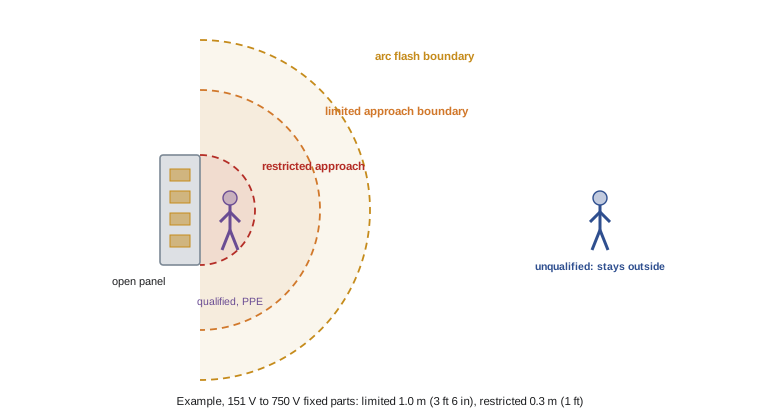
The boundaries depend on the nominal voltage. The table below shows values for common alternating current systems from the current editions of the standards. The limited approach boundary has two values: a larger one for exposed conductors that can move, such as overhead lines, and a smaller one for fixed parts such as bus bars in a panel.
| Nominal voltage (phase to phase) | Limited approach, movable conductor | Limited approach, fixed part | Restricted approach |
|---|---|---|---|
| Less than 50 V | Not specified | Not specified | Not specified |
| 50 V to 150 V | 3.0 m (10 ft 0 in) | 1.0 m (3 ft 6 in) | Avoid contact |
| 151 V to 750 V | 3.0 m (10 ft 0 in) | 1.0 m (3 ft 6 in) | 0.3 m (1 ft 0 in) |
| 751 V to 15 kV | 3.0 m (10 ft 0 in) | 1.5 m (5 ft 0 in) | 0.7 m (2 ft 2 in) |
| 15.1 kV to 36 kV | 3.0 m (10 ft 0 in) | 1.8 m (6 ft 0 in) | 0.8 m (2 ft 7 in) |
Common Canadian system voltages are 120/240 V single-phase in houses, 120/208 V three-phase in commercial buildings and 347/600 V three-phase in industrial and large commercial buildings. A 600 V system falls in the 151 V to 750 V row.
Worked problem
Finding the boundaries for a panel
An electrician has removed the cover of a 347/600 V distribution panel to take measurements. What are the limited and restricted approach boundaries, and where must a helper who is not qualified stand?
Show solution
- The phase-to-phase voltage is 600 V, which falls in the 151 V to 750 V row.
- Bus bars in a panel are fixed parts, so the limited approach boundary is 1.0 m (3 ft 6 in).
- The restricted approach boundary is 0.3 m (1 ft 0 in).
- The helper must stay outside 1.0 m unless advised of the hazards and continuously escorted by a qualified person, and may never come within 0.3 m. The arc flash boundary, explained in lesson 10, may be larger still, and anyone inside it needs arc-rated protection.
Answer: Limited approach 1.0 m (3 ft 6 in), restricted approach 0.3 m (1 ft 0 in). The helper stays outside the limited approach boundary, and outside the arc flash boundary, unless escorted and protected.
Rules for unqualified persons
Taken together, the standards, regulations and good practice give unqualified persons a short list of rules:
- Do not open electrical enclosures, remove covers or reach into equipment.
- Stay outside the limited approach boundary of exposed energized parts, and outside the arc flash boundary, unless a qualified person escorts and protects you for a specific reason.
- Never cross the restricted approach boundary.
- Do not use test instruments on energized circuits.
- Operate only equipment you are trained to operate, such as normal switching of disconnects in good condition, and only when the equipment shows no sign of damage or trouble.
- Obey barricades, signs and attendants that mark electrical work areas.
- Report missing covers, open doors and damaged equipment immediately.
British Columbia's regulation states plainly that only qualified persons may work on or near exposed energized equipment and that unqualified workers must stay outside the limits of approach. Similar expectations appear in other provinces and in CSA Z462.
Barricades, attendants and signs
When qualified workers open equipment or work near exposed energized parts, they must keep unqualified persons out. They do this with barricades, such as tape, rope or rigid barriers placed at or outside the boundary, and with safety signs. Where barricades and signs are not enough, for example in a busy corridor, an attendant must be posted to warn and protect people. Conductive barricades, such as metal chains or fencing, must not be used where they could contact live parts. If you come across a barricaded area, do not cross the barrier, and do not move the barricade even if it is in your way.
Worked problem
Placing a barricade
A motor control centre is opened in a corridor 2.4 m wide for troubleshooting at 600 V. The arc flash boundary on the label is 1.2 m, and the limited approach boundary for fixed parts is 1.0 m. Where should the barricade go, and is an attendant needed?
Show solution
- The barricade must keep people outside the larger of the boundaries: the arc flash boundary of 1.2 m.
- Place the barricade at least 1.2 m from the open equipment, which leaves only \( 2.4 - 1.2 = 1.2 \) m of corridor.
- If people must still pass, the corridor is too narrow to keep them safely outside the boundary, so close the corridor or post an attendant to stop traffic while the equipment is open.
- Use non-conductive barricade tape or barriers, and signs that explain the hazard.
Answer: At 1.2 m, the arc flash boundary. With only 1.2 m of corridor left, close the corridor or post an attendant.
Escorted entry
Sometimes an unqualified person needs to be inside the limited approach boundary, for example a building engineer pointing out a circuit to a contractor, or a trainee observing. The standards allow this only when a qualified person has advised them of the hazards and continuously escorts them, and they are protected for the arc flash hazard if they are inside the arc flash boundary. The escort is responsible for keeping them well clear of the restricted approach boundary and for stopping the work if the situation changes.
Why distance matters
Distance is one of the simplest and most powerful protections. It prevents accidental contact from a slip, a dropped tool or a reflexive movement, and for arc flash, incident energy falls rapidly as distance increases. Roughly speaking, doubling the distance from an arc reduces the incident energy to about a quarter in open air, and even more in some enclosures. Stepping back a metre or a few feet can turn a disabling burn into no injury at all.
Worked problem
How distance reduces arc flash energy
Suppose the incident energy at a working distance of 455 mm (18 in) from an arc is 8 cal/cm². Assuming energy falls with the square of distance, estimate the energy at 910 mm (36 in) and at 1.82 m (72 in).
Show solution
- At twice the distance, energy falls by a factor of \( 2^2 = 4 \): \( 8 / 4 = 2 \) cal/cm².
- At four times the distance, energy falls by \( 4^2 = 16 \): \( 8 / 16 = 0.5 \) cal/cm².
- The threshold for a second-degree burn on bare skin is usually taken as about 1.2 cal/cm².
- Real calculations use standard methods such as IEEE 1584 and may give different exponents, but the trend holds.
Answer: About 2 cal/cm² at twice the distance and about 0.5 cal/cm² at four times. Distance is powerful protection.
A simple personal rule helps: if a cover is off, a door is open or someone is working inside equipment, treat the space in front of it as off limits until a qualified person tells you where you may stand. When in doubt, step back and ask. No task is so urgent that it is worth crossing a boundary you do not understand.
Common mistakes
MistakeLeaning into an open panel to watch the electrician work.
InsteadStay outside the limited approach and arc flash boundaries unless escorted and protected.
MistakeTreating a person as qualified for everything because they are an electrician.
InsteadQualification is for specific equipment and tasks.
MistakeMoving a barricade because it blocks a walkway.
InsteadGo around, wait, or ask the work crew; never cross or move electrical barricades.
MistakeUsing a metal chain as a barricade around energized equipment.
InsteadUse non-conductive barricades and signs, and an attendant if needed.
MistakeOperating a disconnect that is buzzing or scorched.
InsteadDo not operate equipment showing signs of trouble; report it to a qualified person.
Summary and key terms
- Live parts are hazardous when enclosures are open, missing or damaged.
- A qualified person is trained and skilled for specific equipment and tasks; others are unqualified.
- The limited approach boundary marks where a shock hazard begins; unqualified persons need an escort to cross it.
- Unqualified persons must never cross the restricted approach boundary.
- For 151 V to 750 V fixed parts, the limited approach is 1.0 m (3 ft 6 in) and the restricted approach 0.3 m (1 ft 0 in).
- Barricades, signs and attendants keep unqualified people out of electrical work areas.
- Distance greatly reduces shock and arc flash risk.
- Exposed energized part
- A live part that can be touched or approached because it is not suitably guarded, isolated or insulated.
- Limited approach boundary
- The distance from exposed energized parts within which a shock hazard exists.
- Restricted approach boundary
- A closer distance where arc-over plus inadvertent movement creates an increased likelihood of shock.
- Arc flash boundary
- The distance at which incident energy equals about 1.2 cal/cm², the onset of a second-degree burn.
- Nominal voltage
- The voltage by which a system is identified, such as 120/208 V.
- Escort
- A qualified person who advises and continuously accompanies an unqualified person inside a boundary.
- Attendant
- A person posted to warn and keep others away from an electrical hazard.
- Barricade
- A physical barrier that limits access to a hazardous area.
- Incident energy
- The thermal energy reaching a surface at a working distance during an arc, in cal/cm² or J/cm².
- Working distance
- The distance from the arc source to a worker’s face and chest during a task.
Practice problems
Work each problem on paper first, then reveal the answer to check.
What is the limited approach boundary for fixed parts at 208 V?
Show answer
1.0 m (3 ft 6 in).
What is the restricted approach boundary at 600 V or 480 V?
Show answer
0.3 m (1 ft 0 in).
May an unqualified person cross the restricted approach boundary?
Show answer
Never.
Under what conditions may an unqualified person cross the limited approach boundary?
Show answer
Only when advised of the hazards and continuously escorted by a qualified person.
What is the limited approach boundary for fixed parts at 13.8 kV?
Show answer
1.5 m (5 ft 0 in).
Why must barricades around live equipment be non-conductive?
Show answer
Conductive barricades could contact live parts and become energized.
If energy is 4 cal/cm² at 18 in, roughly what is it at 36 in?
Show answer
About 1 cal/cm², assuming an inverse-square fall-off.
Name two signs that equipment should not be operated by unqualified workers.
Show answer
Damage, overheating, buzzing, scorch marks, missing covers or loose doors.
What is a qualified person trained to determine?
Show answer
Exposed energized parts, nominal voltage, approach distances, PPE and test instruments.
When is an attendant needed?
Show answer
When barricades and signs alone cannot keep unqualified people out.
Lesson quiz · 5 questions
Score 60% or more to complete this lesson.
Create a free account to save your progress, take quizzes and earn a certificate.