
HSE-214 · Lesson 1 of 12 · 27 min
How electricity injures: shock, burns, arc flash and arc blast
Electricity runs almost every workplace. It powers lights, computers, tools, machines, chargers, pumps and heaters, and most of the time it does so silently and safely. That silence is part of the danger. You cannot see, hear or smell a live conductor, and a cord or panel that looks harmless can carry enough energy to stop a heart or start a fire in a fraction of a second. This course is about recognizing electrical hazards and staying out of harm's way when you are not an electrician.
This is an awareness course for workers who are not qualified electrical workers: operators, maintenance helpers, labourers, office and retail staff, cleaners, supervisors and anyone who works near electrical equipment. It explains how electricity injures, what the law and CSA Z462 expect, and what unqualified workers must and must not do. It does not qualify anyone to work on or near exposed energized parts, to perform lockout on electrical systems as an authorized person, or to do electrical work that the Canadian Electrical Code and provincial law reserve for licensed electricians.
A few basic ideas
To understand electrical hazards you need only three quantities. Voltage is the electrical pressure that pushes charge around a circuit, measured in volts (V). Current is the flow of charge, measured in amperes (A), or milliamperes (mA) when the values are small. Resistance is how strongly a material opposes that flow, measured in ohms (Ω). They are linked by Ohm's law.
The law says that, for a given voltage, the current through a path goes up as the resistance of the path goes down. When a person becomes part of a circuit, the current through their body depends on the voltage they touch and on the total resistance of the path: skin, internal tissue, footwear, gloves and the surface they are standing on. It is the current, not the voltage alone, that does the damage, but voltage is what drives the current, so higher voltage means more danger.
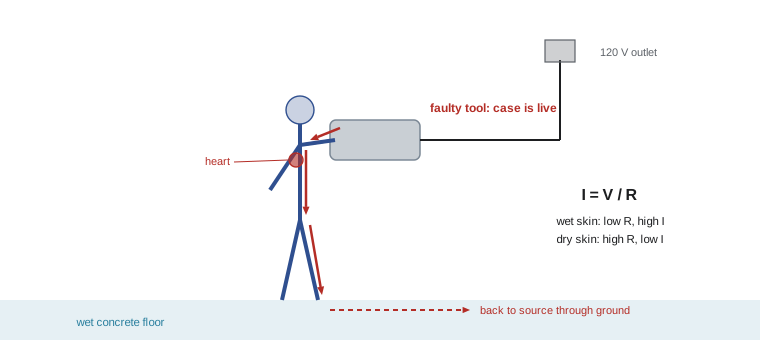
Electricity always tries to return to its source. In most building wiring, one conductor is deliberately connected to earth (ground) at the service. That means a person standing on a floor, touching a grounded metal pipe or leaning on a machine frame can complete a circuit simply by touching one live conductor. You do not have to touch two wires at once to receive a shock.
Electric shock
An electric shock happens when current passes through the body. Its effect depends on how much current flows, how long it flows, which path it takes, and whether it is alternating current (AC) or direct current (DC). Paths that cross the chest, such as hand to hand or hand to feet, are the most dangerous because they cross the heart and the muscles used for breathing.
The values in the table below are approximate. They come from long-standing research summarized in IEC 60479-1 and in OSHA and NIOSH training material, and they vary with body size, health, the exact path and the duration. They are meant to show how small the dangerous currents are, not to set a safe limit.
| Approximate 60 Hz current | Typical effect on an adult |
|---|---|
| About 1 mA | Threshold of perception: a faint tingle |
| About 5 mA | Slight shock; not painful but disturbing; most people can let go |
| About 6 to 30 mA | Painful shock; muscle control lost; the let-go threshold is often around 10 mA |
| About 50 to 150 mA | Extreme pain, breathing may stop, severe muscle contraction; death is possible |
| About 100 mA to several amperes | Ventricular fibrillation likely for exposures longer than a fraction of a second |
| Above about 10 A | Cardiac arrest, severe burns and internal damage |
Three effects matter most. The first is the let-go threshold. Alternating current makes muscles contract in rhythm with the supply. Above about 10 mA, the muscles that close the hand can overpower the muscles that open it, so a person who grips a live conductor may be unable to let go. The longer the contact lasts, the more the skin breaks down, the lower the resistance becomes and the higher the current climbs. The second is ventricular fibrillation, in which the heart's pumping chambers quiver instead of pumping. Without prompt CPR and defibrillation, ventricular fibrillation is fatal within minutes. The third is respiratory arrest, when the muscles that control breathing stop working.
Worked problem
How much current flows through a body?
A worker with wet hands grabs a damaged 120 V tool whose housing has become live. Assume the total resistance of the path from hand to feet is about 1,000 Ω because the skin is wet and the worker is standing on a damp concrete floor. Estimate the current. Then repeat with dry skin and a total resistance of about 100,000 Ω.
Show solution
- Use Ohm's law, \( I = V/R \).
- Wet: \( I = 120 / 1{,}000 = 0.12 \) A, which is 120 mA.
- Dry: \( I = 120 / 100{,}000 = 0.0012 \) A, which is 1.2 mA.
- Compare with the table: 120 mA is in the range where fibrillation and death are likely; 1.2 mA is barely perceptible.
Answer: About 120 mA with wet skin and about 1 mA with dry skin. The same 120 V supply can be harmless or lethal depending on resistance, which is why water, sweat and damaged insulation are so dangerous.
Skin resistance falls sharply when skin is wet, sweaty, cut or burned, and when contact pressure or area is large. Once current passes, the skin can blister and break down within a second, and the resistance collapses to that of the internal tissue, often taken as about 500 Ω. That is why many electrical fatalities happen at ordinary 120 V or 230 V, not only at high voltage.
Direct current behaves differently. It does not produce the rhythmic contractions of AC, so the let-go threshold is higher, but large DC currents still cause burns, muscle damage and cardiac effects. Battery banks, solar arrays, electric vehicle packs and DC drives can deliver very large currents, and DC arcs are hard to extinguish. Lesson 3 returns to these hazards.
Burns
Electricity causes three kinds of burns. Electrical burns occur where current enters and leaves the body and along its path inside. They can look small on the skin while muscles, nerves and blood vessels underneath are badly damaged, because tissue heats as current passes. Arc or flash burns come from the intense heat of an electric arc, which can reach temperatures several times hotter than the surface of the sun, and can injure people who never touched anything. Thermal contact burns happen when skin touches hot conductors or when clothing ignites. Anyone who has had an electric shock should be assessed by a medical professional, even if they feel fine, because internal injuries and heart rhythm problems may appear later.
Arc flash and arc blast
An arc flash is a release of energy caused by an electric arc between conductors, or between a conductor and ground. It can happen when a tool slips in a live panel, when a worker drops a metal part into energized equipment, when insulation fails, when dust or moisture builds up, or when equipment is switched under fault conditions. In a few thousandths of a second, the arc heats the air and vaporizes metal. Copper expands enormously when it turns from solid to vapour, creating a pressure wave.
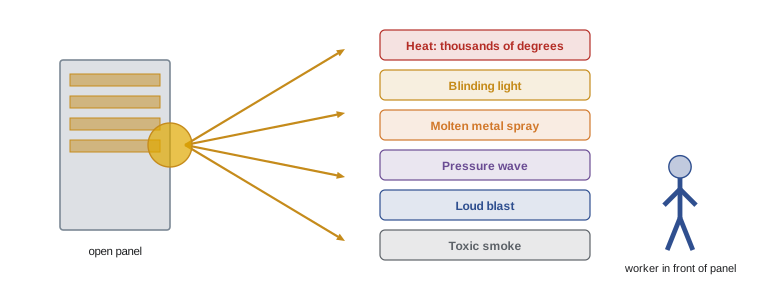
The arc blast that follows can throw a worker across a room, rupture eardrums, collapse lungs and send pieces of metal flying like shrapnel. The light can damage eyes, and the burning materials release toxic gases. Arc flash injuries are often severe burns to the hands, arms, face and chest, because those are the parts of the body closest to the equipment. Many happen to qualified workers doing routine tasks such as testing, racking breakers or removing covers. That is why approach boundaries, arc flash labels and personal protective equipment, covered in lessons 8 and 10, exist.
Secondary injuries
Not every electrical injury is caused directly by current or heat. A small shock can make a worker jerk away and fall from a ladder or platform, or drop a tool. A startle reflex near a machine can bring a hand into moving parts. Electrical faults start fires that injure people far from the equipment. In investigations, a fall after a minor shock is a common pattern, so electrical safety and fall protection go together. HSE-212 and HSE-213 cover work at heights.
Who gets hurt, and how
In Ontario, the Electrical Safety Authority reports that about half of electrical deaths happen at work and half at home or in public places. Over 2016 to 2025, the most common location for occupational electrical deaths was an industrial setting, the most common activity was repair and maintenance, and improper procedures and lack of training were the leading probable causes. Overhead power line contact was the leading cause of utility-related incidents. Similar patterns appear in WorkSafeBC, Alberta and CNESST reports.
The victims are not only electricians. Labourers, painters, roofers, tree trimmers, equipment operators, truck drivers, maintenance staff and cleaners are injured when ladders, booms, dump boxes or tools contact power lines, when they use damaged cords, or when they open panels they were never trained to work in. The most common factor is simple: someone came into contact with something they believed was safe or did not recognize as a hazard.
The approach in this course
The rest of this course follows the same logic as the hierarchy of controls you met in HSE-103. The best protection is to eliminate the hazard by de-energizing equipment and proving it is dead before work begins. Where that is not possible, engineering controls such as ground fault protection, enclosures, insulation and barriers come next, then administrative controls such as approach boundaries, permits, training and labels, and finally personal protective equipment. Above all, unqualified workers must know where their limits are: what they may do, what they must not touch, and when to stop and call a qualified person.
Worked problem
Reading an incident through the hierarchy of controls
A cleaner plugs a floor scrubber into a wall outlet with a cord that has a cut in its outer jacket. The floor is wet. The cleaner receives a shock and falls, striking their head. Identify one control at each level of the hierarchy that could have prevented the injury.
Show solution
- Elimination or substitution: use a battery-powered scrubber, removing the cord from wet work.
- Engineering: plug into a GFCI-protected outlet, which would trip at about 5 mA before harm.
- Administrative: inspect cords before each use, tag out the damaged cord and report it; train cleaners on cord hazards.
- PPE: rubber-soled slip-resistant footwear reduces the fall risk but is not reliable shock protection.
Answer: Several controls would have worked. The strongest are removing the cord from the wet task and providing ground fault protection; inspection and training support them.
Common mistakes
MistakeBelieving that ordinary 120 V outlets cannot kill.
InsteadWet skin and a path through the chest can let a lethal current flow at 120 V.
MistakeThinking you must touch two wires at once to get a shock.
InsteadTouching one live part while in contact with ground can complete the circuit.
MistakeAssuming a small entry wound means a minor injury.
InsteadElectrical burns can hide deep tissue damage; every shock victim needs medical assessment.
MistakeBelieving arc flash only injures people who touch equipment.
InsteadArc flash heat, pressure and metal spray reach people standing nearby.
MistakeTreating a small shock as harmless when working at height.
InsteadA startle from a minor shock often causes a serious fall.
Summary and key terms
- Voltage drives current through a resistance, as Ohm's law describes, and current through the body causes injury.
- Currents of only tens of milliamperes can prevent letting go, stop breathing and cause fibrillation.
- Wet, sweaty or broken skin lowers resistance and can turn a harmless shock into a fatal one.
- Electricity causes electrical, arc and thermal burns, and internal damage may be hidden.
- Arc flash and arc blast release heat, light, molten metal, pressure and toxic gases.
- Falls and other secondary injuries often follow minor shocks.
- This awareness course does not make anyone a qualified electrical worker.
- Voltage
- The electrical pressure that drives current, measured in volts.
- Current
- The flow of electric charge, measured in amperes or milliamperes.
- Resistance
- Opposition to current, measured in ohms.
- Ohm's law
- The relationship I = V/R between current, voltage and resistance.
- Ground
- A conducting connection to the earth or to a body that serves in place of the earth.
- Let-go threshold
- The current above which a person cannot release a gripped conductor.
- Ventricular fibrillation
- A chaotic heart rhythm in which the heart quivers instead of pumping.
- Arc flash
- A dangerous release of heat and light from an electric arc.
- Arc blast
- The pressure wave, sound and flying debris produced by an arc.
- Qualified person
- A person trained and knowledgeable in the construction and operation of electrical equipment and its hazards.
Practice problems
Work each problem on paper first, then reveal the answer to check.
What current flows through a 2,000 Ω path at 120 V?
Show answer
60 mA, from 120 / 2,000.
Why is a hand-to-feet path especially dangerous?
Show answer
It passes through the chest, crossing the heart and breathing muscles.
What is the approximate let-go threshold for an adult?
Show answer
About 10 mA for 60 Hz current, with wide variation.
Name three effects of an arc flash.
Show answer
Intense heat, blinding light, molten metal, a pressure wave, loud noise or toxic gases.
What happens to skin resistance during a shock?
Show answer
It drops as the skin blisters and breaks down, so current rises.
Why should a person who felt fine after a shock still see a doctor?
Show answer
Internal burns and heart rhythm problems may not be obvious at first.
What current flows at 240 V through a 1,000 Ω path?
Show answer
240 mA, well into the lethal range.
Give one example of a secondary electrical injury.
Show answer
A fall from a ladder after a startle from a shock.
What is the first level of the hierarchy of controls for electrical work?
Show answer
Eliminate the hazard by de-energizing and proving the equipment is dead.
Why are DC battery systems a concern?
Show answer
They can deliver very large currents and their arcs are hard to extinguish.
Lesson quiz · 5 questions
Score 60% or more to complete this lesson.
Create a free account to save your progress, take quizzes and earn a certificate.