
HSE-213 · Lesson 2 of 12 · 27 min
Ladder and scaffold law and standards in Canada
Ladders and scaffolds are covered by occupational health and safety law in every Canadian jurisdiction. The general duty clauses in each provincial and territorial OHS act require employers to provide safe equipment, information, instruction and supervision. Detailed regulations then set specific requirements for portable ladders, fixed ladders and scaffolds, and most of them call up CSA standards. This lesson maps the main rules so that you know where to look. Always check the current regulation for your province or territory, because section numbers and details change.
How the pieces fit together
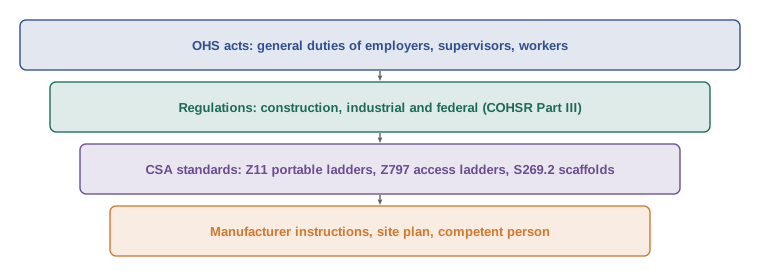
The pattern is the same in both countries. The law sets duties and minimum requirements. Standards describe how equipment must be designed, tested, marked and used. Manufacturers' instructions say how a particular product may be used, and they often set limits that are stricter than the regulation. A site plan or procedure applies all three to a specific job.
Canadian standards for ladders and scaffolds
Three CSA standards matter most:
- CSA Z11, Portable ladders. The current edition is Z11-18, reaffirmed in 2022. It sets design, testing, marking and use requirements and the grades 1AA, 1A, 1, 2 and 3 that tell you how much load a ladder is rated for. Most provinces require portable ladders to meet Z11 or an equivalent standard such as ANSI A14.
- CSA Z797, Code of practice for access ladders. The current edition is Z797-18. It covers fixed access ladders, including cages, rest platforms and ladder safety systems.
- CSA S269.2, Access scaffolding for construction purposes. The current edition is S269.2-16, reaffirmed in 2021. It covers design loads, materials, erection, inspection and use of frame, tube-and-coupler and system scaffolds and mobile scaffolds.
Other CSA standards apply to suspended equipment, such as CSA Z271 for suspended elevating platforms and Z91 for window cleaning operations, and the CSA Z259 family covers fall protection equipment.
Provincial and federal regulations
The table summarizes where to find ladder and scaffold rules in several jurisdictions. These are pointers, not a substitute for reading the regulation.
| Jurisdiction | Ladders | Scaffolds |
|---|---|---|
| Ontario construction (O. Reg. 213/91) | ss. 78 to 84 | ss. 125 to 142, with engineer design above 15 m (10 m tube-and-clamp) |
| Ontario industrial (Reg. 851) | ss. 73 and nearby | ss. 125 to 136 for scaffolds and platforms |
| British Columbia (OHS Regulation Part 13) | Division 2, incl. 13.4 to 13.6 | Division 4, incl. 13.11 to 13.24 |
| Alberta (OHS Code) | Part 8, entrances, walkways, stairways and ladders | Part 23, ss. 323 to 353, with tagging in s. 326 |
| Quebec (Safety Code for the construction industry) | Chapter 3, ladders section | Chapter 3, scaffolds section |
| Federal (COHSR Part III) | Portable ladders in Part III | Scaffolds in Part III, 4 times load capacity |
Several common requirements appear across most of these regulations:
- Portable ladders must be designed, built and maintained to a recognized standard, usually CSA Z11, and marked with their grade.
- Non-self-supporting ladders must be set at the correct angle. Ontario's construction regulation requires the base to be between one quarter and one third of the ladder's length from the wall, and British Columbia specifies about 75 degrees.
- Ladders used for access must extend about 1 m above the landing. Ontario specifies at least 900 mm, and British Columbia about 1 m.
- Scaffolds must support at least four times the maximum load they will carry without overturning, and be designed by an engineer above set heights or loads.
- Free-standing scaffolds must be tied, guyed or braced when the height exceeds about three times the smallest base dimension. Ontario sets ties at vertical intervals of no more than three times the least base dimension, and British Columbia requires ties above three times the minimum base dimension.
- Scaffold platforms must be fully planked, at least the minimum width, and guarded where the fall height reaches the trigger, usually 3 m, or less where the hazard is unusual.
- A competent person must inspect scaffolds before use and regularly afterwards, and keep records where the regulation requires them.
Ontario's Working at Heights training
In Ontario, workers on construction projects who may use fall protection, including on scaffolds without full guardrails, must complete a Working at Heights course approved by the Chief Prevention Officer, valid for three years. HSE-212 covers it. That training does not by itself qualify a worker to erect scaffolds; scaffold erection requires specific competence.
Ladders and scaffolds in other industries
Outside construction, industrial and commercial workplaces follow the general industrial regulations of their province. Film and television productions, theatres, warehouses, retail stores and offices all use ladders and rolling towers, and the same principles apply even where the regulation is less detailed. Many provinces also publish guidelines, and construction safety associations such as IHSA in Ontario, the BC Construction Safety Alliance and the Alberta Construction Safety Association publish practical guides.
Duties under the OHS acts
Even where a specific rule does not exist, the general duty clause in each OHS act requires employers to take every precaution reasonable in the circumstances. A ladder that meets every regulation but is used for the wrong job can still be a breach. Supervisors must ensure workers use equipment as required, and workers must use it properly and report defects. Serious failures can lead to prosecution, and the Criminal Code's section 217.1 applies to anyone who directs work.
Worked problem
Reading the rules for a job
A contractor in Ontario plans to erect a tube-and-clamp scaffold 12 m high on a construction project. Which requirements apply to its design, inspection and use?
Show solution
- O. Reg. 213/91 s. 130(1) requires engineer design for a scaffold more than 15 m high, or more than 10 m for tube-and-clamp. At 12 m, this tube-and-clamp scaffold needs an engineer's design.
- The drawings must show erection instructions and rated loads, and an engineer or a competent worker designated by the supervisor must confirm in writing that it was erected as designed before use.
- Platforms must meet s. 134: at least 2.4 kN/m² plus expected loads, with each component supporting at least 2.2 kN.
- Guardrails are required where workers could fall 3 m or more, and the scaffold must be braced and tied as required.
Answer: The scaffold needs an engineer's design, written confirmation that it was built to the drawings, platforms rated to s. 134, guardrails and ties, and competent inspection.
Duties of manufacturers, suppliers and owners
OHS law does not stop with employers. In most provinces, suppliers must provide equipment that is in good condition and complies with the regulations, and owners of buildings and projects have duties to provide information about hazards such as fragile roofs, overhead lines and weak anchorages. Scaffold rental companies supply manufacturer's data, load ratings and erection instructions, and often provide competent erectors. Constructors on construction projects coordinate the work of several employers and are responsible for making sure that scaffolds on the project are erected, inspected and maintained as required.
How inspectors enforce the rules
Provincial inspectors visit sites in response to complaints, incidents and planned campaigns. Ladders and scaffolds are frequent targets of enforcement blitzes because they are easy to see from the street and their defects are well known. Inspectors can issue orders to comply, stop-work orders for imminent danger, and in some provinces administrative penalties or tickets. Serious cases are prosecuted, and fines for corporations can reach hundreds of thousands or millions of dollars per count depending on the province. Records of inspection, training and competent person designation are often the first documents an inspector asks to see.
Reading a regulation effectively
Regulations can be hard to read, but a few habits help. Start with the definitions section, because words such as scaffold, platform, competent and ladder may have specific meanings. Check whether a section applies to all workplaces, to construction only or to a particular sector. Look for references to standards, and note the edition that the regulation calls up. Read related sections together: the scaffold rules, the guardrail rules and the fall protection rules usually interact. Finally, check for guidance documents from the regulator or industry associations that explain how the rules are applied in practice.
Worked problem
Finding the rule that applies
A maintenance worker in a factory in Ontario wants to use a rolling tower to change high bay lights. Which regulation applies, and what else should the employer consult?
Show solution
- The work is in an industrial establishment, not on a construction project, so the Industrial Establishments regulation (Reg. 851) applies rather than O. Reg. 213/91.
- Reg. 851 has provisions for scaffolds and work platforms, guardrails and fall protection.
- The manufacturer's instructions set the height limits, outrigger use and load ratings for the tower.
- Industry guidance, such as construction safety association booklets on rolling towers, explains practical set-up and use.
Answer: Reg. 851, the manufacturer's instructions and industry guidance together set the requirements for the rolling tower.
Standards editions and reaffirmation
Standards are revised and reaffirmed on a regular cycle. A reaffirmed standard, marked with an R and a year, has been reviewed and kept without technical change. A new edition may change requirements, for example load classes, marking rules or test methods. Regulations usually call up a specific edition or the edition in force when equipment was made. Equipment built to an older edition may remain acceptable if it is in good condition, but new purchases should meet the current edition. When a standard changes, review the fleet and the procedures that depend on it, and update training so that workers understand any new markings or limits.
Federal workplaces
Federally regulated workplaces, such as banks, telecommunications, airlines, ports, railways and federal government operations, follow the Canada Labour Code Part II and the Canada Occupational Health and Safety Regulations. COHSR Part III covers temporary structures, including scaffolds, which must support at least four times the load likely to be imposed on them, and portable ladders. Federal employers must also meet the fall protection requirements of COHSR Part XII. Where a federal workplace hires a contractor for construction, provincial rules may also apply to the contractor's work, so the arrangement should be clear in the contract.
Keep a short reference sheet for your workplace listing the regulation sections, standards and site rules that apply to ladders and scaffolds, with the date it was last checked. Review it at least once a year and whenever a regulation or standard changes, so that supervisors and workers are not relying on memory or on outdated binders.
If the regulation and a standard seem to conflict, follow the regulation and ask the regulator or a qualified advisor for an interpretation.
Common mistakes
MistakeAssuming one set of rules applies everywhere.
InsteadCheck the regulation for the province or territory, and the sector, where the work happens.
MistakeIgnoring manufacturer instructions because the regulation is less strict.
InsteadFollow the stricter of the law, the standard and the instructions.
MistakeTreating consensus standards as irrelevant because they are voluntary.
InsteadRegulations often adopt them, and they show what good practice looks like.
MistakeThinking fall protection training qualifies a worker to erect scaffolds.
InsteadScaffold erection requires specific competence and designation.
MistakeRelying on old section numbers from a binder.
InsteadConfirm current section numbers, because regulations are amended.
Summary and key terms
- Every Canadian jurisdiction regulates ladders and scaffolds through OHS acts and regulations.
- CSA Z11-18 covers portable ladders, Z797-18 access ladders and S269.2-16 access scaffolding.
- Ontario requires ladder bases at one quarter to one third of the length and 900 mm extension above landings.
- Scaffolds must support 4 times their load without overturning and be tied above about 3 times the least base dimension.
- Engineer design is needed for tall or unusual scaffolds, such as over 15 m in Ontario.
- Competent persons erect and inspect scaffolds; manufacturers set limits that must also be followed.
- General duty clauses apply even where no specific rule exists.
- CSA Z11
- The Canadian standard for portable ladders, which defines ladder grades.
- CSA Z797
- The Canadian code of practice for fixed access ladders.
- CSA S269.2
- The Canadian standard for access scaffolding used in construction.
- O. Reg. 213/91
- Ontario's regulation for construction projects.
- OHS Regulation Part 13
- British Columbia's rules for ladders, scaffolds and temporary work platforms.
- OHS Code Part 23
- Alberta's rules for scaffolds and temporary work platforms.
- COHSR
- The Canada Occupational Health and Safety Regulations for federally regulated workplaces.
- General duty clause
- The broad requirement in an OHS act to take every reasonable precaution.
- Rated load
- The maximum load a scaffold or ladder is designed to carry.
- Engineer design
- A scaffold design prepared and sealed by a professional engineer.
Practice problems
Work each problem on paper first, then reveal the answer to check.
Which CSA standard covers portable ladders?
Show answer
CSA Z11, currently Z11-18.
Which CSA standard covers access scaffolding?
Show answer
CSA S269.2, currently S269.2-16.
Where must an Ontario construction ladder base be?
Show answer
Between one quarter and one third of the ladder length from the wall.
When does Ontario require an engineer to design a scaffold?
Show answer
Above 15 m, or above 10 m for tube-and-clamp.
What load must a scaffold support?
Show answer
At least 4 times its maximum intended load without failing or overturning.
Why read manufacturer instructions?
Show answer
They may set limits stricter than the law, such as a lower rated load.
Which Alberta section covers scaffold tags?
Show answer
OHS Code s. 326.
How far must an access ladder extend above a landing in Ontario?
Show answer
At least 900 mm.
What does the general duty clause add?
Show answer
A duty to control hazards even where no specific rule exists.
Does fall protection training qualify a worker to erect scaffolds?
Show answer
No. Scaffold erection needs specific competence and designation.
Lesson quiz · 5 questions
Score 60% or more to complete this lesson.
Create a free account to save your progress, take quizzes and earn a certificate.