
HSE-213 · Lesson 6 of 12 · 26 min
Climbing and working from ladders
A well-chosen, inspected and properly set-up ladder can still be used unsafely. Most ladder falls happen while the person is climbing, reaching, carrying something, stepping off at the top or standing too high. This lesson covers safe climbing, working positions, tools and materials, stepladder and platform ladder rules, and the situations where a ladder simply should not be used.
Before you climb
- Check that you are fit to climb. Dizziness, fatigue, some medications, alcohol and recent injuries affect balance.
- Wear footwear with clean, slip-resistant soles and a defined heel. Clean mud, grease or snow off the soles.
- Make sure the ladder has been inspected, set up and secured as described in lessons 4 and 5.
- Plan how tools and materials will get up and down.
- Know the weather. Wind gusts strong enough to make you brace yourself on the ground are strong enough to push a ladder or its user. Stop outdoor ladder work in high winds, lightning, heavy rain or ice.
Three points of contact
HSE-106 introduced the rule of three points of contact: two hands and one foot, or two feet and one hand, on the ladder at all times while climbing. Face the ladder, keep your body centred between the rails and climb one rung at a time. Grip the rungs or the rails as the manufacturer recommends; many trainers prefer gripping rungs because a slipping hand slides down a rail but catches on a rung.
Provincial regulations, CSA Z11 and manufacturers' instructions all expect workers to face the ladder and keep three points of contact while climbing, with hands free for the ladder rather than for loads.
Carrying tools and materials
Climbing with something in your hand breaks the three points of contact. Instead:
- carry small tools in a tool belt, pouch or holster;
- raise heavier items with a hand line, a bucket and rope, or a hoist, after you reach the top;
- use a ladder tool tray designed for the ladder for items needed at the top;
- tether tools used at height so that they cannot fall on people below, and barricade the drop zone.
Long or awkward items such as pipe, conduit, drywall and roofing bundles should never be carried up a ladder. Use a hoist, a material lift or a scaffold.
The working position
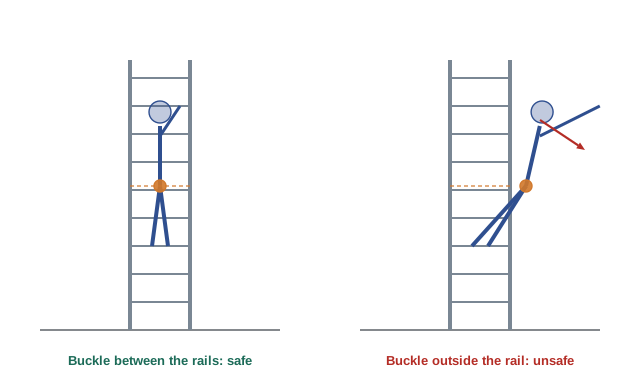
Once at the working height, keep your body inside the rails. The belt buckle rule is a simple test: your belt buckle, or the centre of your body, should stay between the side rails. Leaning so far that your buckle passes a rail moves your centre of gravity outside the ladder's base and can tip it sideways.
Worked problem
Why overreaching tips a ladder
A stepladder has feet 0.6 m apart side to side. A worker whose centre of gravity is 1.5 m above the ladder's feet leans to the side. How far sideways can their centre of gravity move before the combined centre of gravity of worker and ladder passes the edge of the base? Assume the worker is 85 kg and the ladder is 10 kg, with the ladder's centre of gravity on its centreline.
Show solution
- The base edge is 0.3 m from the centreline.
- The combined centre of gravity reaches the edge when \( 85x/(85 + 10) = 0.3 \), so \( x = 0.3 \times 95/85 \approx 0.34 \) m.
- That is only about 34 cm of sideways shift. Reaching out with a heavy drill moves the centre of gravity further than you might expect.
- Pushing or pulling sideways on a tool adds a force that makes tipping happen even sooner.
Answer: About 34 cm. Small leans can tip a stepladder, which is why you move the ladder rather than reaching.
Other rules for the working position:
- Move the ladder rather than overreaching. Climb down, reposition, and climb up again.
- Do not stand on the top cap or top step of a stepladder, the step below the top if it is marked, or the top three rungs of an extension ladder. The top rungs give no handhold above you.
- Avoid side loading: pushing or pulling sideways, such as drilling into a wall at the side, can tip a ladder.
- Avoid jobs that need heavy force, such as breaking out concrete or prying, from a ladder.
- Do not let two people use a single-width ladder at the same time unless it is designed for two, such as a double-sided stepladder with one person on each side, within its rating.
- Never move, shift or extend a ladder while someone is on it.
- Do not use a ladder as a plank, brace, skid or anything else it was not designed for.
Stepping on and off at the top
The transition at the top of a ladder is one of the riskiest moments. The ladder must extend above the landing, or a grab rail must be provided. Step sideways off the ladder onto the landing, holding the rails, rather than climbing over the top. On the way down, face the ladder before you step onto it and test that it is secure. On roofs, the edge area is also a fall hazard; HSE-212 explains how to protect it, for example with a guarded access gate or a parapet opening with a self-closing gate.
Stepladders
Stepladders are the most common ladder in workplaces and homes, and they are involved in many falls.
| Do | Don't |
|---|---|
| Open fully and lock the spreaders | Use it folded and leaning against a wall |
| Set all four feet on a firm, level surface | Stand it on a table, box or uneven surface |
| Face the steps while climbing and working | Stand on the back section or rear braces unless designed for it |
| Stay below the top step and the top cap | Stand on the top cap or the pail shelf |
| Keep the work in front of you | Reach sideways or push hard on the work |
| Choose a taller ladder if needed | Straddle the top or sit on it |
Ontario's construction regulation requires stepladders to be fully opened with spreaders locked, and prohibits standing on the top cap, top step or pail shelf. Similar rules appear in other provinces and in CSA Z11.
Platform ladders and rolling ladders
A platform ladder is often the better choice for work that takes more than a few minutes. The user stands on a wide platform, usually at least 300 mm by 300 mm, with a guardrail or knee rail around it, and can work facing the task with both hands. Rolling ladders and mobile ladder stands, common in warehouses and stores, have casters that retract or lock when weight is put on the steps, and handrails on both sides. Check that the brakes engage before climbing, never ride a rolling ladder while it is pushed, and keep loads within the rating.
Extension ladders at work
On extension ladders, do not stand above the fourth rung from the top, where the top rungs still give a handhold. Work facing the ladder. Where you must use both hands, for example to install a fixture, use a ladder only if the task is short and you can keep your body stable against the ladder; otherwise use a platform. Fall protection from a ladder is difficult: a lanyard tied to the ladder does not help if the ladder itself falls. If fall protection is needed while working from a ladder, connect to an independent anchor and make sure the ladder is secured, or choose a different means of access.
Provincial rules push in the same direction. British Columbia requires a work platform where work cannot be done safely from a ladder (OHS Regulation s. 13.6), and Ontario guidance from the ministry and IHSA treats two-handed work from a ladder more than 3 m above the floor as needing fall protection or a different means of access. Check the rule in your province.
Worked problem
Should this task be done from a ladder?
An electrician must install six light fixtures at 4.2 m. Each takes 25 minutes and needs both hands to hold the fixture and drive screws. The floor is level concrete. A rolling tower is available. Should the work be done from an extension ladder?
Show solution
- Total time at height = 6 × 25 = 150 minutes.
- Both hands are needed, so three points of contact cannot be maintained.
- At 4.2 m, the worker is above 3 m, where two-handed ladder work would need fall protection or a different means of access.
- A rolling tower gives a guarded platform, space for fixtures and both hands free.
Answer: No. Use the rolling tower. The task is long, two-handed and high enough that a ladder would need fall protection that is hard to arrange.
When not to use a ladder
- In strong winds, lightning, icy conditions or poor visibility.
- Near energized equipment with a conductive ladder.
- When you are unwell, tired or impaired.
- For heavy, long, two-handed or forceful work.
- Where the base cannot be made firm, level and secure.
- When the ladder is too short and you would have to stand on the top rungs or steps.
Ladders and human factors
Most people who fall from ladders were not careless in general. They were tired, rushed, distracted, or doing a task they had done safely hundreds of times. Complacency grows with familiarity. Supervisors can counter it by planning ladder work into the schedule rather than letting it be squeezed in, by making the right equipment easy to get, by praising workers who stop to reposition a ladder or fetch a better one, and by talking openly about near misses. A near miss on a ladder, such as a foot slipping or a ladder shifting, is a warning worth reporting and discussing at the next toolbox talk.
Above all, treat stopping to move the ladder as part of the job, not a delay.
Common mistakes
MistakeCarrying a box of fittings up the ladder in one hand.
InsteadUse a tool belt, hand line or hoist and keep three points of contact.
MistakeLeaning sideways to reach the last bit of a job.
InsteadKeep your belt buckle between the rails; climb down and move the ladder.
MistakeStanding on the top cap of a stepladder.
InsteadUse a taller ladder or a platform ladder.
MistakeMoving a rolling ladder or stepladder with someone on it.
InsteadNever move a ladder while it is occupied.
MistakeTying a lanyard to the ladder for fall protection.
InsteadConnect to an independent anchor, or use a platform instead.
Summary and key terms
- Check your fitness, footwear, the ladder and the weather before climbing.
- Face the ladder and keep three points of contact; do not carry loads by hand.
- Raise tools and materials with a belt, hand line, bucket or hoist, and tether tools at height.
- Keep your belt buckle between the rails and move the ladder rather than overreaching.
- Stay off the top cap and top step of stepladders and the top rungs of extension ladders.
- Platform ladders and rolling towers suit longer and two-handed tasks better than stepladders.
- Do not use a ladder in bad weather, near energized equipment with a conductive ladder, or for heavy, forceful work.
- Three points of contact
- Two hands and one foot, or two feet and one hand, on the ladder at all times.
- Belt buckle rule
- Keep the centre of your body between the ladder rails.
- Overreaching
- Leaning so far that the centre of gravity moves outside the ladder base.
- Side loading
- A sideways force on a ladder, such as pushing a drill into a wall at the side.
- Pail shelf
- The fold-down shelf on a stepladder for tools or paint, not for standing.
- Hand line
- A rope used to raise or lower tools and materials.
- Tool tether
- A lanyard that attaches a tool to the worker or structure to stop it falling.
- Drop zone
- The area below work at height where falling objects could land.
- Rolling ladder
- A wheeled ladder whose casters lock under load.
- Independent anchor
- An anchor not attached to the ladder or to the equipment being used.
Practice problems
Work each problem on paper first, then reveal the answer to check.
What does three points of contact mean?
Show answer
Two hands and one foot, or two feet and one hand, on the ladder at all times.
How should you get a heavy tool to the top of a ladder?
Show answer
Raise it with a hand line, bucket or hoist after you reach the top.
What is the belt buckle rule?
Show answer
Keep the centre of your body between the side rails.
Which stepladder parts must you never stand on?
Show answer
The top cap, top step if marked, pail shelf and rear braces unless designed for it.
What is the highest rung to stand on with an extension ladder?
Show answer
No higher than the fourth rung from the top.
Why is a lanyard tied to the ladder not effective?
Show answer
If the ladder falls, the worker falls with it.
When is a platform ladder better than a stepladder?
Show answer
For tasks longer than a few minutes or needing both hands.
What should you do before climbing a rolling ladder?
Show answer
Check that the casters lock or retract under load.
Name three conditions when you should not use a ladder outdoors.
Show answer
High wind, lightning and ice.
Why tether tools at height?
Show answer
To stop them falling on people below.
Lesson quiz · 5 questions
Score 60% or more to complete this lesson.
Create a free account to save your progress, take quizzes and earn a certificate.