
HSE-213 · Lesson 1 of 12 · 27 min
Ladders, scaffolds and falls: why access equipment matters
Ladders and scaffolds are among the most familiar pieces of equipment on any work site. Painters, electricians, carpenters, maintenance staff, warehouse workers, retail clerks and homeowners all use them. Because they are so ordinary, they are easy to underestimate. Yet falls from ladders and scaffolds injure tens of thousands of workers every year and kill many of them. This course looks closely at how to choose, inspect, set up and use ladders and scaffolds safely. It builds on HSE-106, which introduced ladder basics such as the four-to-one angle and three points of contact, and on HSE-212, which covered fall protection in depth. Elevating work platforms such as scissor lifts and boom lifts have their own course, HSE-217.
This is an awareness course. It explains the hazards, the rules and good practice, but it does not make anyone a competent person who may erect, alter, inspect or dismantle scaffolds. In most provinces that role requires specific training, experience and designation by the employer or constructor, and some scaffolds must be designed by a professional engineer.
The scale of the problem
Falls are consistently one of the leading causes of serious injury and death at work in Canada. In construction, falls from height account for a large share of fatalities, and ladders and scaffolds appear again and again in the investigation reports of WorkSafeBC, the WSIB, Alberta OHS and CNESST. Provincial inspectors run regular enforcement blitzes on ladders and scaffolds because the same failures keep recurring: ladders set up at the wrong angle, ladders not secured, scaffolds without guardrails, incomplete planking and missing ties.
These numbers hide a simple truth. Most ladder and scaffold incidents are not mysterious. They happen because the wrong equipment was used, because it was in poor condition, because it was set up badly, or because the person using it took a shortcut. Each of those causes can be controlled.
Worked problem
What a short fall from a ladder really means
A worker is standing on a stepladder with their feet 1.8 m above a concrete floor. They overreach and fall. How fast are they travelling when they reach the floor, and how long does the fall take?
Show solution
- Use the free-fall relationship \( v = \sqrt{2gh} \) with g = 9.81 m/s².
- \( v = \sqrt{2 \times 9.81 \times 1.8} \approx 5.9 \) m/s, which is about 21 km/h.
- The time is \( t = \sqrt{2h/g} = \sqrt{2 \times 1.8 / 9.81} \approx 0.61 \) s.
- Human reaction time is typically around a quarter to a third of a second, and the body often rotates during a fall, so the head can strike the floor or an object first.
Answer: About 5.9 m/s after roughly 0.6 s. There is no time to recover, which is why falls of under 2 m from ladders regularly cause head injuries and deaths.
Why ladder and scaffold incidents happen
Investigations of ladder and scaffold incidents point to a fairly short list of causes. Most incidents involve more than one of them.
- Wrong equipment for the job: a ladder that is too short, a household ladder used on a construction site, a metal ladder used near electrical equipment, or a ladder used where a scaffold or lift was needed.
- Defective equipment: cracked rails, bent rungs, missing feet, broken locks, damaged planks or scaffold frames that have been dropped or overloaded.
- Poor set-up: a ladder at the wrong angle, on soft or slippery ground, not tied off, not extended above the landing; a scaffold on unstable footing, without base plates, with missing braces or ties.
- Unsafe use: overreaching, standing on the top steps, carrying loads while climbing, moving a rolling scaffold with people on it, or removing guardrails to pass materials.
- Missing fall protection: no guardrails on a scaffold platform, or no plan for a worker who must lean out from a ladder.
- Environmental factors: wind, rain, ice, mud, poor lighting and overhead power lines.
- Organizational factors: schedule pressure, no planning, no inspection, inadequate training and supervisors who accept shortcuts.
Choosing the right means of access
The most important ladder safety decision is often made before anyone touches a ladder: is a ladder the right tool at all? A ladder is a means of access and a place to do short, light work. It is not a work platform for long, heavy or two-handed tasks. Before choosing a ladder, ask:
- How high is the work, and how long will it take?
- Will the worker need both hands, handle heavy or bulky materials, or apply force such as drilling overhead?
- How often will the worker need to move along the work?
- Is there a firm, level surface for a ladder, scaffold or lift?
- Are there electrical hazards, traffic, the public or wind to consider?
- Can the work be eliminated or done from the ground with long-handled tools?
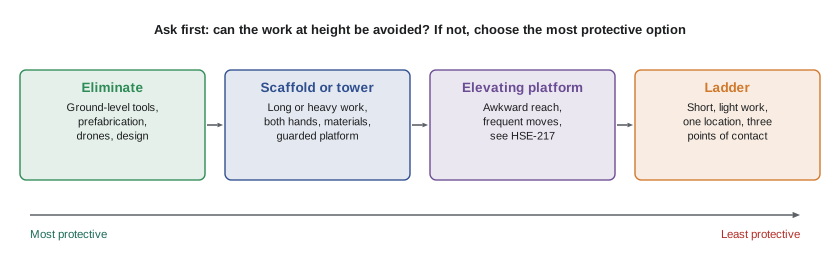
A scaffold or mobile work platform gives a stable, guarded place to work with both hands, room for tools and materials, and the ability to move along the work. An elevating work platform can reach awkward locations quickly. A ladder is light and fast to set up, which is exactly why it is overused.
| Situation | Better choice | Why |
|---|---|---|
| Changing a light bulb at 3 m for 2 minutes | Stepladder or platform ladder | Short, light, one location |
| Painting a 12 m long wall over two days | Rolling scaffold | Long duration and frequent moves |
| Installing heavy ductwork overhead | Scissor lift or scaffold | Two hands, heavy loads, force |
| Re-pointing brick on a three-storey façade | Frame or system scaffold | Long job at height with materials |
| Getting onto a flat roof once a month | Fixed ladder or stair | Permanent, frequent access |
| Inspecting a roof drain | Drone or camera, then a ladder if needed | Eliminate the climb where possible |
The hierarchy of controls for access
The hierarchy of controls from HSE-103 applies directly. Eliminating the work at height is best: prefabricate at ground level, lower fixtures for servicing, or use poles and cameras. Next come engineered means of access with built-in protection, such as permanent stairs, guarded platforms, scaffolds and elevating work platforms. A portable ladder is the least protective option because the worker has no guardrail and relies on balance, grip and correct set-up. Fall protection, training, inspection and supervision then support whichever equipment is used.
Who is involved
Several people share responsibility for ladder and scaffold safety:
- Employers and constructors provide suitable equipment, plan the work, train workers and make sure inspections happen.
- Supervisors check that equipment is right for the task, set up properly and used as intended, and stop work when it is not.
- Competent persons erect, alter, inspect and dismantle scaffolds. In Ontario the supervisor designates a competent worker; in other provinces the regulation or CSA S269.2 describes the qualifications.
- Engineers design scaffolds above certain heights or loads, and unusual configurations.
- Workers inspect ladders before use, set them up and use them correctly, follow scaffold tags and report defects.
- Manufacturers and suppliers provide equipment that meets the standards and instructions for its use.
How this course is organized
Lessons 2 to 7 focus on ladders: the rules and standards, types and ratings, inspection, set-up, safe use, and fixed and job-built ladders. Lessons 8 to 12 cover scaffolds: types and components, foundations, platforms and guardrails, stability and ties, mobile scaffolds, competent person inspection and tagging, erection and dismantling, suspended scaffolds at an awareness level, weather and falling objects. The capstone in lesson 12 brings everything together in a plan for a façade repair.
Worked problem
Comparing access options by exposure time
A crew must replace 40 ceiling tiles spread along a corridor 30 m long, at a height of 3.2 m. Each tile takes 4 minutes. Moving and re-setting a stepladder takes 2 minutes; moving a rolling tower takes 3 minutes, but it covers four tiles per position. Compare the total time spent climbing and repositioning with each option.
Show solution
- Stepladder: one position per tile, so 40 positions. Repositioning time = 40 × 2 = 80 minutes, plus 40 climbs up and down.
- Rolling tower: 40 ÷ 4 = 10 positions. Repositioning time = 10 × 3 = 30 minutes, with climbs only at each new position or none if the tower is moved from the floor with nobody on it.
- Working time is the same, 40 × 4 = 160 minutes, but on the tower the worker stands on a guarded platform with both hands free.
- The tower saves 50 minutes of repositioning and removes about 30 ladder climbs.
Answer: The rolling tower is faster overall and much safer: fewer climbs, both hands free and guardrails on all sides.
Learning from the pattern of incidents
When safety specialists review ladder and scaffold incidents across many workplaces, a few patterns stand out. Falls from ladders cluster at low heights, often under 3 m (10 ft), because that is where most ladder work happens and where people feel least at risk. Falls from scaffolds cluster around missing guardrails, incomplete planking and climbing the frames instead of using proper access. Collapses cluster around poor foundations, missing ties and overloading. Electrocutions cluster around metal ladders and scaffolds moved or raised near overhead lines.
These patterns are useful because they tell supervisors where to look. A quick walk around a site checking ladder angles and tie-offs, guardrails and planking on scaffolds, foundations under scaffold legs and the distance to any overhead line catches many of the conditions that lead to serious harm. The same walk is a chance to talk with workers about how they are getting to the work and whether a better option is available.
A good habit for any job at height is a short pre-task conversation: what is the task, how long will it take, what will we stand on, what could make us fall, what will we do if the weather changes, and who checks the equipment. Five minutes spent on these questions often results in a better choice of access equipment and a safer day.
Common mistakes
MistakeReaching for a ladder by habit for every job at height.
InsteadAsk first whether the work can be eliminated, or whether a scaffold or lift is better.
MistakeAssuming a short fall from a ladder is unlikely to be serious.
InsteadFalls under 2 m (6 ft) regularly cause head injuries and deaths.
MistakeTreating ladder and scaffold incidents as bad luck.
InsteadMost have predictable causes: wrong equipment, defects, poor set-up and unsafe use.
MistakeBelieving that anyone who has used a scaffold can erect or inspect one.
InsteadOnly a trained, designated competent person may erect, alter or inspect scaffolds.
MistakeUsing a ladder as a work platform for heavy, two-handed work.
InsteadUse a scaffold or elevating work platform for long, heavy or forceful tasks.
Summary and key terms
- Ladders and scaffolds are everyday equipment, but falls from them injure and kill many workers each year.
- Provincial inspectors regularly target ladder and scaffold hazards because the same failures keep recurring.
- Most incidents come from the wrong equipment, defects, poor set-up, unsafe use, weather and schedule pressure.
- A ladder is a means of access and a place for short, light work, not a work platform.
- Scaffolds, mobile towers and elevating work platforms give guarded places to work with both hands.
- Employers, supervisors, competent persons, engineers, workers and suppliers all share responsibility.
- This awareness course does not qualify anyone to erect, alter or inspect scaffolds.
- Means of access
- The equipment or structure used to reach a work location.
- Portable ladder
- A ladder that can be moved by hand, such as a stepladder or extension ladder.
- Scaffold
- A temporary elevated platform and its supporting structure used to support workers and materials.
- Mobile scaffold
- A scaffold on casters or wheels that can be moved, also called a rolling tower.
- Elevating work platform
- A powered machine, such as a scissor or boom lift, that raises a guarded platform.
- Competent person
- A person with the knowledge, training and experience to do a task safely and identify hazards, and with authority to correct them.
- Qualified person
- In OSHA usage, a person with a recognized degree or extensive experience who can solve problems in the subject.
- Overreaching
- Leaning so far from a ladder or platform that balance is lost.
- Exposure
- How long and how often a worker is at risk.
- Engineered scaffold
- A scaffold designed and certified by a professional engineer.
Practice problems
Work each problem on paper first, then reveal the answer to check.
How fast is a worker moving after a 3 m fall?
Show answer
About 7.7 m/s, from \( \sqrt{2 \times 9.81 \times 3} \).
List four common causes of ladder incidents.
Show answer
Wrong ladder, defective ladder, poor set-up and unsafe use such as overreaching.
When is a ladder an appropriate choice?
Show answer
For short, light work at one location where three points of contact can be kept.
Why is a scaffold better than a ladder for painting a long wall?
Show answer
It gives a guarded platform, room for materials, both hands free and fewer climbs.
Who may inspect a scaffold?
Show answer
A trained, designated competent person.
What is the best way to eliminate a climb to inspect a roof drain?
Show answer
Use a drone or camera, or design permanent safe access.
Name two organizational causes of incidents.
Show answer
Schedule pressure and lack of planning, training, inspection or supervision.
Which course covers scissor and boom lifts?
Show answer
HSE-217.
Why does reaction time matter in a ladder fall?
Show answer
A fall of under 2 m (6 ft) is over in about 0.6 s, too fast to recover.
What does a worker owe to the system?
Show answer
Inspect before use, set up and use equipment correctly, follow tags and report defects.
Lesson quiz · 5 questions
Score 60% or more to complete this lesson.
Create a free account to save your progress, take quizzes and earn a certificate.