
HSE-213 · Lesson 11 of 12 · 29 min
Competent persons, inspection, tagging, erection and dismantling
Scaffolds change every day. Planks are moved, guardrails are taken down for deliveries, ties are loosened by trades, ground softens in rain and frost, and vehicles bump the base. A scaffold that was perfect on Monday can be dangerous by Wednesday. That is why scaffolds are erected, altered and dismantled only by competent people, inspected before use and at regular intervals, and marked with a tag that tells users whether they may use them. This lesson explains these roles and systems from the user's point of view.
The competent person
Provincial regulations and CSA S269.2 require scaffolds to be erected, altered, dismantled and inspected by, or under the direct supervision of, a competent person. In Ontario, a competent worker designated by the supervisor, or an engineer, must confirm in writing before use that a scaffold built to drawings has been erected as designed, and the constructor keeps the drawings and statement on site. A competent person has the knowledge, training and experience to do the work and to recognize hazards, and the authority to correct them.
The competent person is not just someone who has been on scaffolds for years. They understand the design, the manufacturer's data, the loads, the ties, the foundations and the regulations, and they can say no.
When scaffolds are inspected
- Before first use, after erection, by the competent person or engineer, with written confirmation where the regulation requires it.
- Regularly while in use, at the interval set by the regulation, CSA S269.2 or the site plan, commonly daily before use and in detail at least weekly.
- After any alteration, high winds, heavy rain, freezing and thawing, an impact, overloading or a long period out of use.
- By each user, informally, every time they climb on: is the tag green, are guardrails, planks and access in place, and has anything obviously changed?
What the competent person checks
| Area | Typical checks |
|---|---|
| Foundations | Firm ground, sills, base plates, screw jack extension, no washouts or frost heave |
| Structure | Plumb and level, frames and standards undamaged, all braces and pins in place |
| Ties and stability | Ties at the designed spacing and secure, guys tight, outriggers in place, height-to-base ratio |
| Platforms | Fully decked, secured, correct overhang, no damaged planks, within load |
| Guardrails | Top rail, midrail and toe board on all open sides and ends, gates working |
| Access | Ladders or stairs secured, landing gaps closed, no climbing on braces |
| Public protection | Netting, screens, covered walkways, barricades and signs |
| Environment | Power line clearance, weather, ice, debris and housekeeping |
Scaffold tags
Many sites use a tagging system so that users can see at a glance whether a scaffold has been inspected and whether it is safe to use. A tag holder at each access point holds a card filled in by the competent person.
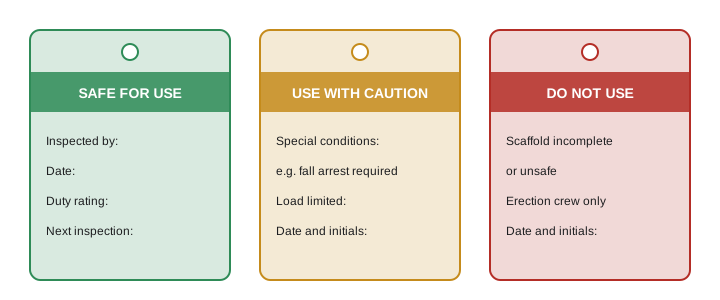
- Green: the scaffold is complete and has been inspected. It may be used within its rated load. The tag shows the inspector, the date, the duty rating and often the next inspection date.
- Yellow: the scaffold has been modified or has a special condition, for example a missing guardrail where fall protection must be used, a restricted load or a limited area. Users must read the tag and follow its requirements.
- Red: the scaffold is incomplete, being erected or dismantled, or unsafe. Nobody except the erection crew may use it.
Tag systems are widespread good practice and are required by some jurisdictions and many site rules. Alberta's OHS Code includes a scaffold tagging section (s. 326), and CSA S269.2 describes inspection and identification. Users should treat a missing tag as a red tag.
Worked problem
Reading a scaffold tag
An electrician arrives at a scaffold. The tag holder has a yellow tag dated yesterday: "Guardrail removed on east end for hoist landing. Fall arrest required within 2 m of east end. Load limited to light duty." She needs to work near the west end with a box of light fixtures. What should she do?
Show solution
- The tag is yellow, so the scaffold may be used only under the stated conditions.
- Her work is at the west end, away from the open east end, so fall arrest is not required for her location, but she must not go near the east end without it.
- Light duty means no stockpiles; a single box of fixtures is acceptable, but no heavy materials.
- The tag is dated yesterday, so she should confirm that today's inspection has been done before using the scaffold.
Answer: She may use the west end with light loads once she confirms today's inspection, and must stay away from the open east end unless she is tied off as the tag requires.
Users must not alter scaffolds
A clear rule on every site: users do not alter scaffolds. That means no removing planks, guardrails, braces or ties, no adding brackets or planks, no moving ladders and no relocating mobile towers beyond the permitted moves. If something is in the way or missing, stop and call the competent person. Alterations made by users are a major cause of scaffold incidents, because the person making them rarely understands what the part was doing.
Erection and dismantling
Erecting and dismantling scaffolds is high-risk work. The erectors are working at the edge of an incomplete structure, often before guardrails and ties exist. Good practice includes:
- Following the manufacturer's erection instructions or engineer's drawings exactly.
- Planning the sequence so that braces, ties and guardrails go in as early as possible.
- Using advanced guardrail systems, which install the guardrail for the next lift from the lift below, so erectors are always protected.
- Using fall protection during erection where guardrails are not yet in place. Ontario requires fall protection where workers could fall 3 m or more, and erectors must be trained in Working at Heights.
- Lifting components with hand lines, gin wheels or hoists rather than throwing them.
- Barricading the area below and keeping other trades away.
- Placing a red tag until the scaffold is complete and inspected.
Dismantling reverses the sequence. Ties are removed only as the scaffold is lowered to below the tie level, never ahead of time. Removing ties early to speed the job has caused many collapses.
Worked problem
The danger of removing ties early
A crew dismantling a scaffold 12 m high and 1.2 m wide removes all the ties on the morning of the job, intending to take the scaffold down by the afternoon. What is the scaffold's height-to-base ratio while it stands untied, and what is the risk?
Show solution
- Ratio = 12 ÷ 1.2 = 10, more than three times the 3 to 1 limit.
- A free-standing scaffold that tall and narrow has almost no resistance to wind or a sideways push.
- Workers on the top lift would be thrown off if it tipped, and the public below could be struck.
Answer: A ratio of 10 to 1 is extremely unstable. Ties must be removed lift by lift, only as the scaffold is lowered below each tie level.
Training
Users of scaffolds need training in the hazards, safe use, load limits, tags and their role in reporting problems. Erectors and inspectors need much more: specific training in the systems they erect, the regulation and CSA S269.2, and supervised experience. Ontario workers who may use fall protection on construction projects also need Working at Heights training. Keep records of training and of who is designated as a competent person on each project.
Records
Keep scaffold records on site: the manufacturer's data or engineer's drawings, written confirmations of erection, inspection records, training records and tags. They help show that the scaffold was managed properly and help trace what happened if something goes wrong.
A day in the life of a scaffold inspection
On a typical morning, the competent person walks the scaffold before the trades arrive. They start at the foundations, looking for settlement, washouts, frost heave or missing sills, and check screw jack extensions. They walk each lift, checking that braces and pins are in place, that ties are present and tight at the designed spacing, that platforms are complete and secured, and that guardrails and toe boards are on every open side. They look at the access ladders or stairs, the netting and the public protection below. They note any changes since the last inspection, such as a plank moved by a trade or a tie loosened for a window installation.
Defects are either fixed on the spot by the competent person and their crew, or the affected area is closed with a red tag or barricade until it is fixed. When the scaffold is ready, the tag is updated with the date, initials and any conditions. Findings are recorded in the inspection log. At the daily coordination meeting, the competent person tells other trades about any restrictions and reminds them not to alter the scaffold.
Communication between trades
On busy sites, many trades use the same scaffold. Masons need it heavy duty with materials; glaziers need a clear face at window openings; painters want light platforms close to the wall. Conflicts over the scaffold often lead to unauthorized alterations. A simple request process, where any trade that needs a change asks the competent person, who then makes the change and updates the tag, prevents most of these problems. Daily coordination meetings and a clear contact name on every tag make the process work.
Worked problem
Estimating inspection time on a large project
A project has 6 scaffolds. A daily pre-use inspection takes 15 minutes per scaffold and a detailed weekly inspection 45 minutes per scaffold. On a five-day week, how much competent person time goes to inspection?
Show solution
- Daily inspections: 6 × 15 = 90 minutes per day, or 450 minutes a week.
- Weekly detailed inspections: 6 × 45 = 270 minutes, replacing that day's quick check (6 × 15 = 90 minutes), so the extra time is 180 minutes.
- Total = 450 + 180 = 630 minutes, or 10.5 hours a week.
Answer: About 10.5 hours a week, plus time for defects and records. Plan it into the competent person's schedule rather than squeezing it in.
When everyone knows who the competent person is and how to reach them, problems are reported early and fixed properly.
A competent person who is respected, available and willing to say no is one of the strongest protections a site can have. Support that role, give it time in the schedule, and back the competent person when they close a scaffold that is not safe.
Common mistakes
MistakeClimbing a scaffold with no tag because it looks finished.
InsteadTreat a missing tag as a red tag and ask the competent person.
MistakeMoving a plank to reach a better spot.
InsteadUsers never alter scaffolds; call the competent person.
MistakeIgnoring the conditions on a yellow tag.
InsteadRead yellow tags and follow every condition.
MistakeRemoving ties early during dismantling.
InsteadRemove ties only as the scaffold is lowered below each tie level.
MistakeSkipping inspection after a windstorm.
InsteadHave the competent person inspect after any event that could affect the scaffold.
Summary and key terms
- Only competent persons erect, alter, dismantle and inspect scaffolds.
- Scaffolds are inspected before first use, regularly in use and after any event that could affect them.
- Inspections cover foundations, structure, ties, platforms, guardrails, access, public protection and environment.
- Green tags mean safe, yellow means use with conditions, red means do not use; no tag means do not use.
- Users must never alter scaffolds.
- Erection and dismantling follow the design sequence, with fall protection and advanced guardrails where possible.
- Ties are removed only as the scaffold is lowered; training and records support every step.
- Competent person
- A person trained and experienced in scaffolds who can recognize hazards and has authority to correct them.
- Scaffold tag
- A card at the access point showing the scaffold's inspection status.
- Green tag
- The scaffold is complete, inspected and safe to use within its rating.
- Yellow tag
- The scaffold may be used only under stated conditions.
- Red tag
- The scaffold must not be used.
- Alteration
- Any change to a scaffold's parts, layout or ties.
- Advanced guardrail
- A system that installs guardrails for the next lift from the protected lift below.
- Erection sequence
- The order in which scaffold components are installed.
- Lift
- One vertical level of a scaffold.
- Written confirmation
- A statement by the engineer or competent person that a scaffold was built as designed.
Practice problems
Work each problem on paper first, then reveal the answer to check.
Who may erect or alter a scaffold?
Show answer
A competent person, or trained workers under their supervision.
When must a scaffold built to drawings in Ontario be confirmed in writing?
Show answer
Before use, by an engineer or a competent worker designated by the supervisor.
What does a yellow tag mean?
Show answer
The scaffold may be used only under the conditions written on the tag.
What should a user do if there is no tag?
Show answer
Treat it as red and contact the competent person.
Why must users not alter scaffolds?
Show answer
They rarely know what the part was doing, and removing it can cause collapse or falls.
What is an advanced guardrail system?
Show answer
One that installs guardrails for the next lift from the protected lift below.
When are ties removed during dismantling?
Show answer
Only as the scaffold is lowered below each tie level.
Name four areas the competent person inspects.
Show answer
Foundations, ties, platforms and guardrails.
What events should trigger a special inspection?
Show answer
High winds, heavy rain, frost, impacts, overloading or alterations.
What records should be on site?
Show answer
Drawings or manufacturer data, erection confirmations, inspections and training records.
Lesson quiz · 5 questions
Score 60% or more to complete this lesson.
Create a free account to save your progress, take quizzes and earn a certificate.