
HSE-213 · Lesson 3 of 12 · 28 min
Portable ladder types, ratings and selection
Choosing the right ladder prevents many incidents before they start. A ladder that is too short tempts people to stand on the top steps. A household ladder on a construction site may be overloaded. An aluminium ladder near live electrical parts can conduct current through the user. This lesson describes the main types of portable ladder, how load ratings work, how material affects safety, and how to select a ladder for a task.
The main types of portable ladder
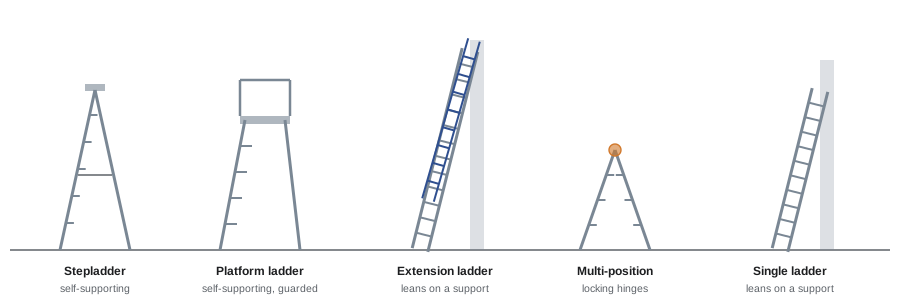
Portable ladders fall into two broad groups. Self-supporting ladders stand on their own: stepladders, platform ladders, trestle ladders and some multi-position ladders in their A-frame configuration. Non-self-supporting ladders must lean against a structure: single straight ladders and extension ladders.
- Stepladder: an A-shaped, self-supporting ladder with flat steps on the front and a rear section that may or may not have steps. Spreader bars lock the two sections open. Stepladders are meant to be used fully open, on a level surface, facing the steps.
- Platform ladder: a stepladder with a large standing platform near the top, usually with a guardrail or knee rail around it. It is a better choice than a stepladder for work that takes more than a few minutes, because the user stands on a wide surface with support at waist or knee height.
- Extension ladder: two or more sections that slide within each other and lock with rung locks, raised with a rope and pulley or by hand. Extension ladders reach higher than any stepladder and are the standard way to reach roofs and upper floors.
- Single or straight ladder: one section with no adjustment. Often used as a fixed-length access ladder or in confined areas.
- Multi-position or articulated ladder: a ladder with locking hinges that can be configured as a stepladder, an extension ladder, a scaffold base or a stairway ladder. Versatile, but every configuration and lock must be set correctly.
- Trestle and extension trestle ladders: pairs of self-supporting sections used to support planks for low-level work.
- Telescoping ladders: compact ladders whose rungs collapse into each other. They are convenient for transport but have more locking points to inspect.
- Mobile ladder stands and rolling platforms: wheeled steps with handrails, common in warehouses and stores, which lock when weight is applied.
Load ratings: grades and duty types
Every ladder is designed for a maximum load. That load includes the user, their clothing and protective equipment, and everything they carry: tools, materials and supplies. Overloading a ladder can cause rails to buckle, rungs to bend and joints to fail.
In Canada, CSA Z11 classifies portable ladders into grades. The grade must be marked on the ladder.
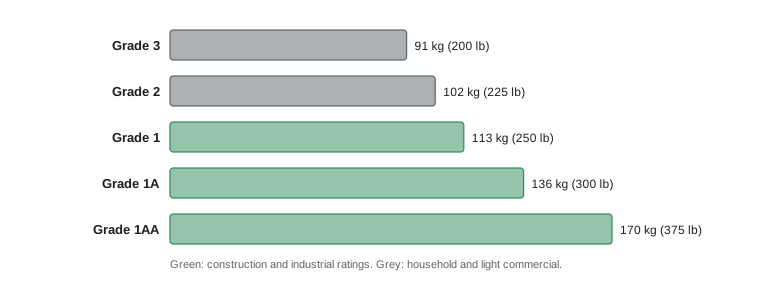
| CSA grade | Description | Load rating |
|---|---|---|
| 1AA | Special duty, construction and industrial | 170 kg (375 lb) |
| 1A | Extra heavy duty, construction and industrial | 136 kg (300 lb) |
| 1 | Heavy duty, construction and industrial | 113 kg (250 lb) |
| 2 | Medium duty, trades and farm | 102 kg (225 lb) |
| 3 | Light duty, household | 91 kg (200 lb) |
Most provinces expect construction and industrial workplaces to use Grade 1, 1A or 1AA ladders. Household Grade 3 ladders are not suitable for work, even for light tasks, because their margins are smaller and they are not built for daily use.
Worked problem
Checking the load on a ladder
A worker weighs 92 kg. They wear boots, a hard hat and a tool belt totalling 8 kg, and they will carry a 14 kg box of fittings up the ladder. Which CSA grades are acceptable?
Show solution
- Total load = 92 + 8 + 14 = 114 kg.
- Grade 1 is rated for 113 kg, which is slightly less than 114 kg, so it is not acceptable.
- Grade 1A is rated for 136 kg and Grade 1AA for 170 kg. Both are acceptable.
- Better still, raise the box separately with a rope or hoist, which keeps both hands free and reduces the load on the ladder.
Answer: Grade 1A or 1AA. A Grade 1 ladder would be overloaded by 1 kg, and carrying the box while climbing is poor practice anyway.
Ladder materials
Portable ladders are made of wood, aluminium or fibreglass. Each has strengths and weaknesses.
| Material | Strengths | Weaknesses |
|---|---|---|
| Aluminium | Light, strong, resists rot and corrosion | Conducts electricity; can bend or dent; cold in winter |
| Fibreglass | Non-conductive when clean and dry; durable; weather resistant | Heavier; damaged by UV light and impact; can crack |
| Wood | Non-conductive when dry; comfortable to grip | Heavy; rots, splits and warps; conducts when wet; hides defects if painted |
Never paint a wooden ladder with an opaque finish. Paint hides cracks, splits and rot. A clear sealer or preservative is acceptable. Fibreglass ladders exposed to sunlight for years develop fibre bloom, a powdery surface with exposed glass fibres, which reduces their strength and electrical resistance; manufacturers describe when to retire them.
Ladders and electricity
Metal ladders conduct electricity. They must not be used where the ladder or the user could contact energized electrical equipment or overhead lines. Use a fibreglass ladder with non-conductive side rails for electrical work, and keep every ladder well clear of overhead power lines. Ontario's construction regulation requires minimum distances from energized overhead lines, starting at 3 m for lines from 750 volts to 150 kilovolts, and other provinces have similar limits. Even fibreglass and wood can conduct if they are wet, dirty or contaminated.
Choosing the right length
A ladder must be long enough for the job without standing on the top steps or rungs. For stepladders, manufacturers mark the top cap and often the step below it as not to be stood on, so the highest standing level is two steps from the top. A useful rule is that a person can reach about 1.2 m above their standing level comfortably. For extension ladders, the ladder must be long enough to reach the support at the correct angle, extend above the landing if it is used for access, and allow the required overlap between sections.
Worked problem
Choosing a stepladder height
A worker needs to change a ceiling sensor 3.4 m above the floor. The highest permitted standing level on a stepladder is about 0.6 m below the top cap. The worker can reach comfortably about 1.2 m above their feet. What stepladder height is needed?
Show solution
- Standing level needed = 3.4 − 1.2 = 2.2 m.
- Top cap height = 2.2 + 0.6 = 2.8 m.
- Choose the next standard size up, a 3 m stepladder, or a platform ladder with a platform at about 2.2 m.
Answer: About a 3 m stepladder, or better, a platform ladder with a 2.2 m platform and a guardrail.
Other selection factors
- Duration: for tasks longer than a few minutes, a platform ladder, rolling tower or scaffold is better.
- Surface: stepladders need firm, level ground; levelling devices or ladder mats help on slightly uneven ground; a scaffold may be better on rough ground.
- Space: in narrow aisles a platform ladder with a small footprint may be the only option; in doorways, lock or guard the door.
- Weather: wind can blow over stepladders and extension ladders outdoors; ice and snow need special feet or a different access method.
- Frequency: permanent stairs or fixed ladders are better where access is needed every day.
- Accessories: stand-off arms keep an extension ladder clear of gutters and give a wider top support; levellers and spurs help on slopes and soft ground; tool trays keep hands free.
Building a ladder fleet
Many employers manage ladders as a fleet rather than letting each crew buy its own. A small set of standard ladder types makes training, inspection and replacement simpler. A typical fleet for a maintenance department might include platform ladders of two or three heights for most indoor tasks, fibreglass extension ladders for roof access and electrical work, a few stepladders for quick jobs, and one or two rolling towers for longer work. Each ladder is numbered, assigned to a location or crew, and entered in the inspection log.
When buying ladders, look for:
- the correct grade or duty type for the heaviest expected user and load;
- fibreglass rails wherever electrical work is possible;
- slip-resistant steps and feet suited to the floors where the ladder will be used;
- platform ladders with guardrails for tasks over a few minutes;
- accessories such as stand-offs, levellers and tool trays from the same manufacturer;
- clear labels and instructions in the languages workers read.
Ladders for specialized environments
Some environments need special ladders. Clean rooms and food plants may need stainless steel or easily cleaned ladders. Areas with flammable atmospheres may need non-sparking ladders and accessories. Warehouses use rolling ladders with locking casters and handrails for picking from racks. Utilities and telecommunications crews use dielectric ladders tested for electrical work. Fire departments and rescue teams use ladders built to their own standards. In each case, the manufacturer's rating and instructions must match the use.
Worked problem
Choosing ladders for a small fleet
A building maintenance team of four handles light fixtures up to 4 m, roof access to a 6 m flat roof, and occasional electrical panel work. The heaviest technician, with tools, weighs about 120 kg. What ladders should the team have?
Show solution
- Load: 120 kg exceeds Grade 1 (113 kg), so choose Grade 1A (136 kg) or 1AA throughout.
- Light fixtures at 4 m: a platform ladder with a platform at about 2.8 m, or a rolling tower for long jobs.
- Roof access at 6 m: a fibreglass extension ladder of about 8.5 m (28 ft) with stand-offs, or better, a fixed ladder with a ladder safety system if access is frequent.
- Electrical work: all ladders fibreglass with non-conductive rails.
Answer: Grade 1A or 1AA fibreglass ladders: two platform ladders, one extension ladder about 8.5 m long and one rolling tower, plus a request to install permanent roof access.
Whatever fleet you buy, train every user on the specific models, because locks, spreaders and hinges differ between manufacturers.
Finally, retire ladders that are damaged, unlabelled or of unknown grade, and replace them with ladders from the fleet list. Mixed collections of old ladders bought over many years are a common source of defects and confusion about ratings.
Common mistakes
MistakeUsing a household ladder at work because the task is quick.
InsteadUse Grade 1, 1A or 1AA ladders at work.
MistakeCounting only body weight against the load rating.
InsteadInclude clothing, equipment, tools and materials.
MistakeUsing an aluminium ladder for electrical work.
InsteadUse a clean, dry fibreglass ladder with non-conductive rails near electricity.
MistakePainting a wooden ladder to protect it.
InsteadUse a clear finish so cracks and rot remain visible.
MistakeBuying a ladder that is just tall enough if you stand on the top.
InsteadChoose a ladder that keeps you below the highest permitted step.
Summary and key terms
- Self-supporting ladders stand on their own; extension and straight ladders must lean on a support.
- Platform ladders give a wide, guarded standing surface and suit longer tasks better than stepladders.
- CSA Z11 grades range from 3 (91 kg) to 1AA (170 kg); workplaces use Grade 1, 1A or 1AA.
- The load includes the worker, clothing, equipment, tools and materials.
- Aluminium conducts electricity; fibreglass is non-conductive only when clean and dry.
- Do not paint wooden ladders, and retire fibreglass ladders with fibre bloom as directed.
- Choose a ladder long enough that you never stand on the top cap or top step.
- Self-supporting ladder
- A ladder that stands without leaning on a structure, such as a stepladder.
- Extension ladder
- A ladder of two or more sliding sections that lock at different lengths.
- Platform ladder
- A self-supporting ladder with a large standing platform and a guardrail or knee rail.
- Spreader
- A hinged brace that locks the two sections of a stepladder open.
- Rung lock
- The device that locks the sections of an extension ladder together.
- Load rating
- The maximum total load, including person and materials, that a ladder is designed for.
- Grade or duty type
- The classification that marks a ladder's load rating and intended use.
- Fibre bloom
- Weathering of fibreglass that exposes glass fibres and weakens the ladder.
- Stand-off
- An accessory that holds the top of an extension ladder away from the wall.
- Multi-position ladder
- An articulated ladder that can be set up in several configurations.
Practice problems
Work each problem on paper first, then reveal the answer to check.
Name two self-supporting ladders.
Show answer
Stepladders and platform ladders.
What is the load rating of a Grade 1A ladder?
Show answer
136 kg (300 lb).
What does the load rating include?
Show answer
The user, clothing, equipment, tools and materials.
Which material should be used for electrical work?
Show answer
Clean, dry fibreglass with non-conductive side rails.
Why should wooden ladders not be painted?
Show answer
Paint hides cracks, splits and rot.
What is fibre bloom?
Show answer
UV weathering of fibreglass that exposes fibres and weakens the ladder.
Why is a platform ladder better for longer tasks?
Show answer
It gives a wide standing surface with a guardrail or knee rail.
A worker plus gear and materials totals 128 kg. Which grades are acceptable?
Show answer
Grade 1A (136 kg) or 1AA (170 kg).
What is a stand-off used for?
Show answer
Holding the ladder top away from gutters or walls and widening its support.
What is the highest standing level on most stepladders?
Show answer
Two steps below the top cap; never the top cap or top step.
Lesson quiz · 5 questions
Score 60% or more to complete this lesson.
Create a free account to save your progress, take quizzes and earn a certificate.