
HSE-213 · Lesson 10 of 12 · 30 min
Scaffold stability: ties, bracing and mobile scaffolds
A scaffold that is strong enough can still fall over. Tall, narrow scaffolds tip easily under wind, sideways pushes, uneven loading or a worker leaning on a guardrail. Stability comes from the right height-to-base ratio, bracing that keeps the structure square, ties or guys to the building, outriggers that widen the base, and careful loading. Mobile scaffolds add the hazard of movement. This lesson explains how scaffolds are kept upright and what users must never change.
Why scaffolds tip
A free-standing scaffold resists tipping only by its own weight and the width of its base. Anything that pushes sideways, or moves the centre of gravity towards one edge, reduces that margin:
- wind, especially on scaffolds wrapped in sheeting, tarps or debris netting, which act like sails;
- workers pulling or pushing on the structure, for example hauling materials up the side with a rope;
- hoist arms, chutes or brackets that cantilever loads outside the base;
- uneven loading, such as stacking all the materials on one side;
- soft or settling ground under one side;
- removed braces, ties or outriggers;
- vehicles or equipment striking the scaffold.
Height-to-base ratio
The height-to-base ratio compares the height of the scaffold to its smallest base dimension. Canadian rules and CSA S269.2 generally require a scaffold to be tied, guyed or braced to a structure, or fitted with outriggers, when its height exceeds three times its smallest base dimension. British Columbia states this directly in s. 13.17(4), and Ontario requires ties at vertical intervals of no more than three times the least base dimension.
Worked problem
Checking whether a scaffold needs ties
A free-standing frame scaffold has a base 1.5 m wide and 2.1 m long. The top platform will be 5.4 m above the base. Does it need ties or outriggers?
Show solution
- The smallest base dimension is 1.5 m.
- Ratio = 5.4 ÷ 1.5 = 3.6.
- 3.6 is more than 3, so the scaffold must be tied, guyed or braced, or its base widened with outriggers.
- Outriggers that widen the effective base to 1.8 m or more would bring the ratio to 3.0 or less.
Answer: Yes. At 3.6 to 1 it exceeds the 3 to 1 limit and needs ties, guys or outriggers.
Ties, guys and bracing
Ties connect the scaffold to the building or structure. They resist both inward and outward movement. Guys are cables or rods to ground anchors, used where there is no structure to tie to. Bracing, such as buttress frames, provides stability from the scaffold itself.
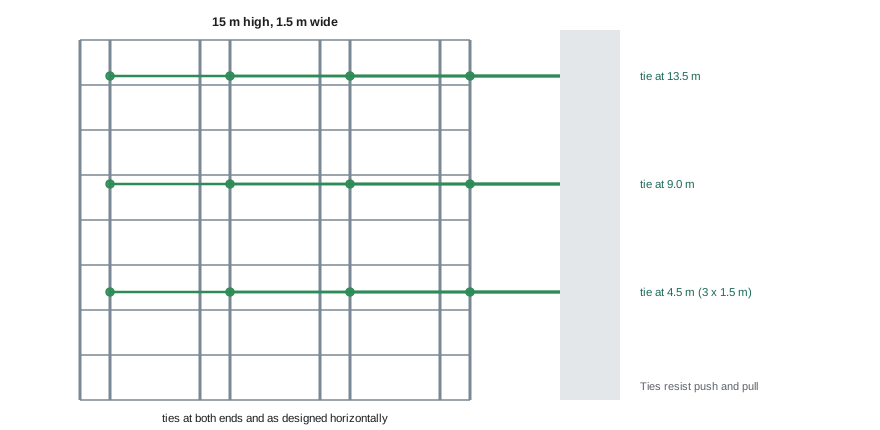
Tie patterns come from the manufacturer's data or the engineer's design. As a minimum, ties are placed at vertical intervals of no more than three times the least base dimension, with the top tie near the top working level, and at horizontal intervals set by the design, commonly every second or third bay and at each end. Ties must be attached at points where the horizontal members support both the inner and outer legs, and to parts of the building strong enough to take the loads, never to window frames, downpipes or railings.
Worked problem
Laying out ties
A scaffold 15 m high and 1.5 m wide runs 24 m along a building. The minimum vertical tie spacing is three times the least base dimension, and the design calls for ties every 6 m horizontally including both ends. How many ties are needed?
Show solution
- Vertical spacing ≤ 3 × 1.5 = 4.5 m. Tie levels at 4.5 m, 9.0 m and 13.5 m; the top tie at 13.5 m is 1.5 m below the top, within 4.5 m.
- So there are 3 tie levels.
- Horizontally, ties every 6 m including both ends: 0, 6, 12, 18 and 24 m, so 5 ties per level.
- Total = 3 × 5 = 15 ties.
Answer: 15 ties: 3 levels of 5. Sheeting or netting would require an engineer to design additional ties.
Sheeting, netting and signs
Enclosing a scaffold with plastic sheeting for winter work, debris netting for public protection or large advertising banners greatly increases the wind load. A sheeted scaffold may need several times as many ties as an open one. Never add sheeting, netting or banners without the approval of the competent person and, usually, an engineer's tie design. Remove or open sheeting before storms if the design requires it.
Never remove ties or braces without authority
Ties and braces are sometimes in the way: a window frame needs fitting, a brace blocks material delivery. Removing them without authority is one of the most dangerous things a scaffold user can do. Only the competent person may alter ties or braces, and only after installing an alternative tie or confirming that the scaffold remains stable. If a tie must come out, a replacement goes in first, nearby.
Mobile scaffolds and rolling towers
Mobile scaffolds are popular indoors because they are quick to move along the work. They also introduce specific hazards: rolling while someone is on them, tipping when a caster drops into a hole or hits an obstruction, and overturning when they are too tall for their base.
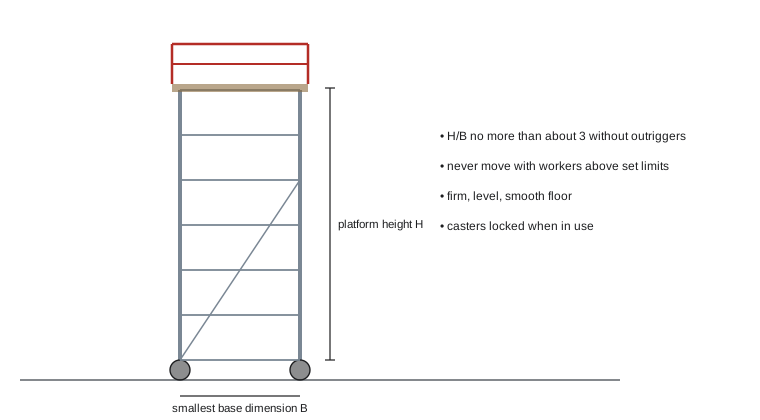
- Height: keep within the height-to-base limit, usually three times the smallest base dimension, unless outriggers or stabilizers are fitted as designed.
- Casters: lock every caster when the scaffold is in use. Casters must be secured in the legs so they cannot fall out.
- Moving: British Columbia allows a mobile scaffold to be moved with a worker on it only if its height does not exceed 1.5 times its least base dimension, permits only a person on the floor to move it between 1.5 and 2 times, and prohibits moving it while occupied above 2 times. Other provinces have similar rules or prohibit riding altogether. Before moving, clear the path, check for holes, slopes and overhead hazards, and remove loose materials from the platform.
- Surface: use mobile scaffolds only on firm, level, smooth floors. Watch for floor openings, trenches, ramps, cables and edges of slabs.
- Platform: guardrails on all sides, internal access by ladder frame or stair, and hatches that close.
- Overhead: watch for beams, lights, sprinklers and power lines when moving.
Worked problem
Can this tower be moved with a worker on it?
In British Columbia, a rolling tower has a base 1.2 m by 2.4 m and a platform 2.6 m high. A painter wants a co-worker on the floor to push the tower along while she stays on the platform. Is this allowed?
Show solution
- Least base dimension = 1.2 m. Ratio = 2.6 ÷ 1.2 ≈ 2.2.
- Above 2 times the least base dimension, BC prohibits moving the scaffold while it is occupied.
- The painter must climb down before the tower is moved, or the platform must be lowered to 2.4 m or less, which is still more than 1.5 times, so only a person on the floor could move it.
Answer: No. At about 2.2 to 1 the tower must not be moved while occupied.
Loading for stability
Keep loads within the rated capacity and spread them evenly. Do not stack materials against guardrails, lean ladders against guardrails, or hang loads from the outside of the scaffold. Hoist arms and gin wheels need to be part of the design, with ties near them to take the extra forces. Never use the scaffold as an anchor for fall protection unless the competent person and engineer confirm that it is designed for it.
Types of ties
Ties come in several forms, chosen by the competent person or engineer to suit the building:
- Through ties pass through an opening such as a window and clamp to a tube on the inside face, resisting push and pull.
- Reveal ties wedge a tube between the sides of an opening; they depend on friction and are used only where permitted and checked regularly.
- Anchor ties use bolts or anchors drilled into the building and tested to confirm their capacity.
- Box ties wrap around a column or structural member.
- Raker or buttress braces brace the scaffold from the ground where no tie point is available.
Anchors drilled into masonry or concrete are often proof-tested, with a sample pulled to a set load to confirm that the wall can hold them. A tie is only as strong as the weakest link: the anchor, the coupler and the part of the building it is fixed to.
Stability on uneven ground and slopes
On sloping ground, screw jacks level the scaffold within their limits, and stepped sills or engineered bases deal with larger slopes. The downhill legs carry more of the load when the scaffold leans, so foundations there need extra care. A scaffold that starts slightly out of plumb becomes more unstable as it gets taller, which is why the competent person checks plumb and level at the first lift before building higher.
Worked problem
How outriggers change the ratio
A rolling tower has a base 0.8 m wide and 2.0 m long. The platform must be at 3.6 m. The manufacturer's outriggers increase the effective base width to 2.0 m. What is the height-to-base ratio with and without outriggers?
Show solution
- Without outriggers: 3.6 ÷ 0.8 = 4.5, well over 3.
- With outriggers: 3.6 ÷ 2.0 = 1.8, within 3.
- Outriggers must be fitted as the manufacturer directs, on both sides, and in contact with the floor.
Answer: 4.5 to 1 without outriggers, which is unacceptable, and 1.8 to 1 with them.
Wind and stopping work
Wind loads increase with the square of the wind speed, so a gust twice as strong pushes four times as hard. A scaffold that is comfortable in a light breeze can be at its limit in a storm. Site rules usually set a wind speed above which work stops, and the competent person inspects after strong winds before work resumes. Loose items, such as sheeting, tarps, empty buckets and boards, should be secured or removed before a storm so they do not become missiles.
Stability is invisible until it is lost. That is why the rules on ties, ratios, outriggers and casters must be followed every time, even when the scaffold seems solid.
Common mistakes
MistakeBuilding a tall, narrow free-standing tower to save time.
InsteadTie, guy or fit outriggers above 3 to 1.
MistakeRemoving a tie to fit a window and planning to replace it later.
InsteadOnly the competent person alters ties, installing a replacement first.
MistakeAdding sheeting or a banner without checking ties.
InsteadSheeting increases wind load; get an engineered tie design.
MistakePushing a rolling tower with someone on the platform.
InsteadFollow the riding limits strictly or clear the platform before moving.
MistakeLeaving casters unlocked while working.
InsteadLock every caster whenever the tower is in use.
Summary and key terms
- Scaffolds tip from wind, sideways forces, uneven loads, soft ground, removed ties and impacts.
- Tie, guy, brace or fit outriggers when height exceeds 3 times the smallest base dimension.
- Place ties at vertical intervals of no more than 3 times the least base dimension, at both ends and as designed horizontally.
- Sheeting, netting and banners greatly increase wind load and need engineered tie designs.
- Only the competent person may alter ties or braces, installing replacements first.
- Mobile scaffolds: lock casters, keep within height limits and follow strict rules for moving with workers aboard.
- Spread loads evenly and keep hoists, chutes and brackets within the design.
- Height-to-base ratio
- Scaffold height divided by its smallest base dimension.
- Tie
- A connection that holds a scaffold to a building or structure.
- Guy
- A cable or rod from a scaffold to a ground anchor.
- Outrigger
- An extension at the base that widens the footprint of a scaffold.
- Buttress
- An additional frame or bracing that stabilizes a scaffold from the side.
- Sheeting
- Plastic or fabric enclosing a scaffold, which increases wind load.
- Debris netting
- Mesh on the scaffold face that catches small falling objects.
- Caster
- A swivelling wheel on a mobile scaffold leg.
- Riding
- Remaining on a mobile scaffold while it is moved.
- Eccentric load
- A load placed off centre, which shifts the centre of gravity.
Practice problems
Work each problem on paper first, then reveal the answer to check.
A scaffold base is 1.2 m wide. Above what height must it be tied?
Show answer
3.6 m.
Why do sheeted scaffolds need more ties?
Show answer
Sheeting acts like a sail and greatly increases wind load.
Where must ties be attached?
Show answer
Where horizontal members support both inner and outer legs, to strong parts of the structure.
Who may remove a tie?
Show answer
Only the competent person, after installing a replacement or confirming stability.
What must happen to casters when a rolling tower is in use?
Show answer
All casters must be locked.
In BC, above what ratio may a mobile scaffold not be moved while occupied?
Show answer
More than 2 times the least base dimension.
Name three things to check before moving a rolling tower.
Show answer
Path clear, floor level and free of holes, overhead hazards, and loose materials removed.
Why must hoist arms be part of the design?
Show answer
They add loads outside the base and need nearby ties.
What is a guy?
Show answer
A cable or rod from the scaffold to a ground anchor.
Can a scaffold be used as a fall arrest anchor?
Show answer
Only if the competent person and engineer confirm it is designed for it.
Lesson quiz · 5 questions
Score 60% or more to complete this lesson.
Create a free account to save your progress, take quizzes and earn a certificate.