
HSE-213 · Lesson 2 of 12 · 26 min
OSHA ladder and scaffold standards and the law in the US
In the United States, ladders and scaffolds are covered by federal OSHA standards for general industry (29 CFR 1910) and construction (29 CFR 1926), by the OSH Act's general duty clause, and in about half the states by state plans that must be at least as effective as federal OSHA. Voluntary consensus standards from ANSI and ASSP fill in the technical details. This lesson maps the main rules so that you know where to look. Always check the current text, because interpretations and state rules vary.
How the pieces fit together
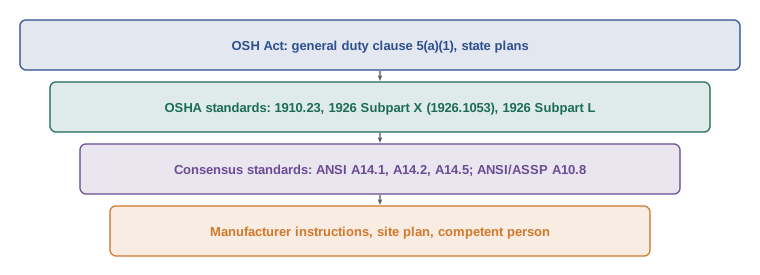
The pattern is the same in both countries. The law sets duties and minimum requirements. Standards describe how equipment must be designed, tested, marked and used. Manufacturers' instructions say how a particular product may be used, and they often set limits that are stricter than the regulation. A site plan or procedure applies all three to a specific job.
OSHA standards for ladders
OSHA covers ladders in two places:
- 29 CFR 1910.23, Ladders, in Subpart D Walking-Working Surfaces, covers ladders in general industry. It was rewritten in the 2016 walking-working surfaces rule, which took effect in January 2017. It covers portable, fixed and mobile ladder stands, rung spacing and width, inspection before each shift, and the phase-in of ladder safety systems on fixed ladders.
- 29 CFR 1926 Subpart X, Stairways and Ladders, covers construction. The key section is 1926.1053, which sets capacity, rung spacing, the 3 ft extension above a landing, the 1:4 angle, nonconductive side rails near energized equipment and the rules for using ladders. Section 1926.1060 requires training by a competent person.
- ANSI A14 standards set design and testing requirements for portable ladders: A14.1 for wood, A14.2 for metal and A14.5 for reinforced plastic, which in practice means fiberglass. They define the duty types IAA, IA, I, II and III. Manufacturers certify ladders to these standards, and OSHA accepts ladders built to them.
OSHA standards for scaffolds
29 CFR 1926 Subpart L, Scaffolds, applies in construction and, through interpretation, to similar work elsewhere. Its main sections are:
- 1926.450, scope and definitions;
- 1926.451, general requirements: capacity, platform construction, criteria for supported and suspended scaffolds, access, use, fall protection and falling object protection;
- 1926.452, additional requirements for specific types of scaffold, including frame, tube-and-coupler, system, mobile, pump jack and suspension scaffolds;
- 1926.453, aerial lifts, covered in HSE-217;
- 1926.454, training: a qualified person trains scaffold users, and a competent person trains those who erect, disassemble, move, operate, repair, maintain or inspect scaffolds.
Appendix A to Subpart L gives non-mandatory specifications, including the light-duty, medium-duty and heavy-duty platform loads of 25, 50 and 75 pounds per square foot. In general industry, scaffolds are covered by the general requirements of Subpart D and by OSHA's practice of applying the construction criteria.
Key numbers in the federal standards
| Requirement | Standard | Value |
|---|---|---|
| Ladder capacity, self-supporting portable | 1926.1053(a)(1)(i) | At least 4 times the maximum intended load (3.3 times for extra-heavy-duty metal or plastic) |
| Extension above upper landing | 1926.1053(b)(1) | Side rails at least 3 ft above the landing |
| Ladder angle | 1926.1053(b)(5)(i) | Horizontal distance about one quarter of the working length |
| Scaffold capacity | 1926.451(a)(1) | Own weight plus at least 4 times the maximum intended load |
| Restraint of supported scaffolds | 1926.451(c)(1) | Tie, guy or brace when height exceeds 4 times the minimum base width |
| Scaffold fall protection | 1926.451(g)(1) | Required above 10 ft |
| Scaffold inspection | 1926.451(f)(3) | By a competent person before each work shift and after any occurrence |
| Fixed ladders over 24 ft | 1910.28(b)(9) | Ladder safety or personal fall arrest system; cages not accepted after November 18, 2036 |
State plans and other rules
About half the states run OSHA-approved state plans. California is the best-known example: Cal/OSHA's Title 8 has its own ladder orders in the General Industry Safety Orders and detailed scaffold rules in the Construction Safety Orders, with some requirements stricter than federal OSHA. Washington, Oregon, Michigan and others also have their own codes. Local building codes, public right-of-way permits and utility rules add requirements for scaffolds over sidewalks and near power lines.
Training requirements
Section 1926.1060 requires a competent person to train each employee using ladders and stairways to recognize hazards and follow procedures. Section 1926.454 sets out scaffold training, including retraining when the employer has reason to believe an employee lacks the skill or understanding. In general industry, 1910.30 requires training for workers exposed to fall hazards, including ladder use.
ANSI/ASSP A10.8 and other consensus standards
ANSI/ASSP A10.8, Scaffolding Safety Requirements, is the construction industry's consensus standard for scaffolds. Its current edition dates from 2019. Like other consensus standards it is voluntary unless a regulation or contract adopts it, but OSHA and courts treat it as evidence of good practice. Ladder manufacturers also follow ANSI A14 marking rules, and the American Ladder Institute publishes training material.
Duties under the OSH Act
Section 5(a)(1) of the OSH Act, the general duty clause, requires employers to keep the workplace free of recognized hazards likely to cause death or serious harm, even where no specific standard applies. Section 5(a)(2) requires compliance with the standards. OSHA's multi-employer citation policy means that general contractors and scaffold contractors can be cited for hazards they create, control or should correct, not only the direct employer.
Worked problem
Reading the rules for a job
A contractor plans to erect a frame scaffold 32 ft high and 5 ft wide on a construction site. Which OSHA requirements apply to its design, inspection, ties and fall protection?
Show solution
- 1926.451(a)(1) requires a capacity of at least 4 times the maximum intended load; Appendix A gives typical load classes.
- Height to base: 32 ÷ 5 = 6.4, which is more than 4, so 1926.451(c)(1) requires ties, guys or braces. For a scaffold wider than 3 ft, ties are needed at least every 26 ft vertically.
- Fall protection is required above 10 ft under 1926.451(g)(1), normally guardrails on all open sides.
- A competent person must inspect before each shift and after any occurrence, and supervise erection under 1926.451(f).
Answer: The scaffold needs 4 times capacity, ties every 26 ft vertically, guardrails, competent-person supervision of erection and inspection before each shift.
Duties of manufacturers, suppliers and owners
OSHA standards apply to employers, but other parties carry responsibilities too. Manufacturers certify ladders to ANSI A14 and provide labels and instructions. Scaffold rental and erection companies supply manufacturer's data, load ratings and erection instructions, and their competent persons erect and inspect scaffolds. Building owners and general contractors often control the site, and under OSHA's multi-employer citation policy a controlling employer can be cited for hazards it should have detected and corrected. Contracts commonly assign scaffold inspection and maintenance to a specific party, and that assignment should be clear to everyone.
How inspectors enforce the rules
OSHA compliance officers inspect workplaces in response to fatalities and serious injuries, complaints, referrals and emphasis programs. Ladders and scaffolds are frequent subjects because their hazards are visible and well known; OSHA's national emphasis program on falls directs inspectors to stop and inspect when they see work at height. Citations carry penalties adjusted for inflation each year, with much higher amounts for willful and repeat violations. Records of inspection, training and competent person designation are often the first documents a compliance officer asks to see.
Reading a regulation effectively
Regulations can be hard to read, but a few habits help. Start with the definitions section, because words such as scaffold, platform, competent and ladder may have specific meanings. Check whether a section applies to all workplaces, to construction only or to a particular sector. Look for references to standards, and note the edition that the regulation calls up. Read related sections together: the scaffold rules, the guardrail rules and the fall protection rules usually interact. Finally, check for guidance documents from the regulator or industry associations that explain how the rules are applied in practice.
Worked problem
Finding the rule that applies
A maintenance worker in a factory wants to use a rolling tower to change high bay lights. Which OSHA standards apply, and what else should the employer consult?
Show solution
- The work is general industry, so 29 CFR 1910 Subpart D (walking-working surfaces and fall protection) applies.
- OSHA applies the construction scaffold criteria in Subpart L as guidance for scaffolds used in general industry, including the mobile scaffold rules.
- The manufacturer's instructions set the height limits, outrigger use and load ratings for the tower.
- Industry guidance, such as construction safety association booklets on rolling towers, explains practical set-up and use.
Answer: Subpart D, Subpart L as guidance, the manufacturer's instructions and industry guidance together set the requirements for the rolling tower.
Standards editions and reaffirmation
Standards are revised and reaffirmed on a regular cycle. A reaffirmed standard, marked with an R and a year, has been reviewed and kept without technical change. A new edition may change requirements, for example load classes, marking rules or test methods. Regulations usually call up a specific edition or the edition in force when equipment was made. Equipment built to an older edition may remain acceptable if it is in good condition, but new purchases should meet the current edition. When a standard changes, review the fleet and the procedures that depend on it, and update training so that workers understand any new markings or limits.
Public sector and other federal rules
State and local government workers in states without a state plan are not covered by federal OSHA, but many states extend protection to public employees. Federal agencies follow OSHA standards through Executive Order and 29 CFR 1960. Other federal agencies regulate some workplaces directly: the Mine Safety and Health Administration covers mines, and the Federal Railroad Administration and Coast Guard cover parts of rail and maritime work. Where a contractor works at such a site, the contract should make clear which rules apply to ladders and scaffolds.
Keep a short reference sheet for your workplace listing the regulation sections, standards and site rules that apply to ladders and scaffolds, with the date it was last checked. Review it at least once a year and whenever a regulation or standard changes, so that supervisors and workers are not relying on memory or on outdated binders.
If a standard and an OSHA rule seem to conflict, follow the OSHA rule. OSHA publishes letters of interpretation that answer many common questions about ladders and scaffolds, and they are worth searching before deciding how a rule applies.
Common mistakes
MistakeAssuming one set of rules applies everywhere.
InsteadCheck federal OSHA, any state plan, and local permits and utility rules.
MistakeIgnoring manufacturer instructions because the regulation is less strict.
InsteadFollow the stricter of the law, the standard and the instructions.
MistakeTreating consensus standards as irrelevant because they are voluntary.
InsteadRegulations often adopt them, and they show what good practice looks like.
MistakeThinking fall protection training qualifies a worker to erect scaffolds.
InsteadScaffold erection requires specific competence and designation.
MistakeRelying on old section numbers from a binder.
InsteadConfirm current section numbers, because regulations are amended.
Summary and key terms
- Federal OSHA covers ladders in 1910.23 and 1926 Subpart X, and scaffolds in 1926 Subpart L.
- ANSI A14 standards define ladder design and duty types; ANSI/ASSP A10.8 covers scaffolds.
- Ladders need a 1:4 angle and side rails 3 ft above the landing; scaffolds need 4 times capacity.
- Supported scaffolds must be restrained above a 4 to 1 height-to-base ratio.
- Fall protection is required on scaffolds above 10 ft.
- Competent persons erect and inspect scaffolds; manufacturers set limits that must also be followed.
- The general duty clause and multi-employer policy extend responsibility beyond specific standards.
- 1910.23
- The OSHA general industry standard for ladders.
- 1926.1053
- The OSHA construction standard for ladders.
- Subpart L
- The OSHA construction standards for scaffolds, 1926.450 to 1926.454.
- ANSI A14
- The family of American standards for portable ladders.
- ANSI/ASSP A10.8
- The American consensus standard for scaffolding safety.
- State plan
- An OSHA-approved state occupational safety and health program.
- General duty clause
- Section 5(a)(1) of the OSH Act, covering recognized serious hazards.
- Multi-employer citation policy
- OSHA policy for citing creating, exposing, correcting and controlling employers.
- Rated load
- The maximum load a scaffold or ladder is designed to carry.
- Qualified person
- A person who designs scaffolds or trains users under Subpart L.
Practice problems
Work each problem on paper first, then reveal the answer to check.
Which OSHA section covers construction ladders?
Show answer
29 CFR 1926.1053.
Which subpart covers construction scaffolds?
Show answer
1926 Subpart L.
What angle does OSHA require for non-self-supporting ladders?
Show answer
A 1:4 ratio, with the base one quarter of the working length out.
When must a supported scaffold be tied under OSHA?
Show answer
When its height exceeds 4 times its minimum base width.
What load must a scaffold support?
Show answer
At least 4 times its maximum intended load without failing or overturning.
Why read manufacturer instructions?
Show answer
They may set limits stricter than the law, such as a lower rated load.
Which section sets scaffold training?
Show answer
1926.454.
How far must ladder side rails extend above a landing?
Show answer
At least 3 ft.
What does the general duty clause add?
Show answer
A duty to control hazards even where no specific rule exists.
Does fall protection training qualify a worker to erect scaffolds?
Show answer
No. Scaffold erection needs specific competence and designation.
Lesson quiz · 5 questions
Score 60% or more to complete this lesson.
Create a free account to save your progress, take quizzes and earn a certificate.