
HSE-108 · Lesson 3 of 12 · 26 min
Violence and harassment law in Canada
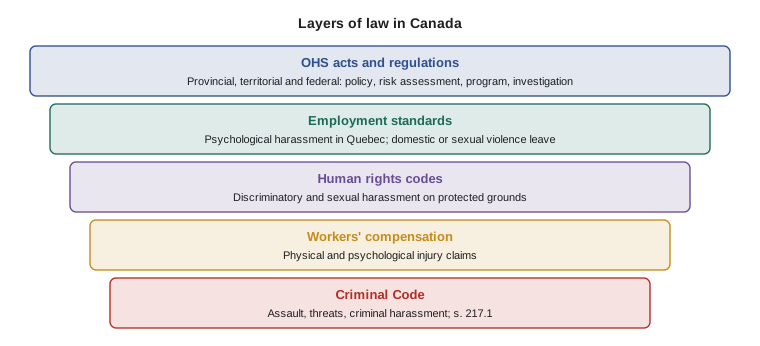
In Canada, workplace violence and harassment are governed mainly by occupational health and safety law, with important roles for employment standards law, human rights law, workers' compensation and the Criminal Code. Because OHS is mainly a provincial and territorial responsibility, the specific rules depend on where you work and whether your employer is provincially or federally regulated. This lesson gives an overview of the main requirements.
The general duty
Every Canadian OHS act places a general duty on employers to take every precaution reasonable in the circumstances to protect workers, or to ensure their health and safety so far as reasonably practicable. Even where a jurisdiction had no specific violence or harassment rules, regulators and courts have applied this general duty to violence and harassment hazards. Today every jurisdiction has added specific requirements as well. Workers have matching duties to follow the employer's policies and procedures and to report hazards, and supervisors have duties to advise workers of known hazards, including risks of violence, and to take every reasonable precaution to protect them.
Ontario
Ontario's Occupational Health and Safety Act added Part III.0.1 on workplace violence and harassment in 2010 (Bill 168) and strengthened the harassment provisions in 2016 (Bill 132). Employers must prepare written policies on workplace violence and workplace harassment, review them at least annually, and post them in the workplace if six or more workers are regularly employed. They must assess the risks of violence arising from the nature of the workplace, the type of work or the conditions of work, reassess as often as necessary, and share the results with the joint health and safety committee or representative. They must develop and maintain a program to implement the violence policy, with measures and procedures to control the risks, to summon immediate help, and for workers to report incidents, and setting out how incidents will be investigated. If an employer becomes aware, or ought reasonably to be aware, that domestic violence that would likely expose a worker to physical injury may occur in the workplace, the employer must take every precaution reasonable in the circumstances to protect the worker. Employers and supervisors must provide information, including personal information, about a person with a history of violent behaviour if a worker can be expected to encounter that person and the risk of violence is likely to expose the worker to physical injury. Workers have the right to refuse work where workplace violence is likely to endanger them, with limited exceptions for some occupations such as police and health care workers when the danger is inherent in the work.
For harassment, Ontario employers must develop a written program that includes measures and procedures for workers to report incidents to the employer or supervisor, and to someone else if the employer or supervisor is the alleged harasser; sets out how incidents and complaints will be investigated and dealt with; explains how information will be kept confidential except where disclosure is necessary to investigate, take corrective action or as required by law; and sets out how the worker who was harassed and the alleged harasser, if a worker, will be informed of the results of the investigation and any corrective action. The employer must ensure that an investigation appropriate in the circumstances is conducted, and an inspector can order an investigation by an impartial person at the employer's expense. The Working for Workers Five Act, 2024 (Bill 190), which received royal assent in October 2024, made it explicit that workplace harassment and workplace sexual harassment include harassment that occurs virtually through information and communications technology.
British Columbia, Alberta and the Prairies
British Columbia's OHS Regulation sections 4.27 to 4.31 require employers to conduct a risk assessment where a risk of injury to workers from violence arising out of their employment may be present, establish procedures, policies and work environment arrangements to eliminate or minimize the risk, inform workers about the nature and extent of the risk, including information about persons with a history of violent behaviour whom workers are likely to encounter, instruct workers in recognizing potential violence and responding to it, and advise workers who have been injured or adversely affected by violence to consult a physician of their choice. WorkSafeBC's bullying and harassment policies, in force since November 2013, require employers to have a policy statement that bullying and harassment is not acceptable, to take steps to prevent or minimize it, to develop and implement reporting and investigation procedures, to train workers and supervisors, and to review the policy and procedures annually.
Alberta's OHS Act defines harassment and violence, including domestic and sexual violence, and requires employers to ensure, as far as reasonably practicable, that no person is subjected to or participates in harassment or violence at the work site. Part 27 of the OHS Code, amended in late 2024 with compliance required by March 31, 2025, now allows a single combined violence and harassment prevention plan. Employers must still eliminate or control the risks, inform workers, and have procedures for reporting and investigating incidents that protect the confidentiality of the people involved. Saskatchewan requires every provincially regulated employer to develop a written violence policy statement and prevention plan under section 3-21 of The Saskatchewan Employment Act and sections 3-26 and 3-27 of the OHS Regulations, 2020, reviewed at least every three years, and to have a harassment policy. Manitoba's Workplace Safety and Health Regulation requires a written harassment prevention policy and, in Part 11, a violence risk assessment, a violence prevention policy, investigation of incidents and an annual report of violent incidents to the committee or representative.
Quebec
Quebec addresses psychological harassment mainly through the Act respecting labour standards. Section 81.18 defines psychological harassment, including sexual harassment, and section 81.19 gives every employee the right to a work environment free from psychological harassment and requires employers to take reasonable action to prevent it and, when aware of it, to put a stop to it. Employers must adopt and make available a psychological harassment prevention and complaint processing policy that includes a section on sexual harassment. Bill 42, assented to on March 27, 2024, strengthened these duties: from September 27, 2024, the policy must cover risk control methods, training, the complaint procedure, protection measures and how internal investigations are conducted, related documents must be kept for two years, settlement processes are confidential unless the parties agree otherwise, and fines for offences increased. From October 1, 2025, the harassment policy forms part of the employer's prevention program under the Act respecting occupational health and safety, which since 2021 has expressly required employers to protect workers exposed to physical or psychological violence, including spousal, family or sexual violence, at the workplace. Employees can file a psychological harassment complaint with the CNESST within two years of the last incident.
Federally regulated workplaces
Federally regulated employers, such as banks, airlines, railways, interprovincial transport, telecommunications, ports and the federal public service, are covered by Part II of the Canada Labour Code. Bill C-65, which received royal assent in 2018, replaced the old separate violence and harassment rules with a single definition: harassment and violence means any action, conduct or comment, including of a sexual nature, that can reasonably be expected to cause offence, humiliation or other physical or psychological injury or illness to an employee, including any prescribed action, conduct or comment. The Work Place Harassment and Violence Prevention Regulations, in force since January 1, 2021, set out detailed requirements: a jointly developed workplace assessment of risk factors, reviewed at least every three years; a prevention policy with prescribed elements; emergency procedures; training within three months of hire and every three years; support measures; a resolution process with set timelines, including contacting the principal party within seven days, beginning negotiated resolution within 45 days, and completing the process within one year; investigations by qualified, impartial investigators; record keeping for ten years; and an annual report to the Labour Program by March 1. Lesson 10 looks at these timelines in more detail.
Other jurisdictions and the Criminal Code
Every other province and territory has violence and harassment requirements in its OHS legislation, typically requiring a risk assessment, a written policy or plan, procedures for reporting and investigating, training and information for workers, and confidentiality. Nova Scotia's Violence in the Workplace Regulations and its newer harassment prevention requirements, New Brunswick's General Regulation provisions on violence and harassment, Newfoundland and Labrador's harassment and violence regulations, and the territories' rules all follow this pattern with local differences. Beyond OHS law, the Criminal Code makes assault, sexual assault, uttering threats and criminal harassment offences, and section 217.1, added after the Westray mine disaster, places a legal duty on everyone who directs how another person does work to take reasonable steps to prevent bodily harm arising from that work. Employment standards laws in every jurisdiction provide leave for victims of domestic or sexual violence, and Canada ratified the International Labour Organization's Violence and Harassment Convention (No. 190) in 2023.
Common elements across jurisdictions
Although the details vary, most laws on workplace violence and harassment share a common structure. If you understand these elements, you can quickly make sense of the specific rules where you work:
| Element | What it usually involves |
|---|---|
| Policy | A written statement that violence and harassment are not tolerated, with roles and responsibilities |
| Risk assessment | Identifying and evaluating sources of risk, reviewed periodically and after incidents |
| Program or plan | Controls, procedures to summon help, reporting, investigation and follow-up |
| Information | Telling workers about risks, including people with a history of violence where required |
| Training | Recognizing, preventing, responding to and reporting incidents |
| Reporting and investigation | Accessible reporting channels and fair, prompt investigation |
| Confidentiality | Protecting personal information except where disclosure is necessary |
| Anti-reprisal | Protecting workers who report or take part in investigations |
| Review | Regular review of the policy, program and controls with worker involvement |
Worked problem
Which rules apply?
A national bank has branches in Ontario and Quebec, and a call centre in Alberta run by a separate company that the bank contracts. A branch teller in Montreal is threatened by a customer. A call centre agent in Calgary is harassed by her team lead. Which main laws apply to each worker?
Show solution
- Identify the employer's jurisdiction: banks are federally regulated, so the teller is covered by the Canada Labour Code Part II and the Work Place Harassment and Violence Prevention Regulations, even though she works in Quebec.
- Identify the second employer: the call centre company is provincially regulated in Alberta, so the agent is covered by Alberta's OHS Act and Part 27 of the OHS Code.
- Add human rights law: if the harassment is linked to a protected ground, the Alberta Human Rights Act may also apply; for the teller, the Canadian Human Rights Act would apply to discriminatory harassment.
- Add criminal law: the customer's threat may be an offence of uttering threats under the Criminal Code.
Answer: The teller is covered by federal law (Canada Labour Code), the agent by Alberta OHS law, and human rights and criminal law may apply to both. Jurisdiction depends on the employer's industry, not only on location.
Keeping up to date
Violence and harassment law is changing quickly. Recent years have brought new rules on virtual harassment, sector-specific laws for health care and retail, stronger confidentiality and anti-reprisal protections, domestic violence leave and changes in the status of guidance and proposed rules. Assign someone to monitor changes, subscribe to your regulator's updates, involve your joint committee or safety committee in reviewing new requirements and update policies, programs and training when the law changes.
Common mistakes
MistakeAssuming that provincial law applies to every workplace in a province.
InsteadCheck whether the employer is federally regulated; federal workplaces follow the Canada Labour Code.
MistakeWriting a policy and never assessing the risks.
InsteadMost laws require a documented risk assessment that drives the controls.
MistakeTreating confidentiality as a reason not to investigate or not to warn.
InsteadDisclose what is necessary to investigate, take corrective action and protect workers.
MistakeRetaliating against workers who report or refuse unsafe work.
InsteadProtect reporters and participants; reprisal is unlawful and destroys trust.
MistakeRelying on an old policy after the law changes.
InsteadReview policies at least as often as the law requires and when rules change.
Summary and key terms
- Canadian OHS laws impose a general duty plus specific violence and harassment requirements in every jurisdiction.
- Ontario requires annual policy review, a violence risk assessment, programs, domestic violence precautions and investigations; virtual harassment is covered since 2024.
- BC requires violence risk assessments (OHSR 4.27 to 4.31) and bullying and harassment policies; Alberta, Saskatchewan and Manitoba have their own plans and policies.
- Quebec's Act respecting labour standards covers psychological harassment; Bill 42 (2024) strengthened policies and confidentiality.
- Federally regulated workplaces follow the Canada Labour Code Part II and the 2021 Work Place Harassment and Violence Prevention Regulations.
- The Criminal Code, human rights codes, employment standards and workers' compensation also apply.
- Common elements: policy, risk assessment, program, information, training, reporting, investigation, confidentiality, anti-reprisal and review.
- General duty
- Broad legal duty to protect workers from hazards, including violence and harassment.
- General Duty Clause
- Section 5(a)(1) of the US OSH Act.
- Workplace violence prevention plan
- Written plan setting out how an employer identifies and controls violence risks.
- Risk assessment
- Systematic identification and evaluation of sources of harm.
- Bill C-65
- Canadian federal law (2018) that reformed harassment and violence rules for federally regulated employers.
- SB 553
- California law (2023) that added Labor Code section 6401.9 on workplace violence prevention.
- Psychological harassment
- Quebec term for vexatious behaviour that affects dignity or integrity and creates a harmful environment.
- Violent incident log
- Record of each workplace violence incident required by some laws.
- Reprisal or retaliation
- Adverse action against a worker for reporting or exercising rights.
- ILO Convention 190
- International treaty (2019) on eliminating violence and harassment in the world of work.
Practice problems
Work each problem on paper first, then reveal the answer to check.
How often must an Ontario employer review its violence and harassment policies?
Show answer
At least annually.
Which BC regulation sections cover workplace violence?
Show answer
OHS Regulation sections 4.27 to 4.31.
Which law covers a flight attendant employed by a Canadian airline?
Show answer
The Canada Labour Code Part II and the Work Place Harassment and Violence Prevention Regulations.
Within how many days must a federally regulated employer contact the principal party after a notice of occurrence?
Show answer
Seven days.
What did Ontario's Bill 190 (2024) clarify?
Show answer
That workplace harassment includes virtual harassment through information and communications technology.
Under which Quebec law is psychological harassment defined?
Show answer
The Act respecting labour standards, section 81.18.
What does Criminal Code section 217.1 require?
Show answer
Anyone directing how work is done must take reasonable steps to prevent bodily harm.
Name four common elements of violence and harassment laws.
Show answer
Policy, risk assessment, program, training (also reporting, investigation, confidentiality, review).
How long must federally regulated employers keep most harassment and violence records?
Show answer
Ten years.
Which Alberta change took effect by March 31, 2025?
Show answer
Employers may use a single combined violence and harassment prevention plan, with confidentiality procedures.
Lesson quiz · 5 questions
Score 60% or more to complete this lesson.
Create a free account to save your progress, take quizzes and earn a certificate.