
HSE-108 · Lesson 1 of 12 · 29 min
What counts as workplace violence and harassment
This is an awareness-level course. It explains how workplace violence and harassment are defined, why they happen, how they can be prevented and how to respond, with reference to occupational health and safety (OHS), employment standards and human rights law across Canada. Some of the material describes violence, harassment and abuse. Take breaks if you need to, and if you are in immediate danger call 911 or your local emergency number. If you are in distress, the 9-8-8 Suicide Crisis Helpline is available by call or text across Canada, and your employer's employee assistance program (EAP) can connect you with confidential support.
Violence and harassment at work are not rare events that happen only in a few dangerous jobs. They range from rude remarks, intimidation and repeated humiliation to threats, sexual harassment, physical assault and, in the worst cases, homicide. They affect nurses and personal support workers, retail and hospitality staff, transit operators, teachers, social workers, security guards, delivery drivers, office workers and people working from home. Before anyone can prevent them, a workplace needs a shared language: what counts, what does not, and why the distinctions matter. This first lesson builds that language.
Why definitions matter
Definitions decide what a policy covers, what must be reported, what an investigation looks at and what the law requires. If a workplace defines violence only as physical assault, threats and attempted assaults may go unreported and unaddressed, even though they often come before physical harm. If harassment is understood only as sexual harassment, a supervisor who belittles one employee in front of the team every day may never be challenged. Clear definitions help workers recognize what they are experiencing, help supervisors respond consistently and help the organization measure the problem.
Definitions also differ between laws. An OHS law, an employment standards law, a human rights code or anti-discrimination statute and the criminal law may each define violence or harassment differently, because each has a different purpose. OHS law aims to prevent harm to workers. Human rights and anti-discrimination law aims to stop discrimination based on protected grounds such as sex, race, disability or religion. Criminal law punishes specific offences such as assault, uttering threats or criminal harassment. A single incident can engage several of these at once. This course focuses on prevention under OHS law, with an introduction to human rights and anti-discrimination law in Lesson 4.
Workplace violence
Most Canadian OHS laws define workplace violence broadly. In Ontario, for example, the Occupational Health and Safety Act defines workplace violence as the exercise of physical force by a person against a worker, in a workplace, that causes or could cause physical injury; an attempt to exercise such force; or a statement or behaviour that it is reasonable for a worker to interpret as a threat to exercise such force. British Columbia's OHS Regulation defines violence as the attempted or actual exercise by a person, other than a worker, of any physical force so as to cause injury to a worker, including any threatening statement or behaviour that gives a worker reasonable cause to believe that he or she is at risk of injury. Alberta's OHS Act defines violence as the threatened, attempted or actual conduct of a person that causes or is likely to cause physical or psychological injury or harm, and states expressly that it includes domestic or sexual violence. The federal Canada Labour Code combines harassment and violence into a single definition, covered in Lesson 3.
Three features run through most definitions. First, threats count. A credible threat to harm someone is itself violence, because it causes fear and often comes before an attack. Second, attempts count, even when no one is hurt. Third, the definition looks at the effect on the worker and what a reasonable person would conclude, not only at what the aggressor intended. A customer who throws a heavy object at a cashier and misses has committed workplace violence, even if the customer later says it was only meant to scare.
The four types of workplace violence
Researchers and regulators commonly group workplace violence into four types based on the relationship between the perpetrator and the workplace. The typology was developed by the University of Iowa Injury Prevention Research Center and is used by NIOSH, by OSHA guidance and, in the US, by California's Labor Code section 6401.9. The type matters because prevention measures differ: what protects a convenience store clerk from robbery is different from what protects a nurse from a confused patient or an employee from a violent ex-partner.
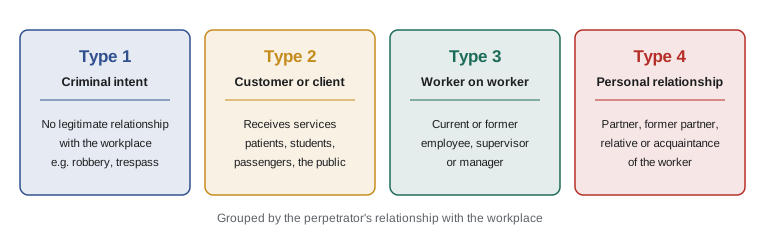
- Type 1, criminal intent: the perpetrator has no legitimate relationship with the business or its employees and is usually committing a crime such as robbery, shoplifting or trespassing. Late-night retail, gas stations, taxis and banks are typical settings.
- Type 2, customer or client: the perpetrator has a legitimate relationship with the business and becomes violent while receiving services. Patients, residents, students, passengers, inmates and members of the public dealing with government offices fall here. Type 2 violence accounts for most non-fatal workplace assaults, and health care and social assistance workers bear a large share of it.
- Type 3, worker on worker: the perpetrator is a current or former employee, supervisor or manager who attacks or threatens others in the workplace. It is often linked to conflict, discipline, termination or long-standing bullying.
- Type 4, personal relationship: the perpetrator does not work there but has a personal relationship with a worker, such as a current or former spouse or partner, relative or acquaintance. Domestic violence that follows a worker to work is the main example, covered in Lesson 9.
Some researchers add a fifth category for ideologically motivated violence directed at an organization or its employees because of what they represent, such as attacks on abortion clinics, government offices or media organizations. Whatever scheme is used, the point is to think about who might harm workers, and why, so that controls can be matched to the real sources of risk.
Harassment
Harassment generally means a course of vexatious comment or conduct against a worker that is known or ought reasonably to be known to be unwelcome. That wording comes from Ontario's Occupational Health and Safety Act, which also defines workplace sexual harassment, and since October 2024 states that workplace harassment includes harassment that occurs virtually through information and communications technology. Quebec's Act respecting labour standards defines psychological harassment as vexatious behaviour in the form of repeated and hostile or unwanted conduct, verbal comments, actions or gestures that affects an employee's dignity or psychological or physical integrity and that results in a harmful work environment; a single serious incidence that has a lasting harmful effect can also be psychological harassment. Alberta's OHS Act defines harassment as a single incident or repeated incidents of objectionable or unwelcome conduct, comment, bullying or action that the person knows or ought reasonably to know will or would cause offence or humiliation, or adversely affects the worker's health and safety. British Columbia uses the phrase bullying and harassment in its OHS policies.
Across definitions, a few ideas recur. The conduct is unwelcome or vexatious, meaning the target did not invite it and finds it offensive, intimidating or humiliating. The test is usually objective: would a reasonable person know, or should they have known, that the conduct was unwelcome? Intent does not have to be shown; a person who says they were only joking can still be harassing someone. And harassment usually involves a pattern, although many laws accept that a single serious incident can be enough.
Forms of harassment
- Personal or psychological harassment and bullying: repeated belittling, insults, yelling, spreading rumours, excluding someone, setting impossible deadlines to make them fail, or constant unjustified criticism.
- Sexual harassment: unwelcome sexual comments, jokes, advances, requests for sexual favours, touching, sexual images, or treating someone differently because of their sex, sexual orientation, gender identity or gender expression.
- Discriminatory harassment: conduct linked to race, religion, disability, age or another protected ground, such as slurs, mocking an accent or refusing to work with someone because of their ethnicity.
- Cyber or virtual harassment: any of the above carried out through email, text messages, messaging platforms, video calls, social media or other technology, including sharing private images without consent.
- Third-party harassment: harassment of workers by customers, clients, patients, contractors or the public.
What harassment is not
Clear definitions also protect the ability of managers to manage. Most laws and policies say that reasonable action taken by an employer or supervisor relating to the management and direction of workers is not harassment. Assigning work, setting performance expectations, giving honest feedback on performance, scheduling shifts, applying the attendance policy and taking fair disciplinary action are all part of normal management, even though they can be unwelcome. A single disagreement, a difference of opinion or occasional workplace friction is also not harassment.
The line is crossed when management action is carried out in an abusive way, or for an improper purpose. Giving an employee an honest performance review is management. Delivering it by shouting at them in front of customers, mocking their family situation or singling them out with impossible targets to force them to quit is not. The question to ask is whether the action was reasonable, in good faith, related to legitimate business needs and carried out respectfully.
| Situation | Likely classification | Why |
|---|---|---|
| A supervisor tells a worker their reports have been late three times and sets a clear deadline | Reasonable management action | Legitimate performance issue, handled factually and respectfully |
| A co-worker repeatedly makes comments about a colleague's body after being asked to stop | Sexual harassment | Unwelcome sexual conduct that continued after an objection |
| A patient with dementia strikes a care aide during bathing | Workplace violence (Type 2) | Physical force by a client; intent is not required for prevention purposes |
| A manager excludes one employee from meetings and tells others not to help her | Personal harassment or bullying | Repeated conduct meant to isolate and humiliate |
| A former partner waits in the parking lot and threatens a worker | Workplace violence (Type 4) | Threat of physical force by someone in a personal relationship with the worker |
| Two colleagues have one heated disagreement about a project and later resolve it | Workplace conflict, not harassment | A single, mutual disagreement without vexatious or threatening conduct |
The continuum of behaviour
Violence and harassment are best understood as a continuum. At one end is incivility: low-intensity rudeness, ignoring colleagues, dismissive comments. Further along are bullying, harassment and verbal abuse, then intimidation and threats, and at the far end physical assault, sexual assault and homicide. Not every rude remark leads to violence, and most incivility never escalates. But many serious incidents are preceded by lower-level behaviour that was noticed and not addressed. A workplace that tolerates disrespect sends a message that the rules do not matter, and that makes escalation more likely.
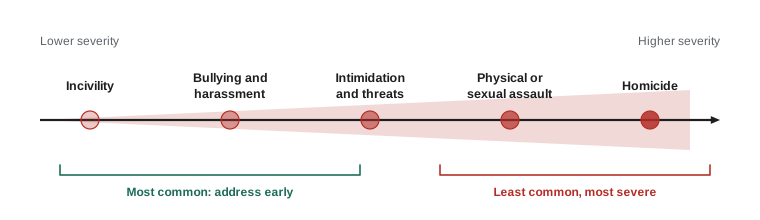
Thinking in terms of a continuum has practical consequences. It means a prevention program should address incivility and disrespect, not only assault. It means reporting systems should welcome reports of threats, near misses and verbal abuse, not only injuries. And it means supervisors need to intervene early, before patterns become entrenched.
Psychological harm is real harm
Violence and harassment cause physical injuries, but much of the harm is psychological. Workers who are assaulted, threatened or harassed can experience fear, anxiety, depression, sleep problems, difficulty concentrating, post-traumatic stress and burnout. Those who witness incidents can also be affected. Many modern OHS laws and definitions of workplace violence and harassment expressly recognize psychological injury, and workers' compensation systems increasingly accept claims for mental stress caused by traumatic events or harassment at work. Lesson 11 looks at how to support people who have been affected.
Where the workplace begins and ends
The workplace is wider than the employer's premises. It can include client homes, vehicles, parking lots, job sites, conferences, business travel, work-related social events and, increasingly, the home offices and digital channels people use for work. Harassment by email at midnight, threats posted on social media about a co-worker, or a sexual advance at an after-work event organized by the employer can all fall within workplace policies and, depending on the law, within the employer's legal duties. When writing or applying a policy, ask whether the conduct has a connection to work, rather than only whether it happened inside the building.
Worked problem
Applying the definitions
A home care worker visits a client's home. The client's adult son, who lives there, follows her from room to room, comments on her appearance, blocks the doorway when she tries to leave and says, "Next time you won't get out so easily." How would you classify this, and why does it matter?
Show solution
- Identify the relationship: the son is not the client but is present at the place of work because of the service, so this is closest to Type 2 (client or client's household); some programs would record it as third-party conduct.
- Look at the conduct: comments on her appearance are unwelcome sexualized remarks, which is sexual harassment. Blocking the doorway and the statement about next time are a reasonable basis to fear physical force, which meets the definition of a threat of violence.
- Consider the location: the client's home is her workplace while she is providing care, so workplace violence and harassment rules apply.
- Decide what follows: the worker should leave safely and report, the employer must assess the risk for future visits (for example, two-person visits, visit only when the son is absent or suspend service), and the incident must be recorded and investigated.
Answer: It is both sexual harassment and workplace violence (a threat), occurring in a workplace. Classifying it correctly triggers the employer's duties to investigate, assess the risk and protect the worker before the next visit.
Key messages for workers and supervisors
For workers, the key message is that you do not have to accept violence, threats or harassment as part of the job, even in work where some risk cannot be removed. You have a right to know about the risks, to have controls in place and to report without reprisal. For supervisors, the key message is that you are often the first person to hear about a problem and the person best placed to stop it early. Treat every report seriously, act promptly and follow your organization's procedures. The rest of this course explains how.
Common mistakes
MistakeTreating only physical assault as workplace violence.
InsteadInclude threats, attempts and threatening behaviour, which are violence in themselves and often come first.
MistakeDeciding something is not harassment because the person "didn't mean it".
InsteadUse the objective test: was the conduct known, or should it reasonably have been known, to be unwelcome?
MistakeLabelling every difficult management decision as harassment.
InsteadDistinguish reasonable management action carried out respectfully from abusive conduct or improper purposes.
MistakeAssuming violence by patients or clients with cognitive impairments "doesn't count".
InsteadRecord and prevent it; intent may matter for discipline, but not for protecting workers.
MistakeLimiting the workplace to the employer's building.
InsteadConsider client homes, vehicles, events, travel and digital channels connected to work.
Summary and key terms
- Workplace violence includes actual, attempted and threatened physical force against a worker.
- The four types of workplace violence are criminal intent, customer or client, worker on worker and personal relationship.
- Harassment is unwelcome or vexatious conduct that a person knows or ought to know is unwelcome; intent is not required.
- Forms include psychological harassment and bullying, sexual and discriminatory harassment, cyber harassment and third-party harassment.
- Reasonable management action carried out respectfully is not harassment.
- Behaviour sits on a continuum from incivility to homicide; acting early helps prevent escalation.
- The workplace includes any setting with a real connection to work, including virtual ones.
- Workplace violence
- Actual, attempted or threatened physical force against a worker at work.
- Type 1 violence
- Violence by someone with criminal intent and no legitimate relationship with the workplace.
- Type 2 violence
- Violence by a customer, client, patient, student or other service recipient.
- Type 3 violence
- Violence by a current or former employee, supervisor or manager.
- Type 4 violence
- Violence by someone with a personal relationship with the worker.
- Harassment
- Unwelcome or vexatious comment or conduct known or ought to be known to be unwelcome.
- Sexual harassment
- Unwelcome conduct of a sexual nature or based on sex, sexual orientation or gender identity.
- Bullying
- Repeated conduct intended or expected to intimidate, humiliate or isolate a person.
- Incivility
- Low-intensity rude or disrespectful behaviour that may lack clear intent to harm.
- Reasonable management action
- Legitimate direction, evaluation or discipline of workers carried out fairly.
Practice problems
Work each problem on paper first, then reveal the answer to check.
A customer shouts that he will "come back and deal with" a clerk after closing. Is this workplace violence?
Show answer
Yes. It is a statement a worker could reasonably interpret as a threat of physical force (Type 2).
Name the four types of workplace violence.
Show answer
Criminal intent, customer or client, worker on worker, and personal relationship.
Which type accounts for most non-fatal workplace assaults?
Show answer
Type 2, violence by customers, clients and patients.
A supervisor calmly tells an employee that her error rate must improve within a month. Is this harassment?
Show answer
No, it is reasonable management action carried out respectfully.
Does a harasser have to intend to offend?
Show answer
No. The test is whether the conduct was known or ought reasonably to have been known to be unwelcome.
Give two examples of cyber harassment.
Show answer
Repeated insulting messages on a team chat; sharing private images or posting threats about a co-worker on social media.
Why should a workplace address incivility?
Show answer
Tolerated disrespect can escalate, and many serious incidents are preceded by lower-level behaviour.
Is an after-work party organized by the employer part of the workplace for harassment purposes?
Show answer
Usually yes, because it has a real connection to work.
A former partner phones a worker at work repeatedly and threatens her. Which type is this?
Show answer
Type 4, personal relationship.
Name two kinds of harm caused by violence and harassment.
Show answer
Physical injury and psychological harm such as anxiety, depression or post-traumatic stress.
Lesson quiz · 5 questions
Score 60% or more to complete this lesson.
Create a free account to save your progress, take quizzes and earn a certificate.