
HSE-108 · Lesson 3 of 12 · 24 min
Workplace violence and harassment law in the US
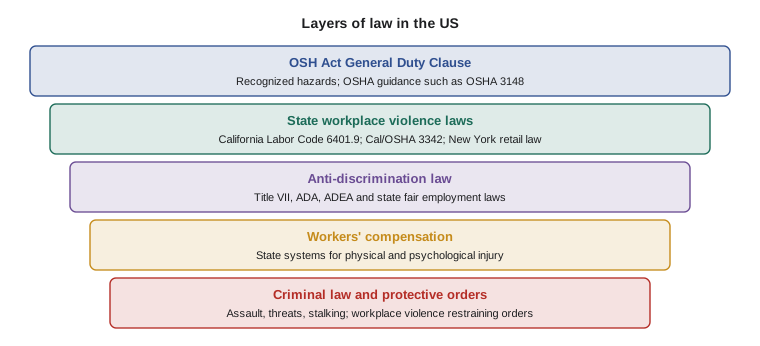
In the US, workplace violence and harassment are governed by a patchwork of federal and state law. There is no federal OSHA standard specifically for workplace violence, so the main federal safety tool is the General Duty Clause of the Occupational Safety and Health Act of 1970 (OSH Act), supported by guidelines. A growing number of states have their own workplace violence laws, especially for health care and retail, and harassment is addressed mainly through federal and state anti-discrimination law, covered in Lesson 4. This lesson gives an overview.
The General Duty Clause
Section 5(a)(1) of the OSH Act requires each employer to furnish a place of employment free from recognized hazards that are causing or are likely to cause death or serious physical harm. OSHA has used the General Duty Clause to cite employers for failing to address workplace violence, most often in health care, social services and late-night retail. To succeed, OSHA must show that employees were exposed to a hazard, that the hazard was recognized by the employer or its industry, that it was causing or likely to cause death or serious physical harm, and that a feasible and effective means of abatement existed. OSHA's enforcement directive on workplace violence (CPL 02-01-058, 2017) explains how inspectors evaluate these elements, and the Occupational Safety and Health Review Commission has upheld General Duty citations for workplace violence, including cases involving a social services provider and a psychiatric hospital. Because each element must be proved case by case, citations are relatively uncommon and often contested.
OSHA guidance and the stalled federal rule
OSHA publishes detailed guidance, including Guidelines for Preventing Workplace Violence for Healthcare and Social Service Workers (OSHA 3148, updated 2016), recommendations for late-night retail establishments and taxi drivers, and materials on workplace violence prevention programs. Guidelines are not mandatory, but OSHA and the Review Commission treat them as evidence of recognized hazards and feasible abatement methods. OSHA began work on a specific standard for workplace violence in health care and social assistance in 2016, held a small business review panel in 2023 and listed a proposed rule for 2025. In its Spring 2025 regulatory agenda, published in September 2025, OSHA moved the rule to the long-term action list, meaning no proposed rule is expected in the near term. Check the current regulatory agenda for its status. Separately, the Joint Commission, which accredits most US hospitals, has required hospitals to have workplace violence prevention programs since January 2022, and the Centers for Medicare and Medicaid Services expects hospitals to provide a safe setting under the conditions of participation.
State workplace violence laws
California's Labor Code section 6401.9, added by Senate Bill 553, took effect on July 1, 2024. It is the first broad general-industry workplace violence law in the US. Most California employers must establish, implement and maintain an effective written workplace violence prevention plan, either as a stand-alone document or as part of their Injury and Illness Prevention Program. The plan must name the people responsible for it, involve employees and their representatives in developing and carrying it out, include procedures to accept and respond to reports without retaliation, to communicate with employees about violence matters, to respond to actual or potential emergencies, to identify, evaluate and correct workplace violence hazards, and to respond after an incident, and be reviewed at least annually and after an incident. Employers must record every workplace violence incident in a violent incident log, provide effective training when the plan is first established and annually, and keep records such as hazard assessments and incident logs for at least five years. The law excludes some settings, including health care facilities covered by Cal/OSHA's separate health care standard and employees teleworking from a location of their choice, and places with fewer than ten employees that are not accessible to the public may be exempt if they meet other conditions. The law also directs Cal/OSHA to adopt a general-industry workplace violence standard by December 31, 2026; a revised draft was released in April 2026.
Cal/OSHA's Workplace Violence Prevention in Health Care standard (Title 8, section 3342), in force since 2017, applies to hospitals, outpatient medical offices, home health, emergency medical services, drug treatment programs and similar settings. It requires a comprehensive plan specific to each unit, hazard assessments, a violent incident log, training, and reporting of certain incidents to Cal/OSHA within 24 or 72 hours. Many other states have health care workplace violence laws, including requirements for prevention programs, committees, training, signage and stronger criminal penalties for assaulting health care workers. New York's Workplace Violence Prevention Act requires most public employers to assess risks and implement prevention programs.
New York's Retail Worker Safety Act requires retail employers with ten or more employees to adopt a written workplace violence prevention policy, provide interactive training on hire and annually (every two years for employers with fewer than 50 retail employees) and give employees the policy. After amendments signed in 2025, the policy and training requirements took effect in June 2025, and retail employers with 500 or more retail employees in the state must install silent response buttons or equivalent technology that alert internal staff by January 1, 2027. Other states, including Illinois, Connecticut, Maryland, Minnesota and Washington, have workplace violence requirements for health care or other sectors. State Plan states may also have their own standards or enforcement policies.
Other federal laws
Several other federal laws are relevant. The Americans with Disabilities Act affects how employers respond to employees whose behavior raises safety concerns and to workers who develop mental health conditions after violence. The Family and Medical Leave Act may provide unpaid, job-protected leave for serious health conditions arising from violence. The Clery Act requires colleges to report campus crimes, and federal criminal law, state criminal law and civil protective or restraining orders can be used against people who threaten workers. In California, employers and, since 2025, collective bargaining representatives can seek workplace violence restraining orders on behalf of employees. Federal contractors and agencies also have their own policies, and the Speak Out Act of 2022 limits the enforceability of pre-dispute non-disclosure and non-disparagement clauses for sexual harassment and sexual assault disputes.
Workers' rights and anti-retaliation
Under section 11(c) of the OSH Act, employers may not retaliate against employees for reporting injuries, raising safety concerns, filing complaints or taking part in inspections; complaints must be filed with OSHA within 30 days. Workers may refuse dangerous work in narrow circumstances under OSHA regulations, when there is a real danger of death or serious injury, there is no time to remove it through normal channels, the employer has been asked to fix it and the worker acts in good faith. Anti-discrimination laws separately protect employees who complain about harassment or take part in investigations, and retaliation is the most frequently alleged basis in EEOC charges. Many state workplace violence laws contain their own anti-retaliation provisions.
Recording and reporting
Injuries from workplace violence must be recorded on the OSHA 300 log when they meet the general recording criteria, such as days away from work, restricted work, medical treatment beyond first aid or loss of consciousness. Mental illnesses may be recorded only when a physician or other licensed health care professional states in writing that the condition is work-related. Employers must report work-related fatalities to OSHA within 8 hours and in-patient hospitalizations, amputations and losses of an eye within 24 hours, including those caused by assaults. California's health care standard and some state laws add their own incident logs and reporting requirements, which apply in addition to OSHA recordkeeping.
Common elements across jurisdictions
Although the details vary, most laws on workplace violence and harassment share a common structure. If you understand these elements, you can quickly make sense of the specific rules where you work:
| Element | What it usually involves |
|---|---|
| Policy | A written statement that violence and harassment are not tolerated, with roles and responsibilities |
| Risk assessment | Identifying and evaluating sources of risk, reviewed periodically and after incidents |
| Program or plan | Controls, procedures to summon help, reporting, investigation and follow-up |
| Information | Telling workers about risks, including people with a history of violence where required |
| Training | Recognizing, preventing, responding to and reporting incidents |
| Reporting and investigation | Accessible reporting channels and fair, prompt investigation |
| Confidentiality | Protecting personal information except where disclosure is necessary |
| Anti-reprisal | Protecting workers who report or take part in investigations |
| Review | Regular review of the policy, program and controls with worker involvement |
Worked problem
Which rules apply?
A national retailer has stores in California, New York and Texas. A cashier in Los Angeles is threatened by a customer. A store employee in Buffalo is pushed by a shoplifter. A stock clerk in Houston is repeatedly harassed by a supervisor because of her religion. Which main laws apply to each worker?
Show solution
- California: the cashier's employer must have a workplace violence prevention plan and record the incident in its violent incident log under Labor Code 6401.9, and the General Duty Clause also applies.
- New York: the Retail Worker Safety Act requires a written policy and training, and the incident should be addressed under that policy; the General Duty Clause applies.
- Texas: there is no general state workplace violence law, so the General Duty Clause and the employer's own policies apply.
- Religious harassment: Title VII, and possibly state law, applies to the stock clerk, independently of safety law.
Answer: California and New York workers benefit from specific state laws in addition to the General Duty Clause; the Texas worker relies on the General Duty Clause and employer policy; and Title VII covers the religious harassment.
Keeping up to date
Violence and harassment law is changing quickly. Recent years have brought new rules on virtual harassment, sector-specific laws for health care and retail, stronger confidentiality and anti-reprisal protections, domestic violence leave and changes in the status of guidance and proposed rules. Assign someone to monitor changes, subscribe to your regulator's updates, involve your joint committee or safety committee in reviewing new requirements and update policies, programs and training when the law changes.
Common mistakes
MistakeAssuming that no federal OSHA standard means employers have no legal duty.
InsteadThe General Duty Clause, state laws and guidelines still apply to workplace violence.
MistakeWriting a policy and never assessing the risks.
InsteadMost laws require a documented risk assessment that drives the controls.
MistakeTreating confidentiality as a reason not to investigate or not to warn.
InsteadDisclose what is necessary to investigate, take corrective action and protect workers.
MistakeRetaliating against workers who report or refuse unsafe work.
InsteadProtect reporters and participants; reprisal is unlawful and destroys trust.
MistakeRelying on an old policy after the law changes.
InsteadReview policies at least as often as the law requires and when rules change.
Summary and key terms
- There is no federal OSHA workplace violence standard; the General Duty Clause applies when four elements are proved.
- OSHA moved its health care workplace violence rule to the long-term agenda in 2025.
- California Labor Code 6401.9 (SB 553) has required written plans, incident logs and training since July 2024.
- Cal/OSHA section 3342 covers health care; New York's Retail Worker Safety Act covers retail employers with ten or more employees.
- Anti-retaliation protections apply under the OSH Act, anti-discrimination law and state laws.
- Violence injuries are recordable on the OSHA 300 log when general criteria are met.
- Common elements: policy, risk assessment, program, information, training, reporting, investigation, confidentiality, anti-retaliation and review.
- General duty
- Broad legal duty to protect workers from hazards, including violence and harassment.
- General Duty Clause
- Section 5(a)(1) of the US OSH Act.
- Workplace violence prevention plan
- Written plan setting out how an employer identifies and controls violence risks.
- Risk assessment
- Systematic identification and evaluation of sources of harm.
- Bill C-65
- Canadian federal law (2018) that reformed harassment and violence rules for federally regulated employers.
- SB 553
- California law (2023) that added Labor Code section 6401.9 on workplace violence prevention.
- Psychological harassment
- Quebec term for vexatious behavior that affects dignity or integrity and creates a harmful environment.
- Violent incident log
- Record of each workplace violence incident required by some laws.
- Reprisal or retaliation
- Adverse action against a worker for reporting or exercising rights.
- ILO Convention 190
- International treaty (2019) on eliminating violence and harassment in the world of work.
Practice problems
Work each problem on paper first, then reveal the answer to check.
What four elements must OSHA prove in a General Duty Clause case?
Show answer
Exposure to a hazard, recognition, likely death or serious harm, and feasible abatement.
When did California's Labor Code 6401.9 take effect?
Show answer
July 1, 2024.
How long must California employers keep violent incident logs?
Show answer
At least five years.
What happened to OSHA's health care workplace violence rule in 2025?
Show answer
It was moved to the long-term action list in the regulatory agenda.
Which Cal/OSHA section covers health care workplace violence?
Show answer
Title 8, section 3342.
Which retail employers must install silent response buttons under New York law, and by when?
Show answer
Those with 500 or more retail employees in the state, by January 1, 2027.
Within how many days must an OSHA retaliation complaint be filed?
Show answer
30 days.
When must an employer report an in-patient hospitalization from an assault to OSHA?
Show answer
Within 24 hours.
Is OSHA 3148 mandatory?
Show answer
No, it is guidance, but it is evidence of recognized hazards and feasible controls.
By when must Cal/OSHA adopt a general-industry workplace violence standard?
Show answer
December 31, 2026.
Lesson quiz · 5 questions
Score 60% or more to complete this lesson.
Create a free account to save your progress, take quizzes and earn a certificate.