
HSE-108 · Lesson 5 of 12 · 25 min
Risk factors and assessing the risk of violence and harassment
Prevention starts with understanding where violence and harassment are likely to come from. A risk assessment for violence and harassment uses the same basic logic as any other hazard assessment: identify the sources of harm, evaluate how likely and how serious harm would be, decide on controls, and review the results. If you have taken a general hazard recognition and risk assessment course, you already know the method. This lesson focuses on what is different about violence and harassment: the hazards are people and situations rather than machines or chemicals, the risk changes from hour to hour, and much of the information needed comes from workers' experience rather than measurement.
Risk factors for violence
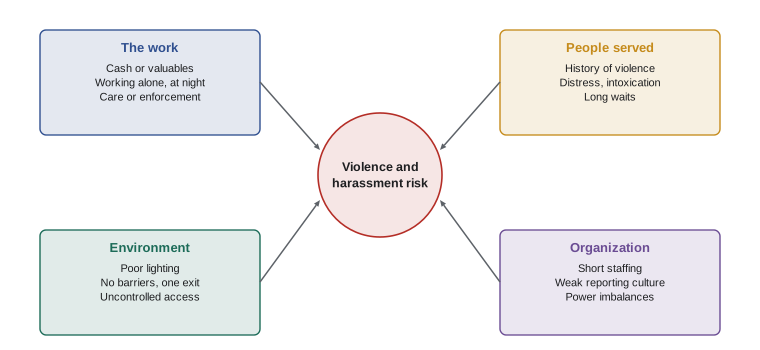
Decades of research and incident investigations have identified factors that increase the likelihood of violence at work. They fall into four groups: the work being done, the people being served, the environment and the organization.
Factors in the work itself
- Handling cash, drugs, alcohol or valuables, or guarding property.
- Working alone, in small numbers, or in isolated or remote locations.
- Working late at night or early in the morning.
- Working in the community, in clients' homes, or in vehicles such as taxis, buses and delivery vans.
- Providing care, advice or services to people in pain, distress, crisis or under the influence of alcohol or drugs.
- Enforcing rules, inspecting, denying services or benefits, collecting payments or delivering bad news.
- Physically restraining, transferring or caring for people.
Factors related to clients and the public
- A history of violent or aggressive behaviour, which is one of the strongest predictors of future violence.
- Conditions that may affect behaviour, such as dementia, delirium, acute mental illness, brain injury or intoxication, recognizing that most people with these conditions are not violent.
- Long waits, crowding, confusion, frustration or the perception of being treated unfairly.
- Access to weapons or objects that could be used as weapons.
Factors in the environment
- Poor lighting, hidden areas, cluttered layouts and lack of visibility from other staff.
- No barrier, counter or safe distance between workers and the public; only one exit from an interview room.
- Uncontrolled entry to the building or work area.
- Noise, heat and crowding in waiting areas.
Organizational factors
- Inadequate staffing, especially at busy times or at night, and high reliance on new or temporary staff.
- Lack of training, unclear procedures and no means of summoning help.
- No system for sharing information about clients with a history of violence.
- A culture that treats aggression as part of the job, discourages reporting or puts customer satisfaction above worker safety.
Risk factors for harassment
Harassment risk factors are mostly organizational and cultural. Research and workplace inquiries consistently point to the following:
- Large power imbalances, such as workers who depend on one supervisor for shifts, tips, immigration status or advancement.
- Workforces where one group is a small minority, such as women in skilled trades or racialized workers in a homogeneous team.
- Isolated work, including night shifts, remote sites and work in clients' homes.
- Cultures that tolerate crude jokes, heavy drinking at work events or rough initiation rituals.
- High-value or star employees whose behaviour goes unchallenged because they bring in revenue or have rare skills.
- Customer service settings where customers are treated as always right and workers rely on tips.
- High stress, heavy workloads, job insecurity, poor communication and unclear roles, which are also psychosocial hazards in their own right.
- Weak leadership, no clear policy, no trusted reporting channel, and past complaints that went nowhere.
Steps in a violence and harassment risk assessment
Most laws require the assessment to be documented, to involve workers or the joint committee, and to be reviewed periodically and after incidents. A practical process has six steps:
- Prepare: decide who will lead, involve the joint health and safety committee or representative and workers who do the job, and define the scope, such as a site, a unit or a job.
- Gather information: review incident and near-miss reports, first aid and compensation records, complaints, security reports and exit interviews; survey or interview workers; walk through the site at different times of day; and check sector guidance.
- Identify situations: list the tasks, locations and times where violence or harassment could occur and who could be involved, using the four types of violence and the forms of harassment as prompts.
- Evaluate risk: estimate the likelihood and severity of harm for each situation, considering the controls already in place.
- Decide on controls: choose additional controls to eliminate or reduce the risk, following the hierarchy of controls covered in Lesson 6, and assign owners and deadlines.
- Communicate and review: share the results with workers and the committee, add them to the program, and review at the required interval and after any incident, change in work, new information or complaint.
Scoring the risk
Many organizations use a simple risk matrix to compare situations and set priorities. Likelihood and severity are each rated on a scale, often 1 to 5, and multiplied to give a risk score. The scales must be defined clearly so different assessors give similar ratings.
| Rating | Likelihood | Severity |
|---|---|---|
| 1 | Rare: not expected in the next few years | Minor: brief distress, no injury |
| 2 | Unlikely: could happen within a few years | Moderate: first aid or short-term distress |
| 3 | Possible: could happen within a year | Serious: medical treatment, lost time or lasting distress |
| 4 | Likely: expected several times a year | Major: serious injury or long-term psychological harm |
| 5 | Almost certain: expected monthly or more | Catastrophic: life-threatening injury or death |
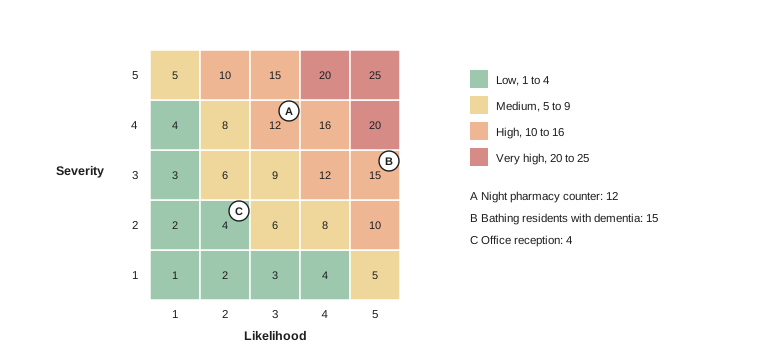
| Score | Priority | Typical action |
|---|---|---|
| 1 to 4 | Low | Maintain controls; review at the next scheduled assessment |
| 5 to 9 | Medium | Add controls within a set period, such as three months |
| 10 to 16 | High | Add controls promptly; interim measures now |
| 20 to 25 | Very high | Act immediately; consider stopping the task until controlled |
Worked problem
Scoring and ranking three situations
A community health agency assesses three situations. (A) Nurses make home visits alone to clients with no known history of violence, in mixed neighbourhoods, in daylight. Staff report a verbal threat about once a year across the team; the worst realistic outcome is a serious assault. (B) Workers run a drop-in centre where verbal abuse occurs weekly and pushing or punching happens several times a year; injuries have required medical treatment. (C) Reception staff at head office deal with occasional angry callers; no one has been threatened in person in five years. Rate and rank them.
Show solution
- Situation A: likelihood 2 (unlikely; threats rare), severity 4 (major; a serious assault is possible when alone). Score = 2 × 4 = 8, medium.
- Situation B: likelihood 4 (likely; physical incidents several times a year), severity 3 (serious; medical treatment). Score = 4 × 3 = 12, high.
- Situation C: likelihood 2 (unlikely), severity 2 (moderate distress). Score = 2 × 2 = 4, low.
- Rank: B (12) first, then A (8), then C (4). B needs prompt controls, such as staffing levels, de-escalation training, an alarm system and a review of the layout. A needs controls such as a check-in system and client risk screening (Lesson 8). C needs existing controls maintained.
- Check for blind spots: A's low likelihood depends on reporting. If nurses do not report threats, the likelihood may be underestimated. Ask them directly.
Answer: The drop-in centre (score 12, high) is the top priority, home visits (8, medium) come second and reception (4, low) third. Scores guide priorities, but the conversation with workers matters as much as the numbers.
Assessing individuals: client and patient risk screening
In health care, social services, corrections and education, part of the assessment is about individuals. Structured screening tools can help identify patients or clients at higher risk of aggression so that staff can plan care and protect themselves. Examples include short observational checklists used at admission and each shift in hospitals, which look at behaviours such as confusion, irritability, boisterousness, verbal threats, physical threats and attacking objects. Where a client is assessed as high risk, the care plan should include specific precautions, and staff should be alerted through a flag or other system, in line with privacy law.
Flagging must be done carefully. It should be based on behaviour, not on diagnosis, race, appearance or stereotypes. The information shared should be what staff need to stay safe and provide care, such as triggers, early warning signs and effective approaches, not unnecessary detail. Flags should be reviewed regularly so that people are not labelled permanently, and the person should be involved where possible. Done well, a flag improves both worker safety and the quality of care, because staff can avoid triggers and respond calmly.
Assessing harassment risk
Harassment risk is harder to observe directly, so assessments rely more on surveys, focus groups and data. Useful questions include: Do workers feel safe raising concerns? Have they experienced or witnessed harassment in the past year, and did they report it? Are there groups who report more negative experiences? Are there managers with repeated complaints, high turnover or many exit interview mentions? Are there teams or sites where one group is a small minority? Are work events organized in ways that increase risk, such as unlimited free alcohol? Anonymous surveys, run regularly, give the best picture, provided the results are acted on and shared.
Involving workers
Workers know where the risks are. They know which clients become agitated at shift change, which corner of the parking lot is unlit, which manager belittles people and which customers make sexual comments. They also know whether the existing controls actually work. Involve them through the joint committee, interviews and surveys, and include workers on night shifts, part-time and casual staff, and those who work in the community. Lack of worker involvement is one of the most common weaknesses in violence and harassment assessments, and many laws make consultation mandatory.
When to review
Review the assessment at the interval required by law, such as every three years for federally regulated workplaces and for Saskatchewan violence prevention plans, and whenever something changes: after a violent incident or harassment complaint, when new information about a risk becomes available, when the work, workplace, staffing or client population changes, when a worker or committee raises a concern, and when new laws or guidance apply. Treat the assessment as a living document rather than a one-time exercise.
Common mistakes
MistakeAssessing risk only from incident reports.
InsteadCombine reports with worker interviews, surveys, site walk-throughs at different times and sector data.
MistakeFlagging clients based on diagnosis or stereotypes.
InsteadFlag based on behaviour and share only what staff need to stay safe.
MistakeLeaving night, casual and community workers out of the assessment.
InsteadInclude all shifts and work settings, especially those working alone.
MistakeTreating the assessment as a one-time exercise.
InsteadReview after incidents, changes, new information and at required intervals.
MistakeIgnoring harassment because it is hard to measure.
InsteadUse anonymous surveys, turnover and complaint patterns to assess harassment risk.
Summary and key terms
- Risk factors for violence relate to the work, the people served, the environment and the organization.
- A history of violent behaviour is one of the strongest predictors of future violence.
- Harassment risk factors include power imbalances, isolation, tolerant cultures and weak reporting systems.
- A risk assessment involves preparing, gathering information, identifying situations, evaluating risk, choosing controls and reviewing.
- Risk score = likelihood × severity on defined scales; scores set priorities.
- Client risk flags should be based on behaviour, limited to what staff need and reviewed regularly.
- Worker involvement and regular review are essential and often legally required.
- Risk factor
- A condition that increases the likelihood or severity of harm.
- Risk assessment
- Process of identifying hazards, evaluating risk and deciding on controls.
- Likelihood
- How probable it is that a harmful event will occur.
- Severity
- How serious the harm from an event would be.
- Risk matrix
- Grid combining likelihood and severity ratings to rank risks.
- Risk score
- Product of likelihood and severity ratings.
- Behavioural flag
- Alert that a client or patient has shown aggressive behaviour, with guidance for staff.
- Psychosocial hazard
- Aspect of work design or social environment that can cause psychological harm.
- Interim measure
- Temporary control used until a permanent one is in place.
- Walk-through
- Physical inspection of the workplace to identify hazards.
Practice problems
Work each problem on paper first, then reveal the answer to check.
A task is rated likelihood 3 and severity 5. What is the risk score and priority?
Show answer
15, high.
Name two risk factors in the work itself.
Show answer
Handling cash and working alone (also night work, care for people in distress, enforcing rules).
Name two environmental risk factors.
Show answer
Poor lighting and an interview room with only one exit (also no barriers, uncontrolled access).
What is one of the strongest predictors of future violence by a client?
Show answer
A history of violent behaviour.
Why should a client flag be based on behaviour rather than diagnosis?
Show answer
Most people with a given diagnosis are not violent; diagnosis-based flags stigmatize and mislead.
Name three sources of information for a violence risk assessment.
Show answer
Incident reports, worker interviews and site walk-throughs (also surveys, first aid records, security reports).
Two situations score 12 and 6. Which should be addressed first?
Show answer
The situation scoring 12.
Give two harassment risk factors.
Show answer
Large power imbalances and cultures that tolerate crude jokes (also isolation, star employees, weak reporting).
When must a risk assessment be reviewed, besides the set interval?
Show answer
After incidents, changes in work, new information, complaints or new laws.
Why might a low likelihood rating be misleading?
Show answer
It may reflect under-reporting rather than low risk.
Lesson quiz · 5 questions
Score 60% or more to complete this lesson.
Create a free account to save your progress, take quizzes and earn a certificate.