
HSE-108 · Lesson 9 of 12 · 26 min
Domestic and intimate partner violence and the workplace
Domestic violence, also called intimate partner violence or family violence, is abuse by a current or former spouse, partner, dating partner or family member. It includes physical and sexual violence, threats, stalking, emotional and psychological abuse, financial abuse and coercive control, a pattern of behaviour that isolates, monitors and dominates the victim. It is often thought of as a private matter that happens at home, but it frequently follows people to work. Abusers may call, text or email the worker repeatedly, turn up at the workplace, wait in the parking lot, harass co-workers for information, sabotage the worker's ability to get to work or, in the worst cases, attack the worker or others at work. This is Type 4 workplace violence, and it is a workplace health and safety issue.
This lesson explains how domestic violence affects the workplace, what the law requires, how to recognize signs that someone may be affected, how to respond supportively and safely, and how to plan for workplace safety. Domestic violence affects people of all genders, ages, cultures and backgrounds, although women experience most of the severe violence and are much more likely to be killed by an intimate partner. Workers who are 2SLGBTQI+, Indigenous, newcomers or living with a disability may face additional barriers to getting help.
How domestic violence reaches the workplace
Research in Canada and the US has found that many people experiencing domestic violence are harassed or threatened while at work or on the way to work, and that abuse often affects their attendance and performance. A large Canadian survey led by Western University with the country's main national labour federation found that about a third of respondents had experienced domestic violence at some point, and that more than half of those said at least one type of abusive act occurred at or near the workplace. Abuse affects work through lateness and absences caused by injuries, court dates or the abuser's interference; difficulty concentrating; being monitored by the abuser through calls and messages; and fear of being found at work. Co-workers may also be targeted or put at risk.
The workplace can be both a place of danger and a place of safety. For many people experiencing abuse, work is one of the few places where the abuser is not present and where they have contact with people who might help. A supportive response from a supervisor or colleague can make a real difference. Domestic violence homicides that occur at work, in which co-workers have sometimes also been killed or injured, show why a well-prepared workplace response matters.
What the law requires in Canada
Several Canadian jurisdictions expressly require employers to address domestic violence as a workplace hazard. Ontario's Occupational Health and Safety Act requires an employer who becomes aware, or ought reasonably to be aware, that domestic violence that would likely expose a worker to physical injury may occur in the workplace to take every precaution reasonable in the circumstances to protect the worker. This duty was added in 2010 after the murder of nurse Lori Dupont by her former partner, a physician, at a Windsor hospital in 2005, and an inquest that followed. Alberta's OHS Act includes domestic violence in its definition of violence. The federal Canada Labour Code definition of harassment and violence is broad enough to include family violence, and the regulations require employers to consider family violence as an external risk factor in their workplace assessment. Quebec's Act respecting occupational health and safety has, since 2021, required employers to take the necessary measures to protect workers exposed to spousal, family or sexual violence at the workplace when they know or ought reasonably to know about it. British Columbia, Manitoba, Newfoundland and Labrador and other jurisdictions address domestic violence through their violence regulations and guidance.
Every Canadian jurisdiction also provides leave for workers affected by domestic or sexual violence under employment standards law, although the amounts differ. Federally regulated employees are entitled to 10 days of leave per calendar year under the Canada Labour Code, the first five of them paid for employees with three consecutive months of continuous employment. Ontario's Employment Standards Act provides up to 10 days and up to 15 weeks of domestic or sexual violence leave each year, with the first five days paid. British Columbia provides five paid days, five more unpaid days and up to 15 weeks of unpaid leave. Manitoba, Quebec, Alberta, Saskatchewan and the Atlantic provinces and territories have their own entitlements. The leave can be used for medical care, counselling, legal proceedings, moving or seeking help from victim services. Employers must keep information about the leave confidential.
Worked problem
Calculating domestic violence leave pay
An Ontario retail employee who works 7.5-hour shifts at $24.00 an hour needs time off after her former partner assaults her. She takes 3 days for medical appointments and to meet with a lawyer, then 2 more days to move to a safe place, and later 4 weeks to attend court and counselling. How much of the leave must be paid, and how much will she receive?
Show solution
- Identify the entitlement: up to 10 days of domestic or sexual violence leave, the first 5 paid, plus up to 15 weeks unpaid.
- Paid days: her first 5 days (3 + 2) are paid.
- \[5 \times 7.5\ \text{h} \times \$24.00 = \$900.00\]
- The 4 weeks for court and counselling can be taken from the 15-week entitlement and are unpaid unless the employer offers more.
- Confidentiality: the employer may ask for reasonable evidence but must keep the information confidential and cannot penalize her for taking the leave.
Answer: Five days are paid, a total of $900.00; the 4 weeks are unpaid but job-protected.
Recognizing that someone may be affected
People experiencing domestic violence often hide it out of fear, shame, concern for their children or worry about their job. Signs that a colleague may be affected include frequent unexplained injuries or explanations that do not fit the injury; clothing that seems intended to hide injuries; frequent lateness or absence; frequent upsetting calls or messages, or a partner who calls or visits constantly; a partner who controls their money, transport or phone; anxiety, distraction, withdrawal or changes in mood; reluctance to leave work at the end of the day; and mentions of a partner's jealousy, temper or controlling behaviour. Signs that a worker may be abusive towards a partner include making threats or controlling calls during work time, using work resources to monitor or harass a partner, and talking about a partner in demeaning or possessive ways.
None of these signs proves abuse, and supervisors should not try to diagnose or investigate a worker's private life. The goal is to notice, to open the door to a conversation in a caring way, and to connect the person with support.
Responding: recognize, respond, refer
A simple framework for supervisors and co-workers is to recognize, respond and refer.
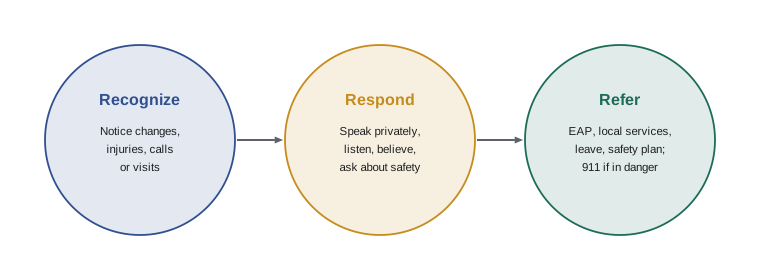
- Recognize: notice the signs, and take seriously any disclosure or concern raised by the worker or co-workers.
- Respond: speak with the person privately and at a good time. Express concern without judgement: "I've noticed you seem stressed lately and I'm concerned. Is everything all right? I'm here if you want to talk." Listen, believe what they tell you, and let them lead. Do not pressure them to leave the relationship, criticize the abuser or demand details. Ask whether they feel safe, at work and getting to and from work.
- Refer: tell the person about the support available, such as the employee assistance program, local domestic violence services, shelters and crisis lines, legal clinics, and the workplace's own leave and safety measures. If there is immediate danger, call 911.
Respect the person's choices. Someone experiencing abuse is the best judge of their own situation, and leaving an abusive partner can be the most dangerous time. A workplace response that takes control away from the person, for example by calling police without their agreement when there is no immediate danger, can increase their risk. The exception is when there is an imminent threat to the worker or others at work: then the employer must act to protect people, while involving the worker as far as possible.
Workplace safety planning
When a worker discloses domestic violence that may affect the workplace, or the employer becomes aware of a risk, the employer should work with the worker to develop a workplace safety plan. The plan should be confidential, shared only with people who need to know to keep the worker and others safe, and reviewed as the situation changes.
| Area | Possible measures |
|---|---|
| Information | With consent, a photo or description of the abuser and their vehicle for reception and security; copies of protection or restraining orders |
| Contact | Screening calls and emails, changing the worker's phone extension or email, removing their name from the website or directory |
| Location | Moving the workstation away from public view or entrances, changing work site or offering temporary remote work if safe |
| Schedule | Changing shifts or hours, flexible start and finish times, varying routines |
| Travel | Escort to and from the car or transit, reserved parking near the entrance, check-ins on arrival and departure |
| Response | Plan for what staff should do if the abuser appears: do not confront, do not confirm the worker is present, call security or 911 |
| Leave and support | Domestic violence leave, EAP referral, connection to community services, flexible deadlines |
Co-workers may need information and training too, especially reception and security staff who might encounter the abuser. They should know never to give out information about a worker's schedule or whereabouts, to report suspicious calls or visitors, and to call for help rather than intervene physically.
When the abuser is an employee
Sometimes the abuser and the victim work for the same organization, or the abuser uses work time and resources to harass a partner elsewhere. Misusing work phones, email, vehicles or databases to monitor, threaten or locate a partner is misconduct that the employer can and should address under its policies. If both people work for the employer, safety planning may involve separating their work locations and schedules, enforcing any court orders, and taking disciplinary action against the abuser where justified. Employers should also offer referral to resources for people who use abusive behaviour and want to change, while keeping the focus on the victim's safety.
Building a domestic violence-aware workplace
Organizations can prepare before a crisis by including domestic violence in their violence and harassment policy and risk assessment, training supervisors to recognize and respond, making leave and support information easy to find, displaying information about local services in private places such as washrooms, and partnering with local domestic violence organizations for advice and training. The message should be clear: domestic violence is not a private matter when it affects safety at work, and workers who disclose it will be supported, not penalized.
Common mistakes
MistakeTreating domestic violence as a private matter with no place at work.
InsteadRecognize Type 4 violence as a workplace hazard that employers must address.
MistakePressuring a worker to leave the relationship or to call police.
InsteadListen, believe, respect their choices and refer them to support, unless there is imminent danger.
MistakeDisciplining a worker for absences caused by abuse without exploring options.
InsteadOffer leave, flexibility and support, and apply the law on protected leave.
MistakeSharing the worker's situation widely to "keep everyone informed".
InsteadShare only what is needed for safety, with consent where possible.
MistakeLetting reception confirm that the worker is at work when someone asks.
InsteadTrain staff never to disclose a colleague's whereabouts or schedule.
Summary and key terms
- Domestic violence often follows workers to work through calls, visits, stalking and attacks; it is Type 4 workplace violence.
- Ontario, Alberta, Quebec and federal law require employers to address domestic violence that may affect the workplace.
- Every Canadian jurisdiction provides domestic violence leave; federal and Ontario law give 10 days, the first 5 paid.
- Signs include unexplained injuries, absences, controlling calls and visits, anxiety and reluctance to go home.
- Use recognize, respond and refer: notice, listen without judgement, and connect to support.
- Respect the worker's choices except when there is imminent danger to them or others.
- A confidential workplace safety plan covers information, contact, location, schedule, travel and response.
- Domestic violence
- Abuse by a current or former partner or family member.
- Intimate partner violence
- Abuse by a current or former spouse or dating partner.
- Coercive control
- A pattern of behaviour that isolates, monitors and dominates a partner.
- Type 4 violence
- Violence at work by someone with a personal relationship with the worker.
- Safety plan
- A plan of measures to protect a person at risk of violence.
- Protection or restraining order
- Court order restricting contact by an abuser.
- Domestic violence leave
- Job-protected leave for workers affected by domestic or sexual violence.
- Disclosure
- When a person tells someone about the abuse they are experiencing.
- Recognize, respond, refer
- Framework for supporting someone affected by domestic violence.
- Employee assistance program (EAP)
- Confidential counselling and referral service provided by an employer.
Practice problems
Work each problem on paper first, then reveal the answer to check.
Which type of workplace violence is domestic violence that follows a worker to work?
Show answer
Type 4, personal relationship.
Which inquest led to Ontario's domestic violence provision?
Show answer
The inquest into the 2005 death of nurse Lori Dupont.
How many days of domestic violence leave are paid for federally regulated employees?
Show answer
Five of the ten days, after three months of continuous employment.
Name three signs that a colleague may be experiencing domestic violence.
Show answer
Unexplained injuries, frequent upsetting calls or visits from a partner, frequent absences (also anxiety, reluctance to go home).
What are the three steps in the framework for supporting a worker?
Show answer
Recognize, respond and refer.
Give an example of a supportive opening question.
Show answer
"I've noticed you seem stressed lately and I'm concerned. Is everything all right?"
Name four elements of a workplace safety plan.
Show answer
Information about the abuser, call screening, changed schedule and escort to the car (also location changes, response plan, leave).
What should reception do if the abuser asks whether the worker is in?
Show answer
Not confirm or deny, and call security or follow the safety plan.
When may an employer act without the worker's agreement?
Show answer
When there is an imminent threat to the worker or others at work.
Is using a work vehicle to follow a partner a workplace matter?
Show answer
Yes. Misusing work resources to harass a partner is misconduct the employer should address.
Lesson quiz · 5 questions
Score 60% or more to complete this lesson.
Create a free account to save your progress, take quizzes and earn a certificate.