
HSE-108 · Lesson 7 of 12 · 25 min
Recognizing escalation and de-escalating conflict
Most violent incidents do not come out of nowhere. They are usually preceded by signs of rising tension: raised voices, pacing, clenched fists, threats or a sudden silence. Workers who can recognize these signs early and respond calmly can often prevent an incident altogether, or buy time to get away and summon help. This lesson describes how aggression typically builds, the signs to watch for, and practical verbal and non-verbal techniques for de-escalation. It is an introduction only: workers in high-risk roles need hands-on training with practice, and no technique works every time. Your own safety always comes first.
How aggression builds
Many training programs describe a cycle in which a person moves from a calm baseline through stages of rising arousal to a crisis, followed by recovery. A common model has five phases:
- Trigger: something happens that the person experiences as a threat, loss, frustration or unfairness, such as a long wait, a refusal, pain, bad news or feeling disrespected.
- Escalation: anxiety and arousal rise. The person may become restless, argumentative or demanding, raise their voice, swear or refuse requests. Reasoning becomes harder.
- Crisis: the person loses control and may shout, threaten, throw objects or attack. At this point, verbal techniques have limited effect, and the priority is safety.
- Recovery: arousal begins to fall, but the person is still easily re-triggered. Pushing for explanations or apologies too soon can restart the cycle.
- Post-crisis: the person returns to baseline and may feel exhausted, embarrassed or remorseful. This is the time to debrief, repair the relationship and plan to prevent a repeat.
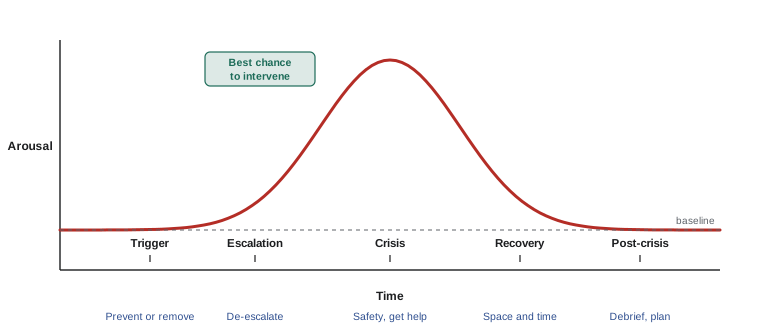
The most important lesson from this model is timing. De-escalation works best early, during the escalation phase, when the person can still listen and respond. Once someone is in crisis, the focus shifts to keeping everyone safe: creating distance, leaving, protecting others and calling for help.
Signs of escalation
No single sign predicts violence, and many people show some of these signs without becoming violent. But a combination of signs, especially if they are increasing, should prompt a worker to change approach and think about safety.
| Type | Signs to watch for |
|---|---|
| Verbal | Raised or rising voice, swearing, rapid speech, repeated demands, threats, sarcasm, abrupt silence or refusal to speak |
| Facial | Staring or avoiding eye contact, flushed or pale face, clenched jaw, frowning, tightened lips |
| Body | Pacing, restlessness, clenched fists, finger pointing, hitting objects, invading personal space, squaring up, sudden stillness |
| Behavioural | Ignoring instructions, refusing to leave, shouting at others, throwing or breaking things, looking around for exits or objects |
| Contextual | Intoxication, recent bad news, long wait, pain, confusion, history of violence, presence of an audience |
Pay attention to your own reactions as well. A feeling of unease, fear or the sense that something is wrong is information. Workers sometimes ignore their instincts because they do not want to seem rude or overreact. If you feel unsafe, it is reasonable to take steps to protect yourself, such as moving towards the exit, getting a colleague or ending the interaction.
Principles of de-escalation
De-escalation is the use of communication and behaviour to reduce a person's agitation and help them regain control. It is based on respect, empathy and the recognition that agitated people usually feel threatened, frustrated or unheard. The goal is not to win an argument or prove a point, but to lower the temperature so that the situation can be resolved safely.
Keep yourself safe first
- Maintain distance. Stay at least two arm's lengths away and do not block the person's exit or your own.
- Position yourself at an angle rather than directly in front, which feels less confrontational and makes it easier to move away.
- Know your exits and where to find help, and keep a barrier, such as a desk, between you if possible.
- Remove or avoid wearing items that could be grabbed or used as weapons, such as lanyards that do not break away, scissors in pockets or heavy objects on the counter.
- Alert colleagues early, using an agreed code word or signal, rather than waiting until the situation is out of control.
Worked problem
How much distance do you need?
A person standing 1.2 m from a worker suddenly lunges. An agitated adult can close a short distance at about 3.5 m/s. A typical person needs about 0.75 s to notice a threat and begin to react. How long does the worker have at 1.2 m, and how far away would the worker need to be to have at least the reaction time before the person arrives? What does this mean for positioning?
Show solution
- \[t = \frac{d}{v} = \frac{1.2}{3.5} \approx 0.34\ \text{s}\]
- At 1.2 m, the worker has about 0.34 s, less than half the 0.75 s needed to begin reacting. The worker cannot get away in time.
- \[d = v \times t = 3.5 \times 0.75 \approx 2.6\ \text{m}\]
- At about 2.6 m the worker would just have time to begin reacting, but would still need time to move. In practice, distance alone is not enough: combine it with a barrier such as a counter, an angled stance, and a clear path to the exit.
Answer: At 1.2 m the worker has only about 0.34 s. To have even the basic reaction time, the worker would need about 2.6 m of space, so barriers, positioning and an exit route matter more than distance alone.
Non-verbal communication
When people are agitated, they pay more attention to tone and body language than to words. Non-verbal communication can either calm or inflame a situation.
- Keep an open, relaxed posture, with hands visible and unclenched. Avoid crossing your arms, putting hands on hips or pointing.
- Use a calm, steady, lower tone of voice and slow your speech. Do not raise your voice to match theirs.
- Make appropriate eye contact without staring. In some cultures, direct eye contact can feel challenging.
- Avoid sudden movements and do not touch the person.
- Respect personal space, which varies between individuals and cultures and increases when people are stressed.
Verbal techniques
- Introduce yourself and use the person's name if you know it.
- Listen actively. Let the person speak, nod, and reflect back what you hear: "So you've been waiting three hours and nobody has told you what's happening."
- Acknowledge feelings without necessarily agreeing: "I can see you're really frustrated." Acknowledgement often lowers agitation more than explanations do.
- Keep sentences short and simple. Agitated people have trouble processing complex information.
- Avoid jargon, arguing, blaming, lecturing, threats, sarcasm and phrases such as "calm down" or "that's the policy", which tend to escalate.
- Offer choices where possible, so the person regains a sense of control: "Would you like to wait here, or in the quieter room?"
- Focus on what you can do rather than what you cannot: "I can't change the wait time, but I can find out where you are on the list."
- Set clear, respectful limits when needed: "I want to help you. I can't do that while you're shouting at me. If we can talk quietly, I'll stay and help."
- Give the person a way to back down without losing face, especially if others are watching. Move the conversation away from an audience if it is safe to do so.
When de-escalation is not working
De-escalation does not always work, and workers should never feel that they failed if a person becomes violent. Know in advance when to stop trying and leave. Clear signs that it is time to disengage include threats of violence, the person producing a weapon or picking up an object, the person moving towards you or blocking your exit, increasing physical agitation despite your efforts, or your instinct telling you that you are in danger. At that point:
- Leave or create distance, and put a barrier or locked door between you and the person if possible.
- Summon help using your alarm, radio, code word or by calling security or 911.
- Warn others and help clients or members of the public move away if you can do so safely.
- Do not try to physically restrain or disarm the person unless you are trained, authorized and it is part of your role, as in some health care, security and corrections settings.
- Once safe, report the incident and seek support.
Special situations
Some situations call for adapted approaches. People with dementia or delirium may become aggressive because they are confused, in pain or frightened, and respond better to slowing down, explaining each step, offering reassurance, changing the approach or trying again later than to firm limits. People experiencing a mental health crisis may need space, quiet and a calm, non-judgmental presence. People who are intoxicated may not be able to reason, so it is often better to minimize engagement and wait for help. Telephone and online interactions also escalate; the same principles of listening, acknowledgement and clear limits apply, and workers should be allowed to end abusive calls or chats according to a set procedure.
In settings such as health care, where workers cannot simply leave, de-escalation is part of a broader approach that includes individualized care plans, team responses, environmental changes and, as a last resort, the safe and lawful use of restraint according to strict policies. Workers in these settings need specific, hands-on training and support.
After the interaction
After any tense interaction, even one that ended well, take a moment to check in with yourself and your colleagues. Report the incident according to your procedure, including verbal abuse and threats; reports help identify patterns and improve controls. If the person is a regular client or patient, record what triggered them and what helped, so colleagues can use that information. Lesson 10 covers reporting and Lesson 11 covers support.
Practising these techniques matters. Under stress, people fall back on habits, so de-escalation skills need to be rehearsed in realistic scenarios until they become automatic. Short refreshers at team meetings, where staff role-play a difficult interaction from their own workplace and discuss what worked, keep skills sharp between formal training sessions.
Finally, remember that de-escalation is a team effort. Colleagues who notice a tense interaction can offer support by standing nearby, taking over the conversation if the person responds better to someone else, or quietly alerting security. Agree in advance how colleagues will signal for and offer help.
Common mistakes
MistakeTelling an agitated person to "calm down".
InsteadAcknowledge their feelings and use a calm tone; telling someone to calm down often escalates.
MistakeStanding face to face, close to the person, blocking the door.
InsteadStand at an angle, keep two arm's lengths or more and keep exits clear.
MistakeContinuing to argue about the policy.
InsteadFocus on what you can do, offer choices and set respectful limits.
MistakeWaiting until the person is out of control before calling for help.
InsteadAlert colleagues early with an agreed signal.
MistakeTreating a violent outcome as the worker's failure.
InsteadRecognize that de-escalation does not always work; focus on safety and support.
Summary and key terms
- Aggression typically builds through trigger, escalation, crisis, recovery and post-crisis phases.
- De-escalation is most effective during the escalation phase; in a crisis, focus on safety and getting help.
- Watch for combinations of verbal, facial, body, behavioural and contextual signs, and trust your instincts.
- Keep distance, stand at an angle, keep exits clear and use barriers where possible.
- Use a calm tone, open posture, active listening, acknowledgement, short sentences and choices.
- Set clear, respectful limits and give people a way to back down without losing face.
- Know when to disengage and leave; do not attempt restraint unless trained and authorized.
- De-escalation
- Using communication and behaviour to reduce agitation and prevent violence.
- Trigger
- An event that provokes rising agitation.
- Escalation phase
- Stage in which agitation rises but the person can still respond to communication.
- Crisis phase
- Stage in which the person has lost control and safety is the priority.
- Active listening
- Listening attentively and reflecting back what the speaker says and feels.
- Acknowledgement
- Recognizing a person's feelings without necessarily agreeing with them.
- Personal space
- The distance a person needs to feel comfortable, which increases under stress.
- Code word
- Agreed phrase that signals colleagues to provide help without alarming the person.
- Disengagement
- Ending an interaction and moving away when de-escalation is not working.
- Face-saving
- Allowing someone to back down without public humiliation.
Practice problems
Work each problem on paper first, then reveal the answer to check.
In which phase of the escalation cycle is de-escalation most effective?
Show answer
The escalation phase, before crisis.
Name three verbal signs of escalation.
Show answer
Raised voice, swearing and threats (also rapid speech, repeated demands, sudden silence).
Why stand at an angle rather than face to face?
Show answer
It is less confrontational and makes it easier to move away.
Rephrase "That's the policy, calm down" in a de-escalating way.
Show answer
For example: "I can see this is really frustrating. Here's what I can do for you right now."
A person lunges from 2.0 m at 3.5 m/s. How much time does the worker have?
Show answer
About 0.57 s.
Name two signs that it is time to disengage.
Show answer
The person produces a weapon or blocks your exit (also threats, moving towards you, increasing agitation).
Why offer choices to an agitated person?
Show answer
Choices restore a sense of control, which often reduces agitation.
How might you adapt your approach for a person with dementia?
Show answer
Slow down, explain each step, reassure, change approach or try again later.
Should verbal abuse that did not lead to violence be reported?
Show answer
Yes. Reports help identify patterns and improve controls.
Give an example of setting a respectful limit.
Show answer
"I want to help you, but I can't while you're shouting. If we talk quietly, I'll stay and help."
Lesson quiz · 5 questions
Score 60% or more to complete this lesson.
Create a free account to save your progress, take quizzes and earn a certificate.