
HSE-108 · Lesson 12 of 12 · 28 min
Building, evaluating and improving a prevention program: capstone
The previous lessons covered the pieces of workplace violence and harassment prevention: definitions, the law, risk assessment, controls, de-escalation, lone and remote work, domestic violence, reporting and investigation, and support. This final lesson brings them together into a program, a coordinated set of policies, procedures and activities that is planned, carried out, checked and improved over time. It explains how to structure a program, how to evaluate whether it is working, and how to keep it alive. It ends with a capstone exercise that applies the whole course to a realistic workplace.
The elements of a program
Whatever the law in a particular jurisdiction requires, effective programs share the same core elements. Many are legal requirements; the rest are good practice.
| Element | Key content | Lesson |
|---|---|---|
| Leadership and policy | Senior commitment, written policy, roles and responsibilities, resources | 1, 3 |
| Worker participation | Joint committee or representative, worker input to assessments and controls | 3, 5 |
| Risk assessment | Identifying and evaluating violence and harassment risks; reviewing regularly | 5 |
| Controls | Elimination, environmental design, staffing, procedures, alarms, information sharing | 6, 8 |
| Training | Matched to roles and risk; de-escalation; supervisors and investigators | 6, 7 |
| Domestic violence | Policy coverage, recognize-respond-refer, safety planning, leave | 9 |
| Reporting and investigation | Accessible reporting, fair investigation, corrective action, no reprisal | 10 |
| Support | Post-incident support, EAP, compensation, return to work | 11 |
| Records and evaluation | Incident data, indicators, audits, surveys, annual review | 2, 12 |
Plan, do, check, act
A useful way to manage the program is the plan-do-check-act cycle used in safety management systems such as CSA Z45001 and ISO 45001. In the plan stage, the organization sets objectives, assesses risks and decides on controls. In the do stage, it puts controls, training and procedures in place. In the check stage, it measures performance, investigates incidents and audits the program. In the act stage, it reviews the results and makes improvements, which feed into the next cycle. The cycle never ends: risks change, people come and go, and new laws and evidence emerge.
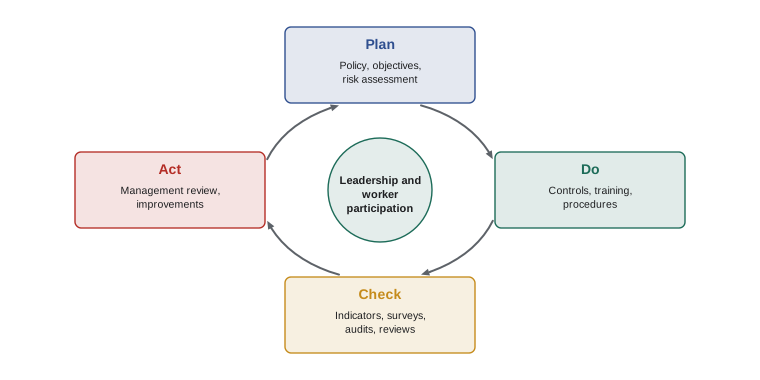
ISO 45003, published in 2021, gives guidance on managing psychological health and safety at work, including violence, harassment and bullying, as psychosocial risks within a safety management system. In Canada, CSA Z1003 (the National Standard of Canada for Psychological Health and Safety in the Workplace) provides a framework for the same purpose. These standards are voluntary but help organizations integrate violence and harassment prevention with their wider approach to health and safety.
Measuring performance
Evaluation answers two questions: Are we doing what we said we would do? And is it making a difference? A balanced set of indicators covers both.
| Indicator type | Examples | What it tells you |
|---|---|---|
| Activity (leading) | Percentage of staff trained; risk assessments reviewed on time; alarms tested monthly | Whether the program is being implemented |
| Process (leading) | Median days from complaint to start of investigation; corrective actions closed on time | Whether processes work as designed |
| Perception (leading) | Survey: "I feel safe at work"; "I would report harassment"; "Reports are acted on" | Trust, culture and confidence in the system |
| Outcome (lagging) | Incident rates; injury rates; lost-time cases; compensation claims; turnover | Whether harm is decreasing |
Interpret outcome indicators carefully. A rise in reported incidents after a program is launched often reflects better reporting rather than more violence. Look at severity as well as frequency: if reports of verbal abuse rise while injuries requiring medical treatment fall, the program may be working well. Compare like with like, use rates rather than counts, and look at trends over several years rather than year-to-year changes in small numbers.
Worked problem
Evaluating a hospital program after two years
A hospital launched a violence prevention program two years ago. Data before and after: reported incidents rose from 120 to 168 a year; hours worked rose from 1,500,000 to 1,600,000; incidents causing lost time fell from 30 to 18; the share of staff trained rose from 35% to 88%; the median time from report to start of investigation fell from 21 days to 4 days; and the share of staff agreeing that "reports are acted on" rose from 31% to 58%. Calculate the incident and lost-time rates per 100 full-time workers and interpret the results.
Show solution
- \[\text{Incident rate before} = \frac{120 \times 200\,000}{1\,500\,000} = 16.0\]
- \[\text{Incident rate after} = \frac{168 \times 200\,000}{1\,600\,000} = 21.0\]
- \[\text{Lost-time rate before} = \frac{30 \times 200\,000}{1\,500\,000} = 4.0\]
- \[\text{Lost-time rate after} = \frac{18 \times 200\,000}{1\,600\,000} = 2.25\]
- \[\text{Change in lost-time rate} = \frac{2.25 - 4.0}{4.0} \times 100\% \approx -44\%\]
- Interpret: reports rose by about 31% per hour worked, but the lost-time rate fell by about 44%. Together with higher training, faster investigations and greater trust, this pattern suggests better reporting and fewer serious incidents.
- Next steps: look at which units and incident types drive the remaining lost-time cases, and check that the rise in reports is not concentrated in one unit where risk has actually increased.
Answer: The incident rate rose from 16.0 to 21.0 while the lost-time rate fell from 4.0 to 2.25 (about 44% lower). With activity, process and perception indicators all improving, the evidence suggests the program is working, with reporting improving and serious harm decreasing.
Audits and management review
In addition to tracking indicators, organizations should periodically audit their program against legal requirements and their own policy. An audit checks whether the policy is current and posted, whether risk assessments are complete and up to date, whether training records are complete, whether incident reports were investigated on time, whether corrective actions were completed, whether alarm tests were done and whether workers know how to report. Audits can be internal, carried out by the joint committee, or external.
At least once a year, senior management should review the program as a whole: the results of indicators and audits, investigation findings, changes in law, feedback from workers and the committee, and the resources needed for the coming year. The review should produce concrete decisions, such as funding for new controls, changes to staffing, updated training or revised procedures, with owners and deadlines. Sharing a summary of the results and decisions with workers shows that the program is real and builds trust.
Keeping the program alive
Programs fail when they exist only on paper. Signs of a paper program include a policy that has not been reviewed in years, training that was delivered once at launch, alarms that are never tested, incident reports that disappear without feedback and a joint committee that never discusses violence or harassment. To keep a program alive, build it into everyday operations: discuss incidents and near misses at team meetings and shift huddles, include violence and harassment in workplace inspections, integrate client risk information into care planning and scheduling, recognize staff who report and help colleagues, hold leaders accountable for results, and refresh training with new scenarios.
Capstone exercise
The capstone brings together the whole course. Read the scenario and work through the tasks. A model answer follows.
Scenario: A municipal recreation centre in Ontario employs 45 workers, including front desk staff, lifeguards, fitness instructors, maintenance staff and a small management team. It is open from 6 a.m. to 10 p.m. In the past year, front desk staff were shouted at and threatened several times by patrons angry about fees and memberships; one staff member was pushed. Two young female lifeguards complained informally about a male supervisor who comments on their bodies and messages them late at night, but nothing was done. A maintenance worker who closes the building alone at night has found people sleeping in the stairwell. A fitness instructor recently disclosed that her former partner has been sending threatening messages and once came to a class. The centre's violence and harassment policy was written six years ago and has not been reviewed.
- Task 1: Identify the types of violence and forms of harassment present.
- Task 2: Identify the main legal duties that apply.
- Task 3: Score the main risks and set priorities.
- Task 4: Propose controls for each priority risk.
- Task 5: Explain how the lifeguards' complaint should be handled.
- Task 6: Outline how to support the fitness instructor.
- Task 7: Propose indicators to evaluate the program after one year.
Worked problem
Capstone model answer
Work through tasks 1 to 7 for the recreation centre scenario.
Show solution
- Task 1: Type 2 violence by patrons at the front desk (threats and a push); possible Type 1 risk from trespassers at night; sexual harassment of the lifeguards by a supervisor, including virtual harassment through late-night messages; Type 4 violence from the instructor's former partner.
- Task 2: Ontario OHSA Part III.0.1: annual policy review (overdue), a violence risk assessment shared with the committee, a violence program with summoning help and reporting procedures, a harassment program with investigation and confidentiality, and the duty to take every reasonable precaution against domestic violence that may occur in the workplace. The Ontario Human Rights Code applies to the sexual harassment. The lifeguards' informal complaint triggered the duty to investigate. ESA domestic or sexual violence leave is available to the instructor.
- Task 3: Front desk threats: likelihood 4, severity 3, score 12 (high). Supervisor harassment: likelihood 5 (ongoing), severity 3, score 15 (high, and a legal breach now). Night closing alone: likelihood 3, severity 4, score 12 (high). Former partner: likelihood 3, severity 5, score 15 (high, act immediately).
- Task 4: Front desk: deeper counter with partial barrier, duress button, posted code of conduct, clearer fee information online, procedures to end abusive interactions, de-escalation training, two staff at peak times. Night closing: two-person closing or a check-in system with escalation to a monitored service, better lighting and access control, a procedure not to confront trespassers but to call police. Harassment: see task 5. Domestic violence: see task 6. Program: review and update the policy, complete the risk assessment with the committee, train all staff.
- Task 5: Treat the informal complaint as a formal matter because of the power imbalance and seriousness. Appoint an impartial investigator, possibly external; take interim measures so the supervisor no longer supervises the lifeguards, without changing their shifts against their wishes; preserve messages; interview the complainants, the respondent and witnesses; decide on the balance of probabilities; take proportionate corrective action; inform the parties of results; follow up for reprisal; and review why the first complaint was ignored.
- Task 6: Meet privately, listen and respect her choices; develop a confidential safety plan with her consent, such as a description of the former partner for the front desk, screening calls, varying her class times, an escort to her car and a plan if he appears; tell her about domestic or sexual violence leave (10 days, the first 5 paid, plus up to 15 weeks), the EAP and local services; and support her if she seeks a court order.
- Task 7: Activity: policy reviewed annually; 100% of staff trained; monthly duress button tests. Process: investigations started within 5 days; corrective actions closed on time. Perception: survey items on safety and trust in reporting. Outcome: rates of threats and assaults, lost-time injuries, and turnover among front desk staff and lifeguards.
Answer: The centre faces Type 1, 2 and 4 violence and supervisor sexual harassment, all high priority. It must update its policy or plan, assess risks with workers, add environmental and staffing controls, investigate the harassment impartially, support the instructor with a safety plan and leave, and measure activity, process, perception and outcome indicators to show improvement.
Course wrap-up
Workplace violence and harassment are preventable. Prevention depends on clear definitions, an understanding of the law, honest assessment of risk, controls that change the work and the workplace, skills to recognize and defuse aggression, systems for lone and remote work, attention to domestic violence, fair and prompt responses when things go wrong, and real support for the people affected. Above all, it depends on leadership and on a culture in which people treat each other with respect, speak up when something is wrong and trust that the organization will act. Every worker, supervisor and manager has a part to play.
Common mistakes
MistakeTreating the program as a document rather than a cycle.
InsteadUse plan-do-check-act and review the program at least annually.
MistakeJudging success only by a fall in reported incidents.
InsteadUse activity, process, perception and outcome indicators, and look at severity.
MistakeAuditing without acting on the findings.
InsteadAssign owners and deadlines for every corrective action and track them.
MistakeKeeping evaluation results within management.
InsteadShare results and decisions with workers and the committee.
MistakeLetting training lapse after the launch.
InsteadRefresh training regularly with new, realistic scenarios.
Summary and key terms
- An effective program combines leadership, worker participation, risk assessment, controls, training, domestic violence measures, reporting and investigation, support and evaluation.
- The plan-do-check-act cycle keeps the program current and improving.
- ISO 45003 and CSA Z1003 offer frameworks for managing psychosocial risks, including violence and harassment.
- Use a balanced set of activity, process, perception and outcome indicators.
- Rising reports with falling severity often signal better reporting and fewer serious incidents.
- Audits and annual management reviews should produce concrete decisions with owners and deadlines.
- Programs stay alive when they are part of daily operations and leaders are accountable.
- Prevention program
- Coordinated policies, procedures and activities to prevent violence and harassment.
- Plan-do-check-act
- Continuous improvement cycle used in management systems.
- Safety management system
- Structured approach to managing health and safety, such as ISO 45001.
- ISO 45003
- International guidance on managing psychological health and safety at work.
- CSA Z1003
- Canadian standard for psychological health and safety in the workplace.
- Audit
- Systematic check of whether a program meets requirements.
- Management review
- Periodic senior-level review of program performance and resources.
- Activity indicator
- Measure of whether planned actions are being carried out.
- Perception indicator
- Survey measure of workers' views of safety and trust.
- Outcome indicator
- Measure of harm, such as injury rates.
Practice problems
Work each problem on paper first, then reveal the answer to check.
Name the four stages of the continuous improvement cycle.
Show answer
Plan, do, check, act.
Incidents rose from 50 to 60 while lost-time cases fell from 10 to 5, with hours unchanged. Interpret.
Show answer
Likely better reporting and fewer serious incidents.
Give one example each of activity and perception indicators.
Show answer
Percentage of staff trained; survey agreement that reports are acted on.
A site had 12 lost-time cases in 900,000 hours. What is the lost-time rate per 100 full-time workers?
Show answer
12 × 200,000 ÷ 900,000 ≈ 2.67.
Name three signs of a paper program.
Show answer
Outdated policy, untested alarms and reports with no feedback (also one-time training, inactive committee).
What should an annual management review produce?
Show answer
Concrete decisions with owners, deadlines and resources.
Which international standard gives guidance on psychosocial risks?
Show answer
ISO 45003.
Why share evaluation results with workers?
Show answer
It shows the program is real and builds trust.
In the capstone, why treat the lifeguards' informal complaint formally?
Show answer
Because of the power imbalance, its seriousness and the employer's duty to investigate.
Name two controls for the night closing risk in the capstone.
Show answer
Two-person closing or a monitored check-in system, and better lighting and access control.
Lesson quiz · 5 questions
Score 60% or more to complete this lesson.
Create a free account to save your progress, take quizzes and earn a certificate.