
HSE-108 · Lesson 10 of 12 · 25 min
Reporting, responding to and investigating incidents and complaints
Even the best prevention program will not stop every incident. What happens next matters a great deal: a prompt, fair and supportive response protects the people involved, prevents repeats, meets legal duties and builds trust that encourages future reporting. A slow, dismissive or unfair response can compound the harm, expose the organization to legal liability and teach workers that reporting is pointless. This lesson covers immediate response, reporting, the choice between informal and formal resolution, and how to plan and carry out a fair investigation. It is an overview; investigators need specialized training, and complex or serious cases often call for an external investigator.
Immediate response to a violent incident
When a violent incident occurs, the first priorities are safety and care:
- Make the scene safe: separate the people involved, remove others from danger, and call security or 911 if needed.
- Provide first aid and medical care, including assessment for injuries that may not be obvious, such as head injuries, and for exposure to blood or saliva after bites or scratches.
- Support the affected worker: do not leave them alone, offer to call someone, relieve them of duties and arrange safe transport home if needed.
- Preserve evidence: keep video recordings, note names of witnesses, keep objects involved, and take photos of the scene and injuries with consent.
- Notify the people who must know, such as the supervisor, the joint committee or representative and, where required, the regulator, police and the workers' compensation board.
- Make the workplace safe before work resumes, for example by reviewing whether the same client or situation still poses a risk.
Reporting
Workers should report all incidents of violence, threats and harassment, including near misses and verbal abuse. Good reporting systems are easy to use, available in several forms (such as online, by phone, on paper or in person), include channels outside the direct chain of command, allow anonymous reports of hazards where possible, and give the reporter feedback on what happened next. Supervisors who receive reports should thank the reporter, take the report seriously, write it down accurately, act on any immediate safety issues and pass it on according to the procedure.
Reporting duties go beyond internal systems. In most Canadian jurisdictions, serious injuries and deaths at work, including those caused by violence, must be reported to the OHS regulator within short time limits, and injuries requiring medical attention or time off must be reported to the workers' compensation board. Federally regulated employers must provide an annual report on harassment and violence occurrences to the Labour Program by March 1. Where a criminal offence may have occurred, the worker has the right to report it to police, and the employer should support them in doing so; in cases of imminent danger the employer should call police itself.
Choosing a resolution path
Not every complaint needs a formal investigation. Many policies provide a range of options, chosen with the complainant and according to the seriousness of the conduct:
| Path | When it fits | Features |
|---|---|---|
| Early or informal resolution | Minor, first-time conduct; complainant prefers it; no power imbalance or safety risk | A conversation, coaching, clarification of expectations; quick and less adversarial |
| Facilitated resolution or mediation | Interpersonal conflict where both parties agree; not for serious harassment or violence | A neutral facilitator helps the parties reach agreement; voluntary |
| Formal investigation | Serious, repeated or contested allegations; violence; sexual harassment; power imbalance; complainant requests it | Impartial fact-finding, written findings and corrective action |
| Investigation and immediate safety measures | Ongoing risk to the complainant or others | Interim measures such as separating parties or administrative leave while investigating |
Informal options should never be forced on a complainant, and they are not appropriate for serious misconduct such as sexual assault, violence, threats or quid pro quo harassment, or where there is a significant power imbalance. Even when the complainant does not want a formal process, the employer may still need to investigate if there is a risk to others or a pattern of conduct.
Interim measures
While a complaint is being dealt with, the employer may need to take interim measures to protect people and the integrity of the process. Examples include changing reporting lines, adjusting schedules or locations so the parties do not work together, restricting access to certain systems, or placing the respondent on paid administrative leave in serious cases. Interim measures should not disadvantage the complainant: moving the complainant to a less desirable job, rather than the respondent, can look like reprisal and discourage others from reporting.
Principles of a fair investigation
A workplace investigation is a fact-finding process. Its purpose is to establish, as far as possible, what happened, and to decide whether the policy was breached. It is not a criminal trial, and the standard of proof is usually the balance of probabilities: is it more likely than not that the alleged conduct occurred?
- Impartiality: the investigator should have no conflict of interest, no reporting relationship with the parties and no stake in the outcome. External investigators are often used for complaints against senior leaders or when internal impartiality is in doubt.
- Promptness: start quickly and complete the investigation within the timelines set by law or policy. Delay harms everyone and causes evidence to be lost.
- Procedural fairness: tell the respondent the substance of the allegations and give them a full opportunity to respond; interview witnesses identified by both parties; consider all relevant evidence.
- Confidentiality: share information only as needed to investigate, take corrective action or comply with the law, and remind participants not to discuss the matter.
- Trauma-informed practice: recognize that people who have experienced violence or harassment may have difficulty recalling events in order, may show unexpected emotions and may need breaks or a support person.
- Documentation: keep accurate notes and records of each step, interview and decision.
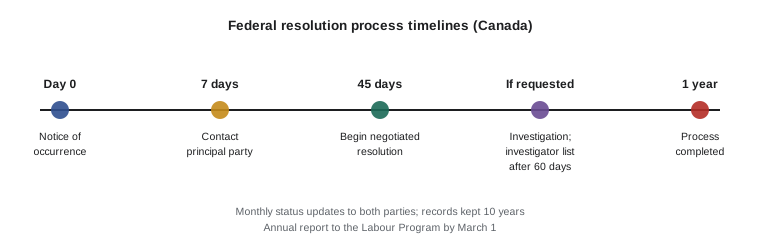
Steps in an investigation
- Plan: define the allegations clearly, identify the policy provisions, witnesses and evidence, decide who will investigate and set a timeline.
- Notify: tell the parties that an investigation is starting, explain the process, their rights and responsibilities, confidentiality and protection from reprisal, and the support available.
- Gather evidence: interview the complainant first, then the respondent, then witnesses, and collect documents, emails, messages, video and records. Re-interview if new information emerges, and give the respondent a chance to respond to all significant allegations and evidence.
- Assess the evidence: weigh the evidence and decide, on the balance of probabilities, what happened, considering consistency, detail, corroboration, plausibility and any motives. Lack of witnesses does not mean a complaint cannot be substantiated.
- Report: write a report that sets out the allegations, the process, the evidence, the findings of fact and the conclusion on whether the policy was breached. In some jurisdictions, recommendations are included and the report must not identify participants unnecessarily.
- Decide and act: management decides on corrective action, such as discipline, training, changes to work arrangements or controls.
- Inform and follow up: tell the complainant and respondent the outcome and any corrective action that relates to them, to the extent allowed by law and policy, and follow up to make sure the conduct has stopped and there is no reprisal.
Worked problem
Tracking federal resolution deadlines
A federally regulated employer receives a notice of occurrence on March 3. When must the designated recipient contact the principal party, by when must negotiated resolution begin, and by when must the resolution process be completed? The principal party is then on sick leave from April 1 to September 15 (more than 90 consecutive days). How does that affect the completion deadline?
Show solution
- Contact the principal party within 7 days: March 3 + 7 days = March 10.
- Begin negotiated resolution within 45 days of the notice: March 3 + 45 days = April 17.
- Normal completion deadline: one year after the notice, March 3 of the following year.
- Absence rule: if a party is absent for more than 90 consecutive days, the deadline becomes the later of one year after notice or six months after the party returns. Six months after September 15 is March 15 of the following year, which is later than March 3.
- Revised completion deadline: March 15 of the following year. Monthly status updates must continue until the process is completed.
Answer: Contact by March 10, negotiated resolution begun by April 17, and the process completed by March 15 of the following year because of the long absence.
Corrective action
When a complaint is substantiated, corrective action should be proportionate to the seriousness of the conduct, take into account any previous incidents and be applied consistently, whatever the person's position. Options include an apology, coaching, training, a written warning, suspension, demotion, transfer of the respondent, and termination for serious misconduct. Corrective action may also address systemic issues the investigation uncovered, such as poor supervision, inadequate controls or a culture that tolerated the conduct. When a complaint is not substantiated, it does not necessarily mean the complainant was lying; it may mean there was not enough evidence. Unless a complaint was made in bad faith, the complainant must be protected from reprisal, and the employer should consider whether broader action, such as training or a team intervention, is still needed.
Common investigation pitfalls
Investigations often fail for predictable reasons: the investigator was not impartial; the respondent was not given a fair chance to respond; key witnesses were not interviewed; the investigation took months to start; confidentiality was breached; conclusions were not supported by the evidence; the investigator applied the wrong standard, such as requiring proof beyond reasonable doubt; or the organization failed to act on the findings. Each of these can lead to grievances, legal claims, orders from regulators and lasting damage to trust.
Keeping records
Good records protect everyone. Keep incident reports, investigation files, interview notes, evidence, reports and decisions securely, with access limited to those who need it, and for as long as the law or policy requires, such as ten years for federally regulated employers in Canada or five years for California violent incident logs and related records. Separate personal health information from general files. Records allow the organization to show that it met its legal duties, to identify repeat respondents or high-risk locations, and to evaluate the program.
Throughout the process, communicate regularly with both parties about progress and expected timelines, even when there is little new to report. Silence breeds anxiety and rumour, while regular updates show that the matter is being taken seriously.
Common mistakes
MistakeAsking the alleged harasser's close colleague or manager to investigate.
InsteadUse an impartial investigator with no conflict of interest, external if needed.
MistakeMoving the complainant to a worse job as an interim measure.
InsteadUse interim measures that protect without disadvantaging the complainant.
MistakeRequiring proof beyond reasonable doubt.
InsteadApply the balance of probabilities standard used in workplace investigations.
MistakeForcing mediation on a complainant in a sexual harassment case.
InsteadOffer informal options only when appropriate and voluntary.
MistakeClosing the file without telling the parties the outcome or following up.
InsteadInform the parties and check that the conduct has stopped and there is no reprisal.
Summary and key terms
- Immediate priorities after an incident are safety, medical care, support, preserving evidence and required notifications.
- Good reporting systems are easy to use, include channels outside the chain of command and give feedback.
- Serious injuries must be reported to the OHS regulator and compensation board; federal employers report annually by March 1.
- Resolution paths range from informal resolution to formal investigation; informal options must be voluntary and suitable.
- Investigations must be impartial, prompt, fair, confidential, trauma-informed and documented.
- The standard of proof is the balance of probabilities.
- Corrective action should be proportionate and consistent, with follow-up to prevent reprisal.
- Occurrence notice
- Report of harassment or violence (a notice of occurrence) under Canada's federal regulations.
- Principal party
- The person who was the object of the alleged harassment or violence (Canadian federal term).
- Respondent
- The person alleged to have engaged in the conduct.
- Interim measure
- Temporary step to protect people during a process.
- Balance of probabilities
- Standard of proof: more likely than not.
- Procedural fairness
- Giving each party notice, a chance to respond and an unbiased decision-maker.
- Substantiated
- Found, on the evidence, to have occurred and to breach the policy.
- Corroboration
- Evidence from another source that supports an account.
- Corrective action
- Steps taken to address a breach and prevent recurrence.
- Violent incident log
- Record of workplace violence incidents required by some laws.
Practice problems
Work each problem on paper first, then reveal the answer to check.
Name three immediate priorities after a violent incident.
Show answer
Make the scene safe, provide medical care and support the worker (also preserve evidence, notify).
Why include a reporting channel outside the direct chain of command?
Show answer
The supervisor may be the harasser or may not act; workers need a safe alternative.
When is mediation inappropriate?
Show answer
For serious misconduct such as violence, sexual assault or quid pro quo harassment, or where there is a power imbalance.
What standard of proof applies in workplace investigations?
Show answer
The balance of probabilities.
Who should usually be interviewed first?
Show answer
The complainant, then the respondent, then witnesses.
A federal notice of occurrence is received on June 10. By when must negotiated resolution begin?
Show answer
July 25 (45 days later).
Give two examples of interim measures.
Show answer
Changing schedules so the parties do not work together; administrative leave for the respondent in serious cases.
Does an unsubstantiated complaint mean the complainant lied?
Show answer
No. It may mean there was insufficient evidence.
Name two common investigation pitfalls.
Show answer
Lack of impartiality and not letting the respondent respond (also delay, confidentiality breaches).
What should happen after corrective action is taken?
Show answer
Follow up to confirm the conduct has stopped and there is no reprisal.
Lesson quiz · 5 questions
Score 60% or more to complete this lesson.
Create a free account to save your progress, take quizzes and earn a certificate.