
GEOM-410 · Lesson 10 of 12 · 20 min
Professional liability
Halfway through the project, Ruth receives a letter. A landowner on a reach the firm retraced last year has built a machine shed, a buyer's lender has found that it sits 0.6 m inside the district's right of way, and the landowner's lawyer says the encroachment is the firm's fault because Coulee's plan showed the right of way in the wrong place. Is it? Ruth pulls the file: the research, the field notes, the photographs, the plan and the report. This lesson is about why that file matters, what a surveyor can be held responsible for, and how good practice manages the risk.
Why surveyors are liable
A surveyor's work is relied on by many people, often long after it is done. Clients rely on it, but so do buyers, lenders, title insurers, builders, municipalities and neighbours who never met the surveyor. An error in a boundary survey may not show up for years, until someone builds a fence, a garage or a pipeline in reliance on it. When it does, the cost can be large: moving a building, settling a lawsuit, buying a strip of land. The law therefore holds surveyors to a professional standard, and a surveyor who falls below it may have to pay for the loss that results.
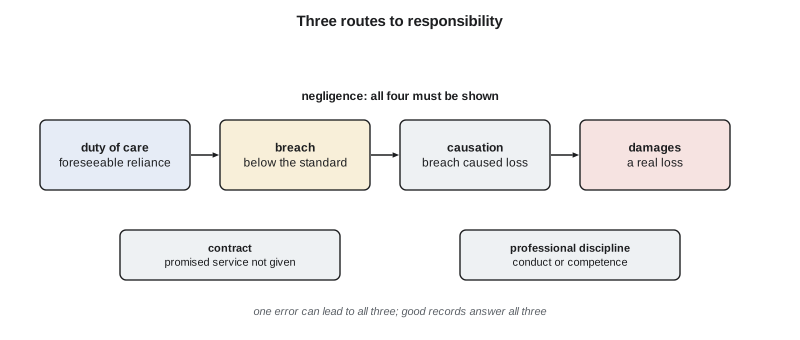
Three kinds of responsibility overlap. Contract liability arises from the agreement with the client: a surveyor who promises a particular service and fails to deliver it has broken the contract. Liability in negligence, called tort in the common law, can extend beyond the client to others who reasonably rely on the work. And professional regulation adds a third layer: the licensing body can discipline a surveyor for unprofessional conduct or incompetence, whether or not anyone sues. A single error can lead to all three.
The elements of negligence
To succeed in negligence, a claimant must usually show four things. First, a duty of care: the surveyor owed a duty to this person, because it was reasonably foreseeable that they would rely on the work and the relationship was close enough. Second, a breach: the surveyor failed to meet the standard of care, which is what a reasonably competent surveyor would have done in the same circumstances, judged by the knowledge and standards of the time. Third, causation: the breach actually caused the loss, so that the loss would not have happened without it. Fourth, damages: a real loss that the law recognizes, such as the cost of moving a building or the reduced value of land.
The standard of care is the heart of most cases. It is not perfection; surveyors are not insurers of their work, and a reasonable professional judgment that later proves wrong is not necessarily negligent. It is measured against the profession's own standards, such as the licensing body's manual or standards of practice, the requirements of statute and regulation, and expert evidence of what competent surveyors actually do. A surveyor who followed the standards, searched thoroughly, documented the evidence and reasoned carefully is in a strong position even if a court later decides the boundary differently. A surveyor who skipped the research, accepted a convenient post or did not record why is not.
Who can rely on the work
In Alberta, the classic third-party reliance problem is the Real Property Report. An RPR is prepared for one owner, often for a sale, but it is relied on by the buyer, the buyer's lender and the municipality, and sometimes reused years later for another sale. Courts look at whether reliance by a particular person was reasonably foreseeable and whether the surveyor limited it. The Alberta Land Surveyors' Association's standards require an RPR to state the date of survey and the purpose for which it was prepared, and to say that it reflects conditions at that date. A surveyor who makes those limits clear reduces the chance of liability to someone who relies on an old report for a new purpose.
Time limits
Claims cannot be brought forever. Alberta's Limitations Act generally requires a claim to be started within two years after the claimant knew, or ought to have known, of the injury and that it was caused by the defendant, and in any event within ten years after the claim arose, with some exceptions. Because a survey error may not be discovered for years, the ten-year ultimate period often decides whether an old error can still be pursued. A surveyor should keep project files at least as long as claims can be brought, and many keep them permanently, because boundary evidence stays useful long after the limitation period.
Managing the risk
Good practice and good risk management are mostly the same thing. A written scope of work, agreed with the client before the job starts, says what the surveyor will do and, as importantly, what is excluded: an RPR does not search title; a right-of-way retracement does not locate underground utilities; a topographic survey is not a boundary survey. Thorough research, careful field work and a documented chain of reasoning for every boundary decision make the work defensible. An independent check of key decisions, especially corner acceptances and restorations, catches errors before they leave the office. Clear plans and reports, stating what was found, what was set and why, reduce misunderstanding. And professional liability insurance, which surveyors in both countries carry and some licensing bodies require, protects the surveyor and the client when something goes wrong anyway.
Theo builds a simple risk register for the district project, scoring each kind of error by its likelihood and severity and estimating its expected cost. The numbers are rough, but they show where the effort of checking pays best.
# A simple risk register for the district's right-of-way project: likelihood x severity, and expected cost
tasks = [  # (task, likelihood 1-5, severity 1-5, cost if it goes wrong, in dollars)
    ("wrong parcel identified from an old legal description", 2, 4, 40_000),
    ("corner restored from a disturbed post",                  3, 5, 85_000),
    ("bank located at today's waterline, not the legal bank",  3, 4, 60_000),
    ("easement plan registered with an arithmetic error",      1, 3, 15_000),
    ("field notes not kept, so a later dispute cannot be answered", 2, 3, 25_000),
    ("scope letter silent on encroachments",                   4, 2, 10_000),
]
prob = {1: 0.01, 2: 0.03, 3: 0.08, 4: 0.15, 5: 0.30}   # rough chance per project for each likelihood score
print("score  expected cost  task")
rows = []
for t, L, S, cost in tasks:
    rows.append((L * S, prob[L] * cost, t))
for score, exp, t in sorted(rows, reverse=True):
    band = "high" if score >= 12 else "medium" if score >= 6 else "low"
    print(f"{score:4d}   {exp:9,.0f}   {t} [{band}]")
print(f"total expected cost {sum(r[1] for r in rows):,.0f} dollars per project before controls")
# Controls: a second-person check of corner decisions cuts likelihood of the top risk from 3 to 1
print(f"with an independent check of corner decisions: {prob[1]*85_000:,.0f} dollars instead of {prob[3]*85_000:,.0f} dollars")score expected cost task 15 6,800 corner restored from a disturbed post [high] 12 4,800 bank located at today's waterline, not the legal bank [high] 8 1,500 scope letter silent on encroachments [medium] 8 1,200 wrong parcel identified from an old legal description [medium] 6 750 field notes not kept, so a later dispute cannot be answered [medium] 3 150 easement plan registered with an arithmetic error [low] total expected cost 15,200 dollars per project before controls with an independent check of corner decisions: 850 dollars instead of 6,800 dollars
The highest risks are restoring a corner from a disturbed post and locating a water boundary at the day's waterline, not the legal bank, both errors of judgment that a second surveyor's review is good at catching. A scope letter that does not mention encroachments is a medium risk, because it invites the kind of letter Ruth has just received. With an independent check of every corner decision, the expected cost of the top risk drops from about 6,800 to about 850 dollars per project, which is far less than the cost of the check. The firm already does this; the register shows the board why.
Worked problem
Expected cost of a risk
An error has a 5 % chance of occurring on a project and would cost 120,000 dollars to fix. A check costing 1,500 dollars reduces the chance to 1 %. Is the check worth it?
Show solution
- \[\text{before} = 0.05 \times 120\,000 = 6\,000\]
- \[\text{after} = 0.01 \times 120\,000 + 1\,500 = 2\,700\]
Answer: Yes: the expected cost falls from 6,000 to 2,700 dollars per project, including the cost of the check.
The shed on the right of way
Ruth's file answers the letter. The plan showed the right of way where the 1952 instrument put it, retraced from three original monuments and checked by a second surveyor; the field notes and photographs show those monuments; the scope letter, signed by the district, said the plan would show the right of way and not locate or advise on any future building; and the landowner never asked the firm where to build. The landowner's contractor, it turns out, measured from the canal water's edge, not from the plan. Ruth sends a short, factual reply through the firm's insurer, offers to meet, and does not admit fault or criticize anyone. The matter ends with the landowner and the district negotiating an encroachment agreement. The file did its job.
When the error is yours
Sometimes the file shows the firm did make a mistake. A surveyor who discovers an error in their own past work faces one of the hardest tests of professional ethics, and the answer is the same everywhere: deal with it promptly and honestly. That means checking the facts carefully, notifying the insurer, telling the client and anyone else who may be relying on the work, and correcting the record, for example by filing a corrected plan or report. It means not quietly moving a monument to match the mistake, and not hoping that no one notices. The cost of an error usually grows with time, as more people build, buy and lend in reliance on it, so early correction is also the cheapest course.
Firms that handle errors well treat them as information. Each claim, near miss or correction is reviewed to see what allowed it: a gap in the research checklist, a field procedure that did not catch a disturbed post, a plan template that left out a note. Ruth keeps a short log of such reviews, and the firm's procedures change as a result. Over the years, the log has led to the independent corner review, a standard paragraph on the date and purpose of every plan, and a rule that no water boundary is located on the day of a high or low release from the reservoir. None of these changes is dramatic; together they are why the firm's claims are rare.
Discipline and ethics
Separate from any lawsuit, the licensing body can investigate a complaint about a surveyor's conduct or competence and, if it is proven, reprimand, fine, require further training, or suspend or cancel the surveyor's registration. In 2026, the Alberta Land Surveyors' Association came under Alberta's Professional Governance Act, which sets a common framework for complaints and discipline across many professions. Codes of ethics add duties that the law of negligence does not: to put the public interest first, to work only within one's competence, to avoid conflicts of interest, to be honest with clients and the public, and to treat colleagues fairly.
Common mistakes
MistakeStarting work without a written scope.
InsteadAgree in writing what is included and excluded before the job begins.
MistakeAccepting a convenient monument without recording why.
InsteadRecord the evidence and reasoning for every corner decision.
MistakeDestroying old project files once the job is paid.
InsteadKeep files at least as long as claims can be brought, and preferably permanently.
MistakeReplying to a claim letter with an apology or blame.
InsteadNotify the insurer, reply factually through it, and do not admit fault.
Summary and key terms
- Surveyors can be liable in contract, in negligence and to professional discipline.
- Negligence requires a duty of care, a breach of the standard of care, causation and damages.
- The standard is that of a reasonably competent surveyor at the time, measured by the profession's standards.
- Third parties who foreseeably rely on a survey may be owed a duty; clear statements of date, purpose and parties limit it.
- Alberta's Limitations Act generally allows two years from discovery and ten years at most.
- Scope letters, thorough research, documented reasoning, independent checks and insurance manage the risk.
- Standard of care
- What a reasonably competent surveyor would have done in the same circumstances.
- Negligence
- Failure to meet the standard of care, causing foreseeable loss to someone owed a duty.
- Duty of care
- A legal obligation to take reasonable care toward a person who may rely on one's work.
- Scope of work
- The written agreement on what a survey includes and excludes.
- Limitation period
- The time within which a claim must be started.
- Professional liability insurance
- Insurance that covers claims arising from professional errors.
- Risk register
- A list of possible errors with their likelihood, severity and controls.
Practice problems
Work each problem on paper first, then reveal the answer to check.
List the four elements of negligence.
Show answer
Duty of care, breach of the standard, causation and damages.
Why is a reasonable judgment that later proves wrong not necessarily negligent?
Show answer
The standard is reasonable competence, not perfection.
An error has a 10 % chance and would cost 50,000 dollars. What is its expected cost?
Show answer
5,000 dollars.
Name three things a scope letter for a right-of-way retracement might exclude.
Show answer
Title search, utility locates, advice on future building, topographic detail.
What should a surveyor do on receiving a claim letter?
Show answer
Notify the insurer, review the file, and reply factually without admitting fault.
Lesson quiz · 5 questions
Score 60% or more to complete this lesson.
Create a free account to save your progress, take quizzes and earn a certificate.